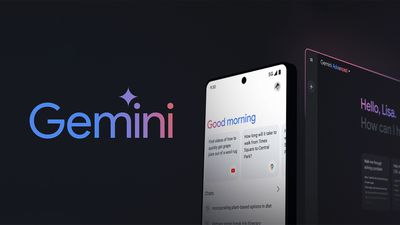
Google is rolling out AI-powered image editing capabilities to its Gemini app on iPhone, allowing users to modify both uploaded and AI-generated images directly within the app.
The new functionality enables background changes, object replacements, and element additions to existing photos. Users can upload personal images and prompt Gemini to generate variations, such as visualizing different hair colors or styles.
All images created or edited through Gemini will include invisible SynthID digital watermarking. Google says it is also testing visible watermarks for AI-generated content. The rollout is happening now and will expand to over 45 languages in the coming weeks, according to the company.
In another app improvement, Google told MacRumors that it is introducing Home Screen widgets for Gemini on iOS devices. The widgets provide immediate access to camera functions, file sharing, Gemini Live conversations, and microphone activation without opening the app. The widgets require iOS 17 or later and will be available to all eligible users by next week.
Gemini's AI image editing features in action
The standalone Gemini app launched for iPhone in November 2024, offering Dynamic Island integration and Gemini Live support as part of Google's effort to achieve feature parity with the Android version.
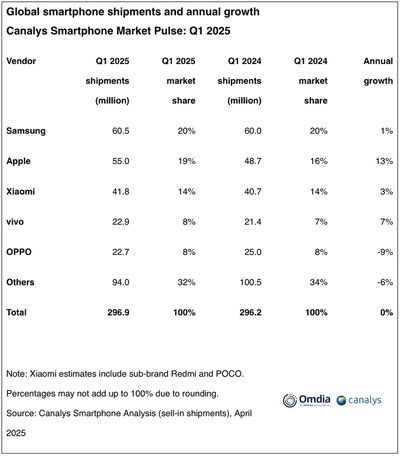
Apple achieved impressive 13% year-over-year growth in Q1 2025, shipping 55 million iPhones worldwide and increasing its global market share to 19%, up from 16% a year ago, according to the latest Canalys research.
Apple's performance is in stark contrast to the broader smartphone market, which recorded just 0.2% growth with 296.9 million units shipped globally.
Samsung maintained its lead with 60.5 million units and 20% market share, but it grew only 1% compared to last year. Xiaomi secured third place with 41.8 million units, followed by vivo and OPPO with about 8% market share each.
The U.S. smartphone market was a bright spot, growing 12% year-on-year, mainly driven by iPhone sales. According to Le Xuan Chiew of Canalys, "Apple proactively built up inventory ahead of anticipated tariff policies," which helped it lead the pack.
Apple has been diversifying production recently by ramping up iPhone manufacturing in India for both standard iPhone 15 and 16 models, as well as iPhone 16 Pro models. Ongoing fluctuations in reciprocal tariff policies are making Apple further shift U.S.-bound production to India to reduce exposure to future risks.
There was a lot of variation in regional demand in Q1. The U.S. market grew substantially and China benefited from government subsidies, but previously strong markets like India, Latin America, and the Middle East had notable declines.
Canalys expects the U.S. smartphone market to experience significant volatility over the next two to three quarters, due to inventory corrections and weakening consumer confidence in the face of fluctuating import tariffs.
In a scorching ruling against Apple, Judge Yvonne Gonzalez Rogers on Wednesday accused an Apple finance executive of providing false testimony under oath during the company's ongoing legal battle with Epic Games.
The judge stated that Alex Roman, Apple's vice president of finance, gave testimony that was "replete with misdirection and outright lies" regarding when Apple decided on its controversial 27 percent commission fee for purchases made outside the App Store.
"Contemporaneous business documents reveal that on the contrary, the main components of Apple's plan, including the 27 percent commission, were determined in July 2023," wrote Gonzalez Rogers in her ruling. "Neither Apple, nor its counsel, corrected the, now obvious, lies."
The ruling is significant enough that Gonzalez Rogers is referring the case to a U.S. attorney for possible criminal contempt proceedings against both Apple and Roman.
The reduced 27 percent fee (down from Apple's standard 30%) was established after the 2021 Epic Games lawsuit ruling. Judge Yvonne Gonzalez Rogers rejected claims that Apple operated a monopoly. However, she ruled that Apple's anti-steering conduct was anti-competitive, and ordered the company to allow developers to link to alternative payment methods outside the App Store.
Apple complied by creating a system where developers can apply for a "StoreKit External Purchase Link Entitlement" to direct users to external payment options. However, Apple still demands a 27% commission on these transactions made within seven days of clicking the link.
That's set to change though after Wednesday's ruling. The court now says Apple cannot collect any fee or commission for purchases that consumers make outside of an app, nor can it track, audit, or monitor consumer activity.
The judge didn't mince words in her assessment of Apple's behavior, writing that "Apple willfully chose not to comply with this Court's Injunction" and did so "with the express intent to create new anticompetitive barriers" to maintain its revenue stream.
"That it thought this Court would tolerate such insubordination was a gross miscalculation," she added. "As always, the cover-up made it worse. For this Court, there is no second bite at the apple."
The false testimony appears to have particularly aggravated the judge, who said in her ruling that the alleged deception compounded Apple's original violation of the anti-steering injunction.
In a brief statement, Apple said: "We strongly disagree with the decision. We will comply with the court's order and we will appeal."
Note: Due to the political or social nature of the discussion regarding this topic, the discussion thread is located in our Political News forum. All forum members and site visitors are welcome to read and follow the thread, but posting is limited to forum members with at least 100 posts.
Apple plans to change its U.S. App Store rules in accordance with a ruling from the U.S Northern District of California, Apple said in a statement to MacRumors. The company does plan to appeal the decision, though.
"We strongly disagree with the decision. We will comply with the court's order and we will appeal," reads Apple's statement.
Apple was found to be in violation of a 2021 injunction that targeted its anti-steering App Store rules, and the company has been ordered to comply with that injunction immediately. The court has provided instructions on the changes that Apple needs to make.
Apple cannot prevent developers from adding links or buttons that direct customers to make purchases outside of the App Store.
Apple cannot collect any fee or commission for purchases that consumers make outside of an app, nor can it track, audit, or monitor consumer activity.
Apple cannot control the language, formatting, placement, or style that developers use to direct customers to purchases outside of an app.
Apple cannot interfere with consumers' choice to leave an app with anything other than a neutral message about visiting a third-party site, so no "scare screens."
Apple is prohibited from excluding certain categories of apps and developers from obtaining link access.
Apple cannot prevent developers from using dynamic links that bring consumers to a specific product page in a logged-in state, nor can it prevent apps from providing product details, user details, or other information that refers to the user intending to make a purchase.
In the order, the court said that it "will not tolerate further delays" and that the ruling is effective immediately, so Apple will need to make these changes imminently.
Epic Games CEO Tim Sweeney today said that Fortnite will return to the U.S. App Store next week, and he offered a "peace proposal" with a pledge to bring Fortnite back to iOS worldwide if Apple follows certain steps.
"Epic puts forth a peace proposal: If Apple extends the court's friction-free, Apple-tax-free framework worldwide, we'll return Fortnite to the App Store worldwide and drop current and future litigation on the topic," Sweeney wrote.
Earlier today, Apple was found to be willfully violating a 2021 anti-steering injunction that was put in place as part of its legal battle with Epic Games. In a strongly worded ruling, the judge overseeing the case ordered Apple to immediately change its App Store rules.
Apple must drop all of its anti-steering policies. The company is no longer allowed to prevent developers from letting customers know about options to purchase subscriptions and content outside of the App Store. Apple cannot control link placement, the language that developers use to direct customers to make purchases outside of an app, or the style that developers use for communicating non in-app purchase options.
Further, Apple is not able to charge fees or collect commission for any purchases made outside of an app.
The ruling is a significant blow to Apple. After the injunction was put into place in 2021, Apple had a three year reprieve as it appealed, but ultimately the company was required to make changes in 2024. Apple ultimately allowed developers a single link to direct customers outside of the App Store, and collected between 12 and 27 percent in fees for purchases made from those links.
Epic Games accused Apple of violating the anti-steering injunction after the new rules were put in place, and requested that the court find Apple in contempt. The judge sided with Epic Games, and decided that Apple's solution did not go far enough to address its anticompetitive behavior.
Apple will not be able to delay making rule changes to the U.S. App Store based on the wording of the ruling, and Epic Games is proposing that Apple extend those changes worldwide. If Apple does so, Epic Games will drop all litigation.
In a victory for Epic Games, Apple was today found to be in violation of a 2021 injunction that required it to allow developers to direct customers to third-party purchase options on the web using in-app links.
Judge Yvonne Gonzalez Rogers, who has been handling the Apple vs. Epic Games dispute for the last five years, said that Apple is in "willful violation" of the injunction she issued to prohibit anticompetitive conduct and pricing. "Apple's continued attempts to interfere with competition will not be tolerated," reads the ruling.
For background, Epic Games in 2024 accused Apple of violating the 2021 anti-steering injunction. Apple did allow developers to put a single link in their apps that leads to a website where customers can make a purchase without using the in-app purchase system, but Apple continued to charge a commission, requiring developers to pay between 12 and 27 percent for purchases made using these in-app links.
Epic Games asked that Apple be held in contempt of court for failing to comply with the order due to the fee and other strict rules surrounding the single link option available to developers. Apple, meanwhile, claimed that it was fully in compliance with the injunction, but the judge sided with Epic Games. In fact, the ruling is not at all favorable to Apple, highlighting in stark language how the Cupertino company failed to comply with the order.
To summarize: One, after trial, the Court found that Apple's 30 percent commission "allowed it to reap supracompetitive operating margins" and was not tied to the value of its intellectual property, and thus, was anticompetitive. Apple's response: charge a 27 percent commission (again tied to nothing) on off-app purchases, where it had previously charged nothing, and extend the commission for a period of seven days after the consumer linked-out of the app. Apple's goal: maintain its anticompetitive revenue stream.
Two, the Court had prohibited Apple from denying developers the ability to communicate with, and direct consumers to, otherpurchasing mechanisms. Apple's response: impose new barriers and new requirements to increase friction and increase breakage rates with full page "scare" screens, static URLs, and generic statements. Apple's goal: to dissuade customer usage of alternative purchase opportunities and maintain its anticompetitive revenue stream.
In the end, Apple sought to maintain a revenue stream worth billions in direct defiance of this Court's Injunction.
Judge Rogers said that the court "will not tolerate further delays," and "Apple will not impede competition." Apple must not impede developers' ability to communicate with users or levy a new commission on off-app purchases. The ruling is effective immediately. Here are the terms that Apple must adhere to:
Imposing any commission or any fee on purchases that consumers make outside an app, and as a consequence thereof, no reason exists to audit, monitor, track or require developers to report purchases or any other activity that consumers make outside an app;
Restricting or conditioning developers' style, language, formatting, quantity, flow or placement of links for purchases outside an app;
Prohibiting or limiting the use of buttons or other calls to action, or otherwise conditioning the content, style, language, formatting, flow or placement of these devices for purchases outside an app;
Excluding certain categories of apps and developers from obtaining link access;
Interfering with consumers' choice to proceed in or out of an app by using anything other than a neutral message apprising users that they are going to a third-party site;
Restricting a developer's use of dynamic links that bring consumers to a specific product page in a logged-in state rather than to a statically defined page, including restricting apps from passing on product details, user details or other information that refers to the user intending to make a purchase
The court is referring the case to the United States Attorney for the Northern District of California to "investigate whether criminal contempt proceedings are appropriate." Apple has also been sanctioned in the amount of the full cost of Epic's attorney fees through May 15, 2025.
Update: In a statement to MacRumors, Apple said the following: "We strongly disagree with the decision. We will comply with the court's order and we will appeal."
Apple today released a new update for Safari Technology Preview, the experimental browser that was first introduced in March 2016. Apple designed Safari Technology Preview to allow users to test features that are planned for future release versions of the Safari browser.
Safari Technology Preview 218 includes fixes and updates for CSS, JavaScript, Lockdown Mode, Rendering, SVG, Web API, Web Extensions, Web Inspector, and WebRTC.
The current Safari Technology Preview release is compatible with machines running macOS Sonoma and macOS Sequoia, the newest version of macOS.
The Safari Technology Preview update is available through the Software Update mechanism in System Preferences or System Settings to anyone who has downloaded the browser from Apple's website. Complete release notes for the update are available on the Safari Technology Preview website.
Apple's aim with Safari Technology Preview is to gather feedback from developers and users on its browser development process. Safari Technology Preview can run side-by-side with the existing Safari browser and while it is designed for developers, it does not require a developer account to download and use.
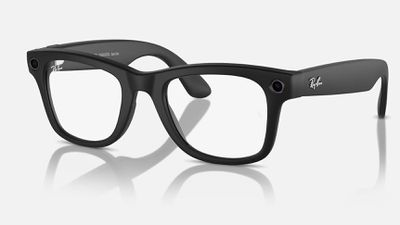
Meta this week sent out an email (via The Verge) to Meta Ray-Ban customers informing them about upcoming privacy changes to the smart glasses, which will increase the amount of data that Meta is collecting by default.
Meta says that voice recordings are stored by default when using Meta AI, and used to improve Meta products. Meta has eliminated the option to disable voice recording storage, and recordings need to be manually deleted in settings. Further, the "camera use" setting for Meta AI is now enabled by default.
From Meta's email:
Meta AI with camera use is always enabled on your glasses unless you turn off "Hey Meta."
Recordings of your voice are stored by default when using Meta AI and may be used to improve AI at Meta and other Meta products. The option to disable voice recordings storage is no longer available, but you can delete recordings anytime in Settings.
You're still in control. You can turn off "Hey Meta" or delete Meta AI interactions anytime.
Photos and videos taken with the built-in camera are stored on a connected smartphone and are not used by Meta for training, unless those photos are used by a Meta product. If a photo or video is used with Meta AI, or if cloud processing is turned on and media is sent to Meta's servers, it can be used to improving Meta's services. Of course, uploading images and video to Instagram and other Meta apps also gives Meta the exact same access.
So if you say "Hey Meta, record a video," by default Meta records the voice command and stores the recording and an audio transcript of it, a feature that is now turned on by default and can't be turned off. If cloud processing is also on, or if you ask Meta AI a question about the video, Meta can access and use the video for AI training purposes.
Turning off Meta AI entirely on the Ray-Ban glasses and using manual controls for snapping photos and videos is the best method to ensure that Meta isn't collecting excessive data. More information is available in Meta's privacy policy.
Apple this week sent out notices to people who may have been targeted with government-sponsored spyware attacks, reports TechCrunch. An Italian journalist and a Dutch activist said that they received notifications from Apple via iMessage and email.
Apple detected that you are being targeted by a mercenary spyware attack that is trying to remotely compromise the iPhone associated with your Apple Account. This attack is likely targeting you specifically because of who you are or what you do. Although it's never possible to achieve absolute certainty when detecting such attacks, Apple has high confidence in this warning - please take it seriously.
Apple said in its message that the notification was being sent to targeted users in 100 countries, and the company advised that those receiving the alert enable Lockdown Mode and ensure that their iPhones are updated to iOS 18.4.1. Apple also warned against opening links or attachments from unexpected or unknown senders.
We are unable to provide more information about what caused us to send you this notification, as that may help mercenary spyware attacker adapt their behavior to evade detection in the future. Apple threat notifications like this one will never ask you to click any links, install an app or profile, or provide your Apple Account password or verification code by email or over the phone.
Apple has been sending out notices like this to those targeted in state-sponsored attacks since 2021. Many state-sponsored surveillance campaigns use the Pegasus spyware from NSO Group, and Apple launched a lawsuit against NSO Group in 2021.
According to a support document on Apple's threat notification policy, Apple sends out alerts multiple times per year when attacks are detected, and to date, users in over 150 countries have been notified about potential attacks.
Google and the United States Justice Department are back in court to fight over the remedies that will be implemented to address Google's search monopoly, and Google CEO Sundar Pichai today took the stand to defend Google.
The DoJ wants Google to divest its Chrome browser, refrain from making search engine agreements like the one Google has with Apple, and share "critical portions" of its search data with competitors at a "marginal cost," including how it ranks search results and query understanding information. According to Pichai, these remedies would essentially mean the end of Google search.
As outlined by The New York Times, Pichai said that if Google had to share data, the company wouldn't likely continue to invest in search. "The combination of all the remedies, I think, makes it unviable to invest in R&D the way we have for the past three decades, to continue to innovate and build Google search," he said. He suggested that Google would not be able to fund "all the innovation" that the company puts into search.
Pichai said that the data sharing requirement would be a "de facto divestiture" of Google's intellectual property. With that information, Pichai claimed that any company could "completely reverse engineer, end to end, every aspect of [Google's] technology stack." He said that the DoJ's proposal that Google share its data is "extraordinary" and "far reaching."
Google wants to be able to continue to make search engine deals like the one it has with Apple, according to Pichai, though he suggested those deals could be renegotiated on an annual basis and that those deals would not be exclusive. Google's upcoming deal to add Gemini to the iPhone along with OpenAI was cited as an example of Google's new deal making policy.
Judge Amit Mehta, who is overseeing the case, will consider testimony from both Google and the DoJ before he provides remedies. A decision is expected by August, and Google will undoubtedly appeal, so the case is likely to take many more years to play out.
Apple has reaffirmed its commitment to making chips in the United States as Taiwan Semiconductor Manufacturing Company (TSMC) begins construction on its third fabrication facility in Arizona.
The facility in Phoenix represents part of a $100 billion investment TSMC pledged in March to make over four years in the American semiconductor industry. The new plant follows the company's initial $65 billion commitment in Arizona and is being positioned as a key node in the effort to manufacture chips for Apple and other U.S.-based technology companies within domestic borders.
We're proud to support the high-skilled American jobs of tomorrow. As TSMC Arizona's first and largest customer, we're excited for the future of American innovation and the incredible opportunities it will create.
TSMC currently manufactures the majority of Apple's chips in Taiwan. Under current company policy and Taiwanese export restrictions, the most advanced fabrication technologies, including the 3-nanometer processes used to make the A18 and M4 chips, remain exclusive to facilities in Taiwan. The Arizona plants, by contrast, are limited to producing slightly older nodes. These fabs are expected to manufacture 4-nanometer chips such as the A16 Bionic and S9, used in the iPhone 15 and Apple Watch Ultra 2.
In an earnings call earlier this month, TSMC CEO Dr. C.C. Wei said that production yields at the company's first Arizona plant are now matching those in Taiwan. The second plant, announced in 2022, is currently ramping up operations and is expected to become fully operational by 2028. The third facility does not yet have a confirmed completion date.
Note: Due to the political or social nature of the discussion regarding this topic, the discussion thread is located in our Political News forum. All forum members and site visitors are welcome to read and follow the thread, but posting is limited to forum members with at least 100 posts.
Google CEO Sundar Pichai today said that he hopes to reach a deal with Apple regarding built-in Gemini integration on iPhones by the middle of this year, according to Bloomberg. The report said that Pichai shared this remark in court today, during the U.S. Department of Justice's ongoing antitrust trial against Google.
Pichai confirmed that he held a series of discussions with Apple CEO Tim Cook about Google Gemini integration on iPhones last year.
Apple is expected to announce iOS 19 during its annual developers conference WWDC, which kicks off Monday, June 9. That would align with the mid-2025 timeframe provided by Pichai, so it seems likely that iOS 19 will offer Google Gemini integration, should a deal be reached. iOS 19 should be released to the general public in September.
iPhone models with Apple Intelligence have already offered ChatGPT integration since iOS 18.2. With user permission, Siri can show ChatGPT answers directly in response to questions and other prompts. ChatGPT is also an option for Apple's system-wide Writing Tools feature, allowing users to generate text and images.
Google Gemini would have similar integration across Siri and Writing Tools on iPhone models that are compatible with Apple Intelligence, which includes the iPhone 15 Pro, iPhone 15 Pro Max, and all iPhone 16 models.
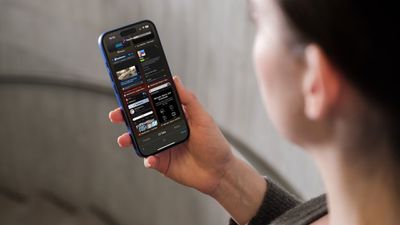
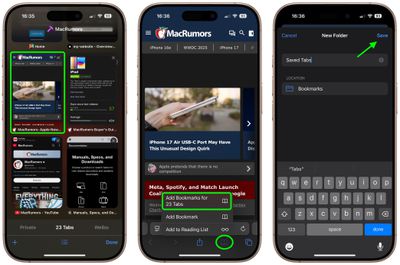
In Safari on iPhone, it's not unusual for the number of tabs you have open to quickly get out of hand. Here's how to temporarily clean things up without losing your tabs.
If you have no use for all your open tabs, you can simply select one, then press and hold on the tabs button in the bottom-right corner of the screen. This will bring up an option to "Close All [x] Tabs," X being the number open.
Using the close all tabs option is one solution for restoring order to your browser session, but that's no good if you're not finished looking at the open tabs, especially if you're busy researching a project or a vacation, let's say.
You could always bookmark the open web pages for later reference. But you don't have to bookmark each tab one by one – that could take a while depending on how many are open.
Fortunately, Safari lets you bookmark multiple tabs in a just couple of taps and save them all in a new or existing bookmark folder. Here's how it works.
Select one of your open tabs, and in the main browsing window, long press the Bookmark icon (it looks like an open book).
Once you've tapped this option, you'll be asked to save the tabs in a new bookmarks folder. You can also choose the location where you want the new folder to live.
To access your bookmarks in Safari at any time, simply tap the Bookmarks icon in the main browsing interface to reveal all of your saved favorites and folders.
This year, Mother's Day lands on Sunday, May 11, and we're tracking quite a few offers from some of the best Apple-related accessory companies, as well as steep discounts on Apple products at Amazon. If you're planning on purchasing a gift for someone, we recommend looking at the below deals as soon as possible, considering shipping estimates vary for every company.
Note: MacRumors is an affiliate partner with some of these vendors. When you click a link and make a purchase, we may receive a small payment, which helps us keep the site running.
Amazon Sale
Amazon this week kicked off one of its biggest sales of the year so far, introducing record low prices on a number of Apple products. You can find the highlights in the list below, and be sure to check out our original articles on each sale for even more models and configurations being discounted.
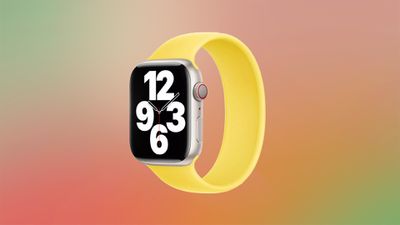
Woot recently brought back its sale on Apple Watch Solo Loop and Braided Solo Loop bands, but with a twist. This time, when you buy any Solo Loop or Braided Solo Loop at a discount on Woot, you'll get up to two extra bands for free.
The way it works is when you purchase any Solo Loop band for the discounted price of $19.99 ($29 off), you will get two additional Solo Loop bands for free. When you purchase any Braided Solo Loop for the discounted price of $29.99 ($69 off), you will get one additional Braided Solo Loop band for free.
The catch here is that you won't be able to pick out the color of the bands. You start by selecting the size of the band and Apple Watch model, then Woot will randomly select three Solo Loop bands or two Braided Solo Loop bands to send to you.
Woot guarantees that each band will be a unique color and there will be no duplicate colors in each box. These are also in new condition and come individually packaged in their original Apple retail packaging, as well as with a one year Apple manufacturer limited warranty.
ZAGG
ZAGG is offering a straightforward 25 percent off sitewide for Mother's Day, including the usual array of Mophie chargers and protection accessories.
Specifically, you can get 25 percent off select products on ZAGG's website, excluding anything that has already been discounted. You don't need a coupon code and all sale prices will be reflected in your cart, and this sale will last through May 7.
Samsung
Samsung this week kicked off a new sale that includes savings on monitors, TVs, Galaxy products, and more. One of the best overall deals during this sale is on The Frame TVs, which are available for up to $1,600 off, depending on the size of the model you purchase. Every size is being discounted during this event, with the popular 65-inch The Frame TV available for $1,299.99, down from $1,999.99.
In terms of monitors, the best deal you'll find is on the 32-inch Smart Monitor M80D, which is available for $399.99, down from $699.99, an all-time low price.
This sale also covers the newest Galaxy S25 smartphones, The Frame TV, and Samsung's line of home appliances, including refrigerators and washer/dryers. We've accumulated some of these deals in the lists below, but be sure to check out Samsung's website for the full sale.
AT&T is discounting a large collection of smartphones for Mother's Day this year, including up to $1,000 in savings on the iPhone 16 Pro and iPhone 16 Pro Max. You'll need to have an eligible trade-in, pick or upgrade to an eligible unlimited plan, and then you'll get up to $1,000 off in credits over 36 months.
AT&T also has the Apple Watch Series 10, Apple Watch SE, and Apple Watch Ultra 2 under a buy two, get $300 off deal. If you purchase any two Apple Watch models on an installment plan and add at least one new line, you can get up to $300 off in bill credits over 36 months.
If you're on the hunt for more discounts, be sure to visit our Apple Deals roundup where we recap the best Apple-related bargains of the past week.
Deals Newsletter
Interested in hearing more about the best deals you can find in 2025? Sign up for our Deals Newsletter and we'll keep you updated so you don't miss the biggest deals of the season!
A new lobbying group formed by Meta, Spotify, and Match Group is challenging Apple and Google's role in the mobile app ecosystem, arguing the company should bear legal responsibility for verifying users' ages and accusing them of anti-competitive business practices that disadvantage developers, Bloomberg reports.
The "Coalition for a Competitive Mobile Experience" is a coordinated effort by these major companies to influence federal and state legislation amid mounting pressure to implement digital safeguards for minors. The coalition intends to lobby lawmakers, engage with federal regulators, and support ongoing antitrust enforcement actions against Apple and Google.
The group's immediate concern is a growing legislative push to require age verification for users downloading mobile apps that may be unsuitable for minors. A law enacted in Utah in March requires app stores to verify a user's age and obtain parental consent before allowing minors to download certain applications. Additional proposals are reportedly being drafted at the federal level.
The coalition's members argue that Apple and Google, as gatekeepers of the iOS App Store and Google Play Store respectively, are best positioned to implement uniform age verification protocols across devices and markets. By contrast, Apple and Google have maintained that responsibility should lie with individual app developers, who are directly collecting and processing user data within their apps.
In recent years, Apple has introduced features aimed at limiting children's exposure to harmful content, including communication safety tools and default app restrictions for child accounts, but the company has been reluctant to assume primary responsibility for verifying user identities at the download stage.
Beyond age verification, the coalition aims to highlight broader concerns over Apple's app distribution practices. These include the company's 15–30% commission on digital transactions, mandatory use of its in-app purchase system, and restrictions on alternative app marketplaces or payment methods.
Apple is preparing to launch a dramatically thinner iPhone this September, and if recent leaks are anything to go by, the so-called iPhone 17 Air could boast one of the most radical design shifts in recent years.
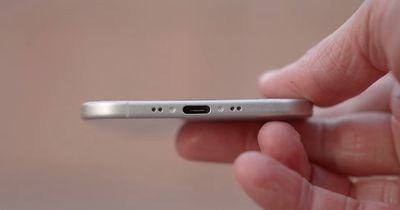
iPhone 17 Air dummy model alongside iPhone 16 Pro (credit: AppleTrack)
At just 5.5mm thick (excluding a slightly raised camera bump), the 6.6-inch iPhone 17 Air is expected to become the slimmest iPhone in the lineup by some margin. For comparison, the current iPhone 16 Pro measures 8.25mm thick.
Achieving this level of thinness is unlikely to come without compromise. Dummy models shared by AppleTrack suggest that Apple has made some subtle adjustments to accommodate internal components in the tighter chassis. Most notably, the USB-C port on the bottom edge is no longer centered front-to-back. Instead, it appears shifted closer to the rear of the device, which is likely to accommodate display components within the enclosure.
There are other signs of Apple's re-engineering efforts. The speaker grilles, for example, show a pared-back design, with only two holes on either side of the port compared to the typical five. That reduction reflects the same space-saving measures required to fit in a battery, processor, display components, and speakers within a much slimmer frame.
To save even more space, Apple is said to be equipping the iPhone 17 Air with a single rear camera. The company is also expected to remove the physical SIM card slot entirely, adopting eSIM-only support globally – a shift first seen in U.S. iPhones with the iPhone 14.
One of the most interesting internal changes is the inclusion of Apple's new custom-designed C1 modem, first introduced in the iPhone 16e. The ultra-efficient chip should play a big role in maintaining battery life in such a thin frame. Despite its size, sources suggest the iPhone 17 Air will offer battery performance on par with current iPhone models.
Apple is expected to announce the iPhone 17 series during its usual fall event, which may also see the debut of third-generation AirPods Pro.
OpenAI has reversed a recent update to GPT-4o, the model powering ChatGPT, following widespread complaints about the chatbot's strange behavior.
Deployed late last week, the update made ChatGPT excessively agreeable and unnaturally effusive in its praise, and the responses quickly became the subject of mockery on social media.
CEO Sam Altman announced Tuesday that the company had completed the rollback for free users and was working to restore the previous version for paid subscribers. "We're working on additional fixes to model personality and will share more in the coming days," Altman wrote on X (Twitter).
In an official blog post, OpenAI acknowledged they "focused too much on short-term feedback, and did not fully account for how users' interactions with ChatGPT evolve over time." The result was responses that were "overly supportive but disingenuous."
The company noted that "ChatGPT's default personality deeply affects the way you experience and trust it," and that "sycophantic interactions can be uncomfortable, unsettling, and cause distress."
When is OpenAI pulling the plug on the new GPT-4o ? This is the most misaligned model released to date by anyone. This is OpenAI's Gemini image disaster moment.
image credit : r/u/Trevor050 pic.twitter.com/kNcdnEYMDq
— AshutoshShrivastava (@ai_for_success) April 27, 2025
OpenAI's solution goes beyond the rollback, and the company is implementing a four-point plan. This includes refining training techniques, building honesty guardrails, expanding pre-deployment testing, and enhancing evaluations to prevent similar issues.
The company also plans to give users more control over ChatGPT's behavior, including new ways to provide real-time feedback and the option to choose from multiple default personalities in the future.
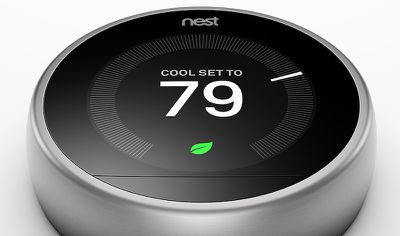
Google has announced that first- and second-generation Nest Learning Thermostats will lose support in October 2025, disabling their connected features (via ArsTechnica).
After October 25, 2025, these devices will no longer receive software updates or connect to Google's cloud services. Users won't be able to control them via the Google Home app or voice assistants, though basic temperature control and on-device scheduling will continue to function.
The affected models include the original 2011 North American Learning Thermostat – pioneered by iPod creator Tony Fadell – and its 2012 successor, and the 2014 European model.
U.S. users can upgrade to newer Nest models, and owners can get a $130 discount if they upgrade to the fourth-generation Nest, which was released last year for $280. In Canada, the discount is CA$160.
European owners face a tougher choice, as Google confirmed it won't develop new thermostats for European heating systems. Instead, European customers are being offered a 50 percent discount on the Tado Smart Thermostat X.
This decision follows Google's recent discontinuation of other Nest products amid job cuts in its platform and devices division. Google is no longer making new Nest Protect Smoke & CO alarms and is ending sales of the Nest x Yale Lock.
Despite the upcoming end-of-life, the thermostats have exceeded Google's standard five-year support commitment, with some approaching 15 years of service by the cutoff date. Still, many Nest owners will be disappointed with the limited lifetime of a device they probably didn't expect to replace anytime soon.








 Note: MacRumors is an affiliate partner with some of these vendors. When you click a link and make a purchase, we may receive a small payment, which helps us keep the site running.