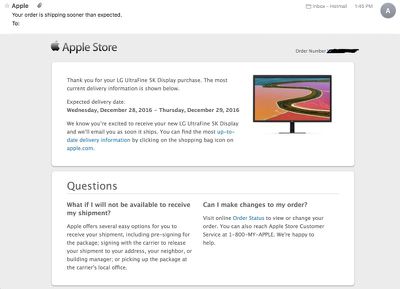
The first U.S. customers who placed orders for an UltraFine 5K Display from LG will begin receiving their shipments over the next few days, with Apple starting to send out pre-shipment notifications this afternoon.
MacRumors reader Jesse, who placed an order for an UltraFine 5K Display order when orders were briefly accepted in late November, has got a notice that his order will ship out soon with an expected delivery date of December 28 to December 29.
Apple first took LG 5K Display orders on November 28 with six to eight week shipping estimates, but supplies sold out quickly and no more were available for order. Those orders placed in November will be arriving to customers ahead of schedule and before the end of the year.
The display became available for sale again just this morning, with initial shipment estimates of three to five business days. Shipping estimates quickly slipped to two to four weeks, but the first customers who ordered new displays this morning may also get them in late December.
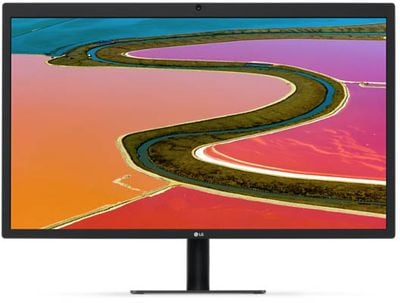
The LG 5K UltraFine Display was created in partnership with Apple for the new MacBook Pro. The display connects to the MacBook Pro over Thunderbolt 3 and include features like built-in USB-C ports for charging, stereo speakers, P3 wide color gamut support, a camera, and a microphone.
Apple has extended its discounted pricing for the LG 5K Display until March, making it available for $974 instead of $1,299.
Apple today released new firmware updates for its Wi-Fi base stations, including the AirPort Express, AirPort Extreme, and AirPort Time Capsule. The 7.7.8 update is available for 802.11ac base stations, while the 7.6.8 update is available for 802.11n base stations.
According to Apple’s release notes, the update fixes an issue that caused AirPort base stations from appearing in the AirPort Utility when Back to My Mac is enabled. The firmware updates can be installed using the AirPort Utility app for iOS or OS X.
Apple has reportedly stopped development on its AirPort wireless routers, with no new AirPort products planned for release, but the company will continue to offer bug fixes and updates in the near future.
Now that iOS 10.2 has been available for over a week, Apple has stopped signing earlier versions of iOS 10, including iOS 10.1 and iOS 10.1.1.
Customers who have upgraded to iOS 10.2 will no longer be able to downgrade their iOS devices to iOS 10.1.1, the previous version of iOS.
Apple routinely stops signing older versions of software updates after new releases come out to encourage customers to stay up to date. iOS 10.2 is the only version of iOS 10 that can be installed on iOS devices, though developers and public beta testers can download iOS 10.2.1, a future update that is currently in a beta testing phase.
Released to the public on December 12, iOS 10.2 introduced major new features like the dedicated TV app, new emoji, and a range of bug fixes. Apple has also stopped signing tvOS 10.0.1 for the fourth-generation Apple TV.
With Christmas less than a week away, Best Buy has decided to offer some last minute holiday deals on Apple products for customers who still need to purchase a gift. Deals include discounts on the iPad Pro, the iPhone 7, and Apple's line of MacBooks.
Note: MacRumors is an affiliate partner with Best Buy and may earn commissions on purchases made through these links.
The discount applies to all 9.7-inch models, both Wi-Fi only and Cellular, in all capacities.
iPad mini 4 models are also available at a $100 discount, dropping prices on the entry-level 32GB model to $299.99.
Macs
Select MacBook Pro and MacBook Air machines are discounted by up to $200, with models listed below. Deals are available on the latest machines, including the 2016 MacBook Pro with no Touch Bar.
Best Buy is offering a $250 Best Buy gift card with the purchase of an iPhone 7 or iPhone 7 Plus when a customer trades in an iPhone 6 or newer and activates a billing plan on Sprint, Verizon, or AT&T. The deal is only available in store.
Best Buy is also discounting the 32GB iPhone 7 to $49.99 with activation and a two-year contract on the Verizon network.
A $200 Best Buy gift card is available with the purchase of an iPhone 6s or 6s Plus on Verizon, AT&T, or Sprint.
Best Buy is offering free two-day shipping on all orders, but for gifts to arrive by Christmas, orders will need to be placed by 11:30 a.m. Eastern Time on Wednesday, December 21.
After that cutoff point, customers will be able to use in-store pickup to get gifts until 6:00 p.m. local time on Christmas Eve.
For more deals on Apple products, including price charts that have the lowest prices on Macs and iPads, make sure to check out our deals roundup.
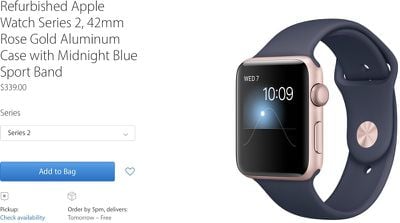
Apple today updated its online store for refurbished products, introducing refurbished Apple Watch models for the first time since the Apple Watch was released in the spring of 2015.
The Apple Watch refurbished section includes both Apple Watch Series 1 and Series 2 models at 14 to 16 percent off depending on configuration. No original Apple Watch models are included.
Both aluminum and stainless steel Apple Watch models are included, in 38 and 42mm size options. All Apple Watches listed in the store feature Sport bands in a variety of colors.
Aluminum Apple Watch models start at $229 for the 38mm version ($40 off), while 38mm stainless steel Apple Watch models start at $469 ($80 off).
Refurbished stock varies on a day-by-day basis according to the models that Apple has on hand, and supplies can potentially go quickly. Refurbished stock is refreshed on a regular basis, however.
All of Apple's refurbished Apple Watch models include magnetic charging cables and a full one-year warranty, just like non-refurbished products. Series 2 models ship with a power adapter, while Series 1 models do not.
The second macOS Sierra 10.12.3 is available for download through the Apple Developer Center or through the software update mechanism in the Mac App Store.
According to Apple's release notes, the 10.12.3 update "improves the stability, compatibility, and security of your Mac." No specific changes, bug fixes, or feature additions were discovered in the first beta, but we'll update this post should any new features be found in the second beta.
Oftentimes, with bug fixes, it's difficult to tell just what's included until Apple supplies detailed release notes with a release. The previous update, macOS 10.12.2, introduced several important bug fixes to resolve battery life issues, fix graphics problems, and more.
Available since September, macOS Sierra is the latest Mac operating system. It includes Siri support, Apple Pay for the web, Universal Clipboard, Apple Watch auto unlocking, improved iCloud Drive integration, Picture-in-Picture multitasking, and dozens of smaller features that can be found in our macOS Sierra roundup.
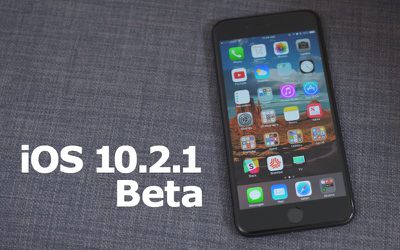
Registered developers can download the second iOS 10.2.1 beta from the Apple Developer Center or over-the-air with the proper configuration profile installed.
It isn't known what features are included in iOS 10.2.1, but as a minor 10.2.x update, it appears to focus on bug fixes and performance improvements rather than major outward-facing changes.
No new features were discovered in the first iOS 10.2.1 beta, but we'll update this post if any changes are found in the second beta.
iOS 10.2.1 follows the release of iOS 10.2, a significant update that brought Unicode 9 emoji, a new TV app, Messages Screen Effects, Music improvements, and a whole slew of bug fixes.
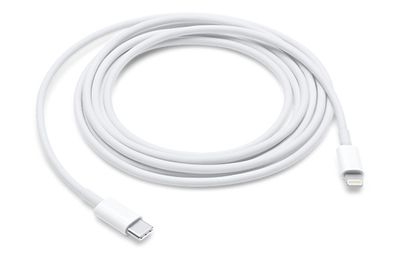
Last month, Apple dropped the price on all of its USB-C adapters and accessories by $6 to $20 until December 31. Today, it has extended that discount until March 31, 2017 for many of the products.
A full list of prices on the adapters in the United States is below:
The discounts may please customers who have been dissatisfied with the high price of the MacBook Pro, coupled with the need to buy a wide range of adapters to use the new notebook with older peripherals.
Apple:
"We recognize that many users, especially pros, rely on legacy connectors to get work done today and they face a transition. We want to help them move to the latest technology and peripherals, as well as accelerate the growth of this new ecosystem. Through the end of the year, we are reducing prices on all USB-C and Thunderbolt 3 peripherals we sell, as well as the prices on Apple's USB-C adapters and cables."
Apple similarly extended its discount on the now-available LG UltraFine 5K Display until March 31.
LG's new UltraFine 5K Display is now available for purchase for $974 on Apple's website in the United States, with orders initially estimated to ship in 3-5 business days but quickly slipping to 2-4 weeks.
Apple has extended its $974 sale price for the display until March 31, 2017, when the price will return to $1,299.95. The discount was previously set to expire on December 31, but it was likely extended due to the display's lack of availability until late into the month. Apple's discount on USB-C adapters is similarly extended.
Apple teamed up with LG to create both the 4K and 5K UltraFine Displays, specifically designed to work with the new 13-inch and 15-inch MacBook Pro. Both displays connect over a single cable, but the 5K display is only compatible with the new MacBook Pro, as it requires a Thunderbolt 3 connection.
The display's Thunderbolt 3 port enables pass-through charging to the new MacBook Pro at up to a full 85W. Its wide DCI-P3 color gamut shows more vibrant colors compared to the traditional sRGB standard. The display also has a built-in camera, microphone, stereo speakers, and three downstream USB-C ports at 5 Gbps speeds.
Tech Specs • 27-inch IPS LED display • 5,120×2,880 pixels resolution • 16:9 at 217 PPI • 60Hz refresh rate • DCI-P3 wide color gamut • 500 cd/m2 brightness • 1 Thunderbolt 3 and 3 USB 3.1 Type-C ports • Thunderbolt 3 cable included • Power delivery up to 85W to new MacBook Pro
Live Tune-In lets users jump directly into the live streams of select apps using the Siri Remote. Users can simply hold down the microphone button and say commands such as "Watch TBS" or "Watch TNT live." The feature requires tvOS 9.2 or later.
Live Tune-In also supports ABC News, CBS, CBS News, CNN Go, Cooking Channel, Disney Channel, Disney Jr, Disney XD, DIY, ESPN, Food Network, FXNOW, HGTV, and Travel Channel, plus live sporting events in the NHL app.
Meanwhile, Apple TV universal search now supports NRK TV and TV 2 Sumo in Norway and SVT Play in Sweden.
Universal search enables fourth-generation Apple TV users to conduct Siri voice searches or text-based searches to find TV and movie content across a wide range of channels. A wide number of apps are supported.
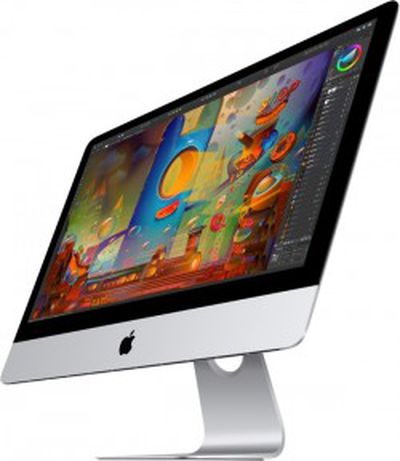
Apple is preparing modest updates to its Mac lineup for next year, including new iMac models with USB-C ports and new AMD graphics chips, and "minor bumps" in processing power for 12-inch MacBook and MacBook Pro models, according to Bloomberg.
Mac fans shouldn't hold their breath for radical new designs in 2017 though. Instead, the company is preparing modest updates: USB-C ports and a new Advanced Micro Devices Inc. graphics processor for the iMac, and minor bumps in processing power for the 12-inch MacBook and MacBook Pro. Cue the outrage.
KGI Securities analyst Ming-Chi Kuo likewise said new iMacs will launch in the first half of 2017 in a research note shared earlier this year, while current iMac models have not been updated in 434 days per our Mac Buyer's Guide, so updates to Apple's consumer desktop lineup would be unsurprising. USB-C ports on new iMacs would likely double as Thunderbolt 3 ports akin to the new MacBook Pro.
Apple designers are also said to be exploring standalone keyboards with a Touch Bar and Touch ID for desktop computers. The report claims Apple will decide whether to release the keyboards depending upon how well the touchscreen strip and fingerprint scanner are received on new MacBook Pro models released a few months ago. Apple's current Magic Keyboard was released in October 2015.
Meanwhile, some Apple engineers have reportedly raised the possibility of moving Mac Pro production back to Asia, as these people believe the supply chain workers have the "required skills" for "ambitious" products. Apple currently assembles the Mac Pro in Texas as its only "Made in USA" computer, but the professional-oriented desktop machine has not been updated in three years.
Three years on, the Mac Pro is ripe for an upgrade with its chips and connector ports lagging rival products. Because of the earlier challenges, some Apple engineers have raised the possibility of moving production back to Asia, where it's cheaper and manufacturers have the required skills for ambitious products, according to a person familiar with those internal discussions.
President-elect Donald Trump recently said he will offer Apple incentives to bring manufacturing back to the United States, including a "very large tax cut" and reduced regulations. Apple CEO Tim Cook himself has said the majority of its products are made in China because the U.S. workforce has a smaller number of individuals with the "vocational kind of skills" needed.
Overall, the article suggests the Mac is "getting far less attention than it once did," partly due to "a lack of clear direction from senior management, departures of key people working on Mac hardware, and technical challenges."
Apple, for its part, told employees it has "great desktops" in its roadmap. Cook said the desktop is "very strategic" to Apple because the performance desktops can provide is "really important" to a lot of people and "critical" for others. He says the current iMac is the best desktop Apple's ever made and its 5K display is the best desktop display in the world. The fate of the Mac Pro and Mac mini is less clear.
In a comprehensive new Bloomberg article diving into the slow refresh cycle of Apple's line of Mac computers, and how the company slowly "alienated Mac loyalists," a few interesting tidbits surfaced providing insight into what could have been for the Touch Bar MacBook Pro, as well as the 12-inch Retina MacBook.
In the MacBook Pro line launched this past October, Apple planned to introduce "higher capacity battery packs" that would have been terraced and shaped to the inside compartment of the computer, boosting battery life in the process. According to a person familiar with the creation of the MacBook, the battery failed a "key test," so instead of delaying the laptop and missing the holiday shopping season, "Apple decided to revert to an older design." This created a domino effect that went on to hit other Mac design teams whose engineers were taken to finish the MacBook Pro.
In the run-up to the MacBook Pro's planned debut this year, the new battery failed a key test, according to a person familiar with the situation. Rather than delay the launch and risk missing the crucial holiday shopping season, Apple decided to revert to an older design.
The change required roping in engineers from other teams to finish the job, meaning work on other Macs languished, the person said. The new laptop didn't represent a game-changing leap in battery performance, and a software bug misrepresented hours of power remaining. Apple has since removed the meter from the top right-hand corner of the screen.
Battery life has been a big complaint among many MacBook Pro users, with some claiming in early December to get as little as 3 to 6 hours of battery life on a single charge. Some users claimed to see better battery life after updating to macOS 10.12.2 last week, but Apple "repeatedly and emphatically" told Ars Technica there are no specific battery life improvements included in the update. The laptop's battery "appeared to be performing as intended," according to the company.
The MacBook Pro is rated for up to 10 hours of battery life for the 13-inch and 15-inch laptop, but the Bloomberg article didn't specify how much that may have been increased by if the larger battery would have made it into the MacBook Pro.
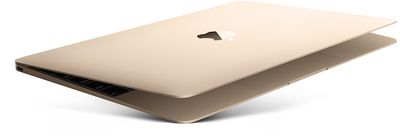
The article continued by saying that a few early prototypes of last year's 12-inch Retina MacBook were built with ports for the iPhone's Lightning cable, but the MacBook eventually launched with USB-C instead. A gold colorway for this year's MacBook Pro was even planned, but Apple designers eventually decided the color didn't work "on such a large product."
These test runs for iPhone-like features on the MacBook are "part of a broader shift toward making Macs more like iPhones." The critique rests on Apple's inability to see what its more creative and loyal users need desktop and laptop computers for, instead opting to bring features from its best-selling product -- the iPhone -- into the Mac line.
That's part of a broader shift toward making Macs more like iPhones. Apple prioritizes features, like thinness and minimal ports, that sell its iPhones and iPads, which generated about 75 percent of revenue this year. Those are contrary to professional needs, like maximum computing power. Early prototypes of the 12-inch MacBook used the iPhone's Lightning connector, although this was ditched for a more standard USB-C port. There was even a gold MacBook Pro planned, but this was shelved because the color didn’t look good on such a large product.
The rest of the Bloomberg article is an interesting read, pointing towards the lack of a "singular vision" in Apple's design and engineering departments that leads to product delays and underwhelming reveals. In the end, dozens of Mac hardware managers and engineers are said to have left for different teams, or left Apple entirely, in the past 18 months. "Some were looking for a less all-consuming work environment, while others felt the future of Mac hardware was unclear in a world of iPhones and iPads."
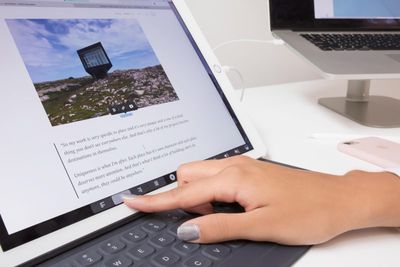
Duet Display, the app that turns an iPad into a second display for a Mac, was today updated with a handy new feature that gives you iPad Touch Bar access, even when you don't have a Mac with a Touch Bar.
The Duet Display app is able to tap into the MacBook Pro's Touch Bar software, displaying a virtual Touch Bar on your iPad's screen. The iPad Touch Bar mirrors the MacBook Pro's Touch Bar on a model with a Touch Bar, and when used with a MacBook Pro that doesn't have a Touch Bar, it lets you tap into functionality that would otherwise be unavailable.
When used with Photoshop on the Mac, for example, the iPad serving as a second display will include a Touch Bar at the bottom of the screen, with the same exact controls you would see on the MacBook Pro Touch Bar.
Like the Touch Bar on the MacBook Pro, the virtual iPad Touch Bar will change contextually based on the app because it is tapping into actual MacBook Pro Touch Bar functionality.
It's a bit more cumbersome to use a Touch Bar on the iPad than it is on the Mac because it requires reaching over to tap on another screen, but it does unlock Touch Bar specific commands that are not accessible to those without a new MacBook Pro.
In some cases, when the Touch Bar option built into an app contains options that are normally hidden behind several screens, the iPad Touch Bar will be immensely useful. Many apps are still being updated with Touch Bar support, but in apps like Final Cut Pro and Photoshop, the Touch Bar is a highly valuable tool.
To use this feature, you will need macOS 10.12.2 and the updated versions of Duet Display for both the Mac and iOS, both of which are available today.
Also new in today's update is iPad keyboard support, so when Duet Display is used with an iPad Pro Smart Keyboard, it will work regardless of whether you're using it alongside a Mac or a PC.
Duet Display's Touch Bar support will be available for free to existing users. New users can download Duet Display for $9.99 for a limited time. [Direct Link]
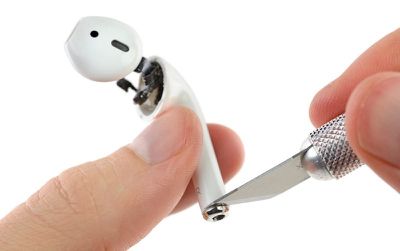
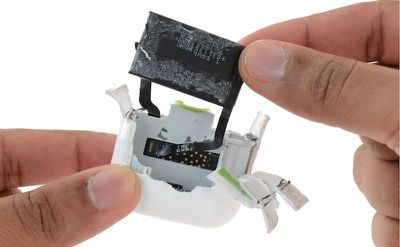
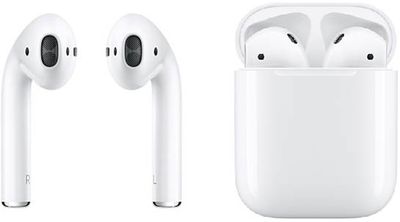
iFixit today published a teardown of Apple's AirPods, uncovering the internal components of both the AirPods themselves, and the charging case that comes with the headphones. Throughout the teardown, iFixit discovered a "hot mess" of close knit components within each AirPod, along with a few "quality issues" within the charging case that may be the reason for the months-long delay of the wireless headphones.
Starting with the AirPods, iFixit separated the speaker portion of the pod from the rest of the device, comparing the tightly-packed internals to the Apple Watch teardown. Further investigating uncovered a miniature coaxial cable and two IR proximity sensors, which allow the AirPods to detect whenever they're inside an ear, and play/pause music accordingly.
Blocked by more glue and cables in the speaker portion of the AirPods, iFixit turned to the "stem" only to find "a waterfall of glue" inside the base section of the device. Just behind the metallic bottom area of each AirPod -- which provides the contact point for charging in the case -- the site uncovered the end of the battery cable underneath the wall of adhesive.
That shiny metal cap provides contact points for charging the AirPod, and surrounds the primary microphone. Hidden behind and within the torrent of glue, we spy the end of the battery cable.
If jamming complex components into a small form factor and sealing it with a copious amount of glue were a game, Apple would be winning.
Cutting open the AirPods completely, iFixit eventually separated the antenna from the battery, theorizing that the "hanging boom is for more than just balance—it's also to improve reception." The earpiece of each AirPod is a 93 milliwatt hour battery, "equivalent to a little over 1% of the charge capacity in an iPhone 7."
Although the site could extract some basic components of the charging case without total destruction -- including the status LED -- it eventually had to resort to using a rotary saw in order to get behind the "impenetrable" shell. Discovered underneath was the case's battery, a 1.52 watt hour lithium-polymer cell that's around 16 times the power capacity of a single AirPod. iFixit equates this to around eight full recharges of the AirPods within the charging case.
iFixit took a few x-ray shots of the charging case's internals, and found "quality issues" within the chip's solder joints. A few empty spaces can be seen, referred to as "voiding," which iFixit said "could be evidence of low quality standards, or a rushed product release." This suggests that the source of the AirPods' delay was with the charging case and not with the AirPods.
The repairability score of the AirPods was ultimately rated at a lowest-possible 0/10, thanks to the copious use of glue as a fastener within most of the components of the AirPods, and the case's resistant outer shell.
Check out the rest of iFixit's teardown to see more internal exploration of the charging case's sync button, lightning connector, and a few more x-ray images of both the case and the AirPods.
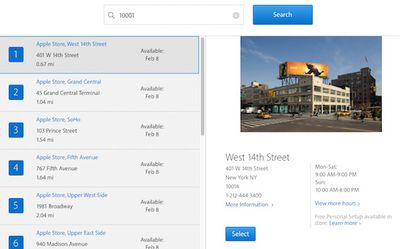
Apple has activated its in-store pickup tool for AirPods on its website, enabling customers to enter a zip or postal code and check for availability of the all-new wireless earphones at Apple Stores in their local areas.
The tool is not yet available in Belgium, Brazil, China, Hong Kong, Switzerland, Turkey, or the United Arab Emirates, countries where Apple also operates retail stores, but it will presumably be expanded soon.
AirPods became available for purchase at Apple Stores yesterday, and some lucky customers were able to secure one of the limited number of pairs available. Apple said stores will continue to receive "regular shipments" of AirPods, so customers may have success finding a pair before the early February dates quoted.
AirPods became available for purchase on Apple's website last week, but orders placed today are estimated to ship in 6 weeks, or around late January. The first wave of customers who ordered AirPods online began receiving their shipments yesterday in the United States and around the world.
Apple Authorized Resellers and carriers also began receiving a limited number of AirPods this week, as seen over the past few days when Best Buy and Verizon have periodically offered AirPods for estimated delivery as early as this week.
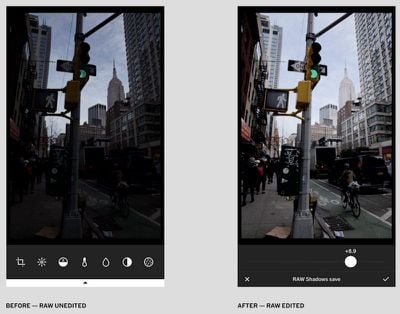
Popular photography app VSCO recently announced that users can now capture and edit images in RAW on the iPhone 6s, 6s Plus, iPhone 7, 7 Plus, and iPhone SE, while running iOS 10. Apple introduced the ability for third-party apps to support RAW shooting and editing in iOS 10, and began highlighting the professional photography feature soon after the launch of the iPhone 7 and iPhone 7 Plus.
Now, VSCO announced that its iOS app will support full RAW capturing, importing, and editing. The company's blog post said that RAW offers "greater creative control" over an image, and users will be able to better adjust color balance and recover any lost highlight details in the process. RAW image capture isn't supported on the iPhone 6 and 6 Plus, but users of those devices will be able to import and edit RAW images.
In our latest update, full RAW image support includes RAW capture, importing and editing, offering greater creative control by preserving an image’s original data and capturing exactly what your camera sees. With RAW, you’re able to recover lost highlight detail, freely adjust color balance, and bring out the full potential of RAW images from both your iPhone and DSLR camera.
Another new feature introduced in the update is called "Film X," and VSCO said that it will "give you the full expressive power of film itself," leading to customized film modeling and high image quality through two new controls called "Character" and "Warmth." Film X is an exclusive feature to the new membership plan, VSCO X, which runs for $19.99/year and grants users new "entitlements" each month like camera presets and advanced controls.
VSCO is available to download from the iOS App Store for free. [Direct Link]
Apple has reportedly offered a three-digit million amount to acquire an underground bunker in Stuttgart that it wanted to convert into a retail outlet similar to its iconic New York 5th Avenue Store.
The city of Stuttgart is still without an Apple Store, with the nearest one in Sindelfingen about 12 miles away. Apple has reportedly been searching for a suitable retail home in the city for some time, having rejected various locations in recent years, including a planned move into the Milaneo shopping mall which the company is said to have pulled out of at the last minute.
According to German tech site ifun.de, Apple's search for a home in the state capital even led to the company offering a "three-digit million amount" for a series of wartime bunker rooms under the Stuttgarter Market Square in the center of the city.
After the Second World War, the bunker system in question was used as a 100-bed hotel from 1945 to 1985. The Bunker Hotel had ventilation shafts instead of windows, and the rooms still exist to this day, but are reportedly dilapidated.
An architectural competition to make the bunker a public exhibit was announced in 1995 and the winning design by Neugebauer + Roesch Architect was a 31 meter-long and 14 meter-high glass prism as an entrance pavilion to underground stores, but the design was never realized because of lack of interest from the city administration.
The original architectural proposals fit Apple's portfolio of underground store, which typically involve a recognizable glass construction entrance leading to retail rooms below, as seen at the company's flagship 5th Avenue store in New York. However, the city administration are said to be reluctant to have an Apple logo-emblazoned edifice directly opposite the Stuttgart City Hall and have so far rejected Apple's large offer of money to acquire the location.
At least for now, Apple's search for a retail home in the the state capital of Baden-Württemberg appears set to continue.
Apple is in talks with India to explore the possibility of making products locally, according to The Wall Street Journal (via Reuters).
The negotiations come as Prime Minister Narendra Modi tries to boost his 'Make in India' initiative, with Apple eager to make deeper inroads into the world's second largest mobile market.
In June, Modi ordered his government to exempt foreign retailers for three years from a requirement to locally source 30 percent of goods solid in their stores.
According to The Journal, Apple sent a letter to India's federal government last month, outlining manufacturing plans and asking for financial incentives. Apple and Indian state representatives have yet to comment on the matter.
In September 2015, Apple CEO Tim Cook sat down with Prime Minister Modi to discuss various matters and Cook reportedly responded positively to Modi's invitation to open a manufacturing base in India. Foxconn was previously reported to be looking at the possibility of an expansion into India to produce iPhones and iPads, but Cook's outspoken interest in the possibility was Apple's first public interest in the expansion.
Apple does not yet have a license to sell products directly to consumers in India, which has led to buyers going through third-party retail stores to get hold of the company's flagship phones. Apple's iPhones currently account for less than 2 percent of Indian smartphone sales.


 Apple today released new firmware updates for its Wi-Fi base stations, including the AirPort Express, AirPort Extreme, and AirPort Time Capsule. The
  Now that iOS 10.2 has been


 Apple is preparing modest updates to its Mac lineup for next year, including new iMac models with USB-C ports and