Apple was granted patents today that include a concept for water-resistant iPhone speakers and a bone conduction technology that could bring advanced noise cancellation to future earbuds (via AppleInsider).
The first application granted by the U.S. Patent and Trademark Office is titled "Liquid resistant acoustic device" and details a protected acoustic port that uses a special mesh "umbrella" inserted between apertures in a device's housing, similar to the design of the mesh-covered loudspeaker found in current iPhones.
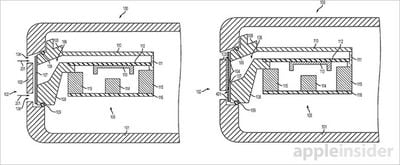
If liquid enters through the housing apertures it immediately comes into contact with the umbrella and is directed away from the internals, although in some versions a small amount of liquid is allowed to pass through if the handset is under significant pressure, to avoid structural damage.
Apple's invention also includes a second line of liquid defense, in the form of a "hydrophobic" coating applied to the outer surface of the iPhone housing and mesh umbrella, while a "hydrophilic" coating applied to the inside of the mesh works to draw liquid out.
As with all patents, whether or not Apple decides to use the invention in any future product remains unclear, although AppleInsider notes that a similar port design can already be found on the current Apple Watch.
Several rumors claim that the upcoming iPhone 7 could be properly waterproof, but it's not obvious that the invention described above would meet the requirements of such a specification.
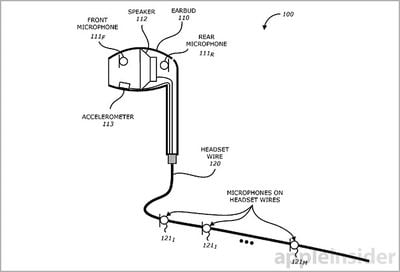
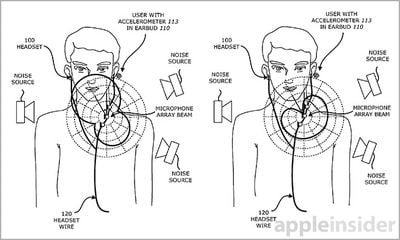
Another Apple patent was awarded today, called "System and method of mixing accelerometer and microphone signals to improve voice quality in a mobile device". This one describes a headset that uses bone conduction technology to effectively filter out ambient noise.
The invention works by using accelerometers that detect vocal chord vibrations which reverberate through the user's skull. Coupled with an onboard microphone, the system is able to measure output signals and effectively parse out ambient noise vibrations.
Output from both systems are processed through a noise cancellation unit which then outputs a clean signal for transmission.





 In recent months, 13-inch Retina MacBook Pro owners


 AT&T this morning


 Netflix today