Apple is set to spend $921 million on a second data center in Denmark run entirely on renewable energy. The news was relayed by the Danish government's Ministry of Climate Energy and confirmed in a statement to Reuters by Apple's Nordic director Erik Stannow.
"We're thrilled to be expanding our data center operations in Denmark, and investing in new sources of clean power," Erik Stannow, Nordic manager for Apple, told Reuters in an email.
"The planned facility in Aabenraa, like all of our data centers, will run on 100 percent renewable energy from day one, thanks to new clean energy sources we're adding," he said.
Apple said the new data center would begin operations in the second quarter of 2019 and would power its online services, including the likes of iMessage, Siri, Maps, and the App Store.
The data center is located in Aabenraa near the German border, which is a couple of hundred miles south of the data center the company has built just outside of Viborg, which is due to start operations later this year.
Apple said a planned data center in Athenry, Ireland, announced in 2015, had yet to begin construction and is awaiting judicial review. Apple faced multipleobjections from local groups because of the planned facility's possibly harmful effects on the nearby wilderness. Originally it aimed to have the Irish data center up and running by early 2017.
Apple could make its upcoming OLED iPhone available in four different shades, including a new "mirror-like" reflective version not seen before in previous models. That's the latest claim from mobile leaker Benjamin Geskin, who shared an example image via Twitter over the weekend showing what the new color option could resemble.
The image the leaker provided is just an iPhone in a third-party reflective case, but it offers some idea of what a purported "mirrored" handset might look like if Apple decided to offer such a design as part of its color options.
Geskin offered no details regarding the source of his information, so there's no way to verify the claim, but it follows predictions from KGI Securities analyst Ming-Chi Kuo earlier this month that Apple's flagship iPhone model could come in limited "boutique" color options, alongside more typical "S" cycle updates to the existing iPhone 7 line-up.
No clarification was forthcoming regarding the other three color options for the redesigned iPhone, but it's possible some of them could be plucked from the existing six iPhone 7 shades currently available, which include jet black, black, gold, silver, rose gold, and (PRODUCT)RED.
Last week's prominent and perhaps most controversial rumor was that the new iPhone may not include TouchID at all, with Apple favoring some sort of face recognition technology as a replacement security feature. The rumor muddied the waters regarding the future of Apple's fingerprint recognition, with previous rumors appearing to indicate that the company had come up with a solution to integrate TouchID in an OLED display, with facial recognition used as an additional security feature via new 3D sensors in the front-facing camera.
Otherwise, Apple's major iPhone redesign is said to include some form of wireless charging, a faster A11 processor, and a glass body. The 5.8-inch "iPhone 8" is expected to be announced in September.
Apple's upcoming 2017 iPhone lineup is expected to include an inductive wireless charging feature enabled through a standalone charging accessory, and new information shared by Apple blogger John Gruber suggests the accessory might not ship alongside the iPhones in September.
In a tweet shared this evening, Gruber says he's heard that the inductive charging accessory will be sold separately rather than included with the iPhones, a rumor we've heard previously, and that it might be shipped later in the year alongside an iOS 11.1 update.
I’ve heard that inductive charging will (a) be sold separately, and (b) might be late, waiting for iOS 11.1 (a la Portrait mode last year). https://t.co/N65dHMNQIJ
— John Gruber (@gruber) July 8, 2017
Gruber's wording says the charging accessory "might" be late, so the delay is not confirmed, and it is not yet clear why Apple would hold off on shipping the rumored standalone charger.
Early rumors about the OLED "iPhone 8" and its two companion devices, the "iPhone 7s" and the "iPhone 7s Plus," suggested Apple was considering a long-range charging feature, but that technology is still new and there are likely many hurdles to overcome before it's ready for inclusion in a device like the iPhone.
Instead, Apple is rumored to be introducing Apple Watch-style inductive charging, enabled through a standalone charging accessory.
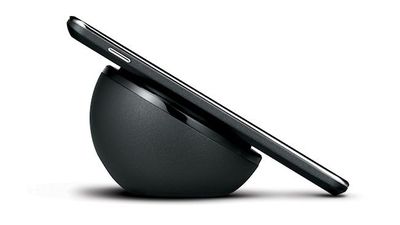
An example of a Qi wireless charging solution
In a research note published earlier this week, trusted KGI Securities analyst Ming-Chi Kuo said the three iPhones coming in 2017 will adopt glass bodies to facilitate WPC-standard wireless charging functionality. WPC-standard refers to the Wireless Power Consortium (Apple is a member), which supports the Qi wireless charging functionality built into many Android devices.
If Apple's upcoming iPhones do indeed support a universal inductive charging technology like Qi, the devices could potentially work with a range of already-available charging solutions once the wireless charging feature is enabled. Apple's exact plans for its inductive wireless charging solution remain unclear, however, and it could be limited to Apple-designed accessories.
Even though the first two days of this week were spent by most Americans celebrating the Fourth of July, there were still a ton of happenings in the iOS gaming arena. Kicking things off was a story surrounding a puzzling update from Five Nights at Freddy's creator Scott Cawthon. Now, this comes with the massive caveat that Cawthon is no stranger to (intentionally or unintentionally) trolling his audience with updates on the state of development of games in the Five Nights at Freddy's series, but, you really never know.
If Scott Cawthon is to be believed, he's been working on Five Nights at Freddy's 6 but eventually decided to pull the plug on the project due to the pressure that comes from trying to develop another unique entry in the series — particularly with the sky-high expectations surrounding another FNAF sequel. Allegedly, instead he's going to be working on smaller projects loosely based on the FNAF universe like the upcoming movie, a VR title, and other things.
What has us raising our eyebrows particularly high on this one is that Five Nights at Freddy's: Sister Location was "delayed" because it was "too scary" and then the game was released four days later. Either way, kids are (still) crazy for FNAF, so it seems worth paying attention to, even if these odd updates seem like a strange way to promote a game.
With Season 3 of Rick and Morty only a few weeks away, Adult Swim has updated Pocket Mortys with online multiplayer battles, new dimensions to explore, and tons of other things. Pocket Mortys features a supremely agreeable free to play system that feels truly optional, and is easily among the best, if not the best Pokemon-like game on the App Store. It's packed with Rick and Morty fan service, but even if you've never seen the show, it's a fantastic collection and battling game only made better by this update.
Another Rome: Total War port is on the way to the App Store, and this time players will travel back in time to an entirely new scenario that begins with the Macedonians and escalates all the way to the Persian Empire. Rome: Total War - Alexander will launch as a standalone expansion for $4.99 soon. The original iPad port of Rome: Total War was received incredibly well by fans of strategy games, so it seems safe to assume Alexander will be just as good.
Telltale's Minecraft: Story Mode is a clever mash-up between Telltale's signature narrative-based games and the Minecraft universe which has practically no story in it at all. The first season of the game spanned eight individual episodes that at times felt a lot like playing a Minecraft-y version of the movie The Goonies. Few details are available yet for the second season except for the trailer and the release date of July 11th, but we'll be keeping a close eye on this one.
The original Sorcery! is now available for free on the App Store, and is a game everyone should download during this promotion. We've written extensively about the game, but CliffsNotes effectively amount to Sorcery! is easily among the best game books on the App Store. If you've never played one, imagine Choose Your Own Adventure novels from when you were a kid, but fleshed out to an unbelievable extent. There are two more entries in the series, so if you find yourself enjoying Sorcery! be sure to check out the two sequels.
While it seems like everyone and their brother is riffing on Supercell's Clash Royale these days, Tilting Point and Simutronics released Siege: Titan Wars this week which is another incredibly polished spin on the formula. Players dispatch swarms of troops and powerful titans, and unleash magic spells in realtime PvP battles. This style of game works incredibly well on mobile, so if you weren't into Clash Royale for whatever reason, it's worth giving this one a try.
In Hearthstone news, surrounding rumors, speculation, and legitimate leaks, Blizzard finally announced the next Hearthstone expansion: Knights of the Frozen Throne. Launching next month, Knights of the Frozen Throne is loosely based on the World of Warcraft expansion Wrath of the Lich King, but with the requisite signature Hearthstone twist. New Death Knight Hero cards are being introduced, which provide each class with a new Undead-centric hero power.
Finally, Tencent's Honor of Kings will be launching globally this year. It's unlikely you've heard of this game unless you're in China, but Honor of Kings has been unbelievably successful, sporting over 50 million daily active users and raking in over $140 million a month. The game is so popular in China that the developers were actually forced to limit how much people can play it by the Chinese government. It's a situation that's almost impossible to believe, but I'm incredibly curious to see how it does outside of Asian markets.
That's it for this week! As always, if you appreciate these iOS gaming roundups and are interested in way more content like this, head over to TouchArcade where we're posting iOS game news, reviews, guides, and more all day long. We've got an iOS gaming Twitch channel, a fantastic Discord server, and a weekly podcast that are also all worth checking out.
Since 2015, Apple has been using LIDAR-equipped mapping vehicles to capture street-level imagery for the Apple Maps app. Apple has expanded the areas where it is collecting data several times over the course of the last two years, and according to the latest update to the company's support page, Apple Maps vehicles have recently made their way into Spain.
Apple regularly highlights the countries and cities around the world where its vehicles are located, and between July 3 and August 13, Apple will collect data in the Biscay province of Spain, in Arratia-Nerbioi, Busturialdea, Durangaldea, Enkarterri, Greater Bilbao, Lea Artibai, and Uribe-Kosta.
Apple is also collecting data in new areas in England, France, Italy, and multiple U.S. states during the months of July and August, but Apple Maps vehicles have been seen in these countries in the past. Data collection in Vermont, Rhode Island, and New Hampshire in the United States may be new, however.
According to Apple's support page, the information collected by the mapping vehicles will be used to improve Apple Maps, but just what Apple plans to do with the data remains unclear.
Because Apple promises to blur faces and license plates ahead of publication, there's been speculation that the company is working on a "Street View" addition to Apple Maps to mirror Google Maps, but it's also possible that the imagery is being used to bolster the autonomous driving software that's in development at Cupertino headquarters, as was recently proposed by analyst Neil Cybart.
Over the course of the last two years, Apple's mapping vehicles have surveyed more than 30 U.S. states and several countries including England, Ireland, Italy, France, and Sweden.
For over a decade, Apple has offered an annual Back to School promotion, offering higher education students, parents of higher education students, and educators incentives, such as a free pair of Beats headphones or an Apple Store gift card valued up to $100, with the purchase of a qualifying Mac, iPhone, or iPad.
We've been receiving questions about the Back to School promotion for a few weeks now, but there's still no sign of an imminent launch. Some have wondered whether Apple is canceling the program entirely, but it's too early to say, as there are still several weeks remaining before students begin returning to classrooms.
Since 2006, Apple has launched its Back to School promotion in the United States and Canada as early as May 25, and as late as July 23. The promotion is usually extended to several European countries such as France, Germany, and Italy on either the same day, or no more than a few weeks later.
These have been the exact kickoff dates each year for North America:
2016: June 2
2015: July 23
2014: July 1
2013: July 2
2012: June 11
2011: June 16
2010: May 25
2009: May 27
2008: June 3
2007: June 5
2006: June 4
Apple's Back to School promotion is highly anticipated because it's one of the few times a year that Apple offers deals to customers, and many hold off on summer purchases until the event begins. Apple offered free Beats headphones in 2016 and 2015, free Apple Store gift cards in 2014, and free iTunes gift cards in 2013.
Apple launched a Back to Uni promotion in Australia and New Zealand in February, offering a free Apple Store gift card valued between $70 and $100 with the purchase of a qualifying new Mac or iPad Pro.
The Back to Uni promotion in Australia and New Zealand can sometimes foreshadow what Apple plans to offer in other countries, but not always. In 2015, for example, Apple offered an Apple Store gift card worth up to $100 in Australia and New Zealand, but the deal was free Beats headphones in the United States.
Apple's stock price has declined around 9 percent from its all-time high of $156.10 in May, but Wall Street analyst Brian White believes the recent sell-off represents "yet another buying opportunity" as investors turn their focus to the so-called "iPhone 8" rumored to launch this fall.
White believes Apple remains "among the most underappreciated stocks in the world," according to his research note distributed to clients today. A copy of the report was obtained by MacRumors.
In our view, Apple's quarterly results will be less important this summer as investors are focused on the iPhone 8 this fall, along with the company's raised capital distribution initiative, depressed valuation and new innovations as showcased at WWDC. We still believe Apple remains among the most underappreciated stocks in the world.
White, an Apple bull, added that the upcoming iPhone cycle is setting up Apple to reach his $202 price target over the next 12 months, which would value the iPhone maker as over a trillion dollar company based on market capitalization. Apple's current market capitalization is around $737 billion.
Similar to the bottoming process in Apple during the summer of 2013 that drove a strong rally into the spring of 2015, we believe the bottom in the stock during May 2016 and the upcoming iPhone cycle is setting up Apple to reach our $202.00 price target over the next 12 months.
In May, RBC Capital Markets analyst Amit Daryanani also said Apple could reach or exceed a trillion dollar market cap within 12 to 18 months, with a stock price of $192-$195. Like White, Daryanani said the "iPhone 8" will be a major catalyst towards Apple's path to a trillion dollar valuation.
White maintains the highest price target for Apple's stock among all institutional analysts. AAPL closed at $142.73 on Thursday.
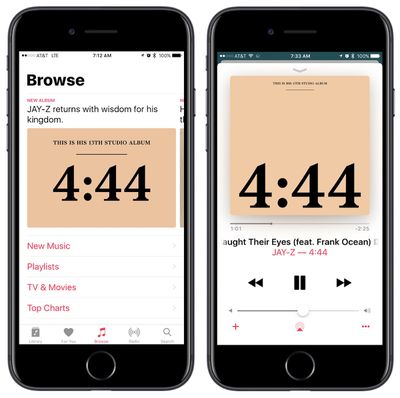
Last week, Jay-Z's new album "4:44" debuted exclusively on his own music streaming service Tidal, and then reports predicted that the album would expand to Apple Music and other services one week later. Now, 4:44 has begun streaming on Apple Music, and is available for $9.99 on iTunes [Direct Link].
Earlier in the week, Jay-Z debuted a video for one of 4:44's tracks, The Story of O.J., on Apple Music while the album was still a Tidal exclusive. Even during its one-week exclusivity window, 4:44 went platinum in under a week, certifying that the record has sold 1 million equivalent album units in the United States. One equivalent album unit represents one full album sale, ten tracks sold from an album, or 1,500 on-demand audio and/or video streams from an album as of February 2016.
In the midst of Jay-Z's new album launch, Kanye West -- one of Tidal's initial sixteen artists/co-owners -- was reportedly seeking to end Tidal's exclusivity rights over his new music and break from the service (via Billboard). West was said to claim he was owed "more than $3 million" because his album "The Life of Pablo" "resulted in 1.5 million new subscribers to Tidal, for which he was supposed to get a bonus but the company hasn't paid."
Now, a source close to West has said that Tidal's exclusivity rights to his music have been terminated, "based on what is alleged to be Tidal's failure to honor its financial obligations." West has been vocal in the past about company rivalries negatively affecting the music industry as a whole, eventually allowing The Life of Pablo onto Apple Music after first saying it would "never" happen.
In addition to Apple Music, 4:44 has also begun streaming on Amazon Music Unlimited, although Spotify has not been included in the expansion of Jay-Z's newest album. Earlier this year, Jay-Z removed his entire catalog of music from Apple Music and Spotify, without giving a clear indication as to why, and while many of the songs reappeared on Apple Music a few days later, most of it remains missing from Spotify.
Apple Maps has been updated with comprehensive transit data in Calgary, Alberta, enabling iPhone users in the Canadian city to navigate with public transportation, including the CTrain light rail system and buses.
Apple Maps transit directions are also available for buses in the smaller Southern Alberta cities of Red Deer, Lethbridge, and Medicine Hat.
Apple Maps enabled transit routing in Calgary just in time for the 2017 Calgary Stampede, which runs between July 7 and July 16.
Apple Maps gained a Transit tab in iOS 9. The feature lags several years behind Google Maps, but Apple's public transportation support is exhaustive, mapping all station entrances and listing departure times.
At launch, the feature was limited to Baltimore, Berlin, Boston, Chicago, London, Los Angeles, Mexico City, New York, Philadelphia, San Francisco, Sydney, Toronto, and over 300 cities in China. Since then, Apple has been working to expand support for public transportation to other cities around the world.
Newer additions include Atlanta, Columbus, Dallas, Denver, Detroit, Honolulu, Houston, Kansas City, Madrid, Manchester, Melbourne, Miami, Minneapolis–Saint Paul, Montréal, New Orleans, Paris, Portland, Pittsburgh, Prague, Rio de Janeiro, Sacramento, Salt Lake City, San Antonio, San Diego, Seattle, and Singapore.
For a complete list of cities with Apple Maps transit directions, visit the iOS Feature Availability page on Apple's website.
Apple today hit back at disgruntled chipmaker Imagination Technologies for questioning whether it can develop new graphics technology without using the supplier's intellectual property, calling the British firm's response to Apple's decision to part ways with it "disappointing, inaccurate, and misleading."
Back in April, Imagination Technologies announced that Apple had told the U.K. firm it planned to stop using its graphics processors in consumer devices over the next two years. The news came as a shock to investors and the company's shares fell by 60 percent on the day.
At the same time, the company criticized Apple, claiming that it doubted the tech giant could go it alone without violating Imagination's patents, intellectual property, and confidential information. One month later, the company opened a "dispute resolution procedure" with Apple after failing to resolve the disagreement.
On Friday, Apple responded to the graphics chip supplier by claiming that the firm had known for nearly two years that it was winding down the relationship. In an email statement received by Bloomberg, Apple said it first informed Imagination in late 2015 that it would no longer be buying the U.K. company's latest technology, but that it would still use its older systems.
Apple claimed that it told Imagination in 2016 that it was further reducing the relationship by initiating a clause in its contract that allows Apple to pay a lower royalty rate for using a smaller amount of intellectual property. By February 2017, Apple said it had told Imagination it was ending the relationship altogether and would no longer be making any royalty payments in up to two years' time.
Apple's statement contradicts those made by Imagination, notes Bloomberg. Last week, Imagination CEO Andrew Heath said the company was informed by Apple at the end of March "that they were certain" that products to be released in 2018 or early 2019 will no longer use Imagination's intellectual property. But Apple claimed the firm had known for longer.
"We began working with Imagination in 2007 and stopped accepting new IP from them in 2015," Apple said. "After lengthy discussions we advised them on February 9 that we expected to wind down our licensing agreement since we need unique and differentiating IP for our products. We valued our past relationship and wanted to give them as much notice as possible to adapt their future plans."
Imagination has yet to comment on Apple's statement, but the supplier's shares fell by up to 8 percent on Friday U.K. trading.
News that Apple would no longer be relying on its processors delivered a major blow to Imagination Technologies, which traditionally provides the PowerVR graphics architecture found in Apple's full range of iOS devices and receives a small royalty on every sale, which amounts to up to half of the British firm's revenue.
The company put itself up for sale in June. The formal sale process is still ongoing, despite a successful restructuring and a return to profitability for the company. Apple is unlikely to make an offer, according to a person familiar with the matter who spoke to Bloomberg.
Amazon is offering Prime members who have yet to try its Music Unlimited streaming service a steep discount in the run-up to the company's Prime Day on July 11.
Prime subscribers can currently sign up for four months for a total cost of $0.99 (or 99p in the U.K.), with the service reverting to its usual price of $7.99 (£7.99) per month thereafter. The non-Prime price for the service is $9.99 (£9.99) per month.
Amazon Music Unlimited launched last year to compete with the likes of Apple Music, Spotify, and Google Play Music. Its music catalog of "tens of millions of songs" makes the service distinct from the company's Prime-only music library, which offers access to "over a million songs". A standard Prime subscription costs $99 (£79) annually.
The four-month discount is only valid for Prime members and is only redeemable toward an Amazon Music Unlimited Individual Monthly Plan. The offer ends on July 11.
Data from Consumer Intelligence Research Partners (CIRP) estimates that Amazon Prime membership has grown 35 percent in the past year. Figures suggest there were 85 million Prime members as of June 30, 2017, while CIRP's June 2016 estimate put the number at 63 million.
Amazon is an affiliate of MacRumors and the site may benefit if you click product links in this article.
Samsung tipped its best-ever operating profit on Friday, with likely record earnings in the company's second quarter ending in June (via Reuters). The Apple rival predicted quarterly operating profit of 14 trillion won ($12.11 billion), a 72 percent jump from a year earlier. The estimate includes sales from the Galaxy S8 for the first time, but analysts pointed to Samsung's components business as the main driving force behind the latest projected figures.
Samsung has yet to provide a breakdown of its performance over the April-June period, with a full earnings report due later this month, but the South Korean company is known to have benefitted from higher prices for the memory chips it supplies that go into servers and smartphones. Samsung expects revenue to be up 18 percent year-over-year at 60 trillion won. Shortages for both DRAM and NAND chips are expected to persist for the rest of the year, increasing the likelihood that 2017 could represent Samsung's best-ever annual earnings.
Ironically, Samsung's continued success is expected to hinge increasingly on the performance of its biggest rival. Apple has reportedly turned to Samsung for more NAND chip supplies for its upcoming phones, since Samsung has relatively stable yield rates and has scaled up its output while other chip suppliers have lagged.
Samsung is also being helped by its sales of OLED panels, which are expected to become the go-to display standard over the coming years. Apple has reportedly signed a two-year contract with Samsung for the supply of up to 92 million curved OLED panels, as it attempts to ramp up capacity for this year's release of its high-end "iPhone 8", before transitioning fully to OLED displays for all its phones in the second half of 2018.
Samsung said on Tuesday it would invest $18.6 billion to extend its lead in memory chips and next-generation displays. Meanwhile, sales of the upcoming Galaxy Note 8 will be closely watched in the third quarter, after its predecessor was pulled from the market last year because of fire-prone batteries. Samsung is expected to unveil the handset in August.
In May of last year, speaker and fitness tracker company Jawbone ended production of its fitness trackers and started seeking a buyer for its speaker business, leading to speculation that the company was going out of business.
Jawbone denied claims that it was shutting down and planned to pivot to medical products for direct sale to clinical practitioners, but that may not have panned out, as The Information reports that the business is officially shutting down.
Jawbone has reportedly started liquidation proceedings and notices have been sent out to its creditors.
Jawbone co-founder and CEO Hosain Rahman has moved on to a new company called Jawbone Health Hub that is designed to make "health-related hardware and software services." Many existing Jawbone employees have already transitioned to the new company.
Jawbone Health will reportedly service existing Jawbone products, which may allow existing Jawbone customers to get help with their devices. Jawbone has been ignoring customer service requests for several months, making customers unhappy. Starting in January, Jawbone customers were unable to contact Jawbone support and did not receive responses to service requests for faulty products.
The legal battle between Qualcomm and Apple continues to escalate, with Qualcomm asking the United States International Trade Commission (ITC) to block imports of select iPhone and iPad models, reports Fortune. Qualcomm also wants to stop sales of devices that are already in the United States and has filed a new patent infringement case against Apple in the Southern District of California.
According to Qualcomm, Apple is infringing on six Qualcomm patents related to carrier aggregation and technologies that are designed to allow iPhones to save battery life while communicating. The six patents cited by Qualcomm were granted between 2013 and 2017 and are not licensed or standard-essential patents that are part of the ongoing Qualcomm v. Apple battle over royalty payments.
Qualcomm is asking the ITC to block all iPhones that are equipped with LTE chips from competing mobile communications companies, which would include AT&T and T-Mobile iPhone 7 and iPhone 7 Plus models equipped with Intel chips, along with some iPad models. In an interview, Qualcomm lawyer Don Rosenberg said Qualcomm is pursuing another lawsuit and an import ban because Apple is not willing to pay for the technology it uses.
"If Apple was a willing licensee and Apple was someone who was, like everybody else, willing to pay for what they use, we wouldn't be suing them on these patents," Don Rosenberg, Qualcomm's general counsel, said in an interview. "But they're not, and we felt we were put in a position, given all the lawsuits they've brought against us around the world, of not simply having to defend ourselves but having to take some affirmative action ourselves."
As noted in Qualcomm's ITC request, a possible ban on the iPhone 7, iPhone 7 Plus, and future iPhones wouldn't happen for approximately 18 months, so it would not affect the devices Apple plans to release in September of 2017. Qualcomm expects the ITC to look into the complaint in August and schedule a trial for 2018, and it believes the new patent infringement case filed today could be put on hold until the ITC makes a decision on the import ban.
The dispute between Apple and Qualcomm kicked off in January, when the FTC complained that Qualcomm had engaged in anticompetitive patent licensing practices. Apple sued Qualcomm for $1 billion shortly after, accusing the company of charging unfair royalties for "technologies they have nothing to do with" and refusing to pay quarterly rebates.
Qualcomm countersued in April, accusing Apple of breaching licensing agreements, making false statements, and encouraging regulatory attacks against Qualcomm, which prompted Apple to stop making royalty payments to Qualcomm entirely until a court can determine the proper amount due.
Since then, the two companies have been fighting a bitter public battle. Apple in late June expanded its lawsuit against Qualcomm and accused the wireless chipmaker of "double-dipping" with unfair patent licensing agreements. According to Apple, Qualcomm has overcharged it by billions of dollars, while Qualcomm says its innovations are "at the heart of every iPhone."
Alongside its dispute with Apple, Qualcomm is also now facing an FTC lawsuit for using anticompetitive tactics to remain the dominant supplier of baseband processors for smartphones.
Apple's bug bounty program has been available to select security researchers for almost a year now, but according to a new report from Motherboard, most researchers prefer not to share bugs with Apple due to low payouts. More money can be obtained from third-party sources for bugs in Apple software.
"People can get more cash if they sell their bugs to others," said Nikias Bassen, a security researcher for the company Zimperium, and who joined Apple's program last year. "If you're just doing it for the money, you're not going to give [bugs] to Apple directly."
Motherboard spoke to several members of Apple's bug bounty program with the condition of anonymity. Every single one said they had yet to report a bug to Apple and did not know anyone who had. iOS bugs are "too valuable to report to Apple," according to Patrick Wardle, a Synack researcher and former NSA hacker who was invited to the bug bounty program last year.
Apple first introduced its bug bounty program in August of 2016 at the Black Hat Conference, an annual global InfoSec event. Apple offers bounties of up to $200,000 depending on the vulnerability. Secure boot firmware components earn $200,000 at the high end, while smaller vulnerabilities, like access from a sandboxed process to user data outside of the sandbox, will earn $25,000.
tvOS 10.2.2 is only available for the fourth-generation Apple TV. Registered developers can download the update by connecting the Apple TV to a computer with a USB-C cable and installing the beta software using iTunes. Once a beta profile is installed, new updates will be received over-the-air.
No major feature changes or bug fixes were discovered in the first four betas of tvOS 10.2.2, so it appears the update focuses on minor under-the-hood improvements and security enhancements.
tvOS 10.2.2 will be one of the last updates to the tvOS 10 operating system as Apple is already working on the next-generation version of tvOS, tvOS 11. tvOS 11 is currently available for developers and public beta testers.
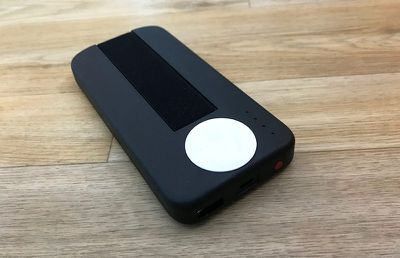
ElevationLab's latest product is the BatteryPro, an Apple Watch and iPhone charger that's got some clever design elements and a built-in Apple Watch charging puck for convenience. Priced at $99, the BatteryPro isn't cheap, but if you value ease of use over cost, it's worth checking out.
At first glance, the BatteryPro doesn't look like much. It's similar in design to many external battery packs, constructed from plain but durable black plastic and designed with a rectangular shape that matches up well with the iPhone. It's meant to fit in a back pocket while charging the iPhone, and it does. Walking around with the BatteryPro in a back pocket isn't exactly comfortable because it's almost an inch thick and weighty, but it's functional in a pinch.
Though it uses a simple design, the BatteryPro features a built-in Apple Watch charging puck and a unique elastic "StowStrap" that's designed to hold the Apple Watch in place while it's charging, so you can toss it in a backpack while on the go. When not in use, the strap sits flush in a groove that's been added to the Battery Pro, but when you need to charge, you unhook it from the back, place the Apple Watch on the charger, wrap the strap over it, and secure it in a second slot on the back of the device.
Uber in June announced plans for a "180 Days of Change" initiative that added a new long-desired tipping feature for drivers.
Tipping was initially limited to Seattle, Minneapolis, and Houston, but Uber said tips would be available to all U.S. drivers by the end of July, and the company is making good on that promise.
Starting today, tipping is rolling out in 121 cities across North America, including New York, San Francisco, Los Angeles, New Orleans, Philadelphia, and several cities in Canada. TechCrunch has a full list of all of the areas where tipping is now available.
The tipping feature will continue to expand to additional cities throughout the month of July, and Uber says it is still planning to have the feature available to all U.S. drivers by the end of the month.
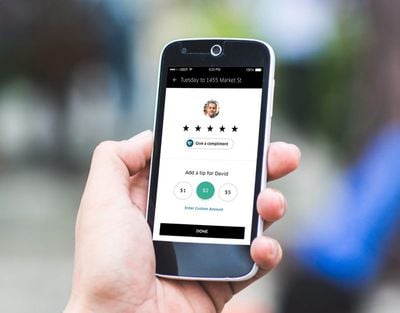
Tips are optional for Uber riders, and the tipping screen will show up after a driver has been rated following the conclusion of a ride. Passengers have up to 30 days after a ride to provide a tip, and there are three custom preset tipping amounts ($1, $2, and $5) along with an option for a custom tip total.
Uber long resisted tipping even as competitors like Lyft implemented tips for drivers, with the excuse that it kept the service hassle-free. Uber is now aiming to bolster its public image and improve working conditions for drivers through the addition of tipping and other "180 Days of Change" features, such as a per minute waiting fee for riders, a shorter cancellation window, and a new Driver Injury Protection insurance option.