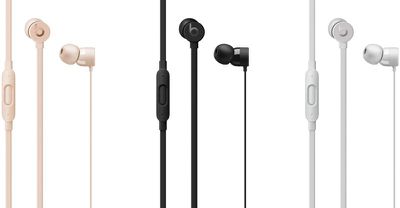
Apple today quietly introduced new urBeats3 Earphones that come equipped with a Lightning connector, allowing them to work with Apple devices that don't have a headphone jack - the new iPhone 8, iPhone 8 Plus, and iPhone X, plus the existing iPhone 7 and 7 Plus.
Apple is also offering a model that has a traditional 3.5mm plug that works with iPads and other Apple devices that continue to offer a headphone jack.
Apple says the urBeats3 wired earphones feature a "fine-tuned acoustic design" for an "exceptional listening experience." They ship with a variety of eartip options for a customized fit, and include secure-fit wingtips for a comfortable, secure fit when working out.
The urBeats3 earphones with a Lightning connector are available in Silver, Gold, and Black to match the new Gold, Silver, and Space Gray iPhone models. The iPhone 8 and 8 Plus come in Gold, Silver, and Space Gray, while the iPhone X comes in Silver and Space Gray.
The urBeats3 earphones with 3.5mm jack are available in Gray, White, Blue, and Black. Both models are priced at $99.95, and will be available for purchase this fall.
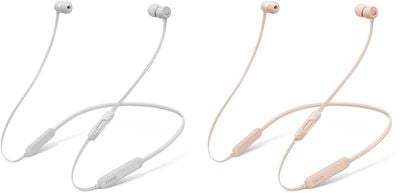
In addition to new urBeats3 earphones, Apple has also introduced new colors for its wireless W1-equipped BeatsX headphones. The BeatsX headphones are available in Silver and Matte Gold to match the iPhone 8 colors.
BeatsX are priced at $149.95 and will ship out in three to five business days for orders placed today.
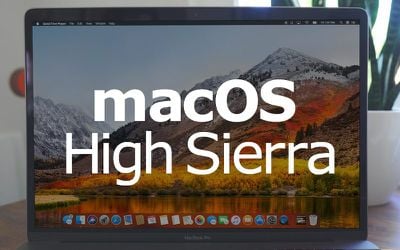
macOS High Sierra, the new version of the macOS operating systems for Macs, will be released to the public on Monday, September 25, according to Apple's macOS High Sierra website.
That's nearly a week after the iOS 11 and watchOS 4 release date, with those software updates coming on Tuesday, September 19. It is not unusual for the Mac operating system to be released after new watchOS and iOS operating system updates.
macOS High Sierra builds on features first introduced in the macOS Sierra update in 2016, focusing primarily on new storage, video, and graphics technology. The update brings a new Apple File System (APFS), High Efficiency Video Codec (HEVC), new HEIF image encoding, and an updated version of Metal with support for VR and external GPUs.
Multiple apps have been updated with new capabilities in macOS High Sierra. Photos features a new sidebar to make it easier to access editing tools and albums, and there are new filters and editing options like Curves and Selective Color.
Safari is gaining speed enhancements, an option to prevent autoplay videos, and a privacy feature aimed at cutting down on cross-site data tracking. Siri in macOS High Sierra has a new, more natural voice, and Spotlight offers flight status information. iCloud, FaceTime, Notes, and Mail also include useful new features.
macOS High Sierra will run on all machines that are capable of running macOS Sierra, the current Mac operating system.
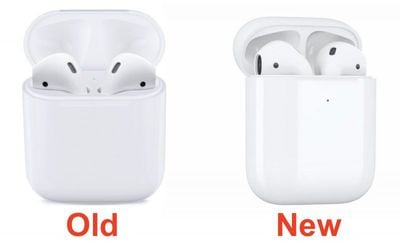
At today's iPhone-centric event, Apple briefly introduced a new second-generation AirPods case that features support for wireless charging.
The AirPods Case is physically identical to the current-generation AirPods Case, with the exception of a charging indicator light located on the outside of the case instead of the inside.
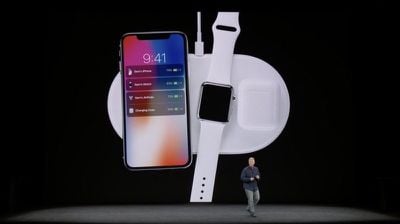
Apple's new AirPods Case will work with the company's upcoming "AirPower" wireless charging mat, which will be able to charge the AirPods, the Apple Watch Series 3, and the iPhone X or iPhone 8 simultaneously.
Apple does not yet appear to be offering the new AirPods Case either on a standalone basis or in a set with AirPods. It may be coming at a later date, as the AirPower charging accessory is not expected to ship until 2018.
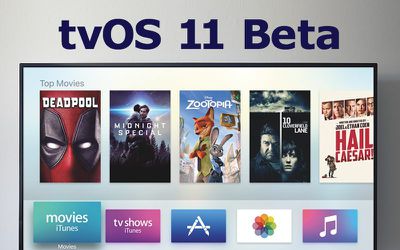
Apple today seeded the golden master (GM) version of tvOS 11 to developers following a beta testing period that saw the company release 10 tvOS 11 betas. The golden master represents the final version of tvOS 11 that will be released to the public on Tuesday, September 19.
Registered developers can download the tvOS 11 update by connecting the Apple TV to a computer with a USB-C cable and installing a beta profile using iTunes. Once the profile is in place, new beta updates are available over the air.
tvOS 11 is a modest update that has not received a lot of attention from Apple. It brings automatic switching between light/dark mode based on local time, Home screen syncing options that keep multiple Apple TVs in a household in sync, new background modes and notification support, Focus API improvements, custom sound support, network-based pairing and development support, improvements to Mobile Device Management, and other small changes.
Update: The GM version is also available to members of Apple's public beta program.
Apple today seeded the golden master (GM version) of watchOS 4 to developers following a beta testing period that saw the company release a total of eight betas. The golden master version of watchOS 4 represents the version of the software that will be released to the public on Tuesday, September 19.
Once the proper configuration profile has been installed from the Apple Developer Center, the new watchOS 4 golden master can be downloaded through the dedicated Apple Watch app on the iPhone by going to General --> Software update.
To install the update, the Apple Watch needs to have at least 50 percent battery, it must be placed on the charger, and it has to be in range of the iPhone.
watchOS 4 brings three new watch faces, including a dedicated Siri watch face that displays dynamic information unique to each individual user. There are new complications for Now Playing and Apple News, and an enhanced Workout app that supports High Intensity Interval Training and new swimming options.
GymKit, new in watchOS 4, lets the Apple Watch interface with gym equipment for workout data sharing purposes, and the Activity app has been updated to provide intelligent coaching, monthly activity challenges, and tailored workout encouragement.
Starting a workout is faster than ever with a new Quickstart interface, there's a new look for Apple Music, and with under-the-hood improvements, third-party apps are faster than ever and can do more.
Apple plans to release watchOS 4 to the public on Tuesday, September 19, three days ahead of when the new Apple Watch Series 3 will be available to consumers.
At its iPhone-centric event that saw the unveiling of the new iPhone X and iPhone 8 equipped with Qi wireless charging capabilities, Apple announced a new wireless charging accessory called "AirPower."
Designed as a simple oval-shaped white charging mat, AirPower is able to charge the iPhone X and the iPhone 8 inductively. It also works with the Apple Watch Series 3 models and a new AirPods charging case that was briefly mentioned during the keynote.
The new AirPods charging case is identical to the current case, with the exception of a new indicator light located on the outside of the body and the wireless charging capabilities.
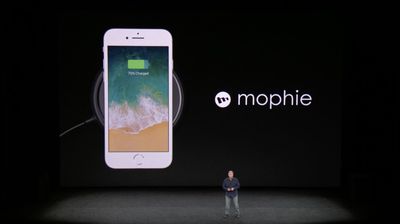
In addition to being able to charge through Apple's AirPower charging mat, the new iPhone X and the iPhone 8 will also be able to charge using Qi-based charging accessories. Apple will partner with companies like Mophie and Belkin to create iPhone-specific accessories, but all Qi chargers should work as event videos showed the iPhone charging in cafes and other locations.
According to Apple, its AirPower charging mat uses a new kind of charging standard that is able to support multiple devices at once, so it won't be immediately available.
Apple plans to ship the AirPower in 2018, but a more specific launch date hasn't been announced. Pricing is also unknown at this time.
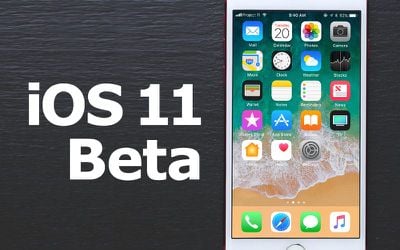
Apple today seeded the golden master (GM) version of iOS 11 to developers. The golden master represents the final version of iOS 11 that will be released to the public, and it comes after a beta testing period that saw Apple release a record 10 betas.
Registered developers can download the iOS 11 golden master from the Apple Developer Center or over-the-air once the proper configuration profile has been installed.
iOS 11 is a major update to the operating system designed for the iPhone and the iPad. It introduces several new design changes like a customizable Control Center and a reimagined Lock screen that's been merged with the Notification Center, along with smaller tweaks like bolder fonts, redesigned app icons for major apps, and a revamped App Store.
Peer-to-peer Apple Pay payments are coming in the Messages app, a Do Not Disturb While Driving feature is designed to help drivers stay focused on the road, and Siri has been enhanced with a new more natural voice, cross-device syncing, and the ability to learn more about each user's habits.
Photos includes new editing options for Live Photos, the Camera app offers optical image stabilization for Portrait Mode, Apple Music lets you follow friends, Maps features indoor mapping and lane guidance, and Notes has a new Document Scanner and handwriting recognition.
ARKit for developers brings a range of new augmented reality apps and games to iOS devices, and a new Core ML SDK lets developers build smarter apps. iOS 11 is also the biggest update ever for the iPad, with a new Dock that introduces much improved multitasking, a Files app for better managing files, improved Apple Pencil support, a revamped App Switcher, and a system-wide drag and drop feature.
iOS 11 will be released to the public on Tuesday, September 19, three days ahead of the official launch date of the iPhone 8 and 8 Plus.
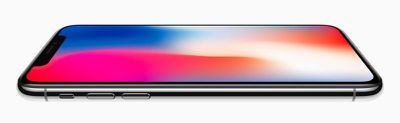
Apple announced the iPhone X during its special event at Steve Jobs Theater in Apple Park, Cupertino, today. Apple CEO Tim Cook said the iPhone X was "the future of the smartphone" and will "set the path for technology for the next decade".
"For more than a decade, our intention has been to create an iPhone that is all display. The iPhone X is the realization of that vision," said Jony Ive, Apple’s chief design officer. "With the introduction of iPhone ten years ago, we revolutionized the mobile phone with Multi-Touch. iPhone X marks a new era for iPhone — one in which the device disappears into the experience."
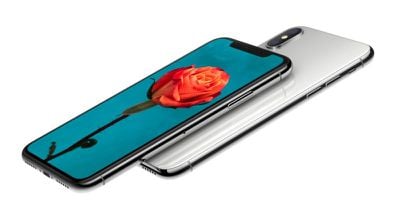
The iPhone X, pronounced "ten", features a 5.8-inch Super Retina OLED edge-to-edge display with a 2436 x 1125 resolution and 458 pixels per inch, including HDR support in Dolby Vision and HDR10 formats, as well as True Tone technology.
The device uses touch-based gestures to interact with iOS 11 in lieu of a home button, and is powered by a next-generation A11 Bionic neural processor that handles world tracking and scene recognition, backed up by a GPU that enables graphics at 60 frames per second. The handset comprises a glass and stainless steel design, which features a front-facing camera with advanced facial recognition and authentication technology called Face ID.
The Face ID authentication process utilizes the 7-megapixel front-facing TrueDepth camera along with a dot projector, infrared camera, and flood illuminator, in order to accurately map and recognize the user's face, so that it can be used to authenticate Apple Pay and gain access to secure apps. By combining these technologies, Apple claims that Face ID learns to recognize the user's face under a variety of conditions, and can't be fooled by photographs, with a 1 in 1,000,000 chance of mismatch, which compares to 1 in 50,000 for Touch ID.
There's also a redesigned, vertically aligned dual-lens TrueDepth 12-megapixel rear camera, featuring Quad-LED True Tone flash with dual optical image stabilization, while Portrait mode with Portrait Lighting on both the front and rear cameras offers dramatic studio lighting effects for creating portraits with a shallow depth-of-field effect in five different lighting styles.
Elsewhere, the iPhone X's glass back supports wireless inductive charging that works with Qi-certified third-party charging devices, including pads offered by Mophie and Belkin. Apple also gave a sneak peek of AirPower, an Apple-designed wireless charging accessory coming in 2018, which offers an active charging area to simultaneously charge up to three devices, including Apple Watch Series 3 and a new optional wireless charging case for AirPods.
The iPhone X is fast-charge capable, while its surgical steel band is said to enhance its water and dust resistance at a microscopic level. The handset will be available in space gray and silver colors.
The iPhone X also supports new animated emoji, or "Animoji", thanks to the phone's new 3D sensing capability, enabling users to create custom 3D animated emoji based on facial expressions picked up by the camera. The new A11 Bionic chip is also tuned for augmented reality experiences made using Apple's ARKit software framework.
The iPhone X comes in 64GB and 256GB storage capacities, costing $999 and $1149, respectively. The iPhone X will be available to pre-order from October 27 and will ship on November 3.
Apple today revealed the iPhone 8, iPhone 8 Plus, and iPhone X, all of which will support Qi wireless charging. Although Apple's own wireless charging accessory won't be coming out for a while, customers will be able to purchase charging pads from other accessory makers: Mophie, Belkin, Incipio, and more.
The iPhone's charging is based on the Qi standard, so users will be able to charge their iPhones anywhere they can find a Qi charging pad.
Apple today launched new bands for the Apple Watch, and announced new case finishes for the Apple Watch Series 3, during its special event at the Steve Jobs Theater in Apple Park, Cupertino.
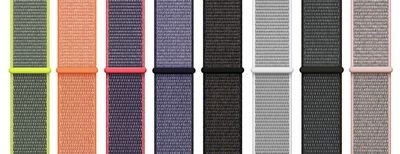
The new bands begin with the "Sport Loop," which Apple describes as a "soft, breathable, and lightweight" strap that's made of double-layer nylon and fastens with a hook-and-loop enclosure that should make fitting easier. It's made for users who want to wear their Apple Watch while working out, with soft cushioning that allows moisture to escape.
Sport Loop is available in Flash, Spicy Orange, Electric Pink, Midnight Blue, Black, Seashell, Dark Olive, and Pink Sand. Similar to other sport-related bands, Sport Loops cost $49.
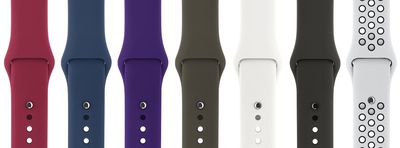
There's also six new colorways in the classic Sport Band that users can choose from: Rose Red, Blue Cobalt, Ultra Violet, Dark Olive, Soft White, and Gray. There's just one new Nike Sport Band in Pure Platinum/Black. Similar to previous iterations of the Sport Band, the new colors are made with high-performance fluoroelastomer and are Apple's most water- and sweat-resistant Apple Watch band. Sport Bands still cost $49.
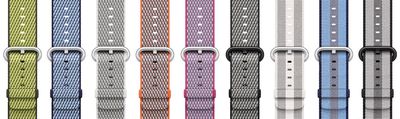
Woven Nylon got one of the biggest updates today, with nine total new colorways: Dark Olive Check, Midnight Blue Check, White Check, Spicy Orange Check, Berry Check, Black Check, White Stripe, Midnight Blue Stripe, and Black Stripe. Woven Nylon bands cost $49.
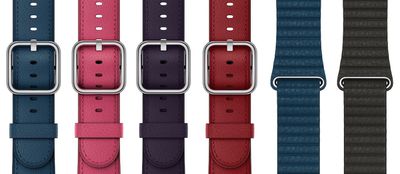
For anyone looking into buying a new leather Apple Watch band, there's quite a few new additions to the Classic Buckle and Leather Loop collections. Classic Buckle has Cosmic Blue, Pink Fuchsia, Dark Aubergine, and Ruby (PRODUCT)RED. Leather Loop has new Cosmic Blue and Charcoal Gray colorways. Classic Buckle and Leather Loop bands cost $149.
Hermès has two new Apple Watch bands, the Bordeaux Swift Leather Double Tour and the same colorway in a Single Tour. The accessories cost $489 and $339, respectively.
In addition to all of the new and updated band colorways, Apple unveiled a few new case options today. There's the usual silver and space gray aluminum, but Apple Watch Series 3 now comes in a new gold aluminum. Silver or space black stainless steel cases remain an option as well.
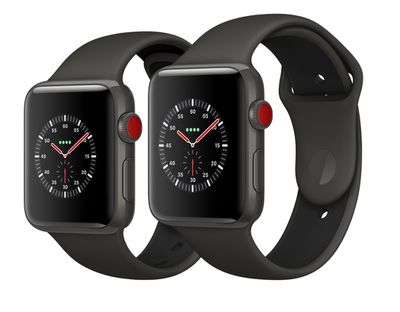
One of the more notable case additions is the new Apple Watch Gray Ceramic Case with Gray/Black Sport Band. This is the new "Edition" version of the Apple Watch, beginning at $1,299 and sold alongside last year's White Ceramic model.
Elsewhere, Hermès has new Apple Watch collections with new bands that can't be purchased individually. These include the Single Tour Rallye in perforated Gala calfskin, inspired by the classic Hermès driving glove, and the Single Tour Eperon d'Or in printed Gala calfskin, inspired by the equestrian scarf pattern designed by Henri d'Origny in 1974. A new watch face, inspired by the Carrick Hermès watch, also designed by Henri d'Origny in 1993, completes the existing selection of Hermès watch faces.
Apple Watch Series 3 with cellular connectivity will be available in 9 countries and 14 carriers from September 22, while pre-orders for the device will go up one week prior on September 15. Visit Apple's website to browse all of the collections that will be available for pre-order.
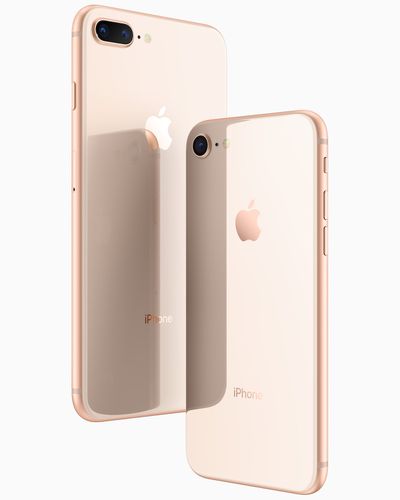
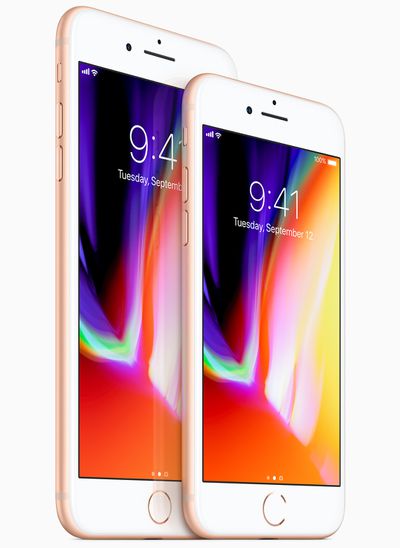
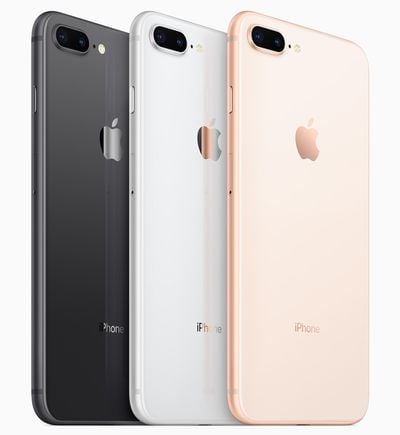
Apple today officially announced the all-new "iPhone 8" and 'iPhone 8 Plus." The iPhones are made from glass, combined with an aluminum frame design, and both come in three colors: Silver, Space Gray, and a new Gold finish
The backs of the iPhone 8 and iPhone 8 Plus are made from "the most durable glass ever in a smartphone," according to Apple, and each one is color-matched to an aerospace-grade aluminum bezel. Both devices are splash, water, and dust resistant to IP67 standards.
The iPhone 8 measures in at 4.7 inches and the iPhone 8 Plus is 5.5 inches, like the past few models of iPhone, and they come with a new Retina HD display with True Tone technology. True Tone adjusts the white balance of the display to match the surrounding light so looking at the iPhone 8 provides a "more natural, paper-like" experience.
“iPhone 8 and iPhone 8 Plus are a new generation of iPhone that improve on everything we love about iPhone,” said Philip Schiller, Apple’s senior vice president of Worldwide Marketing. “iPhone 8 and iPhone 8 Plus have new glass and aluminum designs, new Retina HD displays and A11 Bionic — the smartest chip ever in a smartphone. Packed with more advanced cameras with Portrait mode and Portrait Lighting, and the highest quality video capture in a smartphone, iPhone 8 and iPhone 8 Plus enable the freedom of wireless charging, all with AR optimization like no phone ever before.”
Apple said that the speakers have been redesigned and are as much as 25 percent louder and deliver deeper bass than the iPhone 7. All of the iPhone 8's new technology is powered by the A11 Bionic chip, featuring a six-core CPU design with two performance cores and four efficiency cores. A11 Bionic integrates an Apple-designed GPU for "up to 30 percent faster" graphics performance than the A10.
All of these advancements will help boost app performance on the new iPhone 8 and iPhone 8 Plus, particularly including the new ARKit-fueled augmented reality experiences. The A11 Bionic chip handles world tracking, scene recognition, and the GPU enables graphics running at 60fps.
The iPhone 8 and iPhone 8 Plus are each getting a "more advanced" 12-megapixel rear camera, with a faster and larger sensor, new color filter, and deeper pixels. Each smartphone includes Portrait mode with Portrait Lighting, which introduces studio lighting effects to iPhone, letting users change the depth-of-field effect with five different lighting styles.
In terms of video, users can capture 4K video up to 60fps and 1080p, and slo-mo up to 240fps. Thanks to HEIF and HEVC in iOS 11, there will also be room for twice the photos and videos.
The glass backs of the iPhones enable wireless charging on inductive charging pads, and support the Qi ecosystem of accessories. Apple's own mat is called the "AirPower mat" and it'll launch sometime in 2018 with the ability and room to charge an iPhone, Apple Watch, and AirPods simultaneously. Before that, users will be able to purchase mats from Mophie and Belkin to use iPhone 8 inductive charging.
The iPhone 8 will be available in 64GB ($699) and 256GB ($849), while the iPhone 8 Plus will be available in 64GB ($799) and 256GB ($949). Each device will be available to order starting Friday, September 15 and then launch September 22.
Upon launch, the iPhones will be available in the following territories: Australia, Austria, Belgium, Canada, China, Denmark, Finland, France, Germany, Hong Kong, Ireland, Italy, Japan, Luxembourg, Mexico, Netherlands, New Zealand, Norway, Portugal, Puerto Rico, Singapore, Spain, Sweden, Switzerland, Taiwan, UAE, the UK, the US, and US Virgin Islands.
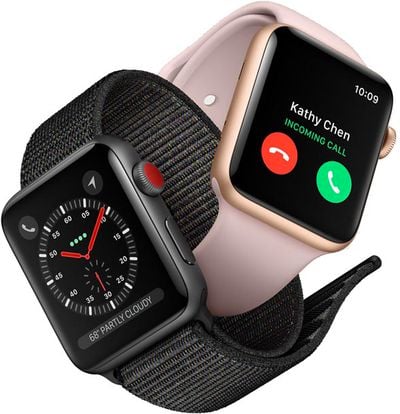
Apple Watch Series 3 is available with cellular capabilities built right into the device, so you can leave your iPhone behind and still send or receive calls and messages, listen to Apple Music, and more over LTE or 3G. Apple Watch shares the same phone number as your iPhone, but it requires an add-on plan.
Apple Watch Series 3 is also available in a Wi-Fi + GPS version without cellular. All models feature a 70 percent faster dual-core processor, a new Apple W2 chip, and a barometric altimeter.
Series 3 models look the same as Series 2 models, with 38mm and 42mm sizes in gold, silver or space gray aluminum, or silver or space black stainless steel.
Apple Watch Series 3 pre-orders start on Friday, September 15, with in-store availability beginning September 22, in the United States, Australia, Canada, China, France, Germany, Japan, Puerto Rico, Switzerland, and the United Kingdom.
Wi-Fi + GPS models start at $329, while Wi-Fi + GPS + Cellular models start at $399.
In addition, watchOS 4 includes a Heart Rate complication, and the smart watch can measure new heart rate data like resting heart rate. The Apple Watch will also notify you when it detects an elevated heart rate, and can even detect irregular heart beat rhythm thanks to the new "Apple Heart Study." watchOS 4 debuts September 19.
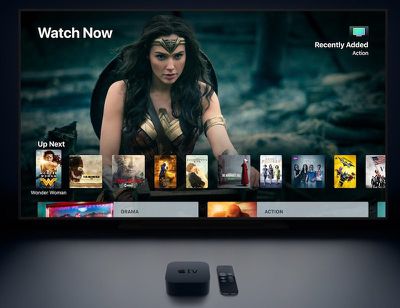
The new Apple TV 4K supports HDR in both the HDR10 and Dolby Vision standards.
Apple TV 4K is powered by an Apple A10X chip, which delivers up to two times the CPU performance and up to four times the GPU performance compared to the previous-generation Apple TV.
Apple services chief Eddy Cue said the price of 4K HDR movies on iTunes will be the same price as HD movies, and users will get automatic upgrades of HD titles in their existing iTunes library to 4K HDR versions when they become available for no additional charge.
4K content will also be available from popular services such as Netflix and Amazon Prime Video on the new Apple TV coming soon.
Apple TV 4K is available with 32GB or 64GB of storage for $179 and $199 respectively. It can be ordered starting September 15, with in-store availability starting September 22.
With support for AirPlay 2, coming later this year, Apple TV can control multiple AirPlay 2-compatible speakers as well as your home theater speakers to create the ultimate home music experience.
The fourth-generation Apple TV did not receive a price cut and remains available for $149.
Apple's first-ever event at the Steve Jobs Theater begins at 10:00 a.m. Pacific Time, where it is widely expected to unveil the iPhone X, a new Apple TV with 4K video, and Apple Watch Series 3 models with LTE connectivity.
Steve Jobs Theater via Apple CEO Tim Cook
We should also be hearing final details and the official release date for iOS 11, and likely macOS High Sierra, watchOS 4, and tvOS 11 as well. And, of course, there may be plenty of other announcements and surprises in the cards.
In addition to Apple's video stream, we will be updating this article with live blog coverage—no need to refresh—and issuing Twitter updates through our @MacRumorsLive account as the keynote unfolds.
Highlights from the event and separate news stories regarding today's announcements will go out through our @MacRumors account.
Sign up for our newsletter to keep up with Apple news and rumors.
Apple's online store is currently down in advance of the event. It should be accessible again shortly after the keynote.
Apple's event has concluded. Liveblog updates are available after the break...
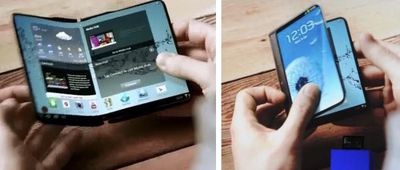
Ahead of the iPhone X unveiling, and the launch of the Galaxy Note 8 on Friday, Samsung today made a few announcements at a press event in Seoul, South Korea. The company said that it aims for the next iteration of the Galaxy Note to be bendable in some capacity, with the goal of launching sometime next year (via The Associated Press).
Samsung Electronics mobile business president Koh Dong-jin confirmed the company's plans, saying it's looking at a 2018 release date for "a smartphone with a bendable display." The president also commented that there are "several hurdles" Samsung has to overcome to implement a smartphone with a bendable screen, so the company is leaving itself room to push back the 2018 release if it needs to.
A bendable smartphone mockup by Samsung
Similar reports about bendable smartphones from Samsung have come out in the past, but the company has yet to officially launch such a device.
Koh Dong-jin, president of mobile business at Samsung Electronics, said the company is setting its eyes on 2018 to release a smartphone with a bendable display. But he said there are several hurdles it has to overcome, leaving room to push back the release if those problems are not solved.
“As the head of the business, I can say our current goal is next year,” he told reporters. “When we can overcome some problems for sure, we will launch the product.”
What those issues might be were not detailed, but analysts watching the company pointed out that mass production on a premium smartphone with a bendable display and a thin body "will take time." Rumors surrounding Samsung's entry into the bendable smartphone market have been swirling for the past few years. In late 2016, reports even began citing Apple's interest in the technology for future iPhones, which could be sourced from LG.
Koh further commented about Samsung's plans to launch a smart home speaker in partnership with Harman, which will allow users to talk to an artificial intelligence assistant -- likely Bixby -- to control the device and perform various tasks. A release date or design details for the Samsung speaker were not given. Later today, Apple may reveal more information about its own smart speaker, the HomePod, which it announced in June for a December release.
Despite the Galaxy Note 8's expensive price tag (about $930 in the United States), Samsung has said that pre-orders were the highest ever for the Note smartphone line, "beating its predecessor Note 7 over five days by about 2.5 times." Samsung's announcements come a few hours ahead of Apple's big media event, where the Cupertino company will debut the significantly redesigned OLED iPhone X.
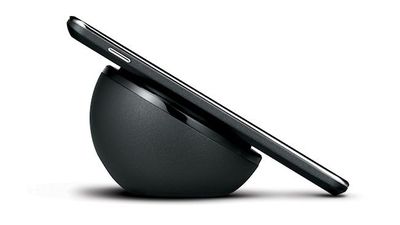
Apple isn't prepared to debut its own first-party wireless charging accessory for the upcoming iPhones, according to KGI Securities analyst Ming-Chi Kuo. The iPhone X, iPhone 8, and iPhone 8 Plus are all expected to support inductive wireless charging when they are announced later today, so in the interim between the smartphones' launch and the launch of a first-party Apple wireless charging pad, users will have to purchase third-party accessories.
Apple isn't ready for the launch of its own wireless charging accessory because it has "higher requirements for wireless charger RF specifications," according to Kuo. This means that there is currently no definite timetable for the mass production of Apple's accessory, and it's unclear when such a device will launch. Apple might even be waiting for certain "technological breakthroughs" before ramping up production.
An example of a Qi wireless charging pad
Apple’s own-brand wireless charger is not expected to debut at the media event, which we believe is primarily because Apple has higher requirements for wireless charger RF specifications, so there will be no definite mass production timetable prior to technological breakthroughs. However, the new iPhone models supports the WPC standard, so we think users will be able to purchase and use non-Apple WPC-compliant wireless chargers with the new iPhone models.
In the same report, Kuo said that Foxconn is planning to see a significant ramp-up in production on its 5.5-inch LCD iPhone assembly line, by as much as 70-80 percent. This falls in line with previous reports that said Apple plans to boost production and availability of the iPhone 8 and iPhone 8 Plus, while the OLED iPhone X will be particularly difficult to come by early on.
We're now just a few hours away from the official unveiling of the tenth-generation iPhone X, iPhone 8, iPhone 8 Plus, Apple TV 4K, Apple Watch Series 3, and more, all taking place at the Steve Jobs Theater at Apple Park. MacRumors will follow all of the stories and news coming out of the event today with a live blog, articles, video recap, and more. Follow our @MacRumorsLive Twitter account ahead of time to see live tweets as Apple breaks news during the event.
At the event, Apple is widely expected to announce the "iPhone X" with an OLED display, wireless charging, and facial recognition. It is rumored the company will also unveil a new Apple TV with support for 4K video playback, and new Apple Watch Series 3 models, including some with LTE connectivity.
MacRumors will provide full coverage of the event throughout the day, with a live blog, news stories, video recap, and more. Mac users can get headlines right on their desktops by enabling Safari push notifications. We'll also be live-tweeting the event through @MacRumorsLive on Twitter.
MacRumors readers can follow along in our forums, which are a great place to discuss the announcements before, during, and after the event. Be sure to keep tabs on the iPhone, Apple TV, and Apple Watch sections in particular.
If you will be unable to watch Apple's event today, consider bookmarking our spoiler-free article, which will be updated with nothing other than a direct link to the presentation once it becomes available from Apple.
Facebook is testing a new mobile app feature called Instant Videos that downloads video clips for later viewing whenever a user's phone is connected to Wi-Fi, to save from burning through their mobile data plan.
First spotted by The Next Web's Matt Navarra and later confirmed by TechCrunch, the feature will identify pre-loaded and cached videos in the news feed with a lightning bolt icon so that users know they can watch them for free while on the go.
The Instant Video feature is in a similar vein to Facebook's Instant Articles, the hosted content format that loads much faster than mobile websites and negates the need to wait for a separate web app to load the content. Likewise, publishers could see the new feature as a way to get their video clips maximum exposure on the social network.
The feature could also benefit Facebook's own original content push, with video organized under the new Watch tab, allowing users to cache episodes for viewing on their daily commute.
According to TechCrunch, the Instant Video test is currently only available to a small number of Android users, as the company lays the groundwork for more budget-conscious users in the developing world. But it's likely the feature will eventually make its way over to Facebook's iPhone app if the mini rollout is deemed successful.