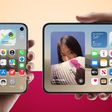
Sony today announced that the Apple TV app is launching on select 2018 and newer smart TV models, starting with the X900H series through a free software update that will begin rolling out today in the United States.
Sony says the Apple TV app will launch on select 2018 models and most 2019 and 2020 models by the end of the year in multiple regions.
The Apple TV app allows users to stream TV shows and movies from Apple TV+, access à-la-carte Apple TV Channels and their iTunes libraries, as well as buy or rent more than 100,000 shows and movies from the iTunes Store.
The Apple TV app is also available on select Samsung, LG, and Vizio TVs, and it can be accessed through select Roku and Amazon Fire TV devices.
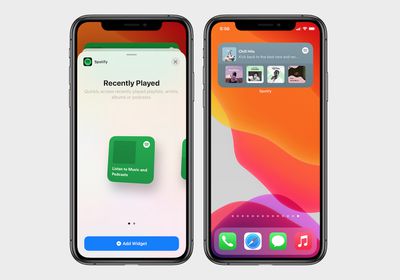
Following a brief beta testing period, Spotify today updated its iPhone and iPad app with a new Home Screen widget that provides quick access to recently played playlists, artists, albums, or podcasts. The widget is available in small and medium sizes.
To access the widget, update the Spotify app to version 8.5.80 or later and open the app. Then, tap and hold a widget or an empty area of the Home Screen until the app icons jiggle, tap the plus sign in the top-left corner, tap on Spotify in the list, and select the size of the widget. Home Screen widgets require iOS 14 or iPadOS 14 or later.
As with other Home Screen widgets, this one only serves as a shortcut to various parts of the Spotify app, as Apple does not allow Home Screen widgets to offer playback controls or toggles due to battery life considerations.
Apple has posted promotional ads on its YouTube channel for all the new products that were announced during Tuesday's Apple event, including the iPhone 12, iPhone 12 Pro, and HomePod mini. Check out the embedded videos below.
Hello 5G. A14 Bionic, the fastest smartphone chip ever. Night mode on all cameras. Super Retina XDR display. The first camera ever to record in Dolby Vision. Ceramic Shield that’s tougher than any other smartphone glass. A whole new way to connect accessories with MagSafe. And the world’s smallest 5G phone, iPhone 12 mini.
5G. A14 Bionic, the fastest chip in a smartphone. An all-new design. A Ceramic Shield front cover that’s tougher than any smartphone glass. A custom LiDAR Scanner. The first camera ever to record in Dolby Vision. An advanced Pro camera system for next-level low-light photography. And connect accessories in a whole new way with MagSafe. iPhone 12 Pro, the most powerful iPhone ever.
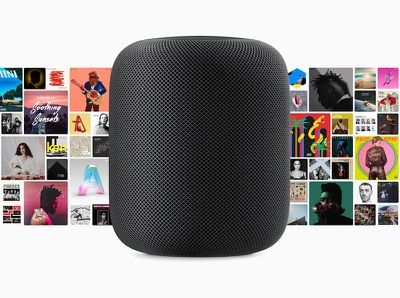
Room-filling sound, an intelligent assistant, and smart home control. All private and secure. Order 11.6. Available starting 11.16
Apple announced that the 6.1-inch models of the iPhone 12 and iPhone 12 Pro will be available to pre-order beginning this Friday, October 16 at 5 a.m. Pacific Time, with deliveries and in-store availability beginning one week later on Friday, October 23.
The smaller 5.4-inch iPhone 12 mini and larger 6.7-inch iPhone 12 Pro Max are launching later, with pre-orders beginning Friday, November 6 at 5 a.m. Pacific Time and shipments beginning one week later on Friday, November 13. iPhone 12 Pro pricing starts at $999, while the iPhone 12 starts at $799 and the iPhone 12 mini starts at $699.
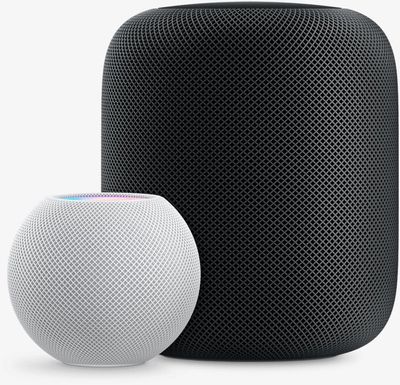
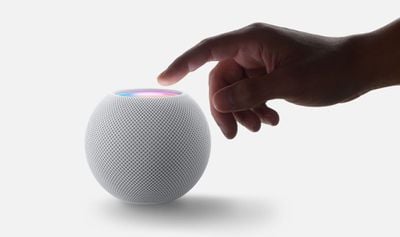
The HomePod mini is priced at $99, and pre-orders begin on November 6, with deliveries beginning on November 16.
Below, we've recapped all of the announcements in just seven minutes for our readers who want a no-frills but thorough overview of all the announcements.
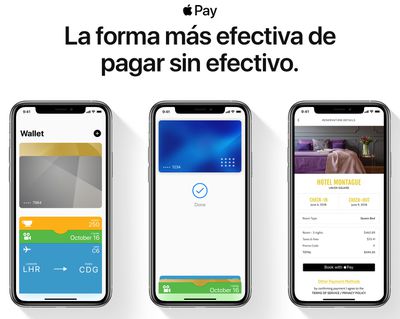
Apple added an Apple Pay landing page to its regional Mexico website late on Tuesday, indicating the mobile payment system could launch in the country imminently.
Way back in March there were suggestions that Apple Pay could be coming to Mexico, after reports that some iPhone users in the country had been able to add their Banregio cards to the Wallet app, with only the verification process failing.
Cards from banks other than Banregio were not able to be added to the Wallet app on the iPhone, suggesting Apple Pay in Mexico could be limited to Banregio at launch.
That's still uncertain, since the Apple Pay page on Apple's Mexican website offers no launch date and doesn't list any banks that will integrate with the service. All it says is Apple Pay will be compatible with "credit and debit cards of the most important payment networks, issued by various banks," which sounds a lot like Visa, MasterCard, and American Express.
When Apple Pay launches in Mexico, it will be the second country in Latin America to support the payments service. Apple launched Apple Pay in Brazil in 2018, but has not expanded it to other Latin America countries. Apple Pay has also been available in the United States and Canada for years.
Apple maintains a complete list of the countries where Apple Pay is available on its support site, and we have a detailed Apple Pay roundup with everything you need to know about Apple's payments service.
HomePod can be used as an alarm clock replacement to wake you up in the morning or remind you of something, and soon HomePod owners with an Apple Music subscription should be able to set alarms on the smart speaker that play their favorite songs instead of the default alarm sound.
Prior to the original HomePod's release, there were rumors suggesting users would be able to set songs as custom ringtones for the alarm feature of the HomePod, but that is not possible without resorting to automations. There is currently no option to change the default sound on the HomePod when setting up an alarm.
However, changes uncovered by MacRumors in the latest HomePod beta software reveal that Apple Music subscribers will soon be able to do just that.
The beta software includes a revised interface for adding alarms to HomePod in the Home app that provides a choice of playing a tone or media as the alarm sound.
As long as you have an active Apple Music subscription, tapping "Play Media" lets you choose a song from your music library. If you don't have a subscription you'll be prompted to get one, or revert to the default alarm tone.
During the unveiling of HomePod mini at Tuesday's Apple event, Apple introduced an upcoming new feature called Intercom that works across all Apple devices with the exception, it would seem, of Mac.
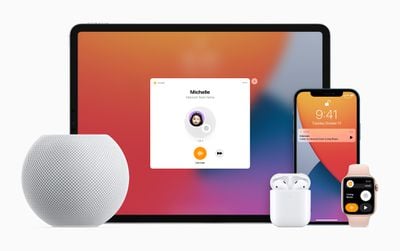
Intercom will enable family members to communicate with each other wherever they are in the home, with the ability to send and receive spoken messages via HomePod speakers. If a family member is in the garden or away from home, they can still use Intercom on their iPhone, iPad, Apple Watch, and even CarPlay. Apple explains:
A new Intercom feature offers a quick and easy way for family members to connect with each other at home. One person can send an Intercom message from one HomePod to another — whether in a different room, a specific zone, or multiple rooms throughout the home — and their voice will automatically play on the designated HomePod speaker. Intercom works with iPhone, iPad, Apple Watch, AirPods, and CarPlay, so everyone in the household can get Intercom notifications and send Intercom messages from the backyard or on their way home.
In the latest HomePod beta software, the setup process explains that users can say "Hey Siri, Intercom," followed by their message, and then choose which HomePods and/or personal devices the message should be sent to. Other options include "Hey Siri, tell everyone," and "Hey Siri, reply..." to respond to a message.
On personal devices, Intercom messages appear as notifications with the option to listen to the audio message. Users can also choose when Intercom notifications are delivered to their iPhone (Never / When I'm Home / Anywhere), and can select who can use Intercom via the Home app if they have remote access. Apple is also including an accessibility option that transcribes spoken messages on personal devices.
The Intercom feature will arrive in upcoming software updates, which are likely to roll out in step with the launch of HomePod mini on November 16.
Following the HomePod mini announcement at Tuesday's Apple event, The Loop's Jim Dalrymple has answered a key question many people have been asking: Can you pair a HomePod mini with an original HomePod to make a stereo pair?
"The short answer is no," explains Dalrymple. "You can't make a stereo pair of a HomePod and a HomePod mini. You can make a stereo pair of two HomePods or two HomePod minis, but you can't mix and match the two products."
That's not to say the two devices can't be used together at all, however. Dalrymple goes on to explain that if you have a HomePod and HomePod mini in the home, they can be used to play your music in different rooms. Apple's new Intercom feature will also work on both devices.
Dalrymple says an update is on the way for the original HomePod that will add many features that are coming with the HomePod mini, including Intercom, personal update, Maps continuity, multiuser support for Podcasts, and support for third-party music services like Pandora and Amazon music.
In another notable tidbit, he says an additional upcoming feature exclusive to the original HomePod will add "an immersive home theater experience when paired with an Apple TV 4K."
To get the 5.1, 7.1 surround, and Dolby Atmos, you need to pair one or two HomePod speakers to the Apple TV. This feature requires the spatial sound support of HomePod, so it isn’t available for the HomePod mini.
It's understood that this ability to select HomePods as home theater speakers for Apple TV will also fix the lingering issue of Apple TV often forgetting that HomePods are the preferred speakers for audio output.
Lastly, Dalrymple notes that a HomePod and HomePod mini can't be connected to Apple TV at the same time, but two HomePod minis connected to Apple TV will provide stereo sound.
The HomePod mini costs $99 and is available in both White and Space Gray. Pre-orders begin on November 6, and deliveries begin on November 16.
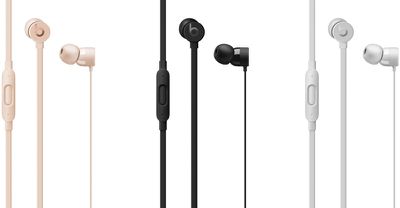
Apple's website encourages customers to use their existing Apple power adapter and headphones or buy these accessories separately, and to help offset the cost, Apple has now lowered the price of its EarPods with a Lightning connector from $29 to $19. Apple's new 20W power adapter for iPhones also retails for $19, down from $29 for its now-discontinued 18W power adapter that was included with the iPhone 11 lineup until now.
Apple touted the environmental benefits of no longer including EarPods or a power adapter with iPhones, noting that the move reduces carbon emissions and avoids the mining and use of rare-earth elements. iPhone 12 models also ship in a thinner box as a result, with Apple claiming that it can fit 70 percent more iPhone boxes on a single pallet during shipping.
Apple added that many customers have switched to wireless headphones like AirPods, and said there are over two billion Apple power adapters in the world, implying that many customers no longer need these accessories.
Last month, the Apple Watch Series 6 and Apple Watch SE launched without power adapters in the box, so it is no surprise that iPhones have followed suit. However, all iPad models are still bundled with power adapters in the box for now.
We've been getting a number of questions from readers about a mysterious "patch" on the edge of all of the iPhone 12 models introduced today. The patch is unlabeled on Apple's specs page, but The Verge has confirmed that it is a window for the mmWave 5G antenna.
Side-by-side comparison showing U.S. phones with the antenna window and international phones without (via Apple and The Verge)
The mystery patch was first seen in leaked schematics dating back many months, and was initially speculated to potentially be a Smart Connector or docking site for a small Apple Pencil, given its similar appearance to the magnetic Apple Pencil attachment site on iPad Pro models. That speculation was, however, quickly dispelled as new rumors indicated it was for a 5G antenna.
Thread is a low-power IP-based networking technology for connecting Internet of Things (IoT) devices, offering a secure, mesh-based system that makes it easy to build an ecosystem of devices.
While Thread is essentially agnostic to the application layers that run on top of it, it can support multiple layers and may play a role in Project Connected Home over IP, the alliance of Apple, Amazon, Google, and other companies that is seeking to make it simpler to build devices compatible with multiple ecosystems such as Siri, Alexa, and Google Assistant.
For the time being, however, Apple says in a footnote that HomePod mini's Thread support is limited to HomeKit devices, so the technology can't yet be leveraged cross-platform and it remains to be seen how Apple will embrace Thread going forward.
Apple is a noted supporter of the Thread project, with longtime Apple engineer Stuart Cheshire, who developed the Rendezvous/Bonjour zero-configuration standard nearly 20 years ago, serves as a director of Thread Group.
Apple's HomePod mini will be available for pre-order starting November 6, and it will officially launch on November 16.
Following the debut of the iPhone 12 mini, iPhone 12, iPhone 12 Pro, and iPhone 12 Pro Max, Apple is offering pre-approval for the iPhone Upgrade Program ahead of when the first pre-orders begin this Friday.
Existing and new iPhone Upgrade Program members can use the Apple Store app on the iPhone to go through all of the pre-approval steps to get ready to purchase one of the new iPhones on October 16.
Pre-approvals are available until 9:00 p.m. Pacific Time on October 15 for those who want to purchase an iPhone 12 or iPhone 12 Pro through the iPhone Upgrade Program. Apple's pre-approval process is designed to make it simple and quick for iPhone Upgrade Program members to purchase their new iPhones right when pre-orders become available.
Those who are part of the iPhone Upgrade Program can select their preferred iPhone, confirm their carrier, and get loan approval ahead of time, cutting down on the steps needed to make a purchase on launch date.
iPhone Upgrade Program pricing starts at $49.91 per month for the iPhone 12 Pro and $39.50 per month for the iPhone 12. AppleCare+ is included in that monthly price.
Pre-orders for the iPhone 12 and iPhone 12 Pro kick off at 5:00 a.m. Pacific Time on Friday, October 16, with the first orders set to arrive to customers on Friday, October 23. Those who want an iPhone 12 Pro Max or iPhone 12 mini will need to wait, as those devices will be available for pre-order on November 6 with a launch to follow on November 13.
Apple today held its annual iPhone-centric event, introducing the new iPhone 12 mini, iPhone 12, iPhone 12 Pro, iPhone 12 Pro Max, and, as a bonus, HomePod mini and new MagSafe charging options for iPhones.
It took Apple an hour to introduce the new devices during the "Hi, Speed" event, but we've recapped all of the announcements in just seven minutes for our readers who want a no-frills but thorough overview of all the announcements.
All of our event coverage is also available below, so make sure to check out our articles so you don't miss any information about Apple's newest products.
The iPhone 12 and iPhone 12 Pro will be available for pre-order this Friday, with a launch to follow on October 23. The iPhone 12 Pro Max and iPhone 12 mini will be available for pre-order on November 6, with a launch to follow on November 13.
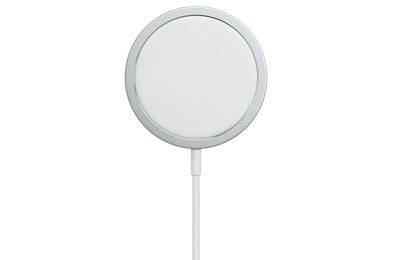
Apple today introduced a new MagSafe charging puck that's designed for the iPhone, with a design that's similar to the inductive chargers used for the Apple Watch.
The new MagSafe charging pucks are able to charge the new iPhone 12 models faster than Qi-based charging options, offering up to 15W of power. Apple mentioned the 15W charging on stage during the event, and it's also confirmed on product pages for the new devices.
Qi-based wireless chargers continue to be limited to a maximum of 7.5W of charging power when used with an Apple device, so those who are looking for the fastest "wireless" charging option will want to opt for one of the new MagSafe chargers from Apple.
Apple has designed an Apple Watch-style MagSafe charging puck for iPhones, along with a dual charger that also includes an Apple Watch charger. MagSafe charging specifications are also being made available to third-party companies who will be able to design magnetic chargers for Apple's new iPhone lineup.
The product page for the new charger suggests that it is compatible with all iPhones dating back to the iPhone 8, which is all models that support wireless charging, but the description suggests faster wireless charging is limited to the new models.
Apple's MagSafe charger for iPhone will be available for $39, with pricing on the combo Apple Watch version unknown as of now.
Apple this morning quietly introduced new Beats Flex headphones, marking the launch of the brand's most affordable wire-free headphones to date.
Beats Flex are priced at just $50, and are identical in design to the BeatsX earphones. With lower-cost Bluetooth-based Beats headphones now available, Apple has discontinued the UrBeats headphones that it previously offered under Beats branding.
UrBeats3 were priced at $60 and were available in Lightning and 3.5mm versions, and with their discontinuation, the Beats brand is no longer offering affordable wired headphone options. The $130 wired Beats EP headphones are still available, though.
For those who prefer wired headphones, Apple still sells EarPods with Lightning and 3.5mm connector options for $19 each, but EarPods no longer come free with iPhones.
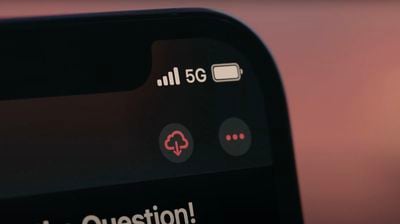
As expected, the entire iPhone 12 lineup is compatible with faster 5G networks, but Apple's website confirms that support for high-frequency mmWave bands is limited to models sold in the United States. This includes compatibility with Verizon's new 5G Ultra Wideband network, which as of today is available in 55 cities across the country.
mmWave is supported on all iPhone 12 models sold in the United States, ranging from the iPhone 12 mini to the iPhone 12 Pro Max. iPhone 12 models sold in all other countries and regions are limited to sub-6GHz bands for 5G.
mmWave is a set of 5G frequencies that promise ultra-fast speeds at short distances, making it best suited for dense urban areas. By comparison, sub-6GHz 5G is generally slower than mmWave, but the signals travel further, better serving suburban and rural areas. In most countries that offer 5G, sub-6GHz networks are more common.
Apple says iPhone 12 models support more 5G bands than any other smartphone, and the devices can automatically adjust to LTE when necessary to save battery life, such as when updates are taking place in the background.
iPhone 12 and iPhone 12 Pro pre-orders begin Friday, October 16 at 5 a.m. Pacific Time, with shipments starting Friday, October 23. The smaller 5.4-inch iPhone 12 mini and larger 6.7-inch iPhone 12 Pro Max are launching later, with pre-orders beginning Friday, November 6 at 5 a.m. Pacific Time and shipments starting Friday, November 13.
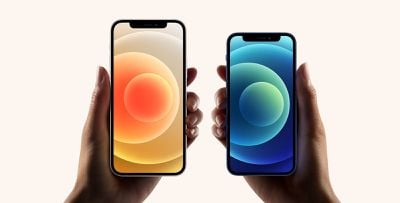
Apple's iPhone 12 mini is the smallest iPhone that's been made available since the original iPhone SE, with a 5.4-inch display and a body that's 5 inches high and 2.5 inches wide.
Since it's the smallest iPhone Apple sells, it's also the iPhone 12 model with the lowest battery life, coming in at 15 hours of video playback compared to the iPhone 12's 17 hours. For streaming video, the iPhone 12 mini offers 10 hours of playback, while the iPhone 12 offers 11 hours. The iPhone mini outperforms the iPhone SE, but doesn't measure up to any of the other larger iPhones.
The 6.7-inch iPhone 12 Pro Max features 20 hours of video playback, offering five hours longer battery life than the iPhone 12 mini.
Apple breaks battery life down in three categories: video playback, video playback when streaming video, and audio playback. Battery life info for all iPhones in the current iPhone lineup is listed below.
iPhone 12 Pro Max - Up to 20 hours video playback, 12 hours streamed, 80 hours audio
iPhone 12 Pro - Up to 17 hours video playback, 11 hours streamed, 65 hours audio
iPhone 12 - Up to 17 hours video playback, 11 hours streamed, 65 hours audio
iPhone 12 mini - Up to 15 hours video playback, 10 hours streamed, 50 hours audio playback
iPhone 11 - Up to 17 hours video playback, 10 hours streamed, 65 hours audio
iPhone XR - Up to 16 hours video playback, 65 hours audio
iPhone SE - Up to 13 hours video playback, 8 hours streamed, 40 hours audio
All of Apple's new iPhone 12 devices support fast charging and can be charged to 50 percent within 30 minutes using a 20W power adapter and the included USB-C to Lighting cable.
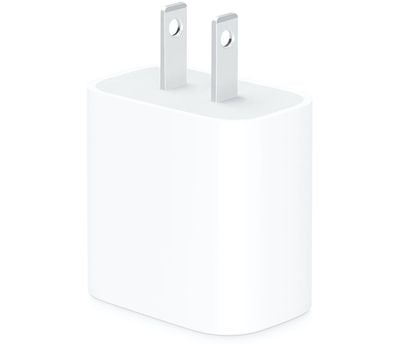
With the iPhone 12 and 12 Pro models no longer shipping with a power adapter, Apple has started selling the 20W USB-C power adapter that was first introduced with the iPad Air on a standalone basis for $19.
The 20W power adapter is included in the box with the iPad Air, but those who want one for use with the new iPhone models will need to shell out $19.
All of the new iPhone 12 models and older iPhone models ship only with a USB-C to Lightning cable, with customers expected to provide their own power adapters. Most people likely have several USB-C power adapters on hand from past device purchases, but this will be an inconvenience for those who have few power adapters available already.
Apple's selling price for the new 20W USB-C power adapter is cheaper than the older 18W USB-C model that used to be available for $29.
According to Apple, the power adapter and EarPods were removed from the iPhone boxes to reduce the company's environmental impact, but rumors have also suggested that this transition helps to save a few dollars to offset the cost of the more expensive 5G modems included in the new devices.
AppleCare+ for the new iPhone 12 and iPhone 12 mini models is priced at $149 in the U.S. for two years of coverage, or $7.99 per month for ongoing subscription coverage.
The AppleCare+ plan for the new iPhones provides coverage for two incidents of accidental damage every 12 months, provided the deductible is paid out.
AppleCare+ with Theft and Loss is also available for $219 for two years of coverage or $11.49 per month for ongoing subscription coverage. Theft and Loss AppleCare+ provides the same benefits, but with added coverage for two incidents of theft or loss every 12 months.
AppleCare+ for the iPhone 12 Pro and iPhone 12 Pro Max is priced at $199 for two years of coverage, or it can be purchased for $9.99 per month. Theft and Loss coverage is priced at $269 or $13.49 per month.
With AppleCare+, customers must pay a deductible of $29 for screen damage, $99 for other accidental damage, and $149 for theft or loss.