Following in the footsteps of a discount on the 9th generation iPad yesterday, Amazon today has an all-time low price on the 10th generation iPad. You can get the 64GB Wi-Fi tablet for $299.00 in Blue and Silver, down from $349.00.
Note: MacRumors is an affiliate partner with Amazon. When you click a link and make a purchase, we may receive a small payment, which helps us keep the site running.
Amazon provides an estimated September 10 - 12 delivery estimate for most orders placed in the United States. Right now we're only tracking record low prices on the 64GB Wi-Fi model, but you can find a few solid second-best prices on the other configurations as well.
This iPad launched in October 2022 and was completely redesigned compared to the 9th generation model. It features a larger 10.9-inch display, USB-C port, A14 Bionic chip, 12-megapixel camera, Touch ID, and more.
Be sure to visit our full Deals Roundup to shop for even more Apple-related products and accessories.
Australian-based company Kuxiu has come out with a new version of its 3-in-1 charging station that has got to be one of the neatest Apple device charging solutions for home and travel that I've had the pleasure of using.
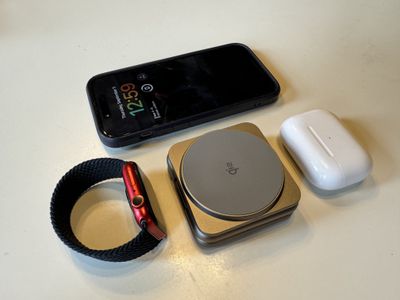
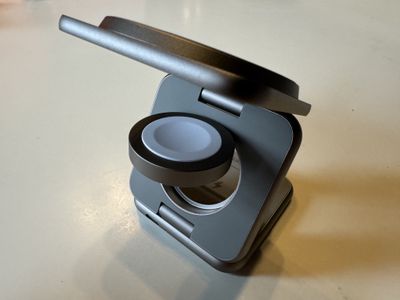
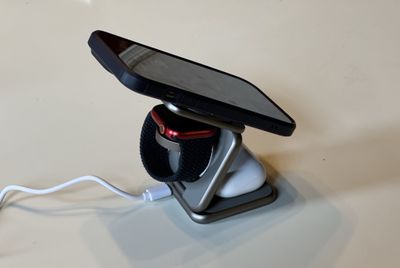
The Kuxiu X40Q features a tri-fold design, allowing it to be folded into a small square for easy portability. When unfolded, it serves as a stable magnetic iPhone stand and wirelessly charges an iPhone, Apple Watch, and AirPods simultaneously.
The big difference from Kuxiu's previous model is that the X40Q uses Qi2 wireless charging technology that supports magnetic connections and up to 15 watts of charging power, just like Apple's MagSafe standard. In that sense, it provides 15W charging for iPhone, 5W for Apple Watch, and 5W for AirPods.
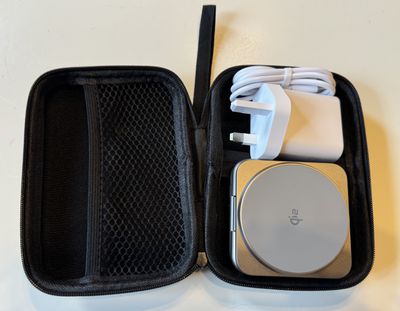
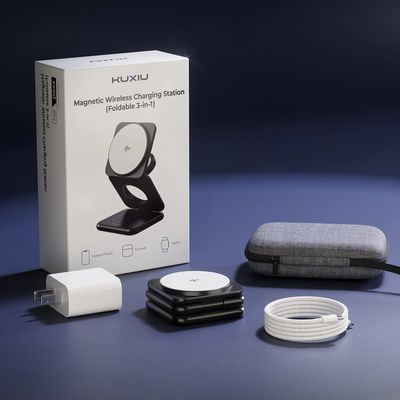
The overall package includes the 3-in-1 charging station, a 30W charging adapter (with a UK plug in my case – Kuxiu lived up to its stated claim to ship the right adapter for your country), a 3-foot long USB-C charging cable, and a carrying pouch.
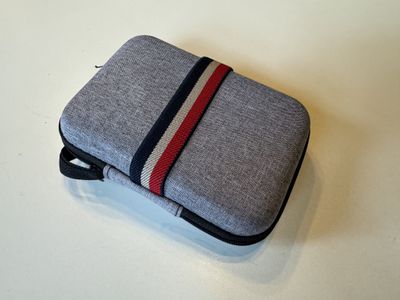
At about six inches long and three inches in width, the carry case is hard and nicely compact for stowing in your luggage, and it also boasts an attractive svelte texture and a neat tri-color elastic band for attaching anything to the outside, like a passport, extra cable, or even an iPhone.
It's plenty big enough to hold the folded stand, cable, and charger, plus there's an internal attachment band as well as a netted pocket for anything else small enough to fit inside, like your AirPods, for example, or spare Apple Watch bands.
The charging stand I received was gray, but it's also available in titanium gold, black, and wood grain. All of them are made from a smooth anodized CNC-machined aluminum alloy, and the Qi2 magnet still works in folded mode if you're just charging your iPhone on the square puck.
When unfolding it, you can also feel the hinges are strong and durable enough to ensure longevity, and at full extension there's a definite sense that the design has got the center of gravity and rigidity just right to take the weight of three devices.
In the unfolded position, the watch magnet pops out to form a base for placing your watch on the back without having to take off the band, and the magnets are strong enough to hold your iPhone in place, even with a MagSafe-compatible case on, in my experience. You can also adjust the angle of the iPhone section for a more stable affordance, or to get your view of your iPhone's Standby mode just right.
When connected to power with your iPhone, AirPods, and Apple Watch, the LED indicator on the back of the X40Q lights up for five seconds when charging begins, and then it turns off, so it doesn't get distracting in low light when you're trying to get to sleep. I found it could charge my dead iPhone up to 50% in around 30 minutes, which is what you'd expect from Qi2 at the maximum 15W. I was also really impressed with the lack of heat generated when charging all three devices simultaneously.
Currently costing $79.99 (usually $99.99) directly from the Kuxiu website, I'd say the price right now is pretty unbeatable, especially if you compare it to something like Belkin's BoostCharge Pro 3-in-1 Qi2 charging stand, which costs $129 and is much less portable.
Whether you're looking for an all-in-one Qi2 charger for your desktop, bedside table, or when you're on the road, you'd be hard-pressed to find a better solution for keeping your iPhone, Apple Watch, and AirPods charged when not in use.
Note: Kuxiu provided MacRumors with a X40Q Qi2 3-in-1 Foldable Charging Station for the purpose of this review. No other compensation was received.
Philips Hue parent company Signify today announced two new products for Hue lighting setups, a new HDMI Sync Box and a new pendant light, as well as new software-based features.
The Philips Hue Play HDMI Sync Box 8K is a successor to the current Hue Play Sync Box that came out in 2019. It is designed to connect to your TV, serving as an interface between the TV and connected set-top boxes, gaming systems, and more. The Sync Box is able to detect content, matching the color of connected Hue lights to what's on the TV.
HDMI 2.1 support has been a major missing feature on the current Sync Box, but the new model adds HDMI 2.1 for use with the PlayStation 5, Xbox One, and other devices that can take advantage of the standard. It supports resolutions up to 8K and refresh rates up to 60Hz for video content and 120Hz for console gaming.
Up to 10 color-capable Hue lights can be synced to the Sync Box, with what's on the screen determining the color. Brightness and intensity can be controlled in the Philips Hue app.
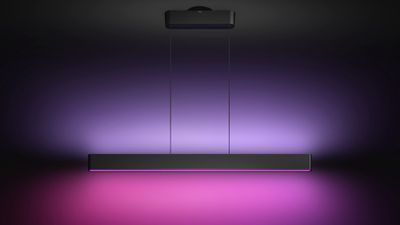
The Philips Hue Ensis light, a new pendant light, can be purchased in the United States as of today. Available in black or white, it is equipped with two lights that can be controlled individually, and it supports both white shades and color. It offers both a downlight and an upper light for different activities.
Along with the new products, Signify is updating the Philips Hue app with four new effects, Cosmos, Underwater, Enchant, and Sunbeam. These animated effects can be used with select Hue lights. There are also now options for changing brightness, speed, and base color, adding more versatility to effect options.
The Hue app is gaining a Do Not Disturb option, which prevents motion sensors from changing the active scene when motion is detected, and the starting and stopping of mimic presence and timers via Hue switches.
Later this year, the Philips Hue app will support the integration of multiple Bridges, so they will no longer need to be set up and viewed separately. Multiple Bridges will be able to be added to a single home, with a unified view that encompasses all of the products in the home.
Prospective Hue customers will soon be able to use the new AR feature in the app to explore Hue lights before making a purchase. Lights can be viewed in actual spaces, and the app can demo realistic lighting environments to provide insight into how a light will look in real life. This feature is set to lauch in fall 2024.
For non-Apple users, Philips Hue Secure cameras are now compatible with Alexa and Google Home, but not HomeKit. Routines can be set up for arming and disarming the Secure system based on a daily schedule, and there is a new Battery Saver option for Battery Cameras.
The Philips Hue Play HDMI Sync Box 8K is available from the Philips Hue website and from Best Buy as of today. It is priced at $350. The Philips Hue Ensis can be purchased from the Hue website and it is priced at $480.
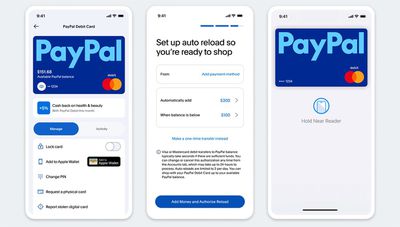
PayPal today announced that the PayPal Debit Card can now be added to the Apple Wallet app and used with Apple Pay in stores and online.
"Whether in-store, online or in-apps, PayPal debit card cardholders will be able to enjoy the convenience and security that Apple Pay brings to their everyday lives," said Apple's services chief Eddy Cue, in PayPal's press release.
PayPal Debit Card cardholders can now select a monthly category of spending, such as groceries, gas, or clothing, and receive 5% cash back on up to $1,000 in purchases in that category per month. Multiple cash back offers can be stacked.
The debit card can be used anywhere MasterCard is accepted. A new auto-reload option can automatically top up the card's linked PayPal account balance if it drops below a set amount, to ensure that the ability to spend is uninterrupted.
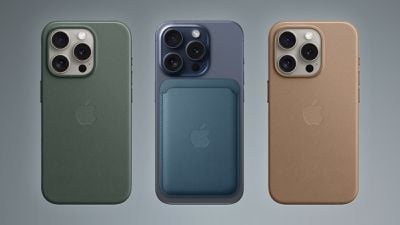
Last September, Apple stopped selling genuine leather accessories in favor of a more environmentally friendly "FineWoven" material, but it did not go down well with customers, and dwindling stock leading up to Apple's iPhone 16 event on September 9 has many people wondering if Apple is about to pull the plug on FineWoven for good.
The company describes FineWoven as "luxurious and durable microtwill," and sells FineWoven iPhone cases at $59, MagSafe Wallets at $59, AirTag holders at $35, and Apple Watch bands at $99. However, many customers consider FineWoven products to be subpar compared to the leather Apple cases they replaced, with various claims that the fabric is prone to scratches, stains, and discoloration.
Back in April, Apple leaker and prototype collector Kosutami claimed that Apple had decided to halt production of FiveWoven accessories over durability concerns, although the leaker did not discount the possibility of one more round of FineWoven products, possibly in a season of new colors. However, FineWoven accessories in new color options were absent from Apple's spring refresh.
Notably, according to Bloomberg's Mark Gurman, stock of iPhone cases and Apple Watch bands in the material is now at an all-time low. That generally means that Apple is either getting ready to kill off FineWoven or plans to update the lineup with different colors and support for new iPhone and Apple Watch models. Will you miss Apple's FineWoven accessories if Apple does discontinue them? Let us know in the comments.
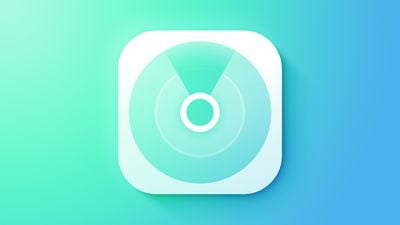
Apple has announced it will finally introduce its popular 'Find My' network to South Korea in the spring of 2025, after apparently overcoming local regulatory hurdles. The launch will bring the full range of Apple's location-based Find My services to South Korean customers for the first time, enabling them to keep track of devices, belongings, and loved ones.
Last July, a petition on Korea's National Assembly Electronic Petition website called for the introduction of Apple's Find My service in the country, garnering over 9,000 signatures. The petitioner highlighted the frustration experienced by Korean users and users from abroad who lost their devices but were unable to use the Find My app to locate them. Apple previously said that the limitation was its inability to export high-precision map data out of the country because of local laws, but Korea also has strict privacy regulations that it may have come up against.
Regardless, the Korea Communications Commission (KCC) apparently responded positively to the petition, and its acting chairman Kim Tae-gyu expressed support for bringing the Find My service to South Korea. The KCC also said it had been in ongoing talks with Apple about the timing of its introduction.
With the Find My network enabled, users will be able to to locate their iPhones, iPads, Macs, and other Apple devices, as well as AirTag-connected personal items and third-party Find My compatible trackers, while maintaining strong privacy protections.
One of the main features of the Find My network is its ability to pinpoint lost devices on a map, providing users with step-by-step directions to retrieve their misplaced items. The app also allows users to trigger a sound on their lost Apple devices, making it easier to locate them when in close proximity.
Find My also lets users stay connected with friends and family by opting to share their location with specific contacts. This can be useful when meeting up in crowded areas, particularly for owners of an iPhone 15 or iPhone 15 Pro, who can take advantage of the Precision Finding capability to navigate directly to their friends' exact locations.
The original "Find My iPhone" app was launched in 2009 alongside iPhone OS 3. "Find My Mac" was added to OS X 10.7 Lion in 2011, while "Find My Friends" was released in October 2011. With the release of iOS 13 and macOS 10.15 Catalina, the functionality of Find My iPhone, Find My Mac, and Find My Friends was unified into the app we know today as Find My.
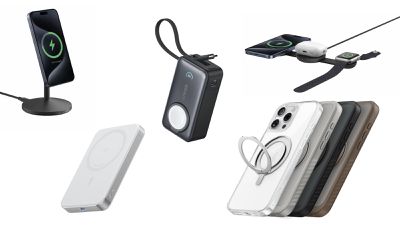
Popular accessory company Anker is launching the latest updates to its MagGo lineup today, showing off a series of five products largely based around Qi2 wireless charging technology that supports magnetic connections and up to 15 watts of charging power, just like Apple's MagSafe standard.
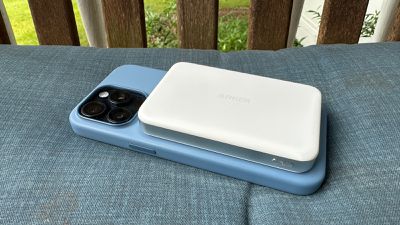
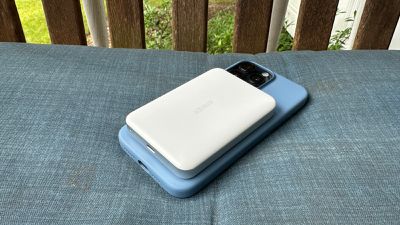
As the name suggests, this is a Qi2 magnetic power bank that sticks onto the back of your iPhone and offers 10,000 mAh of charge. I've been testing this one out for a few days, and the 10K capacity is really handy with my iPhone 15 Pro Max. Most magnetic power banks like this only have 5,000 mAh of capacity, which is generally sufficient to help me get through a busy day but not enough for a full extra charge. The 10K bank offers a full charge for my iPhone with more to spare, so it's great for the longest and most intense days or even an overnight trip where other charging options might not be convenient.
It's unsurprisingly a bit larger than 5K MagSafe/Qi2 banks I've used, which is fine on my Pro Max model but could be less comfortable to hold attached to a smaller phone. It's also quite hefty, weighing in at just over 200 grams (7.25 oz). That's almost as heavy as the iPhone 15 Pro Max itself, so it definitely makes things feel rather heavy if you're using the phone while charging, but it's great when in a pocket or bag. On the plus side, the power bank is remarkably thin for its capacity at just under 1.5 cm, actually coming in a bit thinner than some of the Anker 5K banks I've used in the past.
The design is an obtrusive matte white plastic on both sides, with one side having MagSafe/Qi2 alignment markings and the other having subtle Anker branding. The edges are a matte aluminum, which adds a bit of style. A button on one side activates a series of four LEDs along the bottom edge for a rough gauge of charge level, and there's a USB-C port along that same bottom edge to recharge the power bank. Passthrough charging is supported, so both your phone and the power bank can charge over that single connection.
The MagGo Power Bank (10K, Slim) is priced at $69.99 and is available in black and white, with pink and green options coming soon. A USB-C to USB-C cable is included in the box.
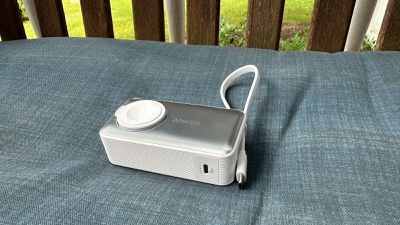
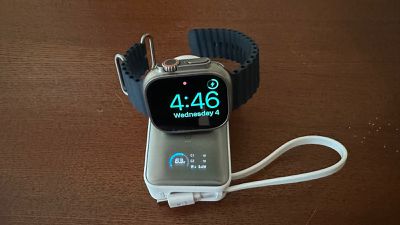
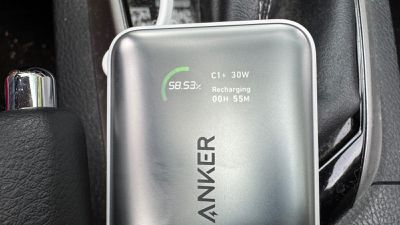
This is a versatile 10,000 mAh power bank that follows a design trend used by several other recent Anker power banks by including a short integrated USB-C cable that doubles as a lanyard for the bank. Part of what differentiates this model is the inclusion of an Apple Watch charging puck that folds nearly flat into the body of the power bank or which can be lifted to any angle up to 90 degrees if you prefer to use Nightstand mode for your watch.
In addition to the integrated USB-C cable, there's a second USB-C port for even more charging flexibility, and both the integrated cable and the port support bidirectional charge flow, so either one can be used to charge devices or to recharge the power bank. The 10,000 mAh capacity can easily recharge an iPhone Pro Max and an Apple Watch from empty and still have charge left over, so it's a great travel companion.
Another neat feature that Anker has been incorporating into its accessories recently is a display, which shows not only the exact charge percentage of the power bank but also an estimate of the time remaining to reach full while it's recharging, and even input and output wattage for each connection. Cleverly, the orientation of the display automatically rotates depending on whether you're using the Apple Watch charging puck, providing an optimal viewing angle regardless of how you're using the power bank.
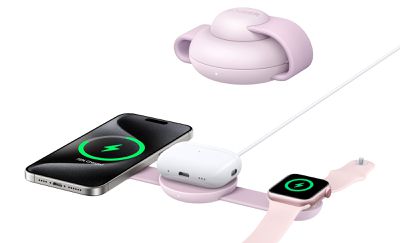
This is a compact foldable charging station for iPhone, Apple Watch, and AirPods, delivering up to 15 watts to an iPhone via Qi2, and then 5 watts each to a second Qi pad capable of charging compatible AirPods cases and an Apple Watch charging puck. It comes with a 5-foot USB-C to USB-C cable and a power adapter.
The whole thing folds up tightly for travel and the flexible connectors between the charging modules allow you to either lay your Apple Watch flat or prop it up for Nightstand mode. The MagGo Wireless Charging Station (3-in-1, Foldable Pad) is priced at $89.99 and is available in black or white, with pink and green options coming soon.
This is a simple desktop charging stand with Qi2 charging technology to support up to 15 watts. The minimalist design includes a mechanical rotation system for the charging pad assembly, allowing you to easily fine tune your phone angle without needing to adjust your phone's connection to the charger. The pad itself can rotate 360º, while the angle can be adjusted over a range of 70º.
A 5-foot USB-C to USB-C cable is included in the box, but you'll have to provide your own power adapter. The MagGo Wireless Charger (Stand) is priced at $35.99 and is available in black or white.
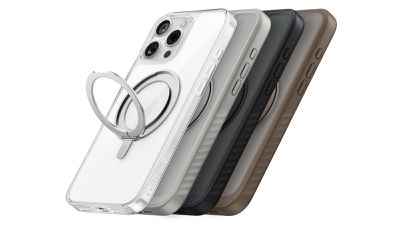
An updated version of similar previous products from Anker, this iPhone case includes a swing-out ring that serves as a stand for your phone when watching video or participating in video calls, or as a grip. The ring rotates 360º and folds flush into the rear of the case, allowing MagSafe/Qi2 accessories to connect to your phone even with the case on. Enhanced 12N magnets in the case provide a strong hold, ensuring your phone stays connected to those accessories through the case.
Note: Anker provided MacRumors with several MagGo accessories for the purposes of this news coverage. No other compensation was received. MacRumors is an affiliate partner with Anker. When you click a link and make a purchase, we may receive a small payment, which helps us keep the site running.
Apple today released new firmware for the Beats Studio Buds +, marking the first firmware update to the earbuds since their 2023 launch. The firmware has a build number of 2C318, up from 2A219.
There is no word on what the new firmware includes in terms of features or bug fixes, and Apple does not provide release notes.
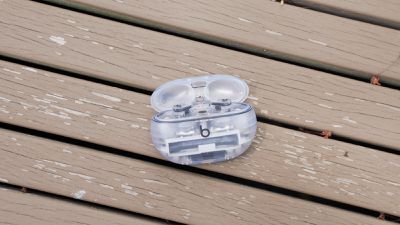
The Beats Studio Buds + are Apple's mid-range Beats earbuds, featuring Active Noise Cancellation, Transparency mode, microphones, battery life, and more. The earbuds come in several colors, including a unique transparent design that shows the internals.
As with most of the latest Beats models, the Studio Buds + do not include an Apple audio chip, and are instead equipped with acustom Beats chip that provides better feature parity between iOS and Android devices. The Beats chip supports one-touch pairing and setup, Find My integration, and Siri support, but automatic switching between devices is not available.
The firmware update for the Beats Studio + are delivered over-the-air. Firmware will be installed while the Beats headphones are charging and are in Bluetooth range of an iPhone, iPad, or Mac that's connected to Wi-Fi.
On Android devices, users will need to download the Beats app for Android and connect the Android device to a power outlet to initiate a firmware update.
Update: MacRumors can confirm that the firmware update added Audio Sharing support to the earbuds.
iOS 18 has been in beta testing for nearly three months, and the software update should finally be widely released later this month.
Below, we outline when to expect iOS 18 to be available on all compatible iPhones.
iOS 18: Beta Testing Wraps Up
In his Power On newsletter last weekend, Bloomberg's Mark Gurman said iOS 18 beta 8 will likely be the final developer beta version for the update. This is a reasonable prediction, as previous updates like iOS 17, iOS 16, and iOS 15 each had a total of eight developer betas. iOS 12 was the last update with at least nine developer betas.
If history repeats itself, Apple should release the iOS 18 Release Candidate immediately following the iPhone 16 event on September 9. Apple considers a Release Candidate to be a "near final" version of an upcoming iOS update.
iOS 18: Release Timing
Apple will likely announce a release date for iOS 18 during its September 9 event. The update is most likely to be released on Monday, September 16, but Tuesday, September 17 and Wednesday, September 18 are also possibilities.
Gurman said Apple has already been installing iOS 18 on iPhone 16 models at factories. Those devices will likely be released on Friday, September 20.
iOS 18: Compatible iPhones
iOS 18 is compatible with the same iPhone models as iOS 17 is:
iPhone 15
iPhone 15 Plus
iPhone 15 Pro
iPhone 15 Pro Max
iPhone 14
iPhone 14 Plus
iPhone 14 Pro
iPhone 14 Pro Max
iPhone 13 mini
iPhone 13
iPhone 13 Pro
iPhone 13 Pro Max
iPhone 12 mini
iPhone 12
iPhone 12 Pro
iPhone 12 Pro Max
iPhone 11
iPhone 11 Pro
iPhone 11 Pro Max
iPhone XS
iPhone XS Max
iPhone XR
iPhone SE (2nd generation or later)
iOS 18 will be available in the Settings app under General → Software Update.
Apple Music today introduced five new mood stations that allow you to shuffle through songs fitting for a certain mood. The stations are available to Apple Music subscribers worldwide in the Music app under Home → Find Your Mood.
Apple says the mood stations are personalized based on your Apple Music listening history, and they are always updating with new songs.
The new stations:
Feel Good: Happy music with a positive vibe
Energy: Upbeat music to get you moving
Relax: Music that helps you find peace in the moment
Focus: Music to help you lock-in to the task at hand
Feeling Blue: Moody music that helps you lean into feeling down
Beats today teased that new Powerbeats Pro 2 are coming next year, but it did not share a specific release date for the wireless headphones.
MLB superstar Shohei Ohtani can be seen wearing the Powerbeats Pro 2 in a clip shared on social media platforms like Instagram and X. They look similar to the existing Powerbeats Pro released in 2019, but have a more vertical, slimmer design. Beats did not reveal any new features or other specific details about the Powerbeats Pro 2 at this time.
Powerbeats Pro are a sportier, fitness-focused version of AirPods Pro with built-in, adjustable ear hooks for a secure fit. Key features of the current Powerbeats Pro include the H1 chip that debuted in the AirPods 2, IPX4-rated sweat and water resistance, up to nine hours of battery life, and silicone ear tips with four size options.
While we do not know what to expect from the Powerbeats Pro 2 at this time, plausible upgrades based on other Beats headphones models released over the past two years include improved sound, longer battery life, a USB-C charging case, and improved cross-platform compatibility with Android features like Find My Device.
Beats will likely continue to tease the Powerbeats Pro 2 headphones over time, so we should learn more about them in the coming months.
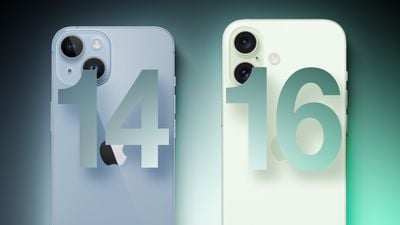
The iPhone 16 succeeds 2023's iPhone 15, introducing over 30 new features and improvements. With many users adopting two-year upgrade cycles, plenty of iPhone 14 owners will be looking to upgrade to the iPhone 16, so this guide outlines some of the major differences you should be aware of between the two generations.
In 2022, Apple unveiled the iPhone 14 as the successor to the popular iPhone 13, introducing an improved main camera with the Photonic Engine, Action Mode, longer battery life, satellite connectivity and Crash Detection, and more. Two years later, the iPhone 16 offers a noticeable upgrade, with the accumulative improvements of two generations stacking up. To get a sense of the entirety of the upgrades, see our other two buyer's guides that set out every difference offered when making the jump from the iPhone 14 to the iPhone 15, and the iPhone 15 to the iPhone 16:
Overall, the iPhone 16 is a fairly significant upgrade over the iPhone 14, introducing meaningful quality-of-life features like the USB-C port, Action button, and Camera Control that change the methods of interaction with the device. The new design with the Dynamic Island and slimmer bezels, frosted back glass, and contoured edges result in a noticeably different aesthetic and feel in the hand.
The iPhone 16 also brings advancements to photography and videography, adding macro photography and revamped Photographic Styles – practical features that most users can take advantage of. There are substantial hardware improvements with the addition of a 48-megapixel Fusion main camera with a 2x optical zoom option, which significantly enhances image quality.
The iPhone 14 does not support Apple Intelligence, Apple's upcoming suite of AI tools. With the A18 chip, the iPhone 16 has full support for Apple Intelligence, including Apple's new Visual Lookup feature, which is exclusive to the iPhone 16 lineup. It is also worth noting that the iPhone 16 offers considerably longer battery life, Roadside Assistance via satellite, Thread networking support, faster charging, new color options, Wi-Fi 7 support, the second-generation ultra wideband chip, and more.
Due to the scale and breadth of these improvements, some iPhone 14 users can justify upgrading to the iPhone 16, especially if they value the new design, USB-C port, Action button, and camera improvements. However, many users will still be able to stick with their device for another year, holding off for an even more substantial upgrade in the future.
The latest version of Bluetooth was released this week, and it includes a new feature that could benefit the Find My app across Apple devices.
Bluetooth 6.0 introduces "Channel Sounding," a feature that will bring "true distance awareness" to billions of future Bluetooth devices and accessories. The organization behind Bluetooth promises that this technology will achieve "centimeter-level accuracy over considerable distances," making it easier and quicker for users to locate lost items.
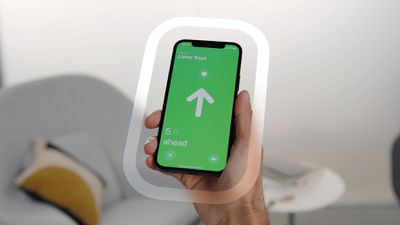
Apple already offers a Precision Finding feature in the Find My app that leverages Ultra Wideband technology to help users pinpoint the specific location of select accessories. The feature is available on the iPhone 11 and newer, and currently it can be used to find an AirTag or a second-generation AirPods Pro charging case.
Apple could use both Bluetooth 6.0 and Ultra Wideband technologies in unison to improve Precision Finding. Bluetooth 6.0 also paves the way for Precision Finding-like location accuracy for devices that are not equipped with Ultra Wideband chips, such as the Apple TV's Siri Remote and devices released by other companies.
It is unclear when the first devices with Bluetooth 6.0 will be released, but given that the specification is only just now available to hardware manufacturers and developers, the first Apple devices with support are likely at least a year away.
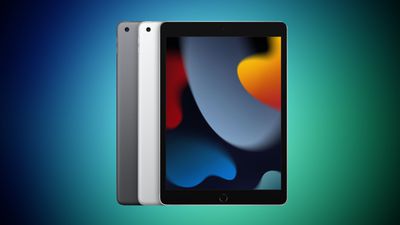
You can still get Apple's 64GB Wi-Fi 9th generation iPad for the all-time low price of $199.00 this week on Amazon, down from $329.00. Shipping dates have slipped into mid-September, but Prime members can still get the tablet as soon as September 10.
Note: MacRumors is an affiliate partner with some of these vendors. When you click a link and make a purchase, we may receive a small payment, which helps us keep the site running.
The 64GB Wi-Fi iPad model is available in both Space Gray and Silver on Amazon, but if you're looking for the 256GB Wi-Fi model you'll need to visit Best Buy. That retailer has the 256GB Wi-Fi iPad for $349.99, another $130 discount and record low price.
Best Buy also has the cellular models on sale for best-ever prices this week. The 64GB cellular iPad is on sale for $329.99, and the 256GB cellular iPad is on sale for $479.99. Both of these deals represent $130 discounts on each model.
Although these iPads are a few years old at this point, today's ultra-low prices should make them perfect for anyone looking for a simple and cheap iPad for daily Internet browsing. Be sure to visit our full Deals Roundup to shop for even more Apple-related products and accessories.
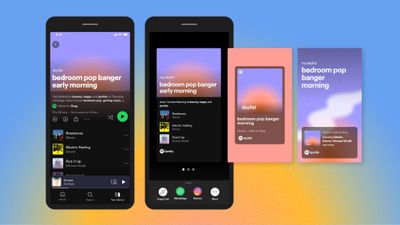
Spotify is globally rolling out "Daylist," a personalized playlist that adapts and evolves to your listening habits as you go about your day.
Available to both free and paying users, the playlist has actually been available in English-speaking markets since September of last year, and expanded to 65 more countries in March. Today, the company is adding support for 14 additional languages, making Daylist accessible to all markets in which Spotify is available.
According to TechCrunch, Daylist is now available in Arabic, Catalan, French (Canada), French (France), German, Indonesian, Italian, Japanese, Korean, Polish, Portuguese (Brazil), Spanish (Spain), Spanish (Mexico), and Turkish.
To access the Daylist in Spotify, navigate to the "Made for You" section in the app, or use this link if you're on the web. According to Spotify, the playlist uses data from "niche music and microgenres" that users listen to at certain times of the day to suggest tracks and update itself. Graphics for the Daylist also adapt throughout the day.
Individual Daylist playlists can also be saved by tapping the three dot menu, selecting "Add to Playlist", and then tapping "New Playlist." Daylists also include a built-in sharing feature designed for social media that comes with a ready-made screenshot, personalized sticker, or customizable sharecard.
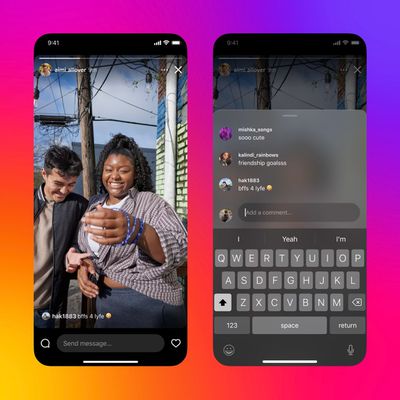
Instagram has announced support for leaving comments on Stories, the ephemeral posts that have become almost as popular as regular Instagram posts.
Previously, the only option was to send a private reply, which appeared as a direct message visible solely to the Story's creator. Now, Instagram has introduced a more public option: Comments. These comments are visible to other users, unlike the private replies.
However, the ability to comment comes with restrictions. Only mutual followers (meaning people who follow the Story creator and are followed back by them) can leave comments. Instagram says the new feature aims to offer a more open way to engage with Stories, while still maintaining the original private messaging option for those who prefer one-on-one interactions.
Like the Stories themselves, comments posted about them are temporary and last for up to 24 hours. Users have the option to turn comments on or off when sharing Stories, but Instagram has not said whether they are archived along with a Story when it reaches its end of life.
Last month, Instagram added support for adding text and additional images to photo and carousel posts, which can now include up to 20 photos and videos. It also recently introduced a feature for adding a song to an Instagram profile.
Apple is introducing a new camera-based "Capture" button on at least some iPhone 16 models this year, and a new rumor claims that Apple's own silicone cases will have a design that is specially made so as not to impede the use of the capacitive button's multiple functions.
Several rumors have suggested that the iPhone 16 models are going to have an all-new button that's designed to make it easier to capture photos when the devices are held in landscape mode. Apple plans to put the button on the right side of the iPhone, in the space where the mmWave antenna is on iPhones that are sold in the United States.
As a capacitive button geared towards fine-grained photography controls, it is said to have support for multiple gestures and the ability to respond to pressure. In a new post on X (Twitter), Chinese leaker DuanRui shared an image of unofficial third-party silicone cases with an opening in the expected location of the Capture button.
While these unofficial cases have a cutout for the Capture button, a machine-translated comment on the image by DuanRui claims that "the official protective case of Apple's iPhone 16 series will not have this opening and will be made into an integrated design, which will not affect the normal use of this capacitive button."
The Capture Button has been depicted in CAD renders and dummy models of all four iPhone devices, but Bloomberg's Mark Gurman last week suggested that there is a possibility that it will only be available on the Pro models.
Along with a Capture Button, the iPhone 16 models will feature slightly bigger displays on the Pro devices, a new A18 chip that supports Apple Intelligence, and 8GB RAM for all models, which is necessary to power Apple's AI models. For more on what's expected to be revealed at Apple's upcoming "It's Glowtime" event on September 9, make sure to check out our iPhone 16 roundup.
As Apple's iPhone 16 launch approaches, questions are swirling about a potential leap in storage capacity for the iPhone 16 Pro models. According to a January report, the iPhone 16 Pro and Pro Max will double their maximum storage to 2TB.
This speculation stems from Apple's rumored adoption of Quad-Level Cell (QLC) NAND flash memory. QLC technology could allow Apple to pack more storage into a smaller space while potentially reducing costs compared to the current Triple-Level Cell (TLC) NAND.
However, it's crucial to approach these rumors with caution. Similar claims about 2TB options surfaced for both the iPhone 14 Pro and iPhone 15 Pro, which ultimately proved false. Yet despite this history, there are new factors that lend credibility to the latest 2TB rumors.
The iPhone 16 Pro models are reportedly set to receive significant camera upgrades that could justify the need for increased storage. Rumors suggest an improved ultra-wide camera with a 48-megapixel sensor, featuring the same pixel-binning technology as the main camera. This upgrade, combined with a wider f/2.2 aperture, promises substantially better low-light performance and support for 48-megapixel ProRaw photography.
Apple is also said to be introducing a new image format called "JPEG-XL." This addition to the existing lineup of HEIF, JPEG, HEIF Max, ProRaw, and ProRAW Max formats could potentially result in larger file sizes, making increased storage more necessary. The rumored capability to shoot 3K video at 120 frames per second with Dolby Vision on the Pro models would also generate significantly larger files.
Last but not least, Apple is reportedly planning to introduce a dedicated "Capture Button" for the iPhone 16 Pro models, emphasizing the device's role as a serious photography and video capture device. Taken together, this collective push towards professional-grade image and video capabilities could justify the need for increased storage options.
While the prospect of a 2TB iPhone is exciting, especially for content creators and power users, it's important to bear in mind that QLC NAND does have drawbacks. Most notably, it typically offers slower read and write speeds compared to TLC NAND.
As we await official announcements from Apple during its upcoming "It's Glowtime" event on September 9, the possibility of a 2TB iPhone 16 Pro model remains an uncertain prospect. Whether this will be the year Apple finally breaks the storage barrier remains to be seen, but the combination of new hardware features and evolving storage technology certainly makes it a possibility. And if it doesn't happen, there's always hope for next year.


 Note: MacRumors is an affiliate partner with Amazon. When you click a link and make a purchase, we may receive a small payment, which helps us keep the site running.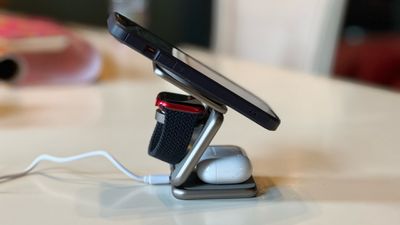




 Note: MacRumors is an affiliate partner with some of these vendors. When you click a link and make a purchase, we may receive a small payment, which helps us keep the site running.