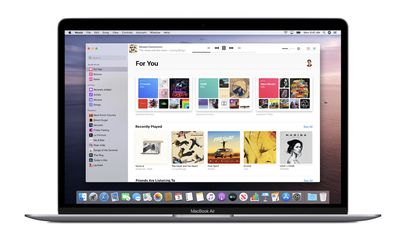
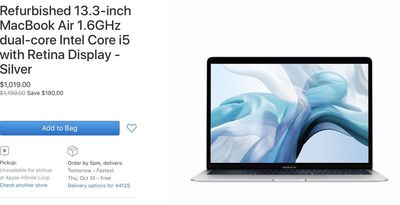
Apple today began adding the 13-inch MacBook Air and the lower-end 13-inch MacBook Pro to its online store for refurbished products in the United States, offering the machines at a discount for the first time.
Both of the new machines were first released in July 2019. The updated MacBook Air features a True Tone display, an updated butterfly keyboard that's more durable, and a lower price point.
As for the lower-end MacBook Pro, the July 2019 update brought Touch ID, a Touch Bar, faster processors, and a True Tone display to Apple's entry-level machines.
Pricing on the MacBook Air starts at $1,099 new and pricing on the entry-level MacBook Pro starts at $1,299. Apple is offering discounted prices on both stock and custom configurations, with multiple options available. Discounts are right around 15 percent off.
The refurbished store is a little bit wonky at this time and isn't listing the MacBook Pro and MacBook Air models in the proper order, but it should be cleared up soon. For now, buyers will need to browse through the dedicated MacBook Pro and MacBook Air sections to find specific machines.
Stock will fluctuate on a day to day basis, so it can take some time for various configurations to show up. Refurbished models ship out right away and are available for delivery later this week.
All of Apple's refurbished products go through a rigorous refurbishment process before being offered for sale, which includes inspection, repairs, cleaning, and repackaging. Like new purchases, refurbished Macs come with a one-year warranty that can be extended with an AppleCare+ purchase.
Apple has picked up the rights to "A Christmas Carol," which is a live action musical that's set to star Ryan Reynolds and Will Ferrell, reports Variety.
Prior to acquiring the musical, based on the classic novel "A Christmas Carol" by Charles Dickens, Apple entered into a heated bidding war with rivals like Netflix, Warner Bros., and Paramount Pictures.
Image courtesy of Shutterstock
Apple is said to have offered a "lavish" deal that "blew away other offers." Will Ferrell and Ryan Reynolds will both make millions, with Apple planning to shell out "north of $60 million" just for talent.
Reynolds and Ferrell stand to make a staggering amounts as producers and stars, along with significant paydays for writer-directors Sean Anders and John Morris ("Daddy's Home," "Instant Family"). Fees for talent alone will clock in at north of $60 million, according to numerous insiders. That includes Anders and Morris' $10 million to $15 million paydays for creating the movie and overseeing its production.
Reynolds is said to have been asking for as much as $27 million for acting and producing services during early negotiations, and ultimately was requesting as much as $35 million. Ferrell, meanwhile, was asking for $25 million to star and produce.
It's not known what Apple ultimately paid, but the deal supposedly includes "unusual provisions" that may ultimately become the standard for digital content.
The filmmakers wanted to keep the rights to the original music written for the film, though Apple might have negotiated to retain those rights. Filmmakers also asked for the movie's copyright to revert back to them in 20 to 25 years, though it is also not known if Apple agreed to that.
"A Christmas Carol" will be added to Apple's Apple TV+ streaming service, and it could also see a theatrical release as some of the films that Apple has purchased will be in the theater before debuting on Apple TV+.
Separately, Variety also did an interview with Jennifer Aniston, who is starring in the upcoming Apple TV+ show "The Morning Show." Aniston goes into some detail about working for Apple and preparing for the role, and it's worth a read for those interested in the series.
Apple TV+ will premiere on November 1 with titles like "The Morning Show," but it's not known specifically when "A Christmas Carol" will be available.
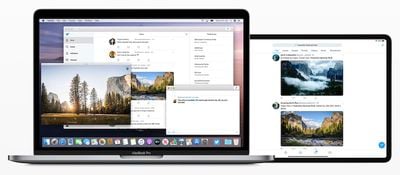
One of macOS Catalina's biggest new features for developers is Mac Catalyst—initially known as Project Catalyst—which Apple says makes porting iPad apps to the Mac as easy as checking a box in Xcode.
However, more work is required for the iPad apps to truly resemble native Mac apps, and Bloomberg's Mark Gurman reports that some developers have encountered "several problems" with Catalyst so far.
For example, the report claims that James Thomson had to work harder than he expected to get his popular PCalc calculator app for iPad to run well on the Mac. Thomson said the Mac version initially "looked like an iPad app floating on a larger Mac screen," so he had to redesign much of the user interface.
Thomson added that some older Macs struggle to handle Catalyst-based apps that use Apple's high-level 3D graphics framework SceneKit.
Lukas Burgstaller, developer of the RSS reader Fiery Feeds for iPad, also "ran into all sorts of walls" trying to adapt the iPad app to the Mac interface using Catalyst, but the report does not mention any specific issues he faced.
On the consumer side of things, the report notes that Catalyst results in users paying twice for the same app across iOS and macOS.
"As a user, I don't want to pay again just to have the same app," well-known developer Steven Troughton-Smith told Bloomberg. "As a developer, I don't want my users to have to make that decision."
Troughton-Smith touched on some of the issues developers are facing with Catalyst, noting that Mac versions of some apps can't hide the mouse cursor while video is playing, or may have issues with video recording, two-finger scrolling, or using the keyboard and full-screen mode in video games.
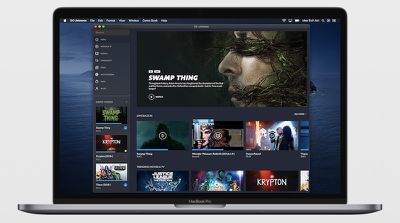
The report adds that two upcoming Catalyst apps that had been featured on Apple's website since June were removed this week, including comic book app DC Universe and the racing game Asphalt 9. It is unclear if the Mac apps are no longer planned or delayed, or if any of the Catalyst issues reported were a factor.
DC Universe for Mac preview on Apple's website prior to being removed
Netflix also confirmed that it has no plans to develop a Mac app using Catalyst at this time, according to the report.
Despite all of this, Troughton-Smith believes Catalyst is the "future of Mac app development," and he is impressed with many of the first apps. There might just be a few growing pains along the way.
Update: Gameloft says Asphalt 9 for Mac via Catalyst has been "slightly delayed" in order to "polish the experience" and that it will launch later this year, according to a follow-up tweet from Gurman.
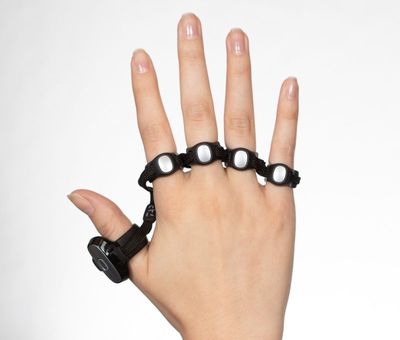
Tap, the company that makes a futuristic, wearable keyboard, today announced the launch of its second-generation keyboard, the Tap Strap 2.
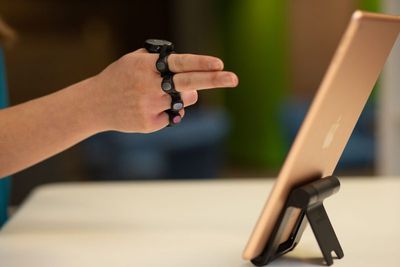
The Tap Strap 2 is similar in design to the original Tap Strap, fitting over the fingers and allowing for typing via a series of different finger taps.
Compared to the original Tap, the Tap Strap 2 offers up a new thumb ring glider and better mouse functionality that's more sensitive. Tapping on soft surfaces to type letters is better than it was with the original Tap version, and it now supports 10 hours of battery life.
It connects to devices via Bluetooth, and sports a new feature called AirMouse. With AirMouse, users can control iPads, smart TVs, set-top boxes like the Apple TV, and more using hand gestures.
AirMouse mode works out of the box without the need for calibration or software drivers. There are multiple modes of operation, which vary based on what the user needs to get accomplished.
In Mouse Mode, the Tap Strap 2 can be used to control a cursor, scroll, and click, just as one can do with a standard mouse. In Multimedia Mode, users can play, pause, adjust volume, or skip a track, and in Smart TV mode, users can navigate through menus, select items, and search for content to watch. There's also a separate selfie tap option for snapping photos from afar.
All of the modes work through different hand gestures, and the Tap Strap 2 is designed to anticipate what the person wearing the device wants to do. When a hand is horizontal, the Tap Strap 2 works in keyboard mode for typing via different finger taps. When the thumb is resting on a surface, it switches over to mouse mode, and when the hand is rotated vertically, it swaps over into AirMouse Mode.
Tap says that the Tap Strap 2 is designed to offer enhanced support for the iPad, offering up interactions like horizontal swipes, getting to the Home screen, and launching the app switcher.
In the future, Tap plans to expand its gesture-based capabilities to work for gaming and with AR and VR devices. Starting in 2020, developers will be able to create applications that incorporate AirMouse capabilities using an AirMouse SDK.
Linksys today announced the launch of a new subscription service that lets you use some of the company's existing Velop mesh Wi-Fi router systems as motion-sensing security devices.
Dubbed Linksys Aware, the technology is initially compatible only with the company's Velop Tri-Band AC2200 routers, but will be rolling out to some of the brand's other mesh Wi-Fi products in a phased rollout.
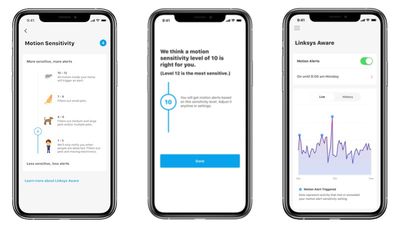
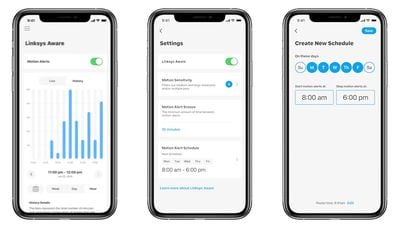
Linksys Aware is able to sense motion in your house without the need to add cameras or other accessory devices, with the various mesh nodes detecting how movement in the vicinity affects Wi-Fi signals as the nodes communicate with each other.
Users can customize the sensitivity level of the system to filter out pets of various sizes, for example, and once the motion threshold is exceeded you'll receive a notification on your phone.
As the system doesn't involve a camera, there's no way to remotely check in on the detected motion to see what it is, but at least you'll be alerted if unexpected motion is detected in your home. Motion events are stored for 60 days, so you can check back to see a recent history by hour, day or week.
Linksys Aware is free for the first 90 days, after which a subscription priced at $2.99 monthly or $24.99 annually will be required. A firmware update and App Store app update will be rolling out today to add support for the feature.
With the discontinuation of its AirPort lineup of wireless routers, Apple has embraced Linksys as one of its primary third-party partners, selling several configurations of the Velop system online and in its retail stores.
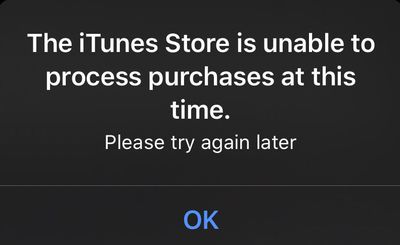
"The iTunes Store is unable to process purchases at this time. Please try again later."
If you are receiving this error when opening third-party apps on an iPhone or iPad today, you are not alone. We've been alerted to the issue by several MacRumors readers, and there are many more complaints flowing in on Twitter.
The cause of the issue is not yet known. Apple's system status page does not currently reflect any issues with the iTunes Store or App Store, but the page is often delayed. We'll update this story as new information becomes available.
In an interview with WIRED, Apple Music head Oliver Schusser has revealed that Apple has a team of employees listening to songs and transcribing the lyrics to ensure they are accurate for iOS 13's new real-time lyrics feature:
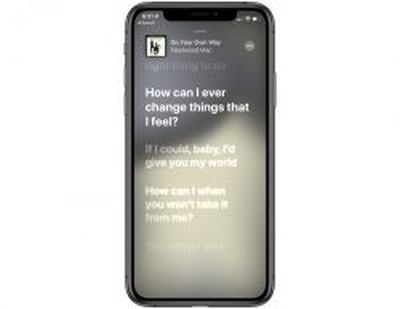
In probably the most bizarre example of Apple spending to get the experience right, Schusser says that Apple has "a team of people listening to music and transcribing the lyrics" to ensure they're accurate enough for Apple Music's new time synced lyrics feature; "we don't get them from the usual sites."
With iOS 13's real-time lyrics feature, each verse appears in time with the music so you can follow along as you listen. To jump to a certain verse, just scroll and tap any line. The feature is not available for all songs.
The interview contains a few other notable tidbits from Beats 1 radio host Zane Lowe, including the possibility of the Apple Music Festival returning in the future and "some big new names" who will accompany Ebro Darden, Julie Adenuga, Matt Wilkinson, and himself as Beats 1 hosts in the future.
UBTECH Robotics today introduced a new version of its programmable robot MeeBot, known for its dancing skills.
MeeBot 2.0 is 30 percent larger and adds new programmable technologies, including two programmable LED "eyes" and a programmable color sensor that responds to included color cards or other colorful objects to make the robot move.
The new robot also has a new gear system, providing an opportunity to learn about engineering movement and motion.
UBTECH Robotics says the MeeBot 2.0 kit will be available exclusively at select Apple Stores in the United States and Canada starting today, priced at $129.99 USD, although it has yet to appear on Apple.com.
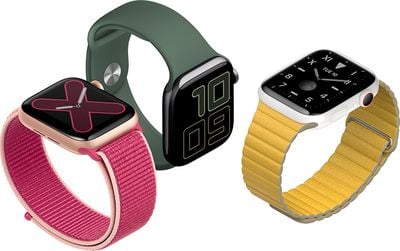
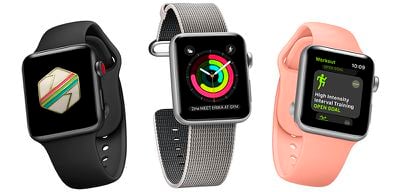
Amazon is discounting the 38mm GPS Apple Watch Series 3 to just $189.00 this week, which is $10 below its previous Amazon list price and $90 off the regular price tag of $279.00. Amazon has both the Silver Aluminum Case with White Sport Band and Space Gray Aluminum Case with Black Sport Band on sale this week.
Note: MacRumors is an affiliate partner with Amazon. When you click a link and make a purchase, we may receive a small payment, which helps us keep the site running.
In regard to Amazon's prices, this is the lowest price we've seen for the 38mm aluminum Apple Watch Series 3 on the retailer's website. If you're looking for the larger size, Amazon also has the 42mm GPS Apple Watch Series 3, priced at $229.00 in both previously mentioned case and band combinations.
The Apple Watch Series 3 launched in 2017 with an optical heart sensor, Digital Crown, dual-core S3 processor, accelerometer, and gyroscope. This was also the first generation to support cellular capabilities, denoted by models with a red Digital Crown, but Amazon's sale this week does not extend to these LTE models.
Head to our full Deals Roundup for a deeper look into all of the best Apple-related sales happening right now.
Amid rumors that Apple is developing a Tile-like accessory that will help users keep track of their personal belongings, Tile today announced a new smart tracker called the Sticker, along with an updated Tile Slim.
About the size of a quarter, the Tile Sticker is the company's smallest tracker to date, and features waterproofing and a 3M adhesive backing for attaching it to most metal and plastic objects, including remote controls, cameras, and outdoor gear. The Tile Sticker is available in black and in twin packs for $39.99, or a pack of four for $59.99.
Meanwhile, the Tile Slim assumes a new compact form factor that's the shape and thinness of two credit cards. It also now features a three-year battery life, a speaker that's twice as loud as the previous model, and a 200-foot range. The Tile Slim also comes in black and costs $29.99 for a single device.
In addition, Tile's most popular tags – the Mate and Pro – have had their ranges extended to 400 feet. The Tile Mate costs $24.99 and the Tile Pro can be had for $34.99. All Tile trackers are available today from Tile's website, Amazon, and other retailers.
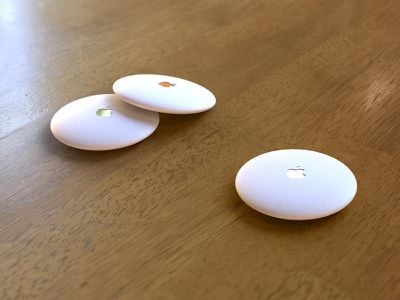
Based on assets discovered in iOS 13 by MacRumors, Apple's equivalent electronic tracker accessory is expected to be a small, circular tag with an Apple logo in the center.
The tags will be closely integrated with the new Find My app in iOS 13 and macOS Catalina, which merged Apple's previous Find My iPhone and Find My Friends services into one.
Apple Tags concept by MacRumors
While not available in public betas of iOS 13, the internal build contains a new "Items" tab in the Find My app for iPhone and iPad, which allows users to track the location of personal belongings.
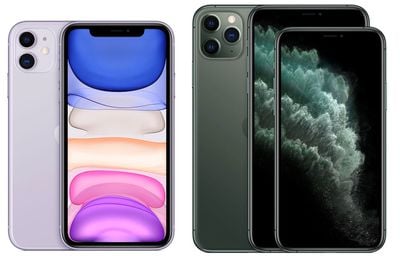
Noted Apple analyst Ming-Chi Kuo has said he expects Apple's tags to feature ultra-wideband or "UWB" technology, which can be found in the iPhone 11, iPhone 11 Pro, and iPhone 11 Pro Max.
Ultra-wideband is a short-range, low-power radio technology that is able to provide more precise indoor positioning than Bluetooth LE and Wi-Fi, suggesting that Apple's tags will be more accurate at pinpointing the location of lost items than Tile's current item trackers, which rely on Bluetooth LE.
Apple's tagging products went unmentioned at its September 10 event, but it's possible the company could make some sort of announcement soon, possibly during an October event.
Apple has several rumored products in its pipeline that could make an appearance as early as this month, including a 16-inch MacBook Pro with a scissor keyboard and an all-new design, refreshed iPad Pro models that will possibly sport triple-lens rear camera systems, and a refreshed Apple TV.
Apple is on course to recapture second place from Huawei in the global smartphone vendor ranking in the fourth quarter of 2019, reports DigiTimes.
The change in ranking is said to be a combined effect of strong sales of Apple's iPhone 11 lineup and the impact of Huawei's trade ban in the United States.
Despite being blacklisted by the U.S. government in the middle of the second quarter this year, Huawei has managed to ship 60 million handsets, which is around the same amount it shipped in the previous quarter, according to data from Gartner.
However, as the trade ban drags on, Huawei is expect to see sales slide over the second half of this year. Gartner estimates that shipments could fall to about 50 million units in the third quarter, before bouncing back to 60 million units going into the holiday period.
According to IDC, Apple shipped 36 million iPhones in Q1 2019. Sales are said to have dropped to 34 million in the second quarter, with an expected slide to 30 million units in Q3 as people waited for Apple's next-generation flagship devices, iPhone 11, iPhone 11 Pro, and iPhone 11 Pro Max.
But with reports of higher-than-expected sales of its iPhone 11 lineup both domestically and abroad, Apple could see its handset shipments reach 70 million units in the fourth quarter, which would exceed the 60 million units Huawei is expected to ship in Q4 2019.
Apple has delayed the introduction of iCloud Folder Sharing in macOS Catalina until spring 2020, according to its website.
The key cloud storage feature has spent months in development and would have allowed users to share folders in their iCloud Drive with other Apple users via a private link.
It first appeared in early beta versions of iOS 13, before it was pulled prior to the official release for iPhones and iPads last month after problems arose during testing. As expected, iCloud Folder Sharing hasn't made it to the Mac either. macOS Catalina was launched on Monday.
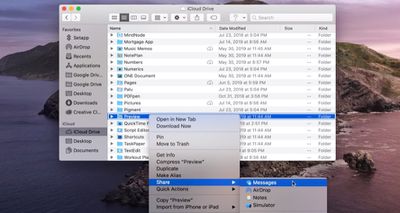
In early beta versions of macOS Catalina, right-clicking a folder in iCloud Drive revealed a submenu that allowed you to generate a private link to the folder and share it via AirDrop, Messages, Mail, or with people in your contacts.
Anyone who received the link was able to access the folder in iCloud Drive, add new files, and stay up-to-date with the latest file versions.
On its macOS Catalina features page, Apple says iCloud Drive folder sharing is now "Coming this spring." In contrast, on its iOS 13 features page, Apple says the feature is coming to iPhones and iPads "later this fall," although it's still unclear whether Apple just hasn't updated the page to reflect the extended delay. Either way, the latest iOS 13.2 beta 1 still does not appear to support the function.
As it stands, it's only possible to share individual files in iCloud Drive, which puts it at a significant disadvantage when compared to rival cloud-storage services like Google Drive and Dropbox, which have provided folder-sharing capabilities for years.
If you still want to use iCloud to share multiple files, you could try sharing a compressed zip containing several files, or creating a sparseimage file using Disk Utility and putting files in that for sharing over icloud. Otherwise, an alternative cloud service is suggested for now.
Following the release of iOS 13.1.2 last week, Apple today stopped signing iOS 13.1, meaning downgrading to this version of iOS is no longer possible.
Apple last Friday stopped signing iOS 12.4.1, iOS 13.0, and iOS 13.1.1, but continued signing iOS 13.1 until today.
iOS 13.1.2 was a bug fix release that quickly followed iOS 13.1.1, which primarily addressed issues with battery drain, Siri, and access permissions for third-party keyboards.
Apple routinely stops signing older versions of software updates after new releases come out in order to encourage customers to keep their operating systems up to date.
iOS 13.1.2 is now the current public version of iOS, but developers and public beta testers can download iOS 13.2, an upcoming update with features like the Deep Fusion image processing system for the new iPhone 11 lineup.
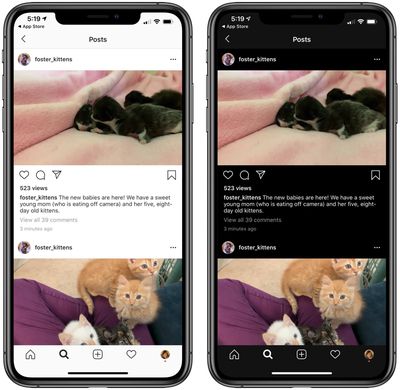
Popular social networking app Instagram was today updated to add Dark Mode support for iOS 13, introducing a darker theme that activates when Dark Mode is turned on.
The new Dark Mode option is available throughout the app, from viewing the main feed to browsing to the profile. Dark Mode can be accessed by activating Dark Mode on an iPhone running the iOS 13 update.
To get Dark Mode, the latest version of Instagram is required, even though the release notes don't mention the new feature.
Samsung's Galaxy Note 10+, the company's newest flagship device, was unveiled just a month ahead of the iPhone 11 and iPhone 11 Pro, and it's one of the main competitors to Apple's newest iPhone devices.
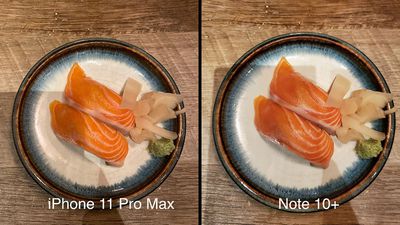
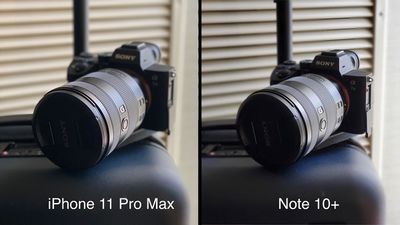
Both have triple-lens camera setups, so we thought we'd compare the camera quality of the iPhone 11 Pro Max with the camera quality of the Galaxy Note 10+ to see if one has an edge over another.
The iPhone 11 Pro Max has 12-megapixel telephoto, wide-angle, and ultra wide-angle lenses. The Galaxy Note 10+ has the same general lens setup, but with a 12-megapixel telephoto lens, a 12-megapixel wide-angle lens, and a 16-megapixel ultra wide-angle lens, so it wins out when it comes to megapixels for the ultra wide-angle camera.
When it comes to photo quality, both of these cameras can take some amazing photos and a lot of the variance is going to depend on your personal shooting conditions, including subject, lighting, and other factors, but there are some differences to be aware of.
The Galaxy Note 10+ seems to overdo highlights, washing out photos and overexposing them in some situations, while the iPhone 11 Pro Max doesn't tend to do that. The Galaxy Note 10+ also has a tendency to oversaturate images somewhat, while the iPhone 11 Pro Max offers more true to life colors.
Some people prefer that slight oversaturation and the brighter light areas that the Samsung device can produce, even if it's not quite as accurate to what you're seeing in front of you when taking a photo. You can, of course, tone down saturation in post processing for Galaxy Note 10+ photos or bump it up for iPhone 11 Pro Max photos, but out of the camera, colors can tend to look a bit more vibrant on the Galaxy Note 10+.
Though the Galaxy Note 10+ has a higher megapixel ultra wide-angle camera than the iPhone 11 Pro Max, it doesn't really produce better pictures. Quality seems similar between the two devices, and on the iPhone 11 Pro Max, the new ultra wide-angle sensor is lacking some of the better features of its wide-angle camera, such as a lower aperture, larger sensor, optical image stabilization, and support for Night Mode.
So while the ultra wide-angle camera can get you some great wide shots of landscapes, architecture, and people, it's best for better lighting conditions, and the same seems to be true of Samsung's ultra wide-angle lens.
The Note 10+ and the 11 Pro Max each offer a nighttime mode for low-light photography, and both do a great job in poor lighting conditions using this feature. The Galaxy Note 10+'s penchant to overexpose can result in some brighter night time shots in some situations, but that's not always a desired effect. Night mode on the iPhone 11 Pro Max is designed to make sure a night time photo feels like it was taken at night, and that's an area where Apple excelled.
Samsung offers a feature called Live Focus, designed to offer an adjustable live background blurring effect for front and rear-facing photos, while the iPhone offers Portrait Mode. Both of these are similar, and have seen improvements over prior-generation smartphones from each manufacturer. Edge detection is better than ever, and the background blurring is better, so it's tough to pick a winner in this category.
As for video, both photos produced impressive 4K footage at 60 frames per second, though the 11 Pro Max had better auto stabilization features without having to delve into settings.
Both smartphones have similar front-facing setups. The iPhone 11 Pro Max has a 12-megapixel front-facing lens while the Galaxy Note 10+ has a 10-megapixel front-facing lens. There's a caveat with the iPhone's front-facing camera - in zoomed in shots (there's an option to zoom in and out now), the photos that you're getting by default are seven megapixels. You need to use the zoomed out mode to get the full 12-megapixel resolution.
When it comes to quality, the front-facing camera of the Galaxy Note 10+ seems to be a bit sharper than the iPhone 11 Pro Max, with more detail, while the iPhone 11 Pro has better color accuracy. Sometimes the Galaxy Note 10+ may be a bit too sharp for some people, so preference between the two will come down to how sharp you want your selfies to be.
Of course, the iPhone 11 Pro Max has Face ID for 3D facial biometric authentication, which the Note 10+ can't match. It does offer iris scanning and facial recognition capabilities, but neither are secure enough to serve as the sole authentication method for payments so there's still a fingerprint sensor.
When it comes down to it, both the iPhone 11 Pro Max and the Galaxy Note 10+ are capable of producing incredible, crisp photos that can often rival what you'll get out of a dedicated camera. Neither one is clearly better than the other, and choosing one will come down to platform preference more than anything else.
That said, the Galaxy Note 10+ appears to be better for those who prefer a more saturated, color rich image and exaggerated highlights, while the iPhone 11 Pro Max appears to be better at producing colors and lighting that's more true to life.
Do you prefer Note 10+ or iPhone 11 Pro Max and think there's a clear winner? Let us know in the comments.
Devoted Health, a private medicare provider that offers Medicare Advantage plans in Florida, now provides the Apple Watch as a benefit to its members, reports CNBC.
Devoted Health says it is the first private Medicare provider to offer the Apple Watch as a fitness option, providing its members with up to $150 to put towards an Apple Watch model. Apple sells the Apple Watch Series 3 for as little as $199.
Plans from Devoted Health now list a $150 per year benefit in "Wellness Bucks" that can be put towards classes, programs, and "wearable devices like an Apple Watch" with the aim of offering members options to "keep healthy outside of the doctor's office."
"We are pleased that CMS agrees that there is a wide variety of ways that older Americans can keep healthy, including fitness and nutrition classes, and activity monitoring devices such as the Apple Watch," said Devoted Health spokesman Kenneth Baer. "We are thrilled to be the first Medicare Advantage plan to collaborate with Apple, and give our members the chance to use their Devoted Health Wellness bucks towards purchasing an Apple Watch. Using innovative technologies to improve the quality of care is core to our mission."
According to CNBC, Apple has been talking with companies like Devoted Health "for months" about subsidizing the cost of the Apple Watch, with Medicare Advantage plans potentially offering an untapped market for Apple, allowing the company to get its devices in the hands of more senior users.
CNBC contacted other Medicare Advantage plans that said they are also considering offering the Apple Watch as a fitness benefit in the future.
macOS Catalina eliminates the iTunes app in favor of new Music, TV, and Podcasts apps, but the lack of iTunes will impact DJs who relied on the software, reports The Verge.
Along with nixing iTunes, Apple is removing support for the method many DJ app developers had been using to access XML playlist files that let users access their iTunes music libraries.
DJs use XML file support to sort tracks into playlists and use iTunes' "Share iTunes Library XML with other applications" to transfer data between apps. The new Music app, though, uses a new, more modern library format that isn't compatible with XML.
Developers still have access to frameworks for accessing Music on the Mac, but XML file support is no longer available in macOS Catalina and developers need to update their apps to take advantage of the new methods that are compatible with music libraries on the Mac. Many DJ app developers are in the process of doing so, but customers using an XML app that is not supported should continue to use macOS Mojave until developer updates are implemented.
We spoke with Michael Simmons of Algoriddim, the developer behind the djay Pro apps, and he provided us with more insight into the issue, pointing to a previous report outlining how Apple launched an official SDK for delivering programmatic access to users' music libraries with the launch of iTunes 11 a number of years ago. Apps like djay Pro that previously transitioned to the SDK will have no problems continuing to integrate with Music libraries in macOS Catalina.
App developers who have continued to rely on the earlier undocumented XML integration and have not updated in time will find that their users will be unable to access their Music libraries after upgrading to Catalina. Companies like Serato and Native Instruments have warned their users not to upgrade to macOS Catalina yet, although Native Instruments has a public beta of its Traktor Pro app available that will support Catalina.
Hulu today updated its iOS app to add support for offline viewing for the first time, which will allow Hulu content to be downloaded so it can be viewed when you don't have an internet connection available for streaming.
Hulu rival Netflix has long offered offline viewing as an option, but until today, Hulu didn't offer the feature.
According to Hulu, downloading of offline content is available to subscribers of the more expensive ad-free Hulu plan. Those with the ad-supported Hulu plan will not be able to download shows for offline viewing as it would presumably be easier to skirt commercials.
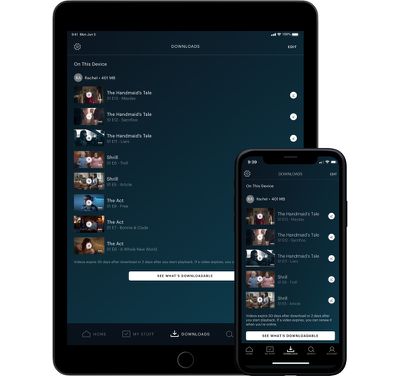
Downloaded content can be accessed through a new Downloads tab in the Hulu app, and there's an option to "See What's Downloadable" to browse through available downloadable content.
Up to 25 titles can be downloaded across five different devices, and users will have 30 days to watch downloaded content. Content that's been watched will expire two days after playback has begun, and downloaded content can be renewed by accessing Hulu over an internet connection.
Downloadable shows are available on Hulu for iOS starting today, with an App Store update required.
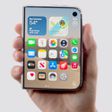
Apple's first foldable iPhone, with a book-style design featuring a 5.4-inch outer display and a 7.6-inch inner display with a minimal crease down the middle.






 In an interview with
 Note: MacRumors is an affiliate partner with Amazon. When you click a link and make a purchase, we may receive a small payment, which helps us keep the site running.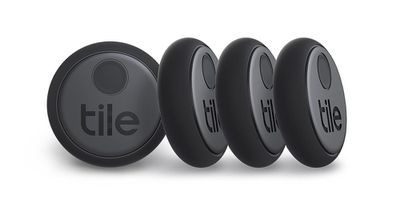

 Following the