Apple today released a new update for Safari Technology Preview, the experimental browser Apple first introduced one year ago in March of 2016. Apple designed the Safari Technology Preview to test features that may be introduced into future release versions of Safari.
Safari Technology Preview release 36 includes fixes and improvements for JavaScript, CSS, WebRTC, Web Driver, Rendering, Media, Web Inspector, and WebAssembly.
With Safari 11 now available to developers through the macOS High Sierra beta, Apple is providing two versions of Safari Technology Preview, one for macOS Sierra users and one for those using macOS High Sierra.
Apple's aim with Safari Technology Preview is to gather feedback from developers and users on its browser development process. Safari Technology Preview can run side-by-side with the existing Safari browser and while designed for developers, it does not require a developer account to download.
The United States Transportation Security Administration today announced stronger screening procedures for carry-on electronics, and will require all devices larger than a cell phone to be placed in bins for X-ray screening when going through standard screening lanes.
The TSA already requires laptops to be removed from carry-on bags and placed in a separate bin with nothing above or below, and it appears this will now expand to devices like iPads and portable gaming consoles.
According to the TSA, extensive testing and successful pilot programs have been going on at 10 airports, which has led the administration to expand the measure to all U.S. airports "during the weeks and months ahead."
"Whether you're flying to, from, or within the United States, TSA is committed to raising the baseline for aviation security by strengthening the overall security of our commercial aviation network to keep flying as a safe option for everyone," said TSA Acting Administrator Huban A. Gowadia.
"It is critical for TSA to constantly enhance and adjust security screening procedures to stay ahead of evolving threats and keep passengers safe. By separating personal electronic items such as laptops, tablets, e-readers and handheld game consoles for screening, TSA officers can more closely focus on resolving alarms and stopping terror threats," said Gowadia.
The TSA has found ways to "improve screening measures" by using "quicker and more targeted measures to clear the bags," but requiring more bins is bound to slow down screening procedures.
The new rules are already in place in the following airports: Boise (BOI), Colorado Springs (COS), Detroit Metropolitan (DTW), Fort Lauderdale-Hollywood International (FLL), Logan International (BOS), Los Angeles International (LAX), Lubbock Preston Smith International (LBB), Luis Muñoz Marín International (SJU), McCarran International (LAS) and Phoenix Sky Harbor International (PHX).
There's one way to get around the rules -- a TSA Pre membership. Customers who are enrolled in TSA Pre and using TSA Pre lanes will not need to remove their laptops or other electronic devices.
Following an Android launch last December, Google recently announced that its location sharing app, "Trusted Contacts," is out now on the iOS App Store [Direct Link]. The company described the app as a way for users to get together in everyday situations, as well as in emergency scenarios where they can let friends and family know that they're safe.
Now that the app is on both Android and iOS, cross-platform location sharing is available so you can keep track of any friends and family members no matter if they own an iPhone or Android smartphone, so long as they're also using Trusted Contacts. Similar to the Android app, the iOS app supports offline use, showing those who can see your location where you were last before you went offline.
Google highlighted a few features on the Trusted Contacts App Store page, including integration with Google Maps and its "Share Location" feature that launched in March:
Add your closest friends and family as trusted contacts.
Allow trusted contacts to request your location. If everything’s fine, you can deny the request. If you’re unable to respond, your last known location is shared automatically within a custom timeframe (works even if you’re offline or your phone is out of battery).
Proactively share your location if you feel unsafe or find yourself in an emergency.
Integration with Google Maps location sharing, so you can easily enable permanent location sharing with selected contacts and find them directly within Google Maps.
Location sharing is a popular, and controversial, feature of many apps nowadays. Most recently, Snapchat launched the "Snap Map," which lets users share and update their location on an animated map any time Snapchat is open. Likewise, Facebook Messenger launched "Live Location" earlier this year, letting friends send their location to one another directly within text conversations.
eBay today announced two new features coming to its mobile apps this fall, called "Image Search" and "Find it on eBay," both of which leverage photography and images to fuel the discovery of new products on eBay. The company said that both new features use computer vision and deep learning to be able to find matching product listings using only images.
Image Search will be coming to iOS and Android, and allows users to take a picture of something they want to buy -- or upload an existing image from the Camera Roll -- and use it as a search tool that sifts through more than 1.1 billion eBay listings to find items that match. Find it on eBay will be Android-only at launch, and it allows shoppers on other social networks to tap a "share" card and upload the image of a product, crop it, and use it as a search tool within the eBay app.
“Moments of shopping inspiration can come at any time, whether you’re walking down the street or browsing your social media feed,” said Mohan Patt, Vice President of Buyer Experience, eBay. “At eBay, we’re focused on creating new complementary technology that helps our millions of shoppers easily find the things they love at the best value. eBay Image Search and Find It On eBay make it possible for people to shop eBay using any image or photo that inspires them.”
The company said it developed Image Search during its internal "Hack Week," an annual company-wide challenge that pits employees against one another in a friendly competition to discover ways to bolster eBay's marketplace using new technology. The team that had the idea for Image Search won Hack Week in 2015 and has added more members and built upon its original features in the subsequent years, with eBay noting it expects "to launch more computer vision products in the coming months."
eBay hopes the new image-focused search features will help reduce the time users spend searching for items on its marketplace with a more seamless solution, as well as occasionally present buyers with new and unexpected items that wouldn't have been discovered using traditional text searches.
Pinterest launched a similar feature earlier this year called "Lens," letting users take pictures of real-world objects to use as a search tool for related products and images on the Pinterest website and app. At the time, Pinterest noted that Lens worked best with home decor, clothing, and food, but the company said it will make continual improvements so the app can learn to recognize new items.
For its app, eBay didn't say whether specific items work best with Image Search and Find it on eBay, but today's press releases are heavily focused on clothing items. Both features will begin rolling out to eBay's mobile apps sometime this fall.
In an internal memo obtained by MacRumors, Apple has informed Genius Bar employees and Apple Authorized Service Providers that it is actively working to rebuild worldwide supply of top case assemblies with batteries for Mid 2012 and Early 2013 models of the 15-inch MacBook Pro with Retina display.
Apple's memo says, effective July 26, service inventory of top case assemblies with batteries is now available for new repairs. The directive adds that MobileGenius, the service and support tool that Genius Bar employees use on the iPads they carry around, has stopped presenting messages about delayed repairs.
For all new repair requests, Apple advises Genius Bar employees and Apple Authorized Service Providers to order the necessary inventory. Apple advises its service providers to inform customers that the inventory should arrive within 15 business days of the part order, corresponding with early August.
Prior to today, a customer with an eligible MacBook Pro that failed Apple's battery diagnostic test was offered the option of exchanging the notebook for a functionally equivalent model. Or, customers could wait until battery inventory became available, in exchange for Apple covering the cost of the repair.
Likely because Apple no longer makes Mid 2012 and Early 2013 models of the 15-inch MacBook Pro, the functionally equivalent model ended up being a refurbished 2015 MacBook Pro, or sometimes even a 2016 or 2017 model, according to many customers who shared their experiences on MacRumors and Reddit.
What made the deal so compelling is that, for the exchange, Apple only charged its out-of-warranty battery fee of $199 in the United States, £199 in the UK, or $259 in Canada, significantly less than a new MacBook Pro costs.
Apple's memo today appears to mark the end of the company offering outright exchanges for newer MacBook Pro models. Many users on MacRumors and Reddit have confirmed Genius Bar employees are now informing customers that battery inventory is available in 15 business days as instructed.
It's unclear if Apple Stores will honor exchanges initiated prior to July 26 that are still being processed.
Apple previously said top case assemblies with batteries for the MacBook Pro models would remain severely constrained until September 15, 2017, according to an older internal memo obtained by MacRumors. The directive did not identify a reason for the shortage, which has been ongoing since at least March.
Apple has partnered with hearing implants company Cochlear to launch the first made for iPhone Cochlear implant, which can stream audio from a compatible iPhone, iPad, or iPod touch directly to a surgically embedded sound processor (via TechCrunch). Cochlear implants are reserved for people with profound hearing loss that traditional hearing aids can't help to alleviate, and consist of both an internal and external component.
Thanks to the Apple-approved certification, patients can control the Cochlear implant directly from their Apple device and not have to download and launch a separate iOS app. Users can navigate to their iPhone Settings app, click General, and then Accessibility, and find their the Cochlear hearing implant -- with a Nucleus 7 Sound Processor -- listed for them under "hearing devices."
Image via TechCrunch
“The approval of the Nucleus 7 Sound Processor is a turning point for people with hearing loss, opening the door for them to make phone calls, listen to music in high-quality stereo sound, watch videos and have FaceTime calls streamed directly to their Cochlear implant,” Cochlear CEO Chris Smith said in a statement. “This new sound processor builds on our long-standing commitment to help more people with hearing loss connect with others and live a full life.”
After being paired, users can control the implant's volume using their iOS device's volume controls, and any audio can be sent into the implant including phone calls and music playback. In addition, the external component of the Nucleus 7 is said to have a longer battery while being smaller and 24 percent lighter than the previous version of the device.
There have been other audio-assisting technologies that Apple has showcased in the past, like the ReSound LiNX 3D hearing aid, and speaking with TechCrunch the company reiterated its intent to push accessibility features in every version of iOS.
“We wanted to see something that could become ubiquitous out in the world,” Apple’s Sarah Herrlinger, senior manager for global accessibility policy and initiatives told TechCrunch. “We want everybody to use our technology and to say ‘wow my iPhone is the best piece of technology I’ve ever used before’…with every iteration of our operating system our goal is to add in new accessibility features in order to expand the support that we can give to people all over the world.”
Earlier in May, news came out that Facebook was working to develop a slate of television shows that would combine short 5-10 minute videos with big-budget, cable-length dramatic series in a new video section on the popular social network. After a delay, people familiar with the company's plans are pointing towards a mid-August debut for the new TV-focused Facebook update (via Bloomberg).
Facebook is said to be asking its video partners to deliver the first episodes of their "spotlight shows," mainly focusing on the shorter and more inexpensive programs that will run under 10 minutes in length. The longer marquee series will launch "later on the site," and presumably on the main iOS app and video-focused Apple TV app.
Despite being delayed numerous times already, the people close to the project said that "further delays could occur." Eventually, the new video section of Facebook will combine both scripted and user-generated content, with Bloomberg describing Facebook's aim to create a "higher end" version of YouTube. While the company is funding hour-long, TV-style shows, those close to the project said that it is refraining from directly competing with the likes of Netflix, HBO, and Showtime.
The company has been asking its partners to turn in the first episodes of their spotlight shows, the people said. Some already have finished these short-form, inexpensive programs. Facebook is also funding higher-end TV-style shows, which will be launched later on the site, said the people, who asked not to be identified because the plans aren’t public.
The new video section will offer the social network’s more than 2 billion users a mix of scripted and user-generated content. Facebook aims to make something higher-end than Google’s YouTube, but it’s not competing with video producers such as Netflix, HBO and Showtime.
Even though it doesn't want to enter the market as a competitor to such big networks, Facebook hopes to use the TV content to gain a cut of the overall advertising market that's traditionally associated with cable networks. To this end, Facebook has already hired former MTV executive Mina Lefevre to oversee its push into original TV shows, one of which is said to be a dating series from media partner Condé Nast.
Original TV production is becoming a focus for many companies that aren't normally associated with scripted television content, with Snapchat having already launched short-form shows on its app, and Twitter gearing up for a big 24/7 live news network in partnership with Bloomberg.
WSJ. Magazine has shared a lengthy interview with Apple design chief Jony Ive about Apple Park, the company's new headquarters in Cupertino, California, revealing a few new anecdotes about the all-new campus and the exhaustive architectural process that has gone into constructing it.
Ive, for instance, reportedly scoffed at a recent article claiming Apple Park has contributed to a tree shortage in the San Francisco Bay Area.
Ive takes offense at the idea that he hasn’t already thought of every detail during the years of planning Apple Park. He scoffs at an article claiming that Apple contributed to a tree shortage in the Bay Area by buying up so many plants for the campus, “as if we’d got to the end of our project and we thought, Oh, we’d better plant some trees.” Apple began working with an arborist years ago to source trees, including varieties that once made up the bountiful orchards of Silicon Valley; more than 9,000, many of them drought-resistant, will have been planted by the time the campus is finished.
The report also mentions that Ive's design team will be among the last to move into the new headquarters this fall. Employees began moving over from Apple's existing Infinite Loop campus in April, and when the transition is completed, the spaceship-like campus will reportedly house some 12,000 workers.
Apple Park's fourth floor is where the company's executives will be situated, including Ive's design studio, along with the Apple Watch team and part of the group working on Siri, according to the report. Apple's Mac and iPad divisions will be interspersed with software teams on the middle levels, it adds.
Apple Park has open workspaces with desks that can be raised to standing level at the push of a button (Image: WSJ)
Apple Park's main cafeteria, which will reportedly serve some 14,000 lunches a day, is a four-level atrium with massive 440,000-pound glass doors. Apple employees have to pay for food, but at a somewhat subsidized rate, the report said. For perspective, some tech companies like Google offer entirely free meals.
Outside, the green space within Apple Park's inner circle will play host to Apple's iconic "beer bashes" on Friday afternoons, which often include featured performances. Here, more than 9,000 trees, many of them drought-resistant, will supposedly have been planted by the time the campus is finished.
Some of the trees will be regularly harvested to provide fruit for the campus kitchen, according to the report.
WSJ. Magazine's complete interview is a worthwhile read for those interested in learning more about Apple Park. A handful of drone operators have also been filming monthly videos that provide a closer look at the new headquarters and its surrounding facilities throughout the construction phase.
Google today released Chrome 60, introducing support for the Touch Bar built into 2016 and 2017 13 and 15-inch MacBook Pro models. After installing Chrome 60, MacBook Pro owners are able to add, remove, and rearrange Chrome shortcuts.
The Touch Bar settings can be accessed by through the Menu bar by going to View -> Customize Touch Bar. The new settings can be combined with existing Touch Bar options for things like controlling brightness and volume, and there's a toggle for turning off predictive typing suggestions.
Today's update also includes a long list of security fixes, which are listed in the Chrome release notes, and new and updated Web Budget, Payment Request, Paint Timing, and Credential Management APIs for developers. Also new is support for the CSS @font-face descriptor and font-display property for faster font loading on websites.
U.S. District Judge William Conley today ordered Apple to pay $506 million to the University of Wisconsin's Alumni Research Foundation for infringing on a patent related to computer processing technology used in its A7, A8, and A8X chips, reports Reuters.
The $506 million total is more than double the $234 million in damages that a Jury ordered Apple to pay back in 2015, with Conley adding an extra $272 million. According to Conley, Apple owes additional damages along with interest because Apple continued to infringe on the patent until it expired at the end of 2016.
The lawsuit in question dates back to 2014, when the Wisconsin Alumni Research Foundation accused Apple of infringing on a patent titled "Table based data speculation circuit for parallel processing computer," that was originally granted in 1998 and covers a method for improving processor efficiency.
A jury ruled that Apple's A7, A8, and A8X processors infringe on the patent, and the university has also filed a second lawsuit covering Apple's A9 chips, which has not yet been ruled on.
Apple is planning to build three "big, big, big" manufacturing plants in the United States, Apple CEO Tim Cook reportedly told U.S. President Donald Trump. The news was shared by Trump in an interview with The Wall Street Journal.
Cook is said to have promised to build "three big plants, beautiful plants," but little additional information is available. What those plants will manufacture is unclear, as is their potential location.
"I spoke to [Mr. Cook], he's promised me three big plants--big, big, big," Mr. Trump said as part of a discussion about business-tax reform and business investment. "I said you know, Tim, unless you start building your plants in this country, I won't consider my administration an economic success. He called me, and he said they are going forward."
Apple representatives declined to provide clarification on Trump's statement.
Apple has been investigating manufacturing in the United States since Trump said "we're going to get Apple to start building their damn computers and things in this country instead of other countries," during a campaign speech at Virginia's Liberty University in 2016. At the time, Trump threatened to introduce a 45 percent tax on products imported from China.
Following pressure from Trump, Apple reportedly asked its suppliers Foxconn and Pegatron to look into making iPhones in the United States.
While Pegatron declined, Foxconn is planning to build a TFT-LCD factory in the United States, with the latest rumors suggesting the company is considering Wisconsin as the state where the facility will be built.
Apple CEO Tim Cook previously explained that iPhones are manufactured in China because of the skill of the workforce. "China put an enormous focus on manufacturing," he said. "The U.S., over time, began to stop having as many vocational kind of skills. I mean, you can take every tool and die maker in the United States and probably put them in a room that we're currently sitting in. In China, you would have to have multiple football fields."
Note: Due to the political nature of the discussion regarding this topic, the discussion thread is located in our Politics, Religion, Social Issues forum. All forum members and site visitors are welcome to read and follow the thread, but posting is limited to forum members with at least 100 posts.
Kanex today announced availability of its GoPlay Sidekick wireless game controller for iPhone, iPad, and Apple TV. The pocket-sized controller, introduced at CES 2017, can be purchased from Kanex's website starting today for $59.95. A company spokesperson told MacRumors it will also be available on Amazon next week.
The console-inspired game controller features pressure-sensitive buttons, dual analog joysticks, trigger buttons, a directional pad, and a Lightning connector, while one of its more interesting features is its patent pending protective clamshell case with an integrated stand that props up an iPhone during gameplay.
The controller, certified under Apple's MFi Program, connects to Apple devices over Bluetooth 4.0 and offers up to 20 hours of gameplay on a single charge. It works with almost any controller-supported game on the App Store.
The USB 3.0 Promoter Group, comprising Apple, HP, Intel, Microsoft, and other companies, today introduced an upcoming USB 3.2 specification, which will eventually replace the existing USB 3.1 specification upon release.
An incremental update, USB 3.2 is designed to define multi-lane operation for USB 3.2 hosts and devices. USB Type-C cables already support multi-lane operation, and with USB 3.2, hosts and devices can be created as multi-lane solutions, allowing for either two lanes of 5Gb/s or two lanes of 10Gb/s operation.
With support for two lanes of 10Gb/s transfer speeds, performance is essentially doubled over existing USB-C cables.
As an example, the USB Promoter Group says a USB 3.2 host connected to a USB 3.2 storage device will be capable of 2GB/sec data transfer performance over a USB-C cable certified for USB SuperSpeed 10Gb/s USB 3.1, while also remaining backwards compatible with earlier USB devices.
"When we introduced USB Type-C to the market, we intended to assure that USB Type-C cables and connectors certified for SuperSpeed USB or SuperSpeed USB 10 Gbps would, as produced, support higher performance USB as newer generations of USB 3.0 were developed," said Brad Saunders, USB 3.0 Promoter Group Chairman. "The USB 3.2 update delivers the next level of performance."
Along with two-lane operation, USB 3.2 continues to use SuperSpeed USB layer data rates and encoding techniques and will introduce a minor update to hub specifications for seamless transitions between single and two-lane operation.
More information about USB 3.2 will be unveiled at USB Developer Days 2017 later this year.
Apple today seeded the third public beta of an upcoming macOS High Sierra update to public beta testers, two weeks after releasing the second public beta. The third public beta of macOS High Sierra is likely identical the fourth developer beta, which was provided to developers earlier this week.
Beta testers who have signed up for Apple's beta testing program are able to download the third macOS High Sierra beta through the Software Update mechanism in the Mac App Store after the proper profile has been installed.
Those who want to be a part of Apple's beta testing program can sign up to participate through the beta testing website, which gives users access to iOS, macOS, and tvOS betas. For instructions on how to install the public beta, check out our how to, and make sure to make a backup before giving the software a try. Don't install the beta on a main machine, as betas are notoriously unstable. High Sierra runs on all machines that support Sierra.
The macOS High Sierra update is designed to improve and refine the existing macOS Sierra operating system. Along with a new, more efficient file system (APFS) designed for modern storage, the update introduces Metal 2, the next-generation version of Apple's Metal graphics API with support for machine learning, external GPUs, and VR content creation.
High Efficiency Video Encoding (HEVC aka H.265) is coming in High Sierra, and many of the existing apps are being updated. Photos features a new persistent side view and editing tools for Curves, Selective Color, and Live Photos, while Siri is gaining a more natural voice and support for more music-related commands.
Safari offers a new autoplay blocking feature for videos and Intelligent Tracking Prevention to protect your privacy, while Mail storage is being optimized to take up 35 percent less space. iMessages can now be stored in iCloud, and there are new iCloud Drive file sharing options and new iCloud storage family plans.
For a full overview of the new features you can expect to see when macOS High Sierra is released in the fall, make sure to check out our macOS High Sierra roundup.
Apple today seeded the third beta of an upcoming tvOS 11 update to its public beta testing group, two weeks after providing testers with the second beta. The tvOS 11 public beta marks the first time public beta testers have had access to pre-release tvOS software, and this third beta corresponds to the fourth developer beta.
Prior to tvOS 11, public betas were limited to iOS and macOS software likely due to the slightly more complicated tvOS beta installation process, but now public beta testers can access all software platforms with the exception of watchOS thanks to new installation procedures.
The tvOS 11 public beta can be obtained by going to the Settings app on the Apple TV and navigating to the Software Updates section under "System." "Get Public Beta Updates" will need to be toggled on, and once it is, the Apple TV will download the beta software.
Compared to iOS 11, macOS High Sierra, and watchOS 4, tvOS 11 is a minor update that brings few changes to the tvOS operating system. It's minor enough that it received no time on stage at the Worldwide Developers Conference aside from a mention of an Amazon Prime Video app coming to the Apple TV this fall.
According to Apple's release notes, tvOS 11 introduces automatic light/dark appearance switching based on local time, Home screen syncing options for syncing content between two or more Apple TVs in a household, new background modes and notification support, plus new tools for developers and improvements to Mobile Device Management.
Additional tvOS 11 features may be unveiled ahead of the operating system's public release, which is expected to be in the fall alongside other software updates.
Apple today released the third public beta of iOS 11 to its public beta testing group, allowing non-developers to download and test the new operating system ahead of its fall launch. The third public beta of iOS 11 comes two weeks after Apple released the second public beta and it likely corresponds to the fourth developer beta.
Beta testers that have signed up for Apple's beta testing program will receive the new iOS 11 beta update over-the-air after installing the proper certificate on an iOS device.
Those who want to join the beta testing program can sign up on Apple's beta testing website, which gives users access to iOS, macOS, and tvOS betas. Step-by-step instructions for downloading installing the public beta can be found in our how to. Betas should only be installed on a secondary device as the software is not stable and often includes many bugs.
The fourth developer beta brought some of the most significant changes we've seen yet in an iOS 11 beta. A much-desired swipe feature for clearing Notifications on the Lock screen has been added, and there are also several visual tweaks to icons throughout the operating system. An overview is below:
The iOS 11 operating system introduces several design changes to the operating system, including a new Lock screen experience and a customizable, redesigned Control Center. Siri is smarter, has a more natural voice, and can do more, Messages features person-to-person Apple Pay, Notes has searchable handwriting and document scanning, and Music lets you share playlists with your friends.
A new Files app improves file management on iOS devices, and on the iPad, there's a new Dock, an App Switcher, and support for Drag and Drop, all of which improves multitasking on the device. A revamped App Store is coming in iOS 11, photos and videos take up less space, iMessages can be stored in iCloud, and developers are getting new tools like ARKit for creating impressive new augmented reality apps and games.
For complete details on all of the features included in iOS 11, make sure to check out our iOS 11 roundup. Apple plans to release iOS 11 to the public in the fall following several months of testing and refinement.
Adobe today announced plans to end-of-life its Flash browser plug-in, ceasing development and distribution of the software at the end of 2020. Adobe encourages content creators to migrate flash content to HTML5, WebGL, and WebAssembly formats.
But as open standards like HTML5, WebGL and WebAssembly have matured over the past several years, most now provide many of the capabilities and functionalities that plugins pioneered and have become a viable alternative for content on the web. Over time, we've seen helper apps evolve to become plugins, and more recently, have seen many of these plugin capabilities get incorporated into open web standards. Today, most browser vendors are integrating capabilities once provided by plugins directly into browsers and deprecating plugins.
The elimination of Flash and Flash Player should not heavily impact most users because popular browsers have already moved away from the format. Starting with macOS Sierra and Safari 10, Apple disabled Adobe Flash by default to focus on HTML 5, and Flash has never been available on Apple's iOS devices. Google's Chrome browser has also been de-emphasizing Flash since the middle of last year.
Adobe's Flash Player has always suffered from a never-ending stream of critical vulnerabilities that expose Mac and PC users to malware and other security risks. Vendors like Microsoft and Apple have had to work continually over the years to keep up with security fixes.
Apple also shared Adobe's Flash news on its WebKit blog, and the company says it is working with Adobe and industry partners on the transition from Flash to open standards.
Ahead of its sunsetting in 2020, Adobe will continue to support Flash on major operating systems and browsers, issuing regular security updates, maintaining OS and browser compatibility, and introducing new features and capabilities "as needed."
Adobe says it will, however, "move more aggressively" to end Flash distribution in countries where unlicensed and outdated versions of Flash Player are distributed.
Apple has shared a new 60-second black-and-white Apple Music ad starring chart-topping American country singer Brantley Gilbert.
According to publicity firm Big Hassle, the ad was shot over two days near the small village of Leiper's Fork, Tennessee. The video captures Gilbert on a motorcycle ride through the heart of rural America, while he praises the small town ethos that has helped him in his songwriting career.
I love the feeling out here. The freedom. The simplicity. The open road. This is my home. No matter where I go, my heart stays here. With my friends, my family. Just country. There's nothing that replaces the feeling of getting out there and letting it all go in the wind. People you meet, memories you share, and the soundtrack that drives it. My country. My people. My music. Apple Music.
The commercial features snippets of Gilbert's latest single, The Ones That Like Me, plus country and rock classics such as Sweet Home Alabama by Lynyrd Skynyrd and Born to Be Wild by Steppenwolf.
"I've never been one for commercials," says the man who's certified back-to-back platinum for Halfway To Heavenand Just As I Am. "But when we started talking to the folks at Apple, they were saying, 'We want to capture you, the way you live and the values you hold. We want people to see your world, show them what you hear and respond to. If they see you, it says everything.'"
The ad debuted on NBC's pre-race show for NASCAR's annual Brickyard 400, sponsored by Gilbert and his label, on Sunday.
Gilbert has released three studio albums since signing with Big Machine Records in 2011, with four chart-topping singles such as Bottoms Up. He also wrote country singer Jason Aldean's popular singles My Kinda Party and Dirt Road Anthem.
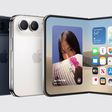
Apple's first foldable iPhone, with a book-style design featuring a ~5.5-inch outer display and a ~7.8-inch inner display with a minimal crease down the middle.