


















Apple's 2026 Worldwide Developers Conference is just days away, and it's going to be an interesting event because it will give us a look at Apple's AI plans. We'll see how Apple is going to compete with OpenAI, Anthropic, and Google in the months to come with an AI version of Siri and new AI features for its apps.
iOS 27 Siri Changes
Big changes are coming in iOS 27, iPadOS 27, and macOS 27, and Apple employees haven't been able to keep quiet. We've heard details on a long list of AI updates Apple has planned, with enough detail that screenshots could be recreated by Bloomberg. Much of what's rumored relates to AI features and changes.
New Siri Features
Based on Apple's promises and rumors about what's coming in the new version of iOS, Siri in iOS 27 will be nothing like Siri in iOS 26. In 2024, Apple showed us three ways that Siri will improve, but two years have passed and extra work has been done, so we're expecting even more than what Apple demonstrated back then.
Siri is going to be able to draw on user data and information from Apple devices, with access to personal data for completing tasks. The assistant is also going to be able to do more with apps, and it will be able to tell what's on the screen to answer questions.
Personal Context
Siri will be able to access emails, messages, files, photos, and more, learning all about you to help you complete tasks and keep track of what you've been sent. Apple offered some examples of how personal context will work:
- Show me the files Eric sent me last week.
- Find the email where Eric mentioned ice skating.
- Find the books that Eric recommended to me.
- Where's the recipe that Eric sent me?
- What's my passport number?
Onscreen Awareness
Onscreen awareness will let Siri see what's on your screen and complete actions involving whatever you're looking at. If someone texts you an address, you can tell Siri to add it to their contact card. Or if you're looking at a photo and want to send it to someone, you can ask Siri to do it for you.
App Integration
Siri will be able to do more in and across apps, performing actions and completing tasks that are just not possible with the personal assistant right now. We don't have a full picture of what Siri will be capable of, but Apple gave a few examples of what to expect.
- Moving files from one app to another.
- Editing a photo and then sharing it with someone.
- Getting directions home and sending the ETA in the Messages app.
- Drafting and then sending an email.
Siri will be able to complete tasks in Apple apps and in third-party apps, with developers able to expose app capabilities to Siri.
Siri Chatbot
Apple needs a Siri app because Siri is becoming a chatbot. Siri will be like ChatGPT or Claude, able to draw on information from the web to provide answers to questions.
Siri will be deeply integrated into iOS, iPadOS, and macOS at the system level, and can draw on device information. It will know more personal context than before, and will be able to access emails, texts, photos, calendar information, contacts, notes, and other personal data. Some of what Siri will be able to do:
- Search the web for information
- Generate images
- Generate content
- Summarize information
- Analyze uploaded files
- Use personal data to complete tasks
- Ingest information from emails, messages, files and more
- Write emails, notes, and texts
- Analyze open windows and on-screen content to take action
- Control device features and settings
- Search for on-device content, replacing Spotlight
Siri will be integrated into Apple apps like Mail, Messages, Photos, and Apple TV.
Siri Design
With Siri's chatbot transition, Apple will be making multiple Siri-related design changes. Siri will largely live in the Dynamic Island, and Bloomberg says there will be new ways to access Siri.
Swiping down from the center of the iPhone's display from the Home Screen or any app will bring up a new "Search or Ask" feature in the Dynamic Island. A glowing, pill-shaped animation will be displayed in the Dynamic Island to indicate that Siri is processing a request.
When Siri has an answer, the Dynamic Island will expand into a transparent card with the result, incorporating images, info from the web, notes and other information relevant to the query or request. Swiping on the results card will bring up a conversation mode that looks similar to an iMessage chat, and there will be an option to transition to the full Siri app.
Search or Ask replaces Siri Suggestions and will let users launch apps, start text messages, ask about the weather, add calendar appointments, trigger shortcuts in apps, and search the web using Apple's new AI web search feature. Search or Ask queries can also be sent to third-party chatbot services like ChatGPT instead of Siri.
While Siri can be accessed through a swipe in iOS 27, Apple is keeping the "Hey Siri" wake word and Siri activation through the Side button. With the new center swipe, accessing the Notification Center will be done with a swipe down on the left side of the display. Swiping down on the right side will continue to bring up Control Center. With the change to how Notification Center is accessed, notifications will now slide in from the left side of the iPhone instead of the top of the display.
Apple will also integrate an "Ask Siri" button into the menus of its apps, giving users a way to send content directly to Siri alongside a request.
The new Siri interface uses dark colors with no light mode available. Siri UI elements have a dark background with color accents that mirror the options Apple is using in WWDC imagery. Apple's WWDC website features a white Swift bird with subtle highlights in pink, dark blue, purple, and orange.
Standalone Siri App
Bloomberg recently shared a mockup of what the standalone Siri app will look like, and it's similar to other chatbot apps like ChatGPT, Claude, or Gemini.
Siri will support text or voice-based conversations. The app will open with an "Ask Siri" bar where users can type in a question. A paperclip icon will be available for attaching images, PDFs, and other documents. Apple will provide prompts with suggestions on what users can ask.
Questions will resemble iMessage chat bubbles, with Apple adopting a design that is familiar to users. Responses will include links, images, and other information.
A section of the app will be dedicated to past conversations that can be shown in a card-style interface with conversation summaries, or a list view. Users will be able to tap into a conversation to continue it.
Siri Privacy
Apple plans to lean into privacy as a central principle of its approach to AI, giving it a way to distinguish Siri from other chatbot options. Apple will likely aim to keep as much processing on-device as possible to limit the amount of data that leaves a user's device.
Apple said that Apple Intelligence features will continue to run on Apple devices and Private Cloud Compute.
Apple will have limits around memory, including restrictions on the information that can persist and how long it is kept. Users will be able to auto-delete Siri chats and requests after a set period of time, like 30 days or one year. There will also be an option to keep chats permanently, and chats will sync across Apple devices signed into the same iCloud account.
Siri can be turned off right now, as can Apple Intelligence, and there's no sign that's going to change in iOS 27. Users who don't want to enable Siri or use the new features will not have to.
Siri Extensions
Apple is letting rival chatbots integrate with Siri in iOS 27, expanding on the OpenAI partnership that currently allows Siri to hand off requests to ChatGPT, Bloomberg says Apple plans to allow other chatbots like Claude and Gemini to work with Siri, so users will be able to send questions to their favorite chatbot instead of Siri.
iPhone users will be able to select which services they want to use inside Siri through "Extensions" options coming to iOS 27, iPadOS 27, and macOS 27. The options will be available in the Apple Intelligence and Siri section of the Settings app, with Apple providing download links for chatbot apps. There will be a dedicated Extensions section in the App Store that will serve as a way to choose a third-party AI app.
Siri will be the default for the Search or Ask interface, but rumors suggest users will be able to select other chatbots to speak with. Users will also be able to choose third-party AI services as the default for Apple Intelligence features like Writing Tools and Image Playground, expanding Apple Intelligence integration beyond ChatGPT.
Apple also plans to let users choose voices from third-party AI to use instead of Siri, so there will be a distinct audio difference between a response from Siri and a response from the user's chatbot of choice. Siri would use one voice, while responses from third-party AI options would use another voice.
Google Gemini Backbone
To get Siri up and running, Apple partnered with Google to use Gemini AI models instead of using its own AI models. Apple signed a multi-year deal to use Google's Gemini models and cloud technology for its Apple Foundation Models, and it's costing Apple somewhere around $1 billion a year.
Google and Apple said that the next generation of Apple Foundation Models will be based on Google Gemini models, with Gemini used to power future Apple Intelligence features and the more personalized version of Siri.
Apple said Google's AI technology offered the most capable foundation for its models.
iOS 27 Apps and Feature Updates
Camera
Apple is moving Visual Intelligence from the Camera Control button to the Camera app in iOS 27. Bloomberg has shared images of the new interface, featuring a Siri mode that's available alongside the existing Photo, Video, Portrait, and Panorama modes. When in Siri mode, the existing Camera app shutter button will feature the Apple Intelligence logo, letting users know the Siri features are available.

Siri mode is a renaming of Visual Intelligence, and it will make the feature more visible. Accessing Visual Intelligence in iOS 26 requires users to hold down the Camera Control button or assign the feature to the Action button, and many people may not even know it exists.
Visual Intelligence can identify objects, plants, animals, art, books, and more, searching for whatever the user snaps on Google Image Search. In iOS 27, Siri will be able to answer questions about what a user is looking at, providing information from the web.
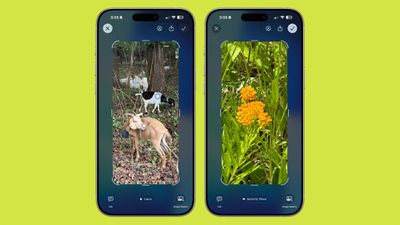
Apple is adding new Visual Intelligence capabilities in iOS 27, and they will be available through the Camera app Siri mode.
- Nutrition - Users can scan nutrition labels on food packaging for calorie and macronutrient tracking using the Health app.
- Contacts - Visual Intelligence will let users scan phone numbers and addresses on business cards and other print media, adding the information to the Contacts app.
Apple plans to make the Camera app more customizable in iOS 27. iPhone users will be able to replace the top row of camera shortcuts with options of their choosing, selecting features like flash, exposure, timer, depth of field, photo styles, and resolution.
Camera controls, now labeled as widgets, can be placed at the top of the Camera interface in any order. Users can select widgets from a transparent widget tray that comes up from the bottom of the app and organizes widgets into categories like basic, manual, and settings.
The Camera app will have the same default layout that's available now with quick tap buttons for flash, Live Photos, and Night Mode, but the customizable widget interface will be added as an advanced layout that will appeal to professional users.
iPhone users can currently tap on an icon at the top right of the Camera app to access all of the Camera controls, but Apple is moving that view to the right of the shutter button in iOS 27.
The Camera app is also going to get new grid and level options that will join the existing features.
Photos
The Photos app will have an Apple Intelligence Tools section when editing an image. According to Bloomberg, there will be new Extend and Reframe options.

- Extend - Extend generates additional image content beyond the original frame of the photo, filling in scenery when changing the crop of an image. This tool will support expanding the edges of an image with zoom gestures.
- Reframe - When used with spatial photos, Reframe will let users change the perspective of an image after it's captured.
Apple is also testing an AI photo editing feature that lets users request edits using natural language. Users would be able to tweak color, lighting, cropping, and other image parameters without having to use manual tools. The natural-language editing feature may not arrive in the first version of iOS 27.
Shortcuts
The iOS 27 Shortcuts app will support using natural language to create a shortcut with AI. Users will be able to tell Siri what they want to accomplish with a multi-step shortcut, and Siri will generate it.
The Shortcuts app will open with a prompt that says "What do you want your shortcut to do?" with a text field to enter a description. Shortcuts that are created using AI are then automatically installed and immediately available for use.
Wallet
The Wallet app is getting a "Create a Pass" option so users can generate digital passes from scans of physical items like movie tickets, concert passes, and gym membership cards.

Users can tap on the "+" button in the Wallet app and then scan a QR code on a pass or ticket if one is available. If there is no QR code available, there will be an option to create a custom pass.
There are three pass types in Create a Pass, each with a different color. Apple is using purple for events, blue for memberships, and orange for other types of passes. Users can customize images, colors, style, and text on the digital passes.
Apple is also adding an AI bill-splitting feature that will work with Apple Cash. iPhone users will be able to take a photo of a receipt and generate Apple Cash payment requests for different people.
Image Playground and Genmoji
Apple is updating the Image Playground app. The interface for generating a new image has fewer controls and a "describe a change" option for editing images that are created. Previously created images are displayed in a grid with more rounded edges, and instead of a New Image button, there's a "+" button.
Apple has also been testing new models that produce more lifelike images, so we could see new image generation capabilities in iOS 27 with better image quality.
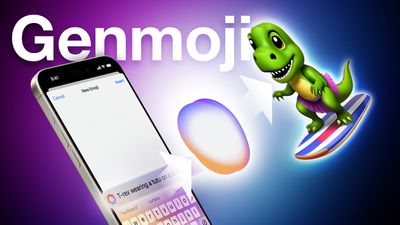
Genmoji is also getting an update so it will use fewer resources, causing less battery drain and fewer heat problems. Genmoji will be better quality with a new Genmoji model, and a Suggested Genmoji feature will bring up custom emoji ideas based on your media and text history.
Writing Tools
Apple is testing an expanded version of Writing Tools that will do more rewriting and text generation than the current version. There is a "Write with Siri" toggle at the top of the keyboard, according to Bloomberg, along with a "Help Me Write" option that comes up when Siri is activated while a text field is open.
Apple is going to add a dedicated AI grammar checker that will work alongside the current spell check. When writing in Messages, Mail, and other apps there will be a translucent menu that slides up from the bottom of the iPhone's screen, and it will show suggested revisions next to the original written text.
Users can go through the suggestions and accept or reject them one by one, approve all of the changes at once, or ignore the changes.
Other Features
- Wallpaper - There will be an option to generate custom wallpapers with the Image Playground app, with the feature built into the interface for selecting a new wallpaper.
- Safari - Safari will get an updated start page with four tabs for switching between favorites, bookmarks, Reading List, and history.
- Calendar - Rumors suggest the Calendar app will incorporate new AI features. Siri will also be able to draw on information in the app.
- Health - With a new calorie scanning feature coming to the Camera app, calorie tracking will be more prominent in the Health app. Apple was also planning a Health+ subscription service, and while that's been scaled back, there could be other AI health app changes.
- Weather - The Weather app will have a new Conditions panel for switching between temperature, rain, and wind from the main interface, without the need to tap into a weather module.
- AirPods settings - The AirPods interface in the Settings app will be simplified, with options featuring better organization. Major features like hearing health will be easier to find.
- AirPlay Alternatives - Apple is adding a feature that will let users beam content to AirPlay alternatives like Google Cast. It could be limited to iPhone users in the EU because it is being implemented as a Digital Markets Act requirement.
iOS 27 System-Wide Design Changes
There are system-wide design changes coming in iOS 27. The separate tab bar in apps like Apple Music, Podcasts, News, and Apple TV will be adjusted to combine search with the other navigation options. Apple separated search in many apps when introducing Liquid Glass, but it's reverting to the original look.
When using the on-screen keyboard, there's a new animation that shows the keys sliding up from the bottom of the iPhone interface, and Apple is adding redo and undo controls for easier customization of the Home Screen's icon and widget layouts.
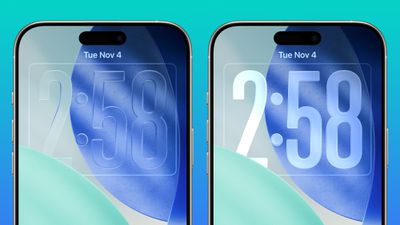
Apple doesn't plan to make major changes to the Liquid Glass aesthetic in iOS 27, but the company is mulling a system-wide setting that would precisely adjust the look of the interface. In iOS 26.2, Apple added a slider that lets users adjust the opacity of Liquid Glass for the Lock Screen's clock, and that setting could be expanded to the entire operating system.
iOS 27 Updates for Foldable iPhone
The first foldable iPhone will be introduced in September. Rumors suggest that it will feature a 5.5-inch display when folded, and a 7.8-inch display when it's opened up like a book.
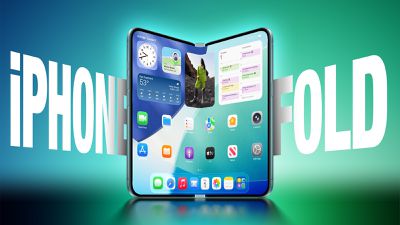
An iPhone with a larger display will require major updates to iOS, and iOS 27 will focus on building new interfaces and experiences made for a larger smartphone display.
The iPhone Fold will operate like a cross between an iPhone and an iPad, but it will run iOS, not iPadOS, and it won't support iPad apps. When unfolded, the iPhone will have an iPad-like layout that supports multitasking with two apps side-by-side. Many of Apple's iPhone apps will have sidebars on the left of the display, with Apple providing developers with tools to easily adapt their apps to the new layout.
Apple is using a wider design for the iPhone Fold than most foldable smartphone makers have used, and it is rumored to have an iPad-like 4:3 aspect ratio. When the iPhone is closed, it will have a standard iPhone layout that looks like the version of iOS we have now.
iOS 27 Satellite Features
Apple is working on several new satellite features for the iPhone, and it's possible some features could be introduced as soon as 2027.
- Apple Maps via satellite
- Photos in Messages via satellite
- Satellite API framework for third-party apps
- Satellite over 5G
- Satellite connectivity without the need for a view of the sky
iOS 27 Accessibility Updates
Each May, Apple previews new accessibility features that are coming later in the year. This year, Apple showed off some new options that are expected in the iOS 27 update.
Apple is adding new Apple Intelligence features to VoiceOver, Magnifier, Voice Control, and Accessibility Reader.
- VoiceOver Image Explorer uses Apple Intelligence for detailed descriptions of images throughout the system, including photographs, scanned bills, and personal records. Users can press the Action button on the iPhone to ask questions about what the camera viewfinder sees, with follow-up questions supported in natural language.
- Magnifier brings Apple Intelligence-powered visual descriptions to its high-contrast interface for users with low vision, with support for spoken commands like "zoom in" or "turn on flashlight."
- Voice Control gains natural language input so users can describe onscreen elements conversationally, such as "tap the guide about best restaurants" or "tap the purple folder," rather than memorizing exact label names or numbers. Apple says the feature can also help when users want to access on-screen elements that don't have clear accessibility labels.
- Accessibility Reader gains support for more complex document layouts including scientific articles with multiple columns, images, and tables, plus on-demand summaries and built-in translation that retains a user's custom font, color, and formatting preferences.
- Generated Subtitles use on-device speech recognition to automatically transcribe spoken audio in uncaptioned video content, including clips recorded on iPhone, received from friends and family, or streamed online, across the iPhone, iPad, Mac, Apple TV, and Apple Vision Pro. The feature will be available in English in the U.S. and Canada at launch.
iOS 27 Performance and Stability
Bloomberg has described iOS 27 as a "Snow Leopard" update, suggesting that Apple will focus on improving underlying performance and quality.
Apple is prioritizing cleaning up the iOS code and removing anything that's outdated, which could mean upgrading apps to improve performance and rewriting some existing features to be more efficient. The code updates could provide a more responsive, faster version of iOS.
Apple is also aiming for efficiency improvements that could translate into tangible battery life gains.
iOS 27 Compatibility
iOS 27 is expected to drop support for the iPhone 11, iPhone 11 Pro, iPhone 11 Pro Max, and second-generation iPhone SE. It will be available on all other iPhones that support iOS 26.
iPadOS 27
Many of the features that are coming in iOS 27 will also extend to the iPad, including all of the new Siri capabilities. We haven't heard rumors of iPad-specific features as of yet.
macOS 27
Like iOS 27 and iPadOS 27, macOS 27 will adopt the new version of Siri with chatbot capabilities, personal context and the ability to access data on your Mac, and improved integration in and between apps. A standalone Siri app for the Mac is likely.
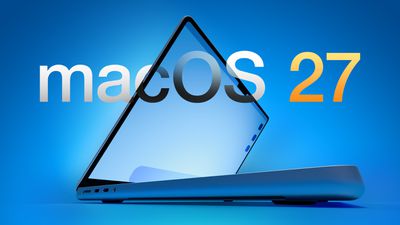
We've heard a lot about what Siri will look like on the iPhone, with it set to be integrated into the Dynamic Island, but no detail on how Siri will look on the Mac. The Siri Mac interface will be more of a surprise.
The Photos app feature for AI reframing and extending an image will be available, as will the text-based option to create a Shortcut with natural language commands. Grammar checking capabilities will be added to Writing Tools, and Image Playground and Genmoji will see improvements to the underlying models. Apple is experimenting with more realistic models, so Image Playground might be able to generate content that's not so cartoonish.
Safari is expected to have a new feature that uses AI to automatically group tabs that are similar to one another, expanding on the tab groups feature.
In iOS 27, we're getting some minor tweaks to Liquid Glass, including tab bars that do away with the standalone search option and possibly a slider for adjusting the overall look of Liquid Glass, but we know less about what to expect for Liquid Glass on the Mac. There has been criticism of the Mac's Liquid Glass interface in particular, so Apple could have changes planned.
Bloomberg claims Apple is working on a "slight redesign" for macOS 27, with plans to address "quirks" with shadows and transparency.
Apple is working on an OLED MacBook Pro with a touchscreen, so there could be new touch-based interface options hidden in macOS 27. The OLED MacBook Pro likely isn't launching until early 2027, so it's not something we're expecting to see in the launch version of macOS 27.
macOS Naming
We don't know what Apple is going to call macOS 27, but it will likely continue to have a California landmark name. The filename of Apple's hashmoji for WWDC 2026 on X is "Project Big Bear," leading to speculation that Apple might go with macOS Big Bear.
The filename could be unrelated to macOS 27, and it's possible Apple will choose something else entirely. Apple has trademarked multiple California-themed names in the past, including Diablo, Grizzly, Mammoth, Miramar, Pacific, Redtail, Redwood, Shasta, Skyline, and Tiburon.
Performance Improvements
Apple has been working on refinements to macOS that will include bug fixes, performance improvements, and tweaks to boost battery life.
No More Intel Macs
Apple is dropping support for Intel Macs with macOS 27, so if you have an Intel Mac, it's not going to be able to run the new Mac software. macOS Tahoe is the last version of macOS that will work on Intel Macs.
Apple is also phasing out Rosetta 2 support, and macOS 27 will be the last version of macOS that includes it. Rosetta 2 lets Apple silicon Macs run apps built for Intel Macs, so older apps that still have the outdated architecture will no longer work in macOS 28.
Current Intel Macs that run macOS Tahoe but won't run macOS 27 include the 13-inch MacBook Pro from 2020, the 16-inch MacBook Pro from 2019, the 27-inch iMac from 2020, and the 2019 Mac Pro.
watchOS 27
In watchOS 27, Apple plans to introduce new watch faces, including a variant of the Modular Ultra face. The new watch face will have a large time readout with three complications, and it will be available for all Apple Watch models.
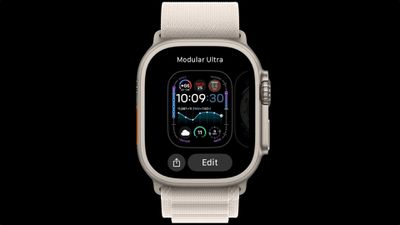
We haven't heard anything else about new watchOS 27 features, and Apple Watch software updates tend to be on the smaller side. With Apple planning to add an option for generating a wallpaper using AI on the iPhone, it's possible there could be some Apple Watch equivalent feature.
Some of the new Siri features could work on the watch, and some of the AI features might transition, like grammar correction when writing or dictating on the watch.
tvOS 27
We haven't heard anything about tvOS 27, and Apple TV updates are usually not super exciting. With the Apple TV expected to be refreshed with a chip that works with Apple Intelligence later this year, we could see Apple introduce some AI features for the Apple TV.

Better TV and movie recommendations are a possibility, as is a more capable Siri that is better at handling requests. There could also be new smart home integrations that will work alongside a centralized smart home hub Apple is rumored to be launching this year. One feature we do know about is larger text, which is an Accessibility option Apple is adding.
visionOS 27
visionOS 27 will apparently be "light on new features," but it could get the same AI app updates and Siri changes that are coming to Apple's other platforms.
New Hardware?
There are several products that Apple is still expected to launch in 2026, but it's not looking like any of them are going to be unveiled at WWDC. With several new software updates to cover and an all-new version of Siri, Apple may not want to take the focus away from its software announcements.
We are expecting M5 Mac Studio and Mac mini updates at some point, plus there could be a new iMac. Unfortunately, high RAM costs and chip shortages mean delayed Mac refreshes, and new models aren't expected until later in the year.
The low-cost iPad still hasn't been refreshed, and updates for the HomePod mini and Apple TV are apparently ready to go. There's also a new smart home hub tied to the new version of Siri, but it's not likely to come out until Siri sees an official launch in the fall.
How to Watch
WWDC 2026 begins at 10:00 a.m. Pacific Time on June 8. Apple plans to stream the WWDC keynote on YouTube, the Apple TV app everywhere it's available, and the Apple Events website.
For those who are unable to watch the livestream, we'll have live coverage at MacRumors.com and the MacRumorsLive X (Twitter) account.
Launch Timeline
Betas of iOS 27, iPadOS 27, macOS 27, tvOS 27, watchOS 27, and visionOS 27 will be seeded to developers after Apple's keynote event. Public betas will come out in July, and after several months of testing, the updates will launch to the public in the fall.










 iOS 27 is rumored to be focused on bug fixes and performance improvements, and this should result in "longer battery life," according to








 Apple and MLB today released the