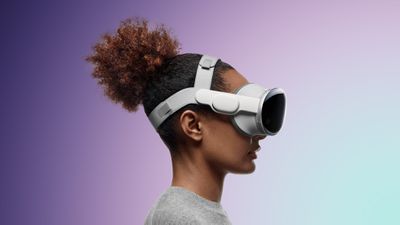
Apple Vision Pro users could soon be able to scroll through content with their eyes, according to Bloomberg. Apple is working on a visionOS 3 feature that would eliminate the need for hand gestures when browsing websites, reading, and more.
The Vision Pro already supports navigating through the operating system by looking at an item and then using a hand gesture to "tap" it, so eye-based scrolling would be a natural extension of that existing functionality. Apple plans to add eye scrolling capabilities to all of the built-in apps on the Vision Pro, and it is developing APIs that will let developers do the same.
There are multiple cameras in the Vision Pro that are used for eye tracking purposes and for iris scanning, a biometric authentication feature. Apple has experimented with eye tracking on other devices too, with an Accessibility feature on the iPhone and iPad allowing iOS users to look at an onscreen pointer that follows eye movement. With this option, users can look to navigate, and then focus their eyes on one spot to perform a tap action.
visionOS 3 is set to debut at the Worldwide Developers Conference that starts on Monday, June 9.
The new Pride Edition Sport Band for the Apple Watch is now available to purchase in person at Apple Store locations in the U.S. and select other countries.
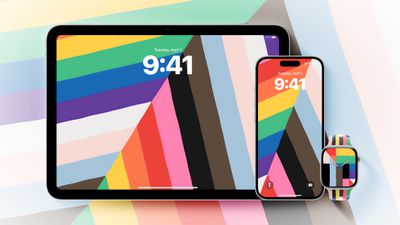
Apple unveiled the band last week, as part of its 2025 Pride Collection, which also includes a new Pride Harmony watch face and a matching iPhone and iPad wallpaper. The watch face and wallpaper are available starting with watchOS 11.5, iOS 18.5, and iPadOS 18.5. All three software updates were released two days ago.
The band has been available on Apple.com since last week, and in-store availability commenced by today. Available in 40mm, 42mm, and 46mm sizes, the band features rainbow stripes that vary in shape and size, with no two bands looking exactly alike.
In the U.S., the band costs $49.
The matching Pride Harmony watch face features rainbow stripes that dynamically shift to form large hour numerals as users raise their wrist to check the time.
The matching iPhone and iPad wallpaper features colorful stripes that change position as users move, lock, or unlock their devices.
Apple says its Pride Collection celebrates the strength and beauty of LGBTQ+ communities around the world. In addition to the Pride Collection, Apple said it is proud to financially support organizations that serve LGBTQ+ communities.
Note: Due to the political or social nature of the discussion regarding this topic, the discussion thread is located in our Political News forum. All forum members and site visitors are welcome to read and follow the thread, but posting is limited to forum members with at least 100 posts.
Apple led the global tablet market in the first quarter of 2025, achieving 14% year-over-year shipment growth amid heightened demand for iPads, according to new data from Canalys.
Worldwide tablet shipments reached 36.8 million units in the first quarter 2025, representing an 8.5% year-over-year increase. Apple shipped 13.7 million iPads during the quarter, up from 12.1 million in the first quarter of 2024, raising its global market share from 35.5% to 37.3%. The company's performance came in the context of growing replacement demand for tablets first purchased during the early stages of the COVID-19 pandemic, supported by recent hardware updates to the iPad lineup.
Apple's shipment growth outpaced the broader market average and occurred despite increased competitive pressure from Chinese vendors including Xiaomi, Huawei, and HONOR. According to Canalys, these brands gained market share by targeting lower cost segments with wide device portfolios and by leveraging ecosystem integration across devices. Xiaomi, in particular, saw a 56.1% year-over-year increase in tablet shipments, reaching 3.1 million units and surpassing Lenovo for the first time.
Every year heading into WWDC, one thought on many Mac fans' minds is what Apple will choose as the name for the next version of macOS. The tradition dates all the way back to the beginning of Mac OS X with its big cat names like Leopard, and Apple shifted to California-themed names with the unveiling of OS X Mavericks in 2013.
Back in 2014, we discovered more than 20 California-themed trademark applications filed by various limited-liability companies, which were all but certain to be shell companies created by Apple to hide its identity. Over time, some of the trademarks like Yosemite, Sierra, Mojave, Monterey, Mojave, Ventura, Sonoma, and Sequoia were indeed used as macOS names, while trademark applications for other names were abandoned.
Apple has still proceeded to use some of the names with abandoned trademark filings as macOS names, such as Big Sur in 2020. So, there is still a possibility that macOS 16 will use one of the names that Apple had filed to protect many years ago.
Here is a list of the remaining macOS name possibilities that Apple had filed to protect:
California
Condor
Diablo
Farallon
Grizzly
Mammoth
Miramar
Pacific
Redtail
Redwood
Rincon
Shasta
Skyline
Tiburon
Apple's trend of using Tiburon in iPhone marketing images in recent years has led some fans to speculate that macOS 16 could be named macOS Tiburon, but this is obviously far from concrete evidence. Indeed, it was once on the trademark path, though.
Of course, there is no guarantee that Apple will ever use any of these names. It is simply fun to think about the possibilities each year.
Today we're tracking a handful of Apple accessory discounts on Amazon, including an all-time low price for the Apple Pencil Pro and a solid deal on the AirTag 4-Pack. Neither deal requires a coupon code this time around, as both have been applied automatically by Amazon.
Note: MacRumors is an affiliate partner with some of these vendors. When you click a link and make a purchase, we may receive a small payment, which helps us keep the site running.
Starting with the Apple Pencil Pro, you can get this accessory for $99.00, down from $129.00. This is a match for the record low price on the Apple Pencil Pro, and it's a deal that doesn't typically stick around long on Amazon, so if you've been waiting for it to return, be sure to check it out soon.
Secondly, Amazon has the AirTag 4-Pack for $79.98, down from $99.00. This is a second-best price on the accessory, and you can find the 1-Pack on sale as well on Amazon, available for $24.95, down from $29.00.
If you're on the hunt for more discounts, be sure to visit our Apple Deals roundup where we recap the best Apple-related bargains of the past week.
Deals Newsletter
Interested in hearing more about the best deals you can find in 2025? Sign up for our Deals Newsletter and we'll keep you updated so you don't miss the biggest deals of the season!
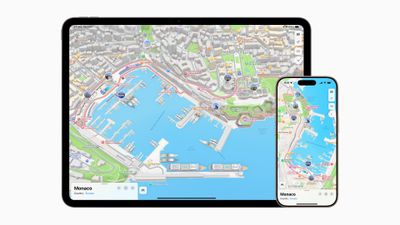
Apple today announced a new custom city experience and guide for the upcoming Formula 1 TAG Heuer Grand Prix de Monaco 2025.
The new Detailed City Experience includes custom-designed 3D Monégasque landmarks of significant locations, such as Casino de Monte-Carlo, Fairmont Monte Carlo, Hôtel de Paris Monte-Carlo, Yacht Club de Monaco, and the F1 Paddock Club. When dark mode is enabled at dusk, the 3D rendition of Monaco gains a unique moonlit glow effect.
There are also new details to represent road markings, land cover, trees, and public transit routes, and important navigation details like turn lanes, medians, bus and bike lanes, and pedestrian crossings. There is also a new windshield view for drivers, which displays a road-level view as the user approaches interchanges.
The F1 racetrack will be highlighted with markers for the circuit's turns, as well as 3D representations of grandstands, footbridges, the finish line, and more. The Maps app will also show advisories like road closures. Apple senior vice president of services, Eddy Cue, said:
Apple Maps is the best way to navigate and explore the world, so we're excited to bring this amazing experience to F1 fans and attendees of the Grand Prix de Monaco. Whether fans are there in person or watching from afar, the beautifully designed Detailed City Experience and Monaco Grand Prix features give them an incredible view into Monaco, just in time for the race and the upcoming premiere of F1 The Movie.
They'll be able to navigate the principality during the iconic Formula 1 TAG Heuer Grand Prix de Monaco 2025 and hunt down key landmarks in Monaco and the race, to truly feel part of the action ahead of the film's launch at the end of June.
In celebration of next month's release of Apple Original Films' "F1 The Movie," starring Brad Pitt, Maps users will also be able to explore a custom Guide featuring the world's most iconic F1 racetracks, including Monaco and other tracks featured in the movie.
The new Apple Maps experience rolls out later today. The Formula 1 Grand Prix de Monaco takes place from May 23 to May 25. Apple's original "F1 The Movie" debuts on June 25.
Apple is believed to be developing several technological innovations to mark the 20th anniversary of the iPhone, and one key technology it's considering is Mobile High Bandwidth Memory (HBM), according to a report from ETNews.
HBM is a type of DRAM that stacks memory chips vertically and connects them via tiny vertical interconnects called Through-Silicon Vias (TSVs) to dramatically boost signal transmission speeds. It's primarily used in AI servers today, and is often referred to as AI memory due to its ability to support AI processing alongside GPUs.
Mobile HBM is what the term suggests – a variant of the technology for mobile devices that is designed to deliver very high data throughput while minimizing power consumption and the physical footprint of the RAM dies. Apple is looking to enhance on-device AI capabilities, and ETNews reports that connecting mobile HBM to the iPhone's GPU units is being considered as a strong candidate for achieving this goal.
The technology could be key for running massive AI models on-device, such as for large language model inference or advanced vision tasks, without draining battery or increasing latency.
The report indicates that Apple may have already discussed its plans with major memory suppliers like Samsung Electronics and SK hynix, both of which are developing their own versions of mobile HBM.
Samsung is reportedly using a packaging approach called VCS (Vertical Cu-post Stack), while SK hynix is working on a method called VFO (Vertical wire Fan-Out). Both companies aim for mass production sometime after 2026.
As always though, there are manufacturing challenges. Mobile HBM is a lot more expensive to manufacture than current LPDDR memory. It could also face thermal constraints in slim devices like iPhones, and the 3D stacking and TSVs require highly sophisticated packaging and yield management.
If Apple does adopt this technology for its 2027 iPhone lineup, it would be yet another example of the company pushing the envelope for its 20th anniversary iPhone, which is rumored to feature a completely bezel-less display that curves around all four edges of the device.
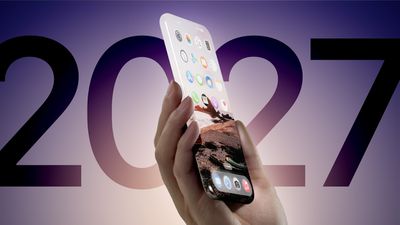
Apple is reportedly considering a radical redesign for the 20th anniversary iPhone that could feature a completely bezel-less display that curves around all four edges of the device, claims a new report out of Korea.
ETNews writes that Apple is aiming to use "four-edge bending" display technology for the 2027 iPhone that would curve not just along the left and right sides as seen in some current smartphones, but also wrap around the top and bottom edges. This would create a truly borderless visual experience with content flowing seamlessly across all sides of the device.
This follows a report by Bloomberg over the weekend that said Apple plans to launch a "mostly glass, curved iPhone without any cutouts in the display." The Information last week also cited multiple sources claiming that at least one new iPhone model launching in 2027 will have a truly edge-to-edge display. Bloomberg previously reported that the device would be a Pro model in Apple's 2027 lineup.
Based on the latest report, the ambitious design would eliminate traditional screen borders entirely, potentially marking one of the most significant design shifts in the iPhone's history since the 10th anniversary iPhone X, which saw Apple drop the Home button, introduce a notched display, and adopt an intuitive swipe gesture-based navigation interface.
The new display technology is said to be part of Apple's broader push toward next-generation hardware for the commemorative iPhone. The company is also reportedly looking to develop an OLED display driver IC (DDI) based on 16nm FinFET process technology, instead of the traditional 28nm planar process currently used.
The display driver technology would apparently deliver significant power efficiency improvements, which is likely to be increasingly important as smartphones get thinner and enhanced on-device AI features demand more power. The report also claims that Apple's 20th anniversary iPhone could include pure silicon batteries instead of graphite-based ones for increased energy density.
Apple is expected to begin discussions with OLED suppliers Samsung Display and LG Display about implementing the advanced technologies for the anniversary model, according to the report.
Technical Challenges
Achieving a four-sided curved all-display design would present Apple with some major technical challenges, such as placing the front-facing sensors, cameras, and speakers under the display.
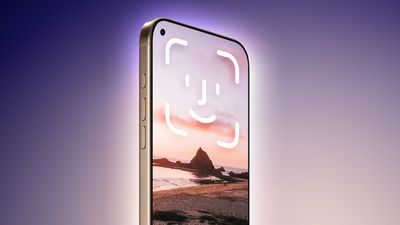
As a stepping stone towards this all-screen design in 2027, The Information on Tuesday reported that the iPhone 18 Pro and iPhone 18 Pro Max will be equipped with under-screen Face ID, with only a small pinhole remaining for the front camera on those devices. Counterpoint Research vice president Ross Young has since corroborated the report.
As for the front-facing camera, several Android phones already feature under-display selfie cameras, and Apple has reportedly been working on its own solution for some time. According to an April 2024 report, LG Innotek – one of Apple's Korean suppliers – is developing under-display cameras that leave no visible hole when inactive. These systems use a "freeform optic" multiple lens array designed to reduce image distortion and improve brightness, compensating for the light loss that typically occurs when a camera sits behind a display.
However, another concern adopting a four-sided curved all-screen design would be structural integrity, since bending the screen on all sides would introduce new stress points that could be more vulnerable to damage from drops. The described design could also require big changes to user interaction. With no bezels to rest fingers on, Apple would likely need to develop new palm-rejection algorithms and potentially revise iOS gesture navigation for edge-sensitive input.
Assuming the reports are accurate, Apple has some major hardware and software hurdles to overcome over the next two years. If the company can pull it off though, such a design sounds like a fitting way to celebrate two decades of Apple's most iconic product.
While the iPhone 17 Pro models are still around four months away, there are already rumors about next year's iPhone 18 Pro models.
The latest word comes from Counterpoint Research vice president Ross Young, who has a good track record with display-related information for future Apple products. In a social media post today, he relayed more information that suggests the iPhone 18 Pro models will be equipped with an under-screen Face ID system.
"At the SID Business Conference today, OTI Lumionics CEO Michael Helander confirmed that they expect phones with under panel Face ID using their materials to be available for sale in 2026," wrote Young. "This suggests that iPhone 18 Pro models will have under panel Face ID with other brands and models to follow."
Earlier this month, The Information's Wayne Ma also reported that iPhone 18 Pro models will feature under-screen Face ID. He said the devices will have only a small hole in the top-left corner of the screen, to accommodate the front camera. The devices will no longer have a pill-shaped cutout at the top of the screen, according to the report, but is unclear if that means the Dynamic Island feature will be discontinued.
Apple should release the iPhone 18 Pro models in September 2026.
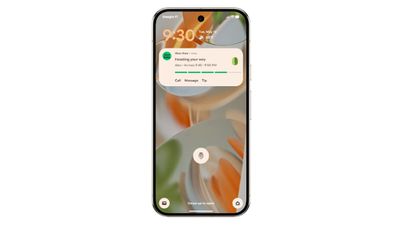
Google today previewed the next-generation version of Android, which has an updated design language that's more expressive, and a range of new features. One of the main new additions is Live Updates, a feature that mirrors Live Activity on the iPhone.
Live Updates lets Android users track progress notifications from apps in real-time, much like Live Activity. Google says that Live Updates will work with top delivery, ride share, and navigation apps.
With Live Activity, incoming food deliveries, sports games, and more can be tracked from the iPhone's Lock Screen or with the Dynamic Island, and Google's feature works in a similar way. Android users will see Live Updates on the lock screen and home screen, and can tap into a menu bar option to get more information.
Google is revamping Android with an interface focused on color, movement, and haptics, and it'll be interesting to see how it compares to the rumored iOS 19 redesign that Apple has in the works.
Google took some cues from Apple on security, adding a Find Hub that's similar to the Find My app for tracking people, items, and devices, with Google even teaming up with airlines for luggage recovery. There's also an Advanced Protection option that looks similar to Lockdown Mode, offering additional safeguards against malware and suspicious contact for journalists and politicians.
More new features that are coming to Android 16 will be introduced at Google I/O next week.
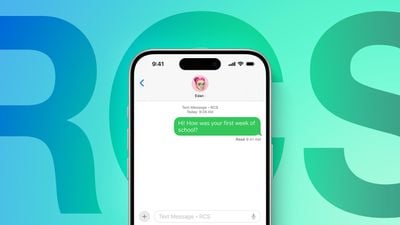
Over a billion RCS messages are sent on a daily basis in the United States, Google said today. RCS, or Rich Communication Services, is a communication protocol that replaced the prior SMS and MMS messaging standards.
It was developed by the GSM Association, but Google has been championing it for years. Apple held out on adopting RCS for quite some time, but finally added support with the launch of iOS 18. On devices running iOS 18, RCS is the default messaging protocol for texts between an iPhone user and an Android user.
Apple's adoption of RCS has undoubtedly increased the number of RCS messages sent per day, but Google's 1 billion figure includes Android to Android text messages along with Android to iPhone text messages (and vice versa).
RCS is a notable improvement over SMS and MMS, and it makes for a better texting experience between iPhone users and Android users, as Android users can't take advantage of iMessage. Some of the RCS features:
Support for higher resolution photos and videos.
Support for larger file sizes and file sharing.
Audio messages.
Cross-platform emoji reactions.
Real-time typing indicators and read receipts.
Better group chats with support for removing people.
The option to send messages over cellular or Wi-Fi.
For iPhone to iPhone conversations, iMessage is still the default, but RCS has made "green bubble" texting with Android users less of a hassle.
RCS is supported by the major carriers in the United States, but some smaller carriers like Boost Mobile, Mint Mobile, Ting, and others have yet to add support.
Ecovacs today announced the launch of its new flagship robot vacuum, the X9 Pro Omni. The robot is able to vacuum and mop floors, and it includes HomeKit integration so it can be controlled using Siri and the Home app.
The X9 Pro Omni is a sensor-laden cleaning bot that can vacuum and mop floors throughout the home, while also using AI to navigate obstacles like pets, items on the floor, furniture, and more. The bot is able to map an entire home with its 3D sensors, detecting walls and using a moving mop and side brush to get debris out of corners and along walls.
Like the prior-generation X8 Pro Omni, the new X9 model features Ecovacs' standout mopping feature, the Ozmo Roller Mop that self washes as it cleans, so that dirty water isn't spread over the floor. The X9 Pro Omni has separate clean and dirty water tanks in the robot itself, which is a unique cleaning feature, plus the mopping brush offers more downward pressure than traditional mop heads for a better clean. The mop is able to lift when the robot encounters carpets, so water does not get on rugs or carpeted areas, and it has hot air drying when cleaning is finished.
As for vacuuming, the X9 Pro Omni uses what Ecovacs calls "Blast" technology, with a 100W high-torque motor and optimized airflow path for better, quieter suction. There is a ZeroTangle brush for pet and human hair that does not get clogged up, cutting down on maintenance.
The X9 Pro Omni refills itself at a base station equipped with clean water, a dust bag, cleaning fluid, and a dirty water reservoir, and all of its functions are controlled via the Ecovacs iPhone app. There are a range of cleaning modes, from just vacuuming to a deep clean, and there are options for using the robot as a home camera that can move from room to room.
The X9 Pro Omni is one of a handful of robot vacuums that offers Matter integration, and with Matter, it is able to connect to HomeKit. As of iOS 18.4, Apple's Home app has supported robot vacuums, which means you can ask Siri to vacuum or mop your house. Siri can be used for an overall cleaning, or you can ask Siri to clean specific rooms. The Home app is also available, as is the Ecovacs app.
The X9 Pro Omni can be purchased from the Ecovacs website for $1,300, which includes a limited time $300 discount to celebrate the launch. We'll have a review of the new robot coming in the next few weeks.
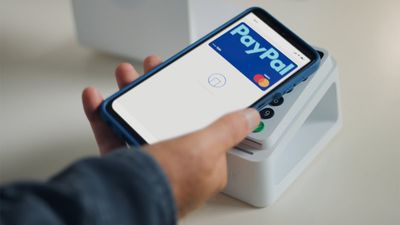
Earlier this month, PayPal said that it would debut contactless iPhone payments in Germany, and German iPhone users now appear to be able to use the feature. According to German site iPhone Ticker, some PayPal customers in Germany have access to PayPal as an alternative to Apple Pay.
PayPal can be used for NFC tap to pay functionality just like Apple Pay, with payments initiated in the same way. PayPal users in Germany are able to set PayPal as the default payment app over Apple Pay, using the side button to bring up PayPal as a payment option for one-tap contactless payments in retail locations.
If PayPal is not set as the default payment method, contactless payments can be made by opening up the PayPal app.
PayPal is able to offer direct tap to pay options in Germany because the Digital Markets Act in Europe forced Apple to allow third-party apps to use the iPhone's NFC chip. Apple has historically restricted access to NFC for payment purposes, only allowing contactless payments with Apple Pay.
With the new regulations, third-party apps from payment services and banks can access the full functionality of the NFC chip, giving iPhone users an alternative to Apple Pay and the Wallet app.
Germany is PayPal's first test market, but the rollout is likely to expand to other European countries in the coming months. To use PayPal for contactless payments, German iPhone users will need the latest version of the PayPal app and a compatible debit or credit card. PayPal can be used in retail stores where Mastercard payments are accepted.
PayPal's tap to pay options are limited to the iPhone, and the feature does not work on the Apple Watch because Apple has not been required to open up NFC on the Apple Watch. PayPal won't be able to bring the contactless payment option to the United States or other countries unless those locations adopt similar rules requiring Apple to expand NFC access.
To attract customers to use PayPal instead of Apple Pay, PayPal is offering cashback promotions in the PayPal app, and will eventually add a pay over time feature with options for six, 12, and 24 monthly installments for purchases.
NFC access is available for banking and wallet apps in the European Economic Area, which includes the 27 European Union countries plus Iceland, Liechtenstein, and Norway.
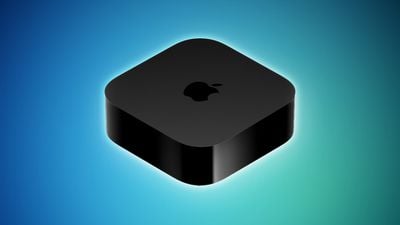
The tvOS 18.5 update that Apple released yesterday adds support for synchronizing Dolby Atmos playback to speakers over AirPlay or Bluetooth, according to Apple's release notes for the update.
The feature could help address some persistent syncing issue that some Apple TV users have encountered when trying to play audio with Dolby Atmos. There are multiple complaints on Reddit and the Apple Support forums about Dolby Atmos audio syncing issues with sound bars and speakers, including those connected via AirPlay and Bluetooth, such as the HomePod.
On affected devices, users find that dialog and other audio can be slightly out of sync with the content that's playing, so lips do not move correctly when people speak in TV shows and movies, and sound effects like explosions are delayed. Switching to 5.1 surround sound eliminates the problem, but people with expensive audio setups have been understandably disappointed not to be able to use Dolby Atmos.
Apple says that the new Dolby Atmos synchronization feature for AirPlay and Bluetooth speakers can be found by going to Settings > Video and Audio > Wireless Audio Sync.
Remotely controlling the shutter on your iPhone's camera lets you include yourself in the photo while avoiding the limitations of a selfie. For example, it allows you to take a picture of a wider scene with you included in the frame, which is ideal for landscape shots or group photos. If your iPhone is on a tripod, taking the shot remotely also reduces the risk of camera shake. Here's how to do it – and you don't need an Apple Watch.
There are more ways than one to take a picture on your iPhone remotely. If you have an Apple Watch, you can open the Camera Remote app that comes included in watchOS (see the second set of steps below). If you don't have an Apple Watch, here's how to use Voice Control.
Use Voice Control to Take a Photo
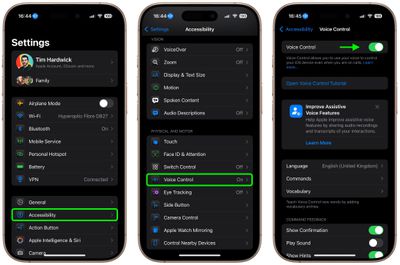
If you don't have an Apple Watch, don't worry. You can also use Voice Control to remotely control the camera on your iPhone. That's because you can trigger the camera shutter with the volume buttons, which can also be controlled with your voice. Here's how it works.
Launch the Settings app and tap Accessibility.
Tap Voice Control.
Turn on the switch next to Voice Control so it's in the green ON position. (You should see a Voice Control active symbol and a little orange dot icon at the top of the screen indicating that Voice Control is using the microphone.)
Next, launch the Camera app and line up your shot.
When you're ready, say "Turn up the volume," to activate the camera's shutter and take the picture.
When you're finished, you can disable Voice Control by toggling the switch again in Settings.
Control Your iPhone's Camera With Apple Watch
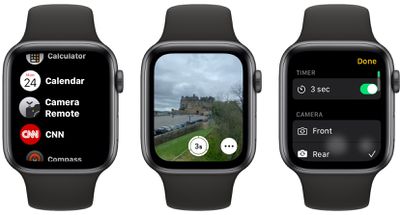
Launch the Camera Remote app on your wrist.
Position your iPhone to frame the shot you want to take.
Tap the Shutter button on your Apple Watch screen.
By default, the shot is taken after three seconds to give you time to move into position, but you can disable the time and control other settings including flash, and Live Photo by tapping the ellipsis (three dots) button. The menu that this calls up also lets you switch between the front and rear iPhone camera.
Final tip: If you're familiar with the Shortcuts app, you can find a shortcut in the Gallery called "Say Cheese" that lets you use Siri to control your iPhone's camera remotely. Once you've added it to your active shortcuts and given it permission to access your camera and microphone, you'll be able to take photos remotely by saying "Hey Siri, say cheese."
Apple and Universal Music Group today jointly introduced a new "Sound Therapy" collection of wellness playlists, consisting of popular songs with added sound waves or white noise to help listeners focus, relax, and sleep better.
Sound Therapy features three categories: Focus, Relax, and Sleep. The playlists include extended, instrumental, and reimagined versions of popular tracks from artists such as Imagine Dragons, Katy Perry, Kacey Musgraves, and others.
The playlists were crafted by a team of producers, scientists, and audio engineers at Sollos, a music-wellness venture within Universal Music Group.
Apple's announcement explains further:
Songs have been enhanced with auditory beats or colored noise to help encourage specific brain responses. Gamma waves and white noise — a whoosh-like combination of every sound frequency — may help with focusing; theta waves could aid in relaxation; and delta waves and pink noise — a deeper, gentler variation akin to rain or wind — might assist in achieving better sleep. A dreamy version of Katy Perry's "Double Rainbow," for example, could help listeners drift off to sleep, while an Imagine Dragons track might help them tackle a to-do list.
The playlists are powered by Universal's proprietary audio technologies, and they are backed by scientific research, according to Apple.
"Sound Therapy harnesses the power of sound waves, psychoacoustics, and cognitive science to help listeners relax or focus the mind," says Apple's announcement.
Sound Therapy is available exclusively on Apple Music.
iOS 19 will not be unveiled until June, but Apple today previewed a long list of new accessibility features that will be coming with the software update, including two CarPlay enhancements that can benefit both drivers and passengers.
We already highlighted some of the key new features, ranging from a new Accessibility Reader to a Magnifier app on the Mac. Below, we have pasted Apple's entire list of additional features, including some of the smaller ones.
For CarPlay, this includes support for the Large Text option that has long existed on iPhones. Apple is also expanding the Sound Recognition feature for drivers or passengers who are deaf or hard of hearing. CarPlay will be able to provide a notification if it hears a crying baby inside the vehicle, whereas the feature is currently limited to detecting sounds outside the vehicle, such as horns and sirens from police cars, ambulances, and fire trucks.
Here is the complete list of additional features, as worded by Apple:
Background Sounds becomes easier to personalize with new EQ settings, a timer to stop sounds automatically, and new automation actions in Shortcuts. Helps minimize distractions and may aid tinnitus.
Personal Voice now creates a voice in under a minute using 10 phrases, with more natural results thanks to on-device AI. Adds support for Spanish (Mexico).
Eye Tracking users on iPhone and iPad can use a switch or dwell to make selections. Keyboard typing is improved across iPhone, iPad, and Vision Pro with a dwell timer, fewer steps, and QuickPath.
Head Tracking allows users to control iPhone and iPad with head movements.
Assistive Access adds a simplified Apple TV app and an API for developers to create tailored apps for users with intellectual and developmental disabilities.
Music Haptics becomes more customizable, allowing users to feel haptics for vocals only or an entire song, with adjustable intensity.
Sound Recognition adds Name Recognition to alert users when their name is called.
Voice Control adds a programming mode in Xcode, vocabulary syncing, and expands language support to Korean, Arabic (Saudi Arabia), Turkish, Italian, Spanish (Latin America), Mandarin Chinese (Taiwan), English (Singapore), and Russian.
Live Captions adds support for English (India, Australia, UK, Singapore), Mandarin Chinese (Mainland China), Cantonese (Mainland China, Hong Kong), Spanish (Latin America, Spain), French (France, Canada), Japanese, German (Germany), and Korean.
CarPlay now supports Large Text and enhanced Sound Recognition to detect a crying baby, horns, and sirens for deaf or hard-of-hearing users.
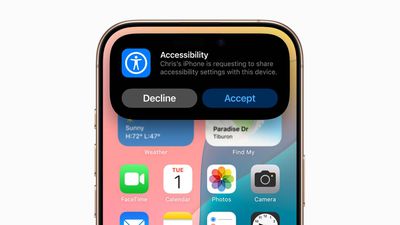
Share Accessibility Settings lets users quickly share their accessibility preferences with another iPhone or iPad — ideal for temporary device use in public or shared spaces.
iOS 19 will be unveiled during the WWDC 2025 keynote on Monday, June 9. Following months of beta testing, the software update should be released in September, bringing these features to the masses. Many of the accessibility features will also be available on iPadOS 19, macOS 16, watchOS 12, and visionOS 3.
Amazon today has low prices across nearly the entire M4 MacBook Air lineup, with up to $167 off both 13-inch and 15-inch models. Many of the notebooks in this sale are seeing delayed delivery estimates, with most arriving in late May or early June, but if you're interested you can lock in these deals now ahead of those delivery dates.
Note: MacRumors is an affiliate partner with some of these vendors. When you click a link and make a purchase, we may receive a small payment, which helps us keep the site running.
Starting with the 13-inch models, Amazon has up to $155 off all three of the new configurations of this notebook. Prices start at $849.00 for the 256GB model, then raise to $1,049.00 for the 16GB/512GB model and $1,245.26 for the 24GB/512GB model. All of these are solid second-best prices on the M4 MacBook Air, and only a few dollars higher compared to their all-time low prices..
Moving to the larger display models, Amazon has both 512GB versions of the 15-inch M4 MacBook Air on sale this week, as well as the 256GB model. The 16GB/512GB model is available for $1,249.00 and the 24GB/512GB model is on sale for $1,432.00. Across the board, these are all record low prices on the 15-inch M4 MacBook Air.
If you're on the hunt for more discounts, be sure to visit our Apple Deals roundup where we recap the best Apple-related bargains of the past week.
Deals Newsletter
Interested in hearing more about the best deals you can find in 2025? Sign up for our Deals Newsletter and we'll keep you updated so you don't miss the biggest deals of the season!
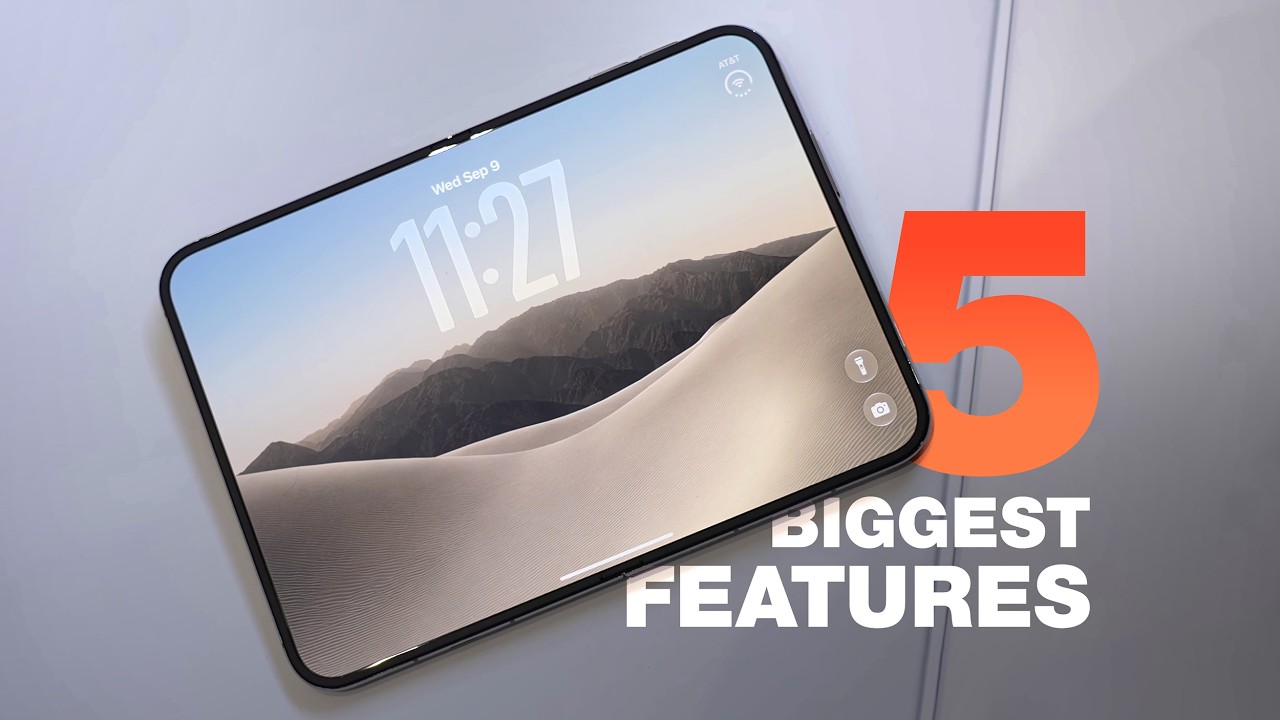
Apple's first foldable iPhone, with a book-style design featuring a 5.4-inch outer display and a 7.6-inch inner display with a minimal crease down the middle.


 Note: MacRumors is an affiliate partner with some of these vendors. When you click a link and make a purchase, we may receive a small payment, which helps us keep the site running.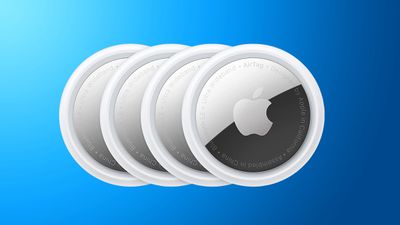








 Note: MacRumors is an affiliate partner with some of these vendors. When you click a link and make a purchase, we may receive a small payment, which helps us keep the site running.