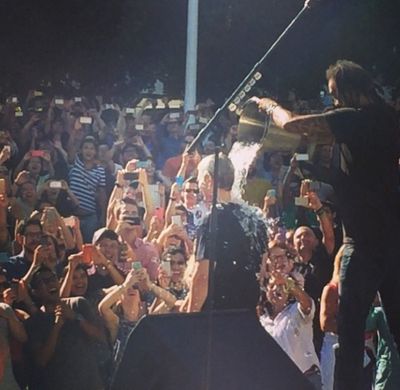
Apple CEO Tim Cook today took the "Ice Bucket Challenge," which is designed to raise awareness for amyotrophic lateral sclerosis or ALS, also commonly known as Lou Gehrig's Disease.
The challenge asks people to pour buckets of ice water over their heads (documented on film and shared on social media sites) and then tag three friends to do the same. Friends unwilling to complete the challenge are asked to donate money towards ALS, but as noted by The Verge, many participants have chosen to participate and donate money to the cause.
According to Instagram and Twitter photos, Tim Cook had a bucket of ice water dumped on him at Apple's Cupertino campus this afternoon during the company's bi-weekly beer bash while Vanilla Ice's Ice Ice Baby played in the background. Cook was first challenged yesterday by Apple marketing chief Phil Schiller, who completed the challenge himself.
Schiller, who dumped a bucket of ice water over his own head at a beach in Half Moon Bay, also challenged actor Chris O'Donnell and his wife Kim. Cook has gone on to challenge Apple board member Bob Iger, musician Michael Franti, and Beats co-founder Dr. Dre.
Phil Schiller takes the challenge
Many notable celebrities and tech industry leaders have completed the ice bucket challenge in recent weeks, including Facebook founder Mark Zuckerberg and Microsoft CEO Satya Nadella. As of August 12, the challenge has raised more than $4 million in donations.
Update: Apple has posted a full video of Cook and Franti taking the challenge.
Beats Music, now owned by Apple, has created a documentary to celebrate the 25th anniversary of Do The Right Thing, a Brooklyn-based film created by Spike Lee. The 22-minute short features Spike Lee and Danny Aiello revisiting some of the original spots where the movie was shot, contrasted by shots from the film itself.
It also delves into some behind the scenes information on the building of the set and the creation of the movie, revisiting many of the actors who starred in the film and getting details on the making of the movie from the original crew.
Towards the end, the documentary features a huge block party thrown by Beats Music in the Brooklyn neighborhood where Do The Right Thing was filmed, with celebrity attendees like Erykah Badu, Dave Chapelle, Wesley Snipes, and Mos Def. The family-friendly event featured a performance of "Fight the Power" by Public Enemy along with activities for kids and adults alike.
As noted by Variety, Beats Music's new documentary suggests the company remains dedicated to expanding the Beats Music brand even after its purchase by Apple. According to rumors, one of the many potential reasons Apple purchased Beats was to up its "coolness" factor among younger consumers, a position Beats has earned with both edgy advertising campaigns like the Do the Right Thing documentary and celebrity endorsements.
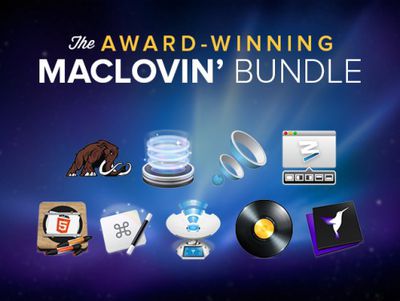
StackSocial is currently offering a bundle of 8 Mac apps, featuring several that have won awards from Apple and Macworld. All buyers receive the following apps for just $39.99, a significant discount compared to the total retail value of $362:
Notably, djay was included in Apple's "Best of Mac App Store" list in 2011 and was updated earlier this year to include full Spotify integration. Cinemagraph Pro was selected as an Apple Design Award winner at WWDC in June.
The first 5,000 buyers of the MacLovin' bundle also receive the OS X App Masterclass, a Mac app development e-learning course that has a retail value of $499, which bumps the total retail value of the bundle to $861.
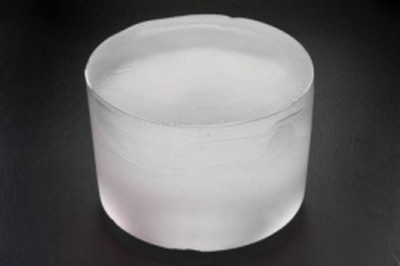
Apple has plans to use a sapphire crystal display in the higher-end models of the two versions of the iPhone 6 that it plans to debut this fall, reports The Wall Street Journal. Because of the higher cost of sapphire, Apple may also charge more for the high-end versions of the devices.
Apple is considering using sapphire screens in more-expensive models of the two new, larger iPhones it plans to debut this fall, if it can get enough of the material, people familiar with the matter say. Some analysts expect Apple to charge more for the phones than previous new models, because of increased component costs.
Multiple iPhone 6 rumors have speculated that sapphire could be constrained to either the larger 5.5-inch iPhone 6 or the higher-end models due to cost and production issues, but The Wall Street Journal is the first mainstream publication to confirm those rumors.
If Apple is only planning to use sapphire in the higher-end models of the 4.7 and 5.5-inch iPhone 6, that could explain why a sandpaper test on a leaked iPhone 6 front panel revealed that it was not made of pure sapphire.
Apple is investing a considerable amount of money into partner GT Advanced’s sapphire plant, shelling out more than $500 million to outfit the factory with high-output furnaces for sapphire production. Rumors have suggested GT Advanced has the capability to eventually produce enough sapphire to outfit 100 to 200 million iPhones, but other rumors have pointed towards high costs and production problems as limiting factors. Apple is also planning to use sapphire for the upcoming iWatch, according to The Wall Street Journal. The first sapphire displays for the two devices are "expected to roll off production lines this month."
Sapphire is seen as a desirable material due to its extreme durability and scratch resistance, but many smartphone manufacturers have suggested Apple’s plan to use the material is just a marketing gimmick due to its prohibitive cost.
While Apple may not be able to produce the entire lineup of iPhone 6 displays in sapphire, rumors have suggested that when the factory is fully functional, it will give the company a way to produce massive quantities of sapphire at a low cost, which means a full sapphire lineup could be more feasible for future devices.
After nearly three and a half years with only a minor processor bump, Apple late last year launched its redesigned Mac Pro, moving to a compact cylindrical design relying on a slew of Thunderbolt 2 ports for expandability. While the new machine began shipping in the last few days of 2013, extreme shortages of the machine persisted for months and it wasn't until two months ago that shipping estimates reached the "within 24 hours" level and Apple's own retail stores began stocking the Mac Pro for immediate purchase.
Potential Mac Pro customers may now, however, be starting to look forward to the first update for the redesigned Mac Pro, as Intel appears set to launch new processors appropriate for the Mac Pro next month. As highlighted by Macworld UK, Intel's "Grantley" Xeon E5 v3 chips are nearly ready to ship as successors to the current "Romley" Xeon E5 v2 chips used in the Mac Pro.
Intel announced last month that it had begun shipping at least some versions of the new Xeon E5 v3 chips to server makers, and widespread availability is reportedly set for September. ChipLoco outlined a significant set of E5-2600 v3 series chips, including several that recently became available for pre-order and could be used as an upgrade to the current top-of-the-line 2.7 GHz 12-core E5-2697 v2 chip found in the Mac Pro.
The direct successor to the current chip is the 2.6 GHz 14-core E5-2697 v3 chip, although the new chip does come with a higher thermal rating and it is unclear whether that change would have any impact on Apple's willingness to use the chip in the Mac Pro. Other variants in the new high-end E5-269x v3 series range from 12 to 18 cores.
Below the top end, Apple currently uses E5-1600 v2 series processors, and Intel is reportedly preparing a full set of successor v3 chips for launch next month.
As with the E5-2600 v3 series chips, these E5-1600 v3 series chips come with higher thermal ratings than their predecessors. All of the new chips in both series also support faster DDR4-2133 memory, which will also contribute to improved performance.
On the graphics side, Apple uses customized versions of AMD's FirePro series of high-end graphics cards, although Apple's D300, D500, and D700 options can be roughly equated with AMD's W7000, W8000, and W9000 on the PC side. Over the last several months, AMD has been updating its FirePro cards, culminating with this week's introduction of four new cards, including the W7100 successor to the W7000 card. Alex4D summarizes how the W9100/W8100/W7100 cards introduced in recent months compare to their predecessors and collates a handy comparison chart showing how these new and old cards compare to Apple's D-series cards.
At each level AMD have at least doubled the VRAM, added 40% more stream processors. The W8100 and W9100 have wider memory buses (so more information can be transferred for each command) and many more transistors.
Although Apple can specify any number of stream processors, clock speeds or VRAM, these more recent cards show what AMD considers is the low-, medium- and high-end when it comes to PCs. For Mac owners perspective, they show how much card for a similar amount of money AMD can now make compared with the cards in the Mac Pro and 2012.
As for when updated Mac Pro models might arrive, that remains unclear, but the good news is that the pieces supporting a potential upgrade are starting to fall into place. While Intel's new processors are reportedly scheduled to arrive next month, it is unlikely a Mac Pro upgrade is that close given Apple's usual iPhone focus for that month. But it seems possible an upgrade could be in the works by late this year or early next year depending on how Apple decides to space out its product launches and at what point it views the Mac Pro as in need of a boost.
According to a report from Thailand's Thai Rath newspaper [Google Translate], Apple has already met with officials at the country's National Broadcasting and Telecommunications Commission (NBTC) to discuss the recent disclosure that two iPhone 6 models have been approved by the government agency for import into the Asian country.
NBTC secretary Takorn Tantasith earlier this week released the approval information on two "iPhone 6" models A1586 and A1524, reportedly in accordance with guidelines that require the public announcement of approved hardware. The declaration, which he also broadcast on Twitter, contained only the product name and model numbers, but no other details about the iPhone 6 handsets. As noted by several observers, the iPhone 6 approval was the first time a specific device was named in a Tweet by the NBTC secretary, making it an obvious deviation from usual practice.
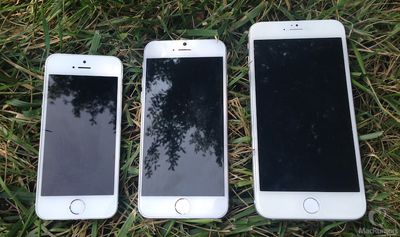
4.7-inch and 5.5-inch iPhone 6 mockups compared to iPhone 5s
Apple is unsurprisingly upset with this public notification, claiming the disclosure released confidential information about its upcoming handset. The NBTC secretary countered Apple's assertion, arguing that that these announcements do not reveal confidential product details and are meant to protect consumers. He said Apple would be within its rights to penalize Thailand for this leak by canceling its plans to release the iPhone in Thailand later this year, but he stands by his decision to disclose the approval. Translation by a MacRumors reader:
The Secretary General said that everything is done according to the protocol and on August 8 the NTBC has approved the two phone models. He insisted that all that was disclosed is not considered a trade secret and Apple only requested for the specification to remain a secret. As for the specs, the NBTC did not disclose anything.
Apple requested a meeting with NBTC officials to discuss the situation, with Apple emphasizing that the new device may not necessarily be called "iPhone 6" but otherwise resolving the matter.
Mr. Takorn said that representatives from Apple South Asia from the Singapore HQ arrived to “have a chat” with him and clarified that the 2 phone models may not use the name “iPhone 6” to market and the company want to make sure that the NBTC understands this fact. Apple in Singapore will also explain the situation to Apple in the US about this matter. Apple also reassured the NBTC that this “leak” has no effect in Apple’s plan to launch and sell the iPhone in Thailand.
Rumors suggest Apple is working on two iPhone models for release in the upcoming months. The next generation handset is expected to be unveiled during a September 9 press event with a 4.7-inch model slated to go on sale shortly after the announcement. A larger 5.5-inch model may debut alongside the smaller model or up to a few months later.
With under four weeks to go until the expected introduction of the iPhone 6, increasingly complex parts are continuing to leak. Just weeks ago, photos showing two bare logic boards similar to but distinct from corresponding parts from existing iPhones surfaced, lending credence to rumors of two larger iPhone 6 models.
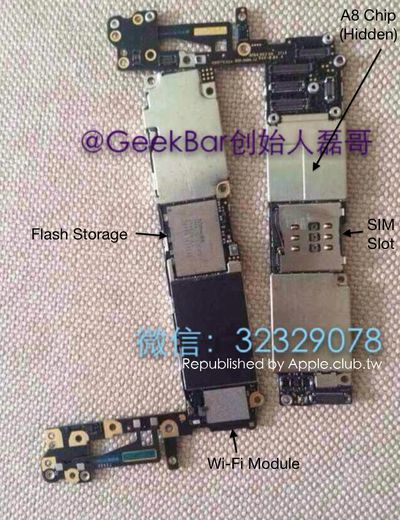
One of those logic boards has now been revealed in what appears to be a fully assembled state in a photo reposted by Apple.club.tw [Google Translate]. While several physical features such as the nano-SIM slot, a number of connectors for flex cable components, and a flash storage chip that appears to be from Toshiba are visible in the somewhat blurry photo, the most interesting components of the board unfortunately remain hidden under electromagnetic shielding. A silver component at the bottom of the board on the left is almost certainly the Wi-Fi module, although no identifiable markings can be seen.
Annotated photo of iPhone 6 logic boards
A second photo [Google Translate] shared by Apple.club.tw today shows a pair of flex cables also said to be from the iPhone 6. The cables appear to be the same as seen in a detailed photo of the front panel display assembly yesterday.
Apple supply partner Pegatron has won a contract that will see it produce 25 million of the estimated 50 million 4.7-inch iPhone 6 units to be shipped this year, reportsDigiTimes. It was reported in January that the company would be awarded 50% of the orders, however a report in May pegged that number at 15%.
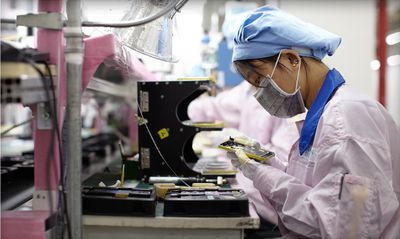
The report also notes that the rest of the orders for the iPhone 6 are expected to go to Foxconn, who has helped produce iPhone 5s and other Apple devices. Pegatron's relationship with Apple is said to also have grown tighter recently, as the supplier has managed assembly for the iPad mini and the iPhone 5c throughout the past year. It is currently unknown which supplier will take care of orders for the 5.5-inch iPhone 6, although the larger device could see constrained supply this year due to production challenges.
Apple will publicly unveil the iPhone 6 for the first time at an event on September 9, with a launch for the 4.7-inch version likely coming a week later as with prior years. In addition to a larger display, the phone is expected to feature a thinner, curved bezel and incorporate a faster A8 chip, an advanced camera, and iOS 8.
Apple announced today that it is banning the use of benzene and n-hexande, two potentially hazardous chemicals, during final assembly for both iPhone and iPad, according to the Associated Press. Benzene is a carcinogen that has been linked to leukemia when not handled properly and n-hexane has been linked to nerve damage.
The decision announced Wednesday comes five months after the activist groups China Labor Watch and Green America launched a petition drive calling on Apple Inc. to abandon the use of benzene and n-hexane in the production of iPhones.
The Cupertino company conducted a four-month investigation at 22 factories and found no evidence that either benzene or n-hexane endangered the 500,000 workers at those factories. Four of the factories had traces of the two chemicals at "acceptable safety levels" while the other 18 contained no trace of either.
Still, Apple decided to order its suppliers to stop using the two chemicals for final assembly for iPhones, iPads, Macs, iPods and accessories. The factories will also be required to test all substances to make sure the chemicals aren't present, even if they're not listed in the ingredients. The two chemicals are often found in cleaner used on machinery and electronics.
However, Apple will still allow benzene and n-hexane at plants responsible for the early production phase of its devices, which are, for the most part, different from the final assembly plants. Apple is lowering the maximum amount of the two chemicals that can be used during early processes.
Lisa Jackson, Apple's VP of environmental initiatives, told the AP that the company wanted to be "responsive to concerns" and "crack down on chemical exposures".
"We think it's really important that we show some leadership and really look toward the future by trying to use greener chemistries."
The two chemicals aren't exclusively used by Apple's manufacturing processes, as other large tech companies have faced the same criticisms. Small traces of benzene can also be found in gasoline, cigarettes, paints, glues and more.
Back in early July, Samsung launched a new Galaxy S5 ad calling iPhone users "Wall Huggers" and mocking the iPhone for having a short battery life while touting the battery-saving capabilities of its own newest flagship phone.
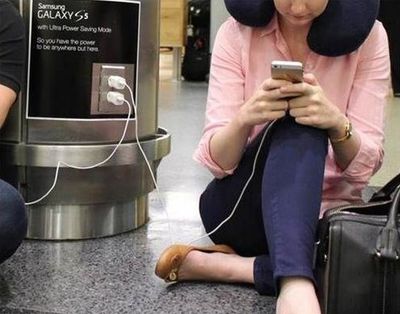
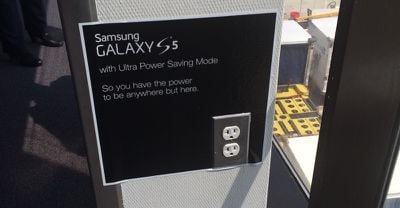
Samsung has now expanded its "Wall Huggers" advertising campaign to select airports, according to CNET, displaying Galaxy S5 ads alongside power outlets.
In addition to highlighting the Galaxy S5's Ultra Power Saving Mode, the ads include the words "So you have the power to be anywhere but here," possibly poking fun at Apple's own recent line of app-focused advertising, which revolves around the tagline "You're more powerful than you think."
First introduced in February, Samsung's 5.1-inch Galaxy S5 includes a fingerprint sensor, a water resistant casing, and a heart rate sensor, along with one of its most highly touted features, the Ultra Power Saving Mode. This mode activates a black and white display with limited app access when the phone's battery is low, cutting off LTE and disabling WiFi/Bluetooth to provide up to an additional 24 hours of standby time with less than 10 percent of battery left.
While Apple does not have a similar power saving feature on the iPhone, it does provide users with quick access to settings like WiFi and Bluetooth, plus options to disable battery draining features like background app usage and location services. Apple's newest operating system, iOS 8, also includes battery saving functions like Battery Usage, which lets users keep an eye on apps that are draining too much power.
Many people are hoping Apple's upcoming iPhone 6 will introduce better battery life, but signs have pointed towards only modest battery gains thus far. Various rumors suggest the 4.7-inch iPhone 6 could get a battery between 1,800 and 2,100 mAh, a moderate improvement over 1,560 mAh battery in the iPhone 5s.
Samsung's Galaxy S5 ads can be found at the John F. Kennedy International Airport in New York, at the Newark Liberty International airport in New Jersey, and at the O'Hare and Midway airports in Chicago. The advertisements may also expand to other airports in the future.
Update:MacRumors reader Harrison Weinerman has sent in a much clearer image of Samsung's new outlet ad taken in Terminal C at the Newark airport in New Jersey on August 10.
Following the release of a new 10.9.5 beta for developers, Apple today released Safari 7.0.6 for OS X Mavericks and Safari 6.1.6 for OS X Mountain Lion to the public, bringing new security fixes to the browser.
The new Safari builds can be downloaded through the Software Update mechanism in the Mac App Store.
Apple has also previously seeded Safari 6.2 and Safari 7.1 for Mountain Lion/Mavericks to developers, and it's likely that update will see its public release alongside OS X Yosemite.
Update 2:00 PM PT: This post originally identified Safari 7.0.6 and Safari 6.1.6 as beta software available only to developers, which has since been corrected.
Popular email app Mailbox was today updated to version 2.1, adding several new email management features. It's now possible to print emails, mark them as spam, or mark them as unread by tapping on a new options menu denoted by three dots on the app's thread view or within individual messages.
Along with these new management tools, Mailbox has gained Passbook integration. Users can select a ticket or other attachment in the inbox, which will then be added directly to Passbook.
The app will also permanently delete messages that have been swiped to the trash and it has been updated to support 19 different languages and 24-hour time.
Now translated into 19 languages, including Chinese (both Simplified and Traditional), Danish, Dutch, French, German, Indonesian, Italian, Japanese, Korean, Malay, Polish, Brazilian Portuguese, Russian, Spanish (both European and Latin American), Swedish, Thai and English
- View spam and mark messages as spam - Passbook support - Permanent delete from trash and spam - Bug fixes and performance improvements
First introduced in early 2013, Mailbox proved to be ultra popular, requiring a reservation system that restricted access to a limited number of users for several weeks. Shortly after its release, however, the app was acquired by file-sharing and storage service Dropbox, and has seen several major updates since then.
Following previous photo sets showing an unfinished 4.7-inch iPhone 6 rear shell and assorted other parts in recent weeks, luxury modified iPhone vendor Feld & Volk [Instagram page] has shared another set of high-quality photos showing parts from the device. While many of the parts have already been seen, this new set provides our best look yet at some of those, as well as a few new ones.
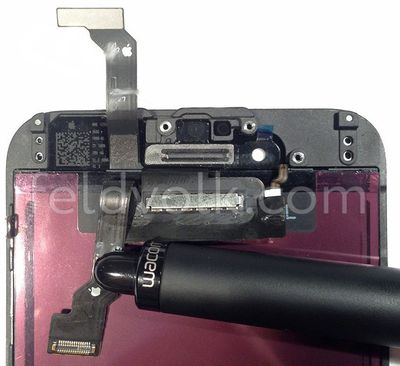
One photo shows the inside of the front panel and display assembly, with some of the components near the top pulled apart to give a good look at how the digitizer/LCD flex cables and earpiece come together with room for the front camera and proximity/ambient light sensors all packed into one small area of the device.
Several other photos also highlight how the edges of the front panel taper. Those tapered edges should sit essentially flush with the edges of the rounded rear shell, providing for a sleek, nearly seamless look and feel for the iPhone 6.
Before announcing an enterprise partnership with IBM, Apple reportedly had discussions with Hewlett-Packard over a mobile search product nicknamed "Enterprise Siri." Detailed in a report from The Information (via BusinessInsider), "Enterprise Siri" is an HP product designed to allow employees to ask their devices for company-specific information like financial data or product inventory numbers.
According to The Information's report, though Apple held discussions with HP, the latter company has also been in talks with Google's Android unit for the past year over a potential partnership for the "Enterprise Siri" technology, which could lead to something like an enterprise version of Google Now for corporate data.
The idea is for employees to be able to ask their Android device for company information such as financial data or product inventory information in the same way they do routine personal searches for weather, traffic or restaurant locations. Google search doesn't currently offer any such integration with corporate databases and software applications, but it's an area Google has looked at as it tries to chip away at the iPhone's lead among business customers.
Now that Apple has inked a deal with IBM to further its hold on the enterprise market, a deal with HP for a powerful enterprise search product could allow Google to gain ground as well.
While more than 98 percent of Fortune 500 companies already use Apple devices in their businesses, Apple's recent partnership with IBM has the potential to skyrocket Apple's enterprise sales. As part of the deal, IBM will develop more than 100 industry-specific native apps that are built from the ground up for the iPhone and the iPad to draw new customers in industries like retail, healthcare, banking, travel, transportation, and more.
IBM will also offer Apple's iOS devices to its corporate customers and has plans to provide cloud storage, analytics services, and 24/7 assistance to enterprise customers under a new AppleCare plan. IBM's first apps will roll out this fall, with additional apps coming in 2015.
Apple today seeded Mavericks 10.9.5 build 13F14 to developers, just over a week after seeding the second OS X 10.9.5 beta, build 13F12, and more than a month after releasing OS X 10.9.4 to the public.
The beta is available through the Software Update mechanism in the Mac App Store and through the Mac Developer Center.
It is unclear what improvements the 10.9.5 update will bring to Mavericks, but it is likely to include bug fixes and stability enhancements. Apple is asking developers to focus on USB, USB Smart Cards, Graphics, Safari, and Thunderbolt.
Along with working on improvements to Mavericks, Apple is also beta testing OS X Yosemite, which is due to be released in the fall. The last Mavericks update, 10.9.4, added several Wi-Fi fixes and improved wake from sleep reliability.
The iPhone 6 is expected to be announced on September 9th, 2014 with an Apple Media event. The actual launch will likely take place a couple of weeks later.
Some of the first rumors of any new Apple iPhone seems to come from the case manufacturers. There's a huge financial incentive for case manufacturers to be early to market with case designs for a new iPhone. The first leaked schematics for the iPhone 6 were published in March, 2014 and the first cases based on the designs started appearing shortly thereafter.
These case-design leaks aren't always correct, but this time there have been part leaks as well. Our iPhone 6 roundup goes into great detail about what we know so far.
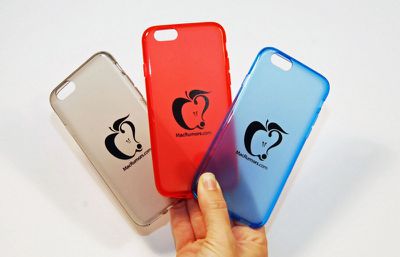
During our early iPhone 6 research, we obtained a batch of 200 rumored 4.7" iPhone 6 cases with our logo on it. We thought they might be useful on day one of iPhone 6 launch, or could simply serve as a MacRumors souvenir if the specs turn out to be not-quite-right. So, we're giving away 200 4.7" iPhone 6 cases to 200 of our mailing list members selected at random. To be clear, these cases might not even fit the real iPhone 6-- but that's part of the appeal. The case colors will be distributed at random, but possibilities include red, blue, grey, and frosted clear.
We'll be giving out other prizes over time to our mailing list subscribers. Official rules are available here. For this initial prize, we have to limit it to U.S. mailing addresses only, due to the cost of shipping 200 items internationally. iPhone 6 case giveaway contest deadline is midnight (Eastern) on the evening of Thursday, August 21st 2014. Winners will then be picked and mailed their cases, hopefully in time for September 9th.
Our mailing list provides readers with regular updates to the biggest stories on MacRumors.
The case giveaway is over, but future giveaways are planned.
If you are already a member of our mailing list, you still have to fill out this entry form (and check the agree checkbox) to get entered. You won't be added to our mailing list twice.
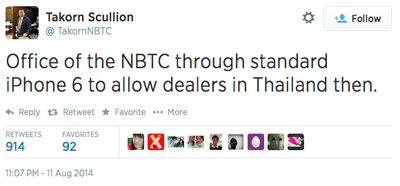
Takorn Tantasith, Secretary General of the National Broadcasting and Telecommunications Commission (NBTC) in Thailand, announced earlier this week that the agency has approved Apple's application to distribute two iPhone 6 models in the country, reports Manager Online [Google Translate]. The Secretary also tweeted word of the approval from his @TakornNBTC Twitter account.
Google Translate version of Tantasith's Tweet
Apple reportedly filed the import application on August 5 and received certification of equipment and a written approval notice on August 8 for two iPhones with model numbers A1586 and A1524. According to government regulations, these approvals must be announced publicly, but details on the iPhone 6 handsets referenced in the documents remain sealed.
Apple is expected to announce the iPhone 6 in early September with retail sales to follow in the weeks following the announcement. Apple reportedly is prepping two iPhone models, with a 4.7-inch version slated to launch first this fall and a 5.5-inch version that could launch either alongside or up to several months later than the smaller version.
An application for approval in Thailand over a month prior to the device's expected introduction is unusual and suggests Apple may be planning for a very large number of countries in the initial wave of launches. For the iPhone 5s, Thailand was part of the second wave of launches that took place on October 25, 2013, and the company reportedly did not apply for approval in the country until September 16, 2013.
New reports from Chinese media sources (Google Translate, via G for Games) claim that the iPhone 6 has entered a final product validation testing stage ahead of mass production before its launch this fall. Apple is reportedly working with Foxconn's Zhengzhou factory to produce a small number of units to ensure quality control standards have been implemented, as the device will then be mass produced at Apple's various supply partners.
Previously, a report last month claimed that Apple had already begun mass production for the iPhone 6, however it is possible that reported production issues may have led to delayed testing and output. It is also unknown whether this final testing stage is for both the 4.7-inch and 5.5-inch iPhone 6, as Apple has reportedly had issues in producing the latter's sapphire display and battery life.
Apple's iPhone 6 is expected to be announced at a launch event on Tuesday, September 9. In addition to a larger screen, the device will likely incorporate a thinner, rounded form factor and feature a faster and more efficient A8 chip, as well as an improved camera with stabilization.



 Apple has plans to use a sapphire crystal display in the higher-end models of the two versions of the iPhone 6 that it plans to debut this fall, reports
 Apple supply partner Pegatron has won a contract that will see it produce 25 million of the estimated 50 million 4.7-inch iPhone 6 units to be shipped this year,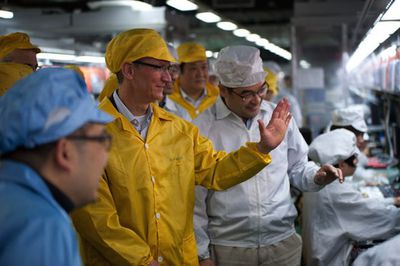


 Before