Apple has posted a message on its regional Taiwan website to announce the imminent opening of its first official retail store in the country. The store is located in the Xinyi District, on the ground floor and basement level of Taipei 101, the fourth tallest skyscraper in the world.
A specific opening date for the store has not yet been provided by Apple, but Taiwanese site AppleDaily speculates it will be by the end of the month, and the wording on Apple's website suggests it can't be far away now. The text on the celebratory page roughly translates to the following:
Taiwan's first Apple Store will soon open in Taipei!
Apple Store - Taipei 101 will provide a space for people to experience Apple's full range of products and services; At the same time, for people to come together to create, share and learn.
Much like how Taiwanese often gather under trees, with a pot of tea, to exchange ideas, share fun, and be prepared for the next journey.
To celebrate the opening, we have invited Taiwanese paper cutting artists, Shih Yi Yan, incorporating the same "tree as a gathering place" theme, to create a large cutout artwork to showcase the beauty of gathering. We welcome everyone to visit the Apple Store when you get a chance.
AppleDaily has grabbed some shots of the hoarding currently concealing the store, which covers 1,322 square meters across two floors.
Image via AppleDaily
Last July, we reported that Apple had posted its first job listings for a Taiwan store, which was soon followed by confirmation of its plans to set up a retail outlet in the country.
Image via AppleDaily
Apple currently only markets products in Taiwan through third-party resellers and direct through its regional online store, so today's announcement should come as good news for Apple fans there.
The company has opened 495 retail stores across 17 countries, including 270 in the United States and 225 elsewhere, since May 2001. We'll let readers know of the Taipei store opening date as soon as we hear of it.
This week in iOS gaming was a littler quieter than usual, likely due to two things: WWDC, obviously, causes most other people in the Apple universe to avoid the week as news from Apple dominates everything. Secondly, the surprise launch of Monument Valley 2 likely had many iOS developers scrambling to push the release date of their games back.
In TouchArcade news, we posted our hundredth weekly Hearthstone roundup. Similar to these roundups on MacRumors, every Monday morning we pile together everything you need to know to follow along with what's been happening in Blizzard's remarkably popular World of Warcraft-themed collectable card game. The constantly evolving metagame, esports aspects, and much more have made Hearthstone a staple in our community.
As mentioned, the release of Monument Valley 2 dominated everything this week. Apple stealthily announced the game during the WWDC keynote on Monday when they showed the new layout of the App Store, then mentioned the game was available immediately. Amusingly enough, ustwo studio head Dan Gray mentioned on Twitter that the game was actually available for download the week prior, but no one knew the magic URL.
Ustwo also posted part one of a behind the scenes series showing both the people and the studio behind the game. There's loads of great looks at different aspects of the art in the game as well as discussions surrounding the evolution of the story in the series along with the addition of the mother and daughter characters.
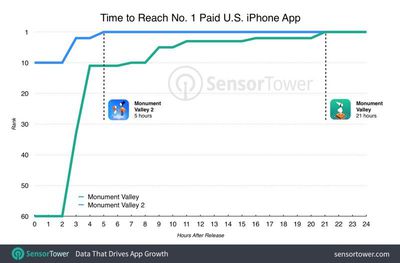
Monument Valley 2 also hit #1 on the iTunes charts much faster than the original Monument Valley. I'm not sure it's much of a surprise, given the success and popularity of the original, along with the absolutely ridiculous level of featuring it got from Apple. On launch day, Monument Valley 2 took over nearly every feature slot available on the App Store- A push we haven't seen since the launch of Supercell's Clash Royale.
In other iOS gaming news, Telltale's Guardians of the Galaxy had its second episode hit the App Store. If you've never played a Telltale game, they're really worth checking out. The Walking Dead is what put them on the map, but over the last few years they've released interactive story games that cover loads of popular IP ranging from Game of Thrones to Borderlands. Modern Telltale games play like a highly cinematic Choose Your Own Adventure book, and many of the first episodes of their games are available for free.
On Wednesday, the Apple Design Award winners were made public, and we've got an article digging into the five games that won. What had us raising our eyebrows this year was that two of the five games were not mobile-first titles. Mushroom 11 launched on Steam first, and Severed started its life as a PS Vita exclusive. Both are fantastic on iOS, however, and those two games as well as the other three winners, Blackbox, Splitter Critters, and Old Man's Journey are all must-haves.
If you're looking for something else to download this week, Xigma Games' Super Nano Jumpers was also released. We've seen tons of developers attempt to take a stab at the Super Meatboy tough-as-nails platformer genre, but this is among the best. Your character runs automatically, and instead of complicated virtual controls, you have two forms of input: Being able to stop, and jumping. The interesting twist is you can even stop in the air. It sounds strange, but it works incredibly well.
While details on the game itself are few and far between, alpha footage of GRID Autosport for mobile was released this week. This racing game looks shockingly similar to its console counterpart, and if nothing else, serves as an incredible example of how far mobile games have come since the launch of the App Store in 2008. We're keeping a close eye on this, and expect to hear more information when we get closer to launch this fall.
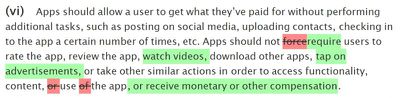
Last, but not least, is an interesting change to the wording of the App Store Review guidelines. way back in 2014, Apple suddenly decided to stop approving apps that incentivized viewing video ads for gameplay bonuses. Developers (and gamers) rapidly responded, and Apple relented. This new wording has loads of developers trying to figure out once again where in-game advertising lies going forward on the App Store. Given how many games rely on ads now, this is going to be a fascinating story to follow as it develops.
That's about it for this week! If you're interested in more news, reviews, and other things that pertain to iOS gaming, be sure to visit TouchArcade. We also stream iOS games on Twitch, and our channel is a great place to get a look at the latest and greatest iOS game releases in action.
Apple revealed more details of its new Business Chat feature for iMessage at a WWDC developer preview on Friday. Coming in iOS 11, Business Chat allows real customer service representatives to communicate directly with users, making the feature separate from existing AI chat bot systems.
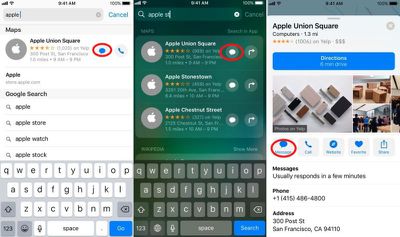
Users send the first message to start a Business Chat conversation by tapping Message icons that appear beside the names of businesses in Spotlight searches, Siri, and Maps, or by scanning a relevant QR code with their phone's camera. These actions switch them into the Messages app, where the business can offer products for sale, provide appointment scheduling options, and send notifications to customers in the related chat thread, among other services.
In addition to connecting the user with a business, the Message icons or QR codes can carry specific information that links the user with a particular geographic location, or a related product or service, and can even provide the customer service representative with the user's first language and any existing customer account details, including past orders and security questions.
To further the conversation, Siri's predictive text bar above the onscreen keyboard can offer up personal details like phone numbers or addresses to the user in case they want to share the information with the business. Elsewhere, a new Time Picker feature in Business Chat makes it easy for customers to select appointment times, while a List Picker lets users choose sale items, like clothes or groceries, with Apple Pay on hand as a convenient payment method.
To help businesses assist customers, Apple is also letting them build their own custom iMessage App extensions. One demonstration given on stage was of an airline seat selector app that allowed the user to tap where they wanted to sit in the cabin when booking a flight.
Crucially, businesses can only send notifications to users who have already initiated contact, and the customer can choose to turn off notifications of incoming messages, delete the chat thread entirely, or simply block the company from communicating with them outright.
Businesses with a Customer Service Platform (CSP) can register for Business Chat. Genesys, LivePerson, Nuance, and Salesforce CSPs are currently supported by Apple.
Business Chat is set to compete with similar services offered by the likes of Facebook Messenger, WhatsApp, Twitter, and Skype, but Apple has the distinct advantage of offering it as a native feature in iOS 11, which will eventually come pre-installed on new devices and will likely enjoy a high adoption rate by millions of existing users when it is released in the fall.
In a Friday session at the Worldwide Developers Conference, Apple revealed some major updates to is native Podcasts app that will be coming in iOS 11. Some of the changes will affect podcast listeners, while others should make it easier for podcasters to learn more about their audience's listening habits.
As mentioned at Apple's WWDC Keynote earlier this week, the Podcasts app is getting an overhaul in iOS 11. Along with a new interface and better title handling, changes to the way Apple's podcast feed works should make for an improved experience for the end user, as Six Colors' Jason Snell explained in a blog post on Friday:
New extensions to Apple's podcast feed specification will allow podcasts to define individual seasons and explain whether an episode is a teaser, a full episode, or bonus content. These extensions will be read by the Podcast app and used to present a podcast in a richer way than the current, more linear, approach. (Since podcast feeds are just text, other podcast apps will be free to follow Apple's lead and also alter how they display podcasts based on these tags.)
Thanks to the new extensions, users will be able to download full seasons, and the Podcasts app will know if a podcast is supposed to be listened to in chronological order or if the most recent downloaded episode is the most relevant to the listener.
The other updates revealed on Friday are more relevant to podcasters. Notably, Apple is launching in-episode analytics, which will enable podcasters to discover how many people are listening to their episodes and where in the app listeners are stopping and skipping. The analytics will use anonymized data to ensure user privacy while allowing podcasters to know more about listening habits, like how many people skip ads, or how long a podcast runs before listeners lose interest.
The redesigned Podcasts app will come will iOS 11, which Apple is releasing in the fall. A public beta of the operating system is expected later this month.
There's a major focus on the iPad in iOS 11, with Apple introducing a huge range of iPad-specific features that offer a much improved multitasking experience, allowing the iPad to better serve as a full PC replacement. Many of the features included in iOS 11 have topped the wish lists of iPad owners for years, including Drag and Drop, the Files app, the persistent dock, and more.
iOS 11 significantly overhauls the way the iPad can be used, as can be seen in our hands-on video covering the iPad-specific features you can expect to see in the update.
There's an expanded Dock on the iPad, which is persistent and can be pulled up with an upwards swipe from within any app. The Dock makes switching between apps much faster, and it enables multitasking features on compatible devices.
Opening the Dock while using an app and dragging a Dock icon upwards will pop up a new window, which can be pulled into a Slide Over or Split View multitasking arrangement. Using the dock, you can switch between Split View apps in seconds.
Accompanying the Dock is a new App Switcher that has a design similar to Spaces on the Mac. It shows all of your most recently used apps, it offers access to Control Center settings, and it even preserves your Split View or Slide Over window arrangements.
Drag and Drop, one of the most desired iPad features, has been implemented in iOS 11. With Drag and Drop, text, links, photos, files, and more can be transferred between apps with simple drag gestures. Drag and Drop supports multitouch, so you can do things like pull a link from Safari, bring up the Dock, open up Messages, and send the link to a friend. Combined with a new Files app, Drag and Drop makes it incredibly easy to manage files.
Apple Pencil support is also expanding in iOS 11. The Apple Pencil can be used systemwide like any other stylus (or a finger), and there are new features that have been designed with the Apple Pencil in mind, including Instant Markup, which allows essentially anything to be annotated, and inline drawing within Mail and Notes.
There's also a neat Instant Notes feature that lets you tap the Apple Pencil on the screen of an iPad Pro to automatically open a new Note for quick note taking purposes. All of the other features that are new in iOS 11 are available on the iPad, so check out our comprehensive iOS 11 roundup for a complete overview of what's coming in the update.
iOS 11 is limited to developers at the current time, but Apple plans to make a public beta available in late June so non-developers will have a chance to test the new iPad features at that time. We'll have more videos covering iOS 11 features coming next week, so make sure to stay tuned to MacRumors.com.
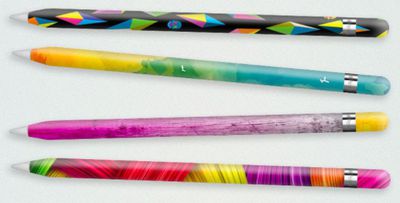
Using the Slickwraps design tool, customers can create their own skin with custom images, text, emoji, and clipart. The skins are available in gloss and matte finishes for $8.42 each, regardless of the design, plus shipping.
Slickwraps already sells a wide variety of predesigned Apple Pencil skins, including one that mimics a retro Mac, for $5.42 each plus shipping.
Apple updated its App Store Review Guidelines this week to indicate that developers may now sell virtual currencies in the form of in-app purchases to enable customers to "tip" content creators within apps.
Like all other in-app purchases, Apple will now receive a 30 percent cut from the virtual currencies used for tipping.
Tipping within apps is popular in China, where live-streaming apps like Yinke and Yizhibo have long allowed viewers to tip or give virtual gifts to the stars they watch as a token of gratitude, according to TechCrunch.
Last month, however, Apple reportedly told WeChat and several other Chinese social networking apps to disable their "tip" functions to comply with App Store rules, as many of the virtual currencies sidestepped Apple's 30 percent cut on purchases.
Now that Apple has formally outlined its stance on the matter, developers who previously feared repercussions from the company may be more inclined to begin offering virtual currencies for users to tip content creators with.
Beyond Apple's 30 percent cut, it's up to developers to determine how much of the tips are relayed to the content creators themselves.
For this week's giveaway, we've teamed up with Intrepid Bag Co to give MacRumors readers a chance to win an Intrepid Adventure Satchel that's been designed specifically for the new 2016 and 2017 13 and 15-inch Retina MacBook Pro models.
Like all of Intrepid Bag Co's products, the Adventure Satchel is made from high-quality full grain tobacco-colored leather that will age into a unique patina, making each bag one-of-a-kind. Intrepid says the satchel is its most rugged bag yet, made with old-world craftsmanship techniques, including hand pounded copper rivets and UV-resistant nylon stitching.
The Adventure Satchel comes in two sizes to accommodate either the 13-inch MacBook Pro or the 15-inch MacBook Pro. It was designed for the new MacBook Pros, but can also fit older models and other types of notebooks.
Under the flap, there's a dedicated laptop holder, a zippered compartment, two medium-sized interior pockets, a main interior pocket, a hidden passport pocket, 2 pen/stylus holders, and a key chain strap. At the sides, there are also two rain-proof flaps, and at the back, there's a quick access flat pocket that's sized to hold papers and other small accessories.
The satchel can be worn cross-body with a side mounted 1.5-inch strap made from leather and canvas, which is padded for comfort even under heavy loads, and there's also a hand-held strap at the top.
Intrepid Bag Co's new Adventure Satchels are on sale for a limited time, with the 13-inch model priced at $235 and the 15-inch model priced at $255. We've got one satchel to give away to a MacRumors reader for free.
To enter to win, use the Rafflecopter widget below and enter an email address. Email addresses will be used solely for contact purposes to reach the winner and send the prize. You can earn additional entries by subscribing to our weekly newsletter, subscribing to our YouTube channel, following us on Twitter, or visiting the MacRumorsFacebook page.
Due to the complexities of international laws regarding giveaways, only U.S. residents who are 18 years of age or older are eligible to enter. To offer feedback or get more information on the giveaway restrictions, please refer to our Site Feedback section, as that is where discussion of the rules will be redirected.
The contest will run from today (June 9) at 10:00 a.m. Pacific Time through 10:00 a.m. Pacific Time on June 16. The winner will be chosen randomly on June 16 and will be contacted by email. The winner will have 48 hours to respond and provide a shipping address before a new winner is chosen.
Apple today uploaded a pair of new iPad Pro-specific ads to its YouTube channel, each focusing on the advantages of owning the 10.5-inch or 12.9-inch iPad Pro.
In the first video, a Twitter user asks, "What's sooo great about the Apple Pencil?" Apple responds that its stylus is just like a real pencil and that when users write on an iPad Pro, "there's basically no lag."
In the second video, someone on Twitter is asking for a "more powerful computer," so Apple recommends that they try out the all-new iPad Pro and "unleash the fury" of its A10x fusion chip.
The new ads are a continuation of Apple's recent Twitter-based campaign, which sources real questions and comments from users on Twitter and uses actors to hold up the signs and do the voiceover work.
Earlier this year, Apple announced a few App Store review policy changes, which included the reveal of an official API for in-app review and rating requests that developers had the option to put in their apps beginning with iOS 10.3 and macOS Sierra 10.12.4. Additionally, Apple limited how often app developers can push out such prompts to just three times each year.
Today, 9to5Mac spotted a new section in the App Store Review Guidelines, pointing towards the launch of the new policy changes coming to iOS 11 and macOS High Sierra this fall. Specifically, in section 1.1.7 of the App Store Review guidelines, Apple states that it will "disallow custom review prompts" in all apps on the App Store.
Image via 9to5Mac
The update also allows developers to respond to customer reviews for the first time.
1.1.7 App Store Reviews: - App Store customer reviews can be an integral part of the app experience, so you should treat customers with respect when responding to their comments. Keep your responses targeted to the user’s comments and do not include personal information, spam, or marketing in your response. - Use the provided API to prompt users to review your app; this functionality allows customers to provide an App Store rating and review without the inconvenience of leaving your app, and we will disallow custom review prompts.
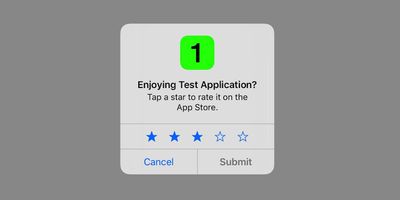
The new user interface includes the App Store's traditional 5-star rating system in a pop-up box, allowing users to enter their opinion of the app without needing to leave it and visit the App Store to submit a review, as was previously the case. In addition to Apple limiting these pop-up boxes to only appear three times per year, if a user actually submits a review for the app, the developer can never request an in-app pop-up review from that user again.
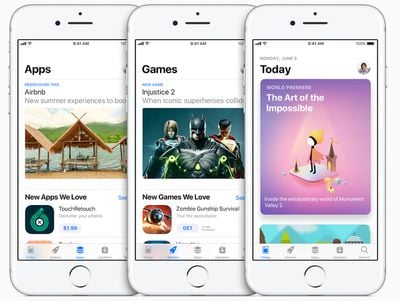
The new App Store in iOS 11
Adding to the strain on in-app review prompts, users can now also turn off these requests completely with a new "In-App Ratings & Reviews" toggle found in the iTunes and App Store section of Settings on iOS 11.
When the updates take full effect, it means that developers won't be able to ask a user for another review of an app after the same user submits a rating using Apple's in-app prompt, even if the app has recently received a huge update. On the plus side, star ratings can now carry over across updates -- if the developer chooses -- so that the App Store rating system is a true overall aggregate of an app and not just user opinions on the app's current iteration.
Apple CEO Tim Cook today delivered the 2017 commencement address at the Massachusetts Institute of Technology.
Cook first reflected on his inability to figure out what the purpose of his life is, while poking fun at Windows PCs in the process. For context, Cook briefly worked at former PC maker Compaq in early 1998 prior to joining Apple.
I tried meditation. I sought guidance and religion. I read great philosophers and authors. In a moment of youthful indiscretion, I might even have experimented with a Windows PC. And obviously that didn't work.
Cook's search eventually led him to Apple in 1998, when the company was flirting with bankruptcy and struggling to survive.
Tim Cook appears around 7:00 mark
Working with Apple co-founder Steve Jobs, Cook said he eventually learned "life's biggest and most important question" being "how can I serve humanity?"
It was in that moment, after 15 years of searching, that something clicked. I finally felt aligned with a company that brought together challenging, cutting edge work with a higher purpose. Aligned with a leader who believed that technology which didn't exist yet could reinvent tomorrow's world. Aligned with myself and my own deep need to serve something greater. Of course, at that moment I don't know all of that. I was just grateful to have a psychological burden lifted. But with the help of hindsight, my breakthrough makes more sense. I was never going to find my purpose working some place without a clear sense of purpose of its own. Steve and Apple freed me to throw myself into the work and embrace their mission and make it my own. How can I serve humanity? This is life's biggest and most important question.
Cook concluded his speech by saying he's "optimistic" in the next generation's own journey to serve humanity.
As you go forward today, use your minds and your hands and your hearts to build something bigger than yourselves. Always remember there is no idea bigger than this: as Dr. Martin Luther King said, we are all bound together in a single garment of destiny. If you keep that idea at the forefront of all that you do, if you choose to live your lives at that intersection between technology and the people it serves, if you strive to create the best, give the best, and do the best for everyone—not just for some—then today all of humanity has good cause for hope. Thank you very much.
Cook toured the MIT campus on Thursday. "So impressed by MIT students and faculty who are finding new ways to tackle the world's biggest challenges," he tweeted. "Thanks for sharing your work!"
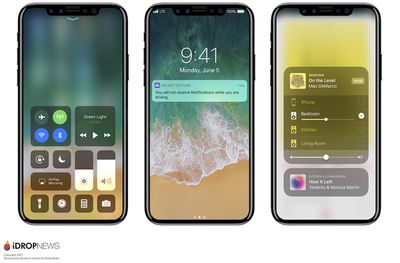
As we get closer to the launch of the so-called "iPhone 8" in the fall, a new report out of Apple's supply chain today confirms that the company has begun mass producing components for all three of 2017's iPhone models. The report corroborates what has been rumored for well over a year: Apple will launch two iterative iPhone updates sized at 4.7 inches and 5.5 inches, along with a 5.8-inch model that includes the first ever OLED screen on an iPhone.
According to DigiTimes' sources, the 4.7-inch and 5.5-inch iPhones will include a reinforced glass chassis and an aluminum metal frame, while the 5.8-inch iPhone will feature the same reinforced glass chassis and an unspecified "metal frame." Recent rumors have largely agreed that the iPhone 8's frame will be made of stainless steel, similar to Apple Watch.
Samsung Display is one of the manufacturers currently in component production on Apple's next-generation iPhones, and is said to be ready to supply up to 80 million AMOLED panels for the 5.8-inch iPhone 8 in 2017, falling between the 70 million and 92 million previously rumored.
Samsung Display is set to supply up to 80 million AMOLED panels for the new 5.8-inch iPhone in 2017, according to sources from the upstream supply chain.
Samsung Display's remaining capacity, which is expected to output another 80 million AMOLED panels in 2017, will be used to supply orders from Samsung Electronics and its other smartphone clients, but the panel maker is expected to keep some flexibility in case Apple places additional orders, the sources noted.
The manufacturer will be capable of outputting another 80 million AMOLED panels this year, but that half will be focused on orders from Samsung Electronics and other, non-Apple smartphone clients. Sources did say that if Apple were to increase its orders, Samsung Display "is expected to keep some flexibility" in its supply chain to cut down orders elsewhere and compensate its output for the Cupertino company.
Daring Fireball has shared the full video of "The Talk Show Live" from Apple's Worldwide Developers Conference this week.
Before a live audience at The California Theatre in San Jose, Apple senior executives Craig Federighi and Phil Schiller joined host John Gruber to reflect on the company's announcements at its WWDC opening keynote on Monday, including several new Macs, macOS High Sierra, iOS 11, and HomePod.
The video, produced by Amy Jane Gruber and Paul Kafasis, is available on Vimeo and embedded below.
MacRumors has put together a WWDC 2017 roundup with the latest news and announcements from the conference.
Fox Networks Group this week announced that Fox Now, its main app for streaming shows like Empire and Prison Break, has gained additional content from the company's other networks, including FX, FXX, and National Geographic (via Variety). The update arrives first on iOS and tvOS and will continue to roll out on other devices throughout the year.
In total, around 500 hours of TV shows will now be available on Fox Now, which also includes a live TV feature and access to popular films. Users will have to provide a log-in for a paid TV provider in order to gain access to the four channels' content within the app. On Apple TV, Fox Now does support Single Sign-On, letting users sign into the Apple TV once and access all of the content available to them across devices.
Existing streaming apps for FX and National Geographic -- FX Now and Nat Geo TV, respectively -- will continue to function as normal. Now, users will simply have Fox's updated app as a hub experience for the collection of channels to watch a wider variety of shows, including Fox's 24: Legacy, FX's The Americans, FXX's You're The Worst, and National Geographic's Genius.
Fox Now has also gained a UI update with the addition of new channels, featuring full-screen video across the app "to emulate the look and feel of linear TV," as well as the ability to "restart" live TV so users can go back to the beginning of a broadcast if they're late. There's also a personalized For You section, and the app will curate shows for users by networks and genres.
The latest Fox Now app update “represents a significant increase in our capabilities and focus, and ensures our viewers will always have the best experience possible when watching our award-winning television brands,” said Brian Sullivan, president and COO of Fox Networks’ Digital Consumer Group.
Each user will be able to access their Fox Profile to see customized favorites, recommendations, notifications, and continue watching the next episode in a series, all of which will sync across devices. The Fox Now app can be downloaded from the iOS App Store [Direct Link] and tvOS App Store for free.
iFixit has posted its teardowns of Apple's new 12-inch MacBook and 13-inch MacBook Pro with Touch Bar, revealing that apart from the advertised performance boosts the models are largely unchanged from the previous models.
The only really notable change comes in the 12-inch MacBook, which Apple has updated with a second-generation butterfly-mechanism keyboard, as found in the 2016 MacBook Pros, according to iFixit. As some readers will remember, Apple's 12-inch notebook debuted in 2015 with a redesigned keyboard that some users criticized for a lack of travel that they felt made it harder to type on.
Apple used a tweaked version of the same keyboard design in its 2016 MacBook Pros, which most users felt was an improvement with "better give", and the same keyboard now adorns the latest MacBook. According to iFixit:
The keyboard trigger looks like a more classic switch this go-around. The plastic butterfly mechanism appears to have thinned out to accommodate the new switch form factor. The keystroke and travel feel about the same to us, so perhaps the real change is reinforcement for repeated use.
Overall, iFixit gave both of Apple's new notebooks a 1 out of 10 on the repairability scale, owing to their soldered-down RAM, processor, and flash storage, along with glued-down batteries. The scores are in contrast to Apple's new 4K 21.5-inch iMac, which was awarded a surprising 3 out of 10 for repairability, thanks to Apple's use of replaceable memory modules and socketed Kaby Lake CPUs.
The refreshed MacBook and MacBook Pro models feature Intel's seventh-generation Kaby Lake processors, improved Intel and AMD graphics options, with the 12-inch laptop also gaining faster SSD storage. The 12-inch MacBook costs $1,299 for the base model, while the base 13-inch Touch Bar Pro costs $1,799. The 15-inch MacBook Pro pricing begins at $2,399.
Taylor Swift is making her entire back catalog of music available across all major streaming services, bringing Apple Music's exclusive content deal with the singer to an end (via TechCrunch).
Beginning today, rival services including Spotify, Amazon Music, and Tidal will all be able to list the artist's existing discography, including Swift's album "1989", which has sold 10 million copies worldwide, it was also announced on Friday.
The move potentially marks a change in the way artists see streaming services, which have previously been criticized for underpaying content creators. With Spotify boasting 50 million paid subscribers and Apple Music now on 27 million, the sheer number of listeners appears to be making up for the decline in physical album sales.
Swift famously got into a spat with Spotify in 2014 because her music was available on the service's free ad-supported tier. The singer said at the time: "I think there should be an inherent value placed on art," contrasting it with how on "Beats Music and Rhapsody you have to pay for a premium package in order to access my albums. And that places a perception of value on what I’ve created."
At the center of the split was Spotify's refusal to let any music only appear on its paid tier and not its ad-supported tier, which led Swift to pull almost all her music from the service.
Swift later berated Apple Music, when the service initially declined to pay royalties to artists if their music was played during the free three-month trial of the service. Apple later reversed course and agreed to pay artists for the free plays, leading to better relations with Swift, who went on to become a promotional figure for the service in several ads and even an exclusive concert film.
During this week's Worldwide Developers Conference, Apple revealed a collection of iPad-specific abilities coming to iOS 11, including a new customizable dock that can be accessed from within any app, a Files app, a new app switcher, and support for drag and drop.
With the first beta of iOS 11 currently in the hands of developers, a few specific examples of what's possible with the much-anticipated drag and drop feature have been causing excitement online.
The short video above demonstrates a possible use case in Safari in particular. The clip shows how the user can now long-press on a URL address in the Safari search bar and drag it to the right-hand side of the screen to duplicate the Safari window in Split View mode. Another action demonstrations the ability to drag a hyperlink on a web page and drop it on the + icon at the top right of the Safari toolbar to instantly open a new tab showing the linked page.
A similar hyperlink drag is then drawn over to the Bookmarks icon at the top left of the screen, but this time the user holds onto the link and is able to navigate to their Reading List and store the link there for later referral.
Lastly, the same action is performed on a web-hosted file link, dragging it to the right of the screen to open the download link in another Safari window in Split View. With the hosted file selected with one finger, the user then uses the finger of another hand to invoke the new iPad dock with a swipe up from the bottom of the screen. Continuing with multitouch, he then drags the File app icon up to the right to open the last-viewed Documents sub-folder, and simply drops the selected file into it with his other finger.
Developers are still experimenting with the potential of drag and drop on iPad, but it's safe to assume that with support for multi-select and spring-loading, the possibilities for various workflows are far-reaching. For instance, another developer has discovered that it is possible to drag up to four different stacks of objects from various apps using four fingers on one hand in order to drop them all into a single Notes sheet.
Drag and drop on iPhone appears to be limited at this stage in iOS 11 in developer beta testing, with the majority of related features restricted to iPad, but it's possible that some aspects could come across to the smaller screen if Apple feels they're practicable.
The public beta of iOS 11 is expected to be released later this month, with the final version coming in the fall.
Apple CEO Tim Cook will visit the White House later this month for the first meeting of U.S. President Donald Trump's American Technology Council, a report revealed on Thursday. Amazon CEO Jeff Bezos and Microsoft CEO Satya Nadella are also expected to be in attendance, but Facebook has not yet responded to its invitation to the event.
The meeting, which was formed as part of an effort to modernize government technology and digital services, will include a gathering of top executives followed by smaller sessions on specific topics, such as technology sales to government agencies and cloud computing, according to Bloomberg.
The council will be led by Trump's son-in-law and senior advisor Jared Kushner and will be attended by government officials including the U.S. chief technology officer, said people with knowledge of the matter. Eleven companies have been invited to participate in the June 19 summit, .
The meeting comes just a few weeks after Cook and Nadella publicly criticized the Trump administration for its decision to withdraw from the Paris climate agreement. Technology companies including Apple, Microsoft, Google, and Facebook have also been critical of a proposed U.S. travel ban on passengers from majority-Muslim countries, with the companies being among 97 that filed a legal brief in February opposing the ban.
Trump held a roundtable discussion with tech executives in December, before his inauguration. The meeting focused on jobs, trade, immigration, and China relations. Afterwards, industry leaders said an area of broad agreement was the potential for the Trump administration to innovate in government services.
Note: Due to the political nature of the discussion regarding this topic, the discussion thread is located in our Politics, Religion, Social Issues forum. All forum members and site visitors are welcome to read and follow the thread, but posting is limited to forum members with at least 100 posts.








 In a Friday session at the Worldwide Developers Conference, Apple revealed some major updates to is native Podcasts app that will be coming in iOS 11. Some of the changes will affect podcast listeners, while others should make it easier for podcasters to learn more about their audience's listening habits.