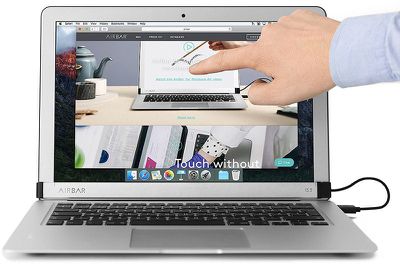
Neonode today announced that AirBar for the 13-inch MacBook Air is now available to purchase for $99 at select retailers in the United States, including Fry's Electronics and Evine.com. It'll also be available online through Amazon, Best Buy, and Staples, but it doesn't appear to be in stock on those websites yet.
AirBar, a CES 2017 Innovation Awards Honoree, is a thin aluminum bar that magnetically attaches below the 13-inch MacBook Air's display, connects to a USB port, and transforms the notebook into a touchscreen device.
AirBar projects an invisible light field on the surface of the MacBook Air's display. When a finger, stylus, brush, or other object breaks the light, users are able to interact with the screen without actually touching it, including gestures such as tap-to-select, swiping, scrolling, and pinch-to-zoom.
Neonode said AirBar requires 17mm of free space below the display, so it won't fit any MacBook Pro, 12-inch MacBook, or 11-inch MacBook Air.
AirBar is a plug-and-play sensor that "instantly activates" upon being plugged into any USB port on the right side of the 13-inch MacBook Air. Neonode also offers multi-touch software as a one-time installation to enable additional gestures.
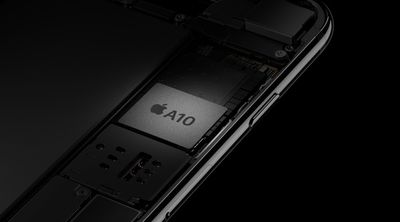
Samsung Electronics will return to producing chips for Apple in next year's iPhone lineup, according to a new report today by The Korea Herald. Before, Taiwan Semiconductor Manufacturing Company held the sole supplier responsibility of providing Apple's A10 chip in the iPhone 7, as well as the A11 chip in the upcoming iPhone 8, but now today's report references a "crucial deal" made between Samsung Electronics co-CEO Kwon Oh-hyun and Apple during a visit to Cupertino last month.
According to the report, Samsung managed to close the deal because of the company's decision to purchase equipment solely intended for 7-nanometer chip fabrication for iPhone devices. This move, as well as using Samsung's "close ties on OLED," convinced Apple to reintroduce the supplier into the iPhone chip supply chain. Although details remain vague, The Korea Herald's sources said that Samsung would "share some parts" of the 2018 iPhone orders that have been previously monopolized by TSMC.
According to news reports on July 18, Samsung recently purchased extreme ultra violet lithography machines, the most advanced chip manufacturing equipment, to produce seven-nanometer mobile processors solely for iPhone.
“The CEO could persuade Apple’s top brass taking advantage of their close ties on OLED,” said an industry source. Samsung, the world’s largest mobile OLED maker with a whopping 95 percent market share, is the sole OLED supplier for the upcoming iPhone.
In 2015, Apple dual-sourced the A9 chip from both TSMC and Samsung for the iPhone 6s and iPhone 6s Plus, leading to some blowback from consumers when battery tests were performed and saw the TSMC chips outperform those made by Samsung. To avoid that issue again, and thanks to TSMC's aggressive moves to adopt smaller and more energy efficient manufacturing processes, Apple chose the company as the sole supplier of the A10 and A11 chips.
Now, Samsung is said to be preparing tests for its own chip processing machines, and next plans to "seek final approval from Apple for the chip production" for what will presumably be called the A12 chip. As the sole OLED supplier for the 2017 iPhone, Samsung Display's deal with Apple has placed the manufacturer with providing between 70 and 92 million OLED displays for the upcoming iPhone 8. Apple is predicted to shift to OLED-only iPhone production as soon as 2018 or 2019.
Developers have wasted no time testing the limits of Apple's new ARKit platform, as each passing week serves up tantalizing previews of what's possible on an iPhone or iPad now that developers can quickly and easily build augmented reality experiences into their apps.
The latest demo to raise the bar comes courtesy of New York-based virtual reality developer Normal VR and offers a sneak peek at what's potentially in store for anyone with an iOS device, an iMac, and a VR headset.
The video clip, recorded on a 10-inch iPad Pro, shows the company using ARKit and the Unity game engine to capture the physical movements of a VR artist and project her virtual painting onto the real world via the mimicking actions of a digital avatar. The interaction also appears to be two-way, with scaling and repositioning functions controlled by the external viewer using iPad gestures.
It's unknown whether the HTC Vive is connected to a Mac or linked to some other supporting machine, but either way the potential uses for such a setup could be pretty far-reaching.
We already know Apple's latest top-of-the-line iMacs will include VR headset support out of the box once High Sierra gets its final release. Steam game platform creator Valve has also developed a version of its SteamVR software development kit for Mac, offering Apple users the same 360-degree, room-scale tracking as the Windows and Linux variants, with the added bonus of Oculus Rift support.
If ARKit-wielding developers can create apps that allow VR content to be viewed and interacted with outside of a headset, cross-platform Apple users could be looking at an exciting future of shared mixed reality experiences.
The first apps powered by ARKit are set to launch on the new-look App Store alongside iOS 11 this fall.
Apple and Qualcomm have been embroiled in a bitter legal battle since the beginning of the year, and though the fight has escalated in recent weeks, Qualcomm CEO Steve Mollenkopf today told Fortune that an out of court settlement is not out of the question.
"There's not really anything new going on," Mollenkopf said speaking at the Brainstorm Tech conference in Aspen. About the Apple dispute, he explained "those things tend to get to resolved out of court and there's no reason why I wouldn't expect that to be the case here."
Mollenkopf went on to say that he has no specific news of a settlement and that nothing new has happened in the case. "I don't have an announcement or anything so please don't ask, he told Fortune. Mollenkopf made a similar statement back in February, but that was before the legal battle between the two companies intensified. At that time, he also said he didn't expect a public fight, something Apple and Qualcomm have not been able to avoid.
Today's interview suggests Qualcomm is still open to settlement talks, but whether that will happen remains to be seen. If Apple and Qualcomm do not settle, we can expect a legal battle that will continue on for several years.
The fight between Apple and Qualcomm started in January, after the FTC complained that Qualcomm had engaged in anticompetitive patent licensing practices. Apple sued Qualcomm for $1 billion just days later, accusing the company of charging unfair royalties for "technologies they have nothing to do with" and refusing to pay quarterly rebates.
According to Apple, Qualcomm has overcharged it by billions of dollars by "double-dipping" with unfair patent licensing agreements, while Qualcomm claims its innovations are "at the heart of every iPhone" and that the royalties are fair.
Qualcomm went on to countersue Apple in April, accusing the company of breaching licensing agreements, making false statements, and encouraging regulatory attacks against Qualcomm, which prompted Apple to stop making royalty payments to Qualcomm entirely until a court can determine the proper amount due.
Apple in late June expanded its lawsuit against Qualcomm, and at the beginning of July, Qualcomm filed a separate patent lawsuit against Apple and asked the International Trade Commission to block imports of select iPhone and iPad models.
Apple today highlighted a new Customer Support role that was recently added to iTunes Connect, which developers can take advantage of if they would like to hire someone specifically to respond to customer reviews in the App Store.
Now you can give the customer support experts in your organization the ability to respond to customer reviews on the App Store with the new Customer Support role in iTunes Connect. Users with the Admin or Customer Support role have the ability to respond to customer reviews.
Your team's admins may choose to assign only this role to users, or assign this role in combination with other roles. Users who have been assigned only the Customer Support role can access Resources and Help, Users and Roles, and My apps in iTunes Connect. When they click on an app in My Apps, they'll go straight to Ratings and Reviews where they can respond to customer reviews.
Apple began allowing developers to respond to customer reviews with iOS 10.3 and macOS Sierra 10.12.4, a feature developers had long requested. The ability to respond to customer reviews allows developers to address negative reviews and offer better service to App Store users.
Prior to iOS 10.3 and macOS Sierra 10.12.4, developers had no way to respond to issues that customers reported via an app review, so there was no way to mitigate a negative review or further converse with a customer having difficulties.
AgileBits today updated 1Password for iOS, introducing a new auto copy feature that's going to make it a lot easier to use two-step authentication for various apps and services.
Whenever you use 1Password to sign into a service on your iPhone that features 1Password integration, the app will now automatically copy any one-time passwords you have associated with that login. That speeds up the login process, because you can have 1Password fill in your account details, and then at the two-factor verification step, the requisite short-term password is already copied to your clipboard.
In the screenshot above, for example, I used 1Password to log in to my Dropbox app. Dropbox has 1Password integration, so I just need to tap the 1Password button to fill in my account details and then choose the appropriate account. As 1Password is adding my details, my one-time password for Dropbox's two-step verification process is also copied, so it's super simple to log in.
Prior to this change, to log in to Dropbox, I'd have to open the 1Password app separately to get the one-time password, negating the usefulness of the integrated login feature.
The update also features the ability to create vaults for 1Password.com accounts, support for Korean, and a tweak that causes item creation and modification dates to now appear in item details. There are also several minor bug fixes and other small improvements, like better translations and the addition of previously used passwords for all categories that support them.
We can't think of anything better to beat the heat than a nice cold ice-cream in the sunshine ... with extra sprinkles, of course. We'd like to think of your one-time passwords as the sprinkles that complete your Login items. Now 1Password automatically copies those one-time passwords when you fill an item with the 1Password Extension, saving you a step and a giving you more time to enjoy that ice cream. Yummy!
1Password for Mac has also been updated with the same features that were added to iOS, but the update has not yet been made available for the Mac App Store. It should be coming soon.
Smartphone accessory companies Olloclip and Incase today announced a new collaborative product called the "Filmer's Kit" for iPhone 7 and iPhone 7 Plus. The $199 kit includes "curated essentials" for users who regularly find themselves filming, taking photos, or live streaming on an iPhone 7.
Specifically, the Filmer's Kit includes an Olloclip Core Lens Set with Fisheye, Super-wide, and Macro 15x lenses, an Olloclip Active Lens Set with Telephoto and Ultra-Wide lenses, an Olloclip Pivot articulating mobile video grip, and a carrying case that was a joint effort between Olloclip and Incase.
“olloclip remains committed to finding new and exciting ways to making inspiring videos and photos fun and easy to capture on your mobile device. Partnering with Incase made sense to us since they, too, understand the importance of the photographic category and offer a complete collection aimed at the modern-day photographer and videographer,” said Patrick O’Neill, founder of olloclip.
“We also appreciate how Incase’s minimalistic and easy-to-use design language complements olloclip’s design ethos by focusing on maximizing functionality while delivering the finest details and finishes.”
The companies are releasing the $199 Filmer's Kit in a super-exclusive supply run of less than 2,000 copies worldwide. The kit won't be made available to purchase on Apple.com, or on Olloclip's and Incase's websites, so those interested will have to visit an Apple retail location to pick up a copy before they sell out.
Olloclip did refer to the Filmer's Kit as the "inaugural" edition, suggesting there could be more of the product, perhaps in a wider release, coming in the future.
Subway today unveiled an all-new "fresh forward" redesign coming to 12 pilot locations at its restaurants throughout the United States, Canada, and the United Kingdom, which includes self-order kiosks in select locations that support checking out via Apple Pay and Samsung Pay. Subway has long supported Apple Pay as a payments option during the traditional check-out process in its restaurants.
The new kiosks will allow customers to browse Subway's full menu, craft their sandwich order, and then check out with a credit card, debit card, Apple Pay, or Samsung Pay.
There will be a designated food preparation and pick-up area for orders made through the new kiosks, on the Subway mobile app, and with Facebook Messenger's Subway chatbot. The company said that this will help speed up food preparation time for both digital orders and for customers waiting in the basic check-out line.
Digital: Self-order kiosks in select locations, digital menu boards and, as always, Apple and Samsung Pay options. Guests enjoy a speedy Subway® experience with a separate food preparation area and a designated pre-order pick-up location for kiosk, mobile app, delivery, catering and bot for Messenger orders.
The Subway redesign will also include dining areas with USB charging ports so customers can fuel up their smartphones and tablets while they eat, as well as complimentary Wi-Fi, menu changes, and new decor.
The "fresh forward" Subway design is launching today at the following locations: Tamarac, FL; Orlando, FL (2 locations); Winter Park, FL; Chula Vista, CA; Knoxville, TN; Palmview, TX; Hillsboro, OR; Vancouver, WA; Beauport, QC; Granby, QC; and Manchester, U.K.
Subway said that, "Many elements of the new brand identity will be worldwide by the end of 2017."
The new emoji previewed today by Apple include Woman with Headscarf, Bearded Person, Breastfeeding, Sandwich, Coconut, T-Rex, Zebra, Zombie, Elf, Star-Struck, Exploding Head, and more. All of the emoji shared today were previously included in the new Unicode 10 standard released in June.
The new emoji make it easier for users to express themselves with greater diversity, additional animals and creatures, new smiley faces and more.
Apple didn't specify a launch date for the new line of emoji characters coming to iPhones, iPads, Macs, and Apple Watches this year, but it's expected that they will arrive sometime around the public launch of iOS 11 this fall, or soon thereafter. World Emoji Day celebrations are also extending to the iOS App Store, where Apple said that it has highlighted apps that showcase fun things to do with the smartphone characters.
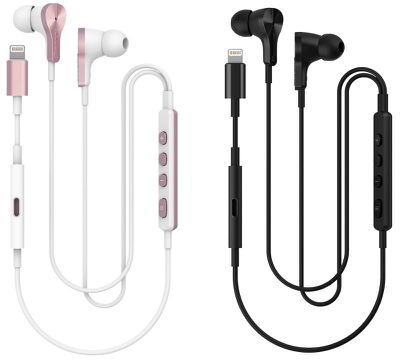
Pioneer today announced that its Rayz line of Lightning-equipped earphones designed for the iPhone are receiving a major update that adds "Hey Siri" functionality along with other new features.
Enabled through new firmware and an update to the Rayz app that's being released today, the earphones can now activate Siri with the standard "Hey Siri" command even while the iPhone is tucked away in a pocket. That means Siri can respond to requests without the need for users to take the iPhone out of a purse, bag, or pocket.
"Today we are pleased to announce that users can say 'Hey Siri' while using Rayz earphones to easily make a call, send a message, listen to music and much more, even when iPhone is in their pocket," said Munenori Otsuki, CEO of Pioneer & Onkyo U.S.A. Corporation. With support for Siri, Rayz Lightning Earphones automatically recognize "Hey Siri" commands and allow our users to do so much more using just their voice."
First announced in February, the Rayz Plus earphones feature a built-in Lightning port for charging an iPhone while listening to music, smart noice cancellation, smart buttons, sensors for auto play/shutoff, and a smart mute function that was added in June.
Today's update also introduces AutoPause improvements, status beeps that indicate when Smart Mute is active, and native language support for Chinese, French, German, Italian, Portuguese, and Spanish.
Pioneer's Rayz Plus earphones can be purchased from Amazon for $149.95 in Bronze and Graphite. Apple also sells the Pioneer Rayz Plus in Rose Gold and Black. The slimmed down standard version of the Rayz, priced at $99.95, is not yet available for purchase.
A recent report by The Wall Street Journal has taken a look into the smartphone design war happening between Apple and Samsung, suggesting that the latter company has begun edging out the former with the design of the Galaxy S8.
According to Hugh Dubberly, formerly of both Apple and Samsung, Samsung isn't ahead of Apple because it has "gotten better" at designing smartphones, but because Apple has "fundamentally changed" following the death of former CEO Steve Jobs.
Some design experts wonder if the Galaxy S8’s visual leap says more about Apple and its chief executive, Tim Cook, whose operational skills contrast with the visionary talents of his predecessor, Steve Jobs. “It’s not so much that Samsung has gotten better, but Apple has fundamentally changed,” said Hugh Dubberly, a former Apple creative director and former member of Samsung’s global design advisory board. “The pipeline that Steve [Jobs] started is over.”
While smartphone innovation has "plateaued" over the last few years, analysts said that consumers are focusing more on the aesthetic of a smartphone to determine if they will buy the device or not.
How a smartphone looks now accounts for about half a consumer’s purchase decision, with the assessment formed in roughly one second, according to Charles L. Mauro, president of MauroNewMedia, a product-design research firm that has done consulting work for Apple and Samsung. Mr. Mauro says peer-reviewed research reveals aesthetics matter much more than previously believed, as older surveys pegged looks as influencing only 7% of a phone purchase.
The report cites recent data accumulated by Consumer Reports, which compared 2016's iPhone 7 to 2017's Galaxy S8. The newer Galaxy S8 bested the iPhone 7 in categories like battery life and design, while most of the iPhone 7's shortcomings are rumored to be addressed in the iPhone 8 later this year.
According to analysts, the iPhone 8 needs "a new distinguishing feature," with The Wall Street Journal referencing a fingerprint sensor embedded under the display as a potential game-changing addition -- although recent rumors have suggested Touch ID could be nixed from the iPhone 8 altogether.
The S8 is nudging the bar higher as Apple seeks to impress with its 10th anniversary iPhone this fall. For Apple to outdo Samsung on design, analysts said, it would need a new distinguishing feature, like a fingerprint sensor beneath the display rather than a physical home button.
Apple and Samsung's smartphone design war has been raging for years, heating up in 2011 when Apple sued Samsung and accused the company of copying the design of the iPhone and iPad and committing patent infringement in the process. Last December, the Supreme Court reversed a decision to award Apple $399 million in damages related to the case, which it was originally awarded by a lower court, and the case will now returned to the U.S. Court of Appeals.
For the next devices, Apple is expected to announce the iPhone 8 in the traditional September timeframe, and the smartphone is believed to include a 5.8-inch OLED screen with an edge-to-edge display, glass body, wireless charging, facial recognition, and no physical Home Button. Samsung is rumored to announce the Galaxy Note 8 in August, potentially launching with a curved display that is "marginally larger" than the 6.2-inch display of the current Galaxy S8+, while also including two rear cameras.
Today, July 17, is celebrated as World Emoji Day thanks to this day being marked on the iOS "calendar" emoji. In celebration, Apple has updated the iTunes Movies storefront with a new emoji-filled carousel that uses the popular smartphone characters to describe recent film releases, as well as older movies.
Some of the films referenced include Kong: Skull Island, Beauty and the Beast, Get Out, Stephen King's It, Logan, Arrival, and more. The iTunes emoji makeover is simply a visual overhaul of the store with no sale prices appearing on any of the participating films.
Apple often updates the iTunes Movies storefront to coincide with new film releases, most recently offering a LEGO makeover to celebrate the digital release of The LEGO Batman Movie. Earlier in June, a few decade-based film collections were put on sale on iTunes to give users the chance to get bundles of films together at lower prices.
Reports of delays to Apple's upcoming iPhone line-up continued this week, with the Chinese-language Economic Daily News claiming on Monday that production of the so-called "iPhone 8" will not start until between November and December, with production of the more typical "S" cycle upgrades to the iPhone 7 and 7 Plus also potentially facing delays.
According to the report, the flagship redesigned OLED iPhone will ship only in small volumes this year, because yield rates at the main manufacturing plants have still not reached the mass production stage.
While there were previous reports indicating that volume production for new iPhone devices has commenced, yield rates at the two main ODMs, Foxconn Electronics and Pegatron, have not yet reached levels that warrant mass production, the report said.
Reports of iPhone delays typically happen every year and don't tend to pan out, but on balance we seem to be seeing more than usual this time around, apparently spurred by claims that Apple has found its redesigned handset particularly challenging to finalize, whether that's because of the intricacies of the customized OLED panel and other key components leading to low or staggered supplies, or problems integrating the Touch ID fingerprint sensor.
KGI Securities analyst Ming-Chi Kuo recently published a report supporting claims that Apple will debut the OLED iPhone in September, but the device will face "severe supply shortages" for some time. Kuo believes that production ramp-up on the OLED iPhone model won't begin until as late as October-November, two months later than previous ramp-ups in August-September. Similar rumors have been circulated by Bloomberg, analysts from Barclays, and Brian White. Today's report is the most delayed 2017 timeframe for "iPhone 8" production we've seen so far.
Last week claims were also made that the software-side of things isn't going well for Apple either, with rumors that problems with the front-facing camera's 3D sensor could see the feature temporarily unavailable at launch. A purported wireless charging accessory for the iPhone is also thought to be coming later than originally planned.
As for the 4.7-inch and 5.5-inch LCD iPhones that Apple is said to be launching alongside the OLED iPhone, volume production is now said to be entering "full swing" in August, which is one to two months later than the normal mass production schedule for Apple's iPhones.
Telegram is to form a team of moderators to remove terrorist-related content from the encrypted messaging platform in Indonesia, after the country's government threatened to ban the app.
Indonesia's Ministry of Communications and Information Technology has already blocked access to the web version of the chat platform, citing concerns that it was being used to spread "radical and terrorist propaganda" in the country, according to Reuters.
"This has to be done because there are many channels on this service that are full of radical and terrorist propaganda, hatred, ways to make bombs, how to carry out attacks, disturbing images, which are all in conflict with Indonesian law," the communications ministry said in a statement on its website.
Telegram co-founder Pavel Durov said on Sunday that the service had blocked channels reported by the government and that it would take further action to remove the illegal content.
"We are forming a dedicated team of moderators with knowledge of Indonesian culture and language to be able to process reports of terrorist-related content more quickly and accurately," Durov said in a Telegram post quoted by Associated Press.
Telegram has been criticized by governments before for its use by terrorist groups to spread propaganda and recruit members. Last month Telegram agreed to provide basic information about the company to Russia after authorities threatened to block access to the service.
Despite pressure from governments, Telegram's founders have refused to bow to demands for backdoors into the platform for authorities to access encrypted messages, arguing that security and privacy are central tenets of the service.
Speaking to The Wall Street Journal on Sunday, Durov said Telegram is "heavily encrypted and privacy-oriented, but we're no friends of terrorists – in fact, every month we block thousands of ISIS-related public channels".
Note: Due to the political nature of the discussion regarding this topic, the discussion thread is located in our Politics, Religion, Social Issues forum. All forum members and site visitors are welcome to read and follow the thread, but posting is limited to forum members with at least 100 posts.
Apple today launched a large-scale promotion in China offering special discounts for consumers who use Apple Pay, in the company's latest bid to counter the dominance of rival digital wallets in the country.
Between July 18 and 24, Apple device owners who use the mobile payment system to make purchases in participating merchants across mainland China will receive concessions of up to 50 percent and as much as 50 times the usual number of reward points for credit cards, according to Apple's official Chinese website.
A total of 28 brick-and-mortar retail outlets are named in the campaign, including supermarkets and restaurants such as 7-Eleven, Watsons, Burger King and Starbucks, while 16 online merchants such as JD.com are also participating, with discounts varying between businesses.
In addition to retailers, 17 Chinese banks are also getting involved, offering up to 50 times the usual amount of reward points accrued when transactions are made using credit cards registered with Apple Pay.
The Apple Pay promotion is the largest of its kind to date in China, where third-party mobile payments are dominated by Alibaba Group and Tencent Holdings, which run Alipay and WeChat Pay, respectively. The rival digital wallets work on various phone brands, whereas Apple Pay, which debuted in China in February 2016, is limited to iOS devices and Apple Watch.
That presents a challenge for Apple, which has struggled to shift iPhones in China. The company shipped 9.6 million units in the first quarter, down 26.7 percent from a year earlier. It also recorded a 9.2 percent share of the smartphone market in Q1 2017, down from 12.7 in the first quarter of 2016.
Users can find the full list of merchants participating in the latest promotion on Apple's website.
The latest update to WhatsApp Messenger rolled out on iOS on Sunday and adds a couple of notable new features, one of which is the ability to share files of any type within conversations.
Version 2.17.40 of WhatsApp is the first to allow any file type to be sent using the Document option in the Share menu. Previously files were limited to PDF documents, but now the only limitation is file size, which is officially 100MB.
It's also now possible to pin chats to the top of the chat list to quickly find important conversation threads. To pin a chat, swipe right on the chat and tap the pin icon. Additionally, users can now tap and hold on groups of multiple photos they've received to quickly forward or delete them.
Version 2.17.40 also includes a couple of new hidden features that still appear to be in testing, suggesting they'll soon become public in a forthcoming update. According to WABetaInfo, they include in-line YouTube video playback with Picture-in-Picture support and an emoji search function.
Finally, a new Recall feature is expected to be enabled in 2.17.40+ that allows users to delete texts, images, videos, GIFs, documents, quoted messages, and even Status replies after they have been sent, as long as the Recall feature is used within a five-minute window.
Amazon is reportedly working on bringing a new mobile messaging platform to the table, according to customer survey details obtained by AFTVnews.
The chat service for iOS, Android, and desktop is said to be called "Anytime" and will include typical messaging features like encryption, video and voice calling, but with some novel touches added to the mix that suggest social network-style aspirations for the app.
For example, it looks as if Anytime users will only need to use a name – as opposed to a phone number, a la WhatsApp – to link themselves and invite others to the service, although its not entirely clear how this will work. There's also talk of Twitter-like @ mentions to involve users in conversation threads or to share photos.
Elsewhere in Amazon's customer survey information are references to additional features such as the ability to color code conversations, play games, order food together, split a bill, location sharing, and group music listening. Users will also apparently be able to chat with businesses through the service, make reservations, check on orders, and even shop, with sensitive content like bank details protected by encryption.
It's possible Anytime will be powered by Chime, Amazon's chat service for enterprise users that it launched earlier in the year. There's also potential scope for Alexa integration – given that the company recently launched messaging and calling features for Alexa devices, it could benefit from separating out these functions in a separate app.
There's no word on when the Anytime service might launch, but Amazon will have to show it can offer something genuinely fresh and appealing if it expects to convince longtime users of rival platforms like WhatsApp and Facebook Messenger to jump ship.
Whatever its plans, Amazon clearly isn't resting on its laurels in the hardware and connected services spaces. Earlier this week it emerged that Amazon is actively developing a redesigned Echo speaker to compete with Apple's forthcoming HomePod. Both smart devices are expected to launch later this year.
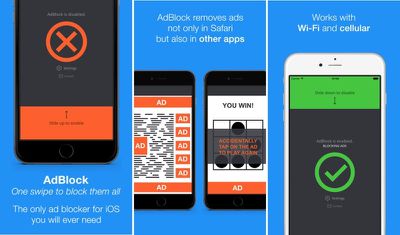
It appears Apple may be cracking down on some VPN-based ad blockers that are designed to block ads in third-party apps, based on a recent interaction iOS developer Tomasz Koperski had with Apple's App Store review team.
Koperski is the CTO of Future Mind, a software company that produces AdBlock, Weblock, and Admosphere, three ad blocking apps. When submitting an update for AdBlock for iOS, a VPN-based ad blocking app, it was rejected.
Upon appeal to the App Review Board, Koperski was told Apple is no longer allowing VPN/root certificate-based ad blockers on the App Store and will not be accepting updates of existing ad blockers that use those techniques going forward. According to Apple, Future Mind's AdBlock app violates section 4.2 of the App Store Review Guidelines, which dictates that apps must be useful, unique, and "app-like."
Specifically, the app violated section 4.2.1, which says "Apps should use APIs and frameworks for their intended purposes and should indicate that integration in their app description," and to get even more specific, Future Mind was told the update was rejected because "Your app uses a VPN profile or root certificate to block ads or other content in a third-party app, which is not allowed on the App Store."
Koperski was told that Safari content blockers, introduced in iOS 9, will be the only Apple-supported ad blockers going forward, and those ad blockers are limited to use in the Safari web browser.
After submitting an appeal to the App Review Board, a member of the Review Team contacted me directly via phone and informed that Apple has officially changed their policy regarding VPN/root certificate based ad blockers on the App Store and is no longer accepting updates of apps, which directly block content in third party apps. The only officially allowed ad blocking method is now Safari Content Blockers.
Koperski says that the change marks a major shift in Apple's ad blocking policy, as Future Mind has had its ad blocking products in the App Store for the past five years. AdBlock, the app that Apple rejected, has been available for purchase since 2014, and it was one of the first VPN-based ad blockers able to block ads in all apps locally on both Wi-Fi and Cellular.
There are dozens of similar ad blocking apps available in the App Store at the current time, some that were updated as recently as June. It's not clear why Apple has changed its policy after so many years, but many apps, including native apps like Apple News, feature ads as a way to monetize.
Apple has recently undertaken a major overhaul of the App Store, eliminating clone apps, outdated apps, and more, so it's possible this new crackdown is a part of that effort. Since late 2015, Apple marketing chief Phil Schiller has been overseeing the App Store and has enacted some significant changes.
Future Mind was told the AdBlock app could be updated if it switches from ad blocking via VPN to the Safari Content Blocker, but the company is worried about upsetting customers who paid for the ability to block ads in both Safari and in apps. The company has not yet decided what to do and is mulling several possible choices, including leaving the app as is, expanding existing functionality into a VPN service, or transitioning to a Safari-only blocker.



 Apple
Apple 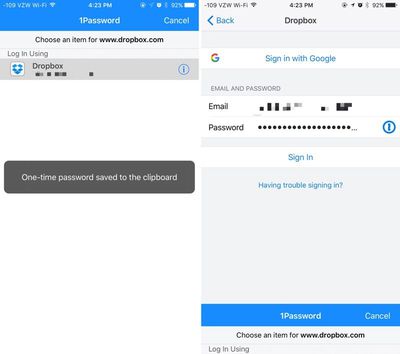







 The latest update to WhatsApp Messenger rolled out on iOS on Sunday and adds a couple of notable new features, one of which is the ability to share files of any type within conversations.