In the wake of Apple CEO Steve Jobs' lengthy comments on Google's Android and other competitors during the company's earnings conference call yesterday, executives from Google and app developer TweetDeck have offered brief public responses disputing Jobs' assertions.
TechCrunch notes that Google's vice president of engineering Andy Rubin, who heads up the Android project, was inspired by Jobs to post his first-ever tweet. Rubin's tweet amounted to defining "open" as the code required to get the Repo tool that serves as a basis for working with Android source code installed and ready for use.
the definition of open: "mkdir android ; cd android ; repo init -u git://android.git.kernel.org/ platform/ manifest.git ; repo sync ; make"
During his comments, Jobs also referred to TweetDeck, developers of a popular Twitter platform who recently launched an Android application, noting that they had to test their application against 100 different versions of Android on 244 different handsets. Jobs contrasted that experience with the tightly-controlled iOS environment, claiming that Android's fragmentation is leading to significant headaches for app developers seeking to ensure compatibility.
TweetDeck CEO Iain Dodsworth quickly responded to Jobs' comments via Twitter, disputing the claim that the burden of testing on Android devices was an onerous one.
Did we at any point say it was a nightmare developing on Android? Errr nope, no we didn't. It wasn't.
Dodsworth followed up with a second tweet noting that the company has only two employees working on the Android version of TweetDeck and citing that as proof that Android fragmentation is essentially a non-issue.
We only have 2 guys developing on Android TweetDeck so that shows how small an issue fragmentation is
Representatives of Research in Motion have apparently yet to speak out on Jobs' claims that the company will be unable to keep pace with Apple as it is forced to move out of its "comfort zone" into a smartphone world where software is driving the innovation.
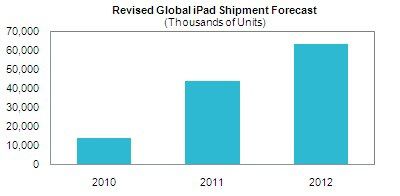
Despite Apple reporting lower-than-expected iPad sales in its quarterly earnings release yesterday, research firm iSuppli has once again raised its projections for iPad sales through the end of 2012 to over 120 million, up over 20 million from its July projections.
iSuppli has increased its iPad sales estimates from 12.9 million to 13.8 million for 2010, from 36.5 million to 43.7 million for 2011, and from 50.4 million to 63.3 million for 2012.
"In its previous iPad forecasts, iSuppli noted that the only constraint on shipment growth now is production - and not demand," said Rhoda Alexander, director of monitor research for iSuppli. "The only factor limiting production is the availability of key iPad components, such as the Field Fringe Switching (FFS) LCD panels, projected capacitive touch screens and NAND flash. Despite ongoing yield issues, Apple's suppliers have steadily increased monthly production to meet Apple's demand. Production rates are now on target to meet the expected strong fourth-quarter sales."
Along with the easing of supply constraints, the report points to faster-than-expected expansion of retail distribution and opportunities in education as positive factors for the iPad's sales future.
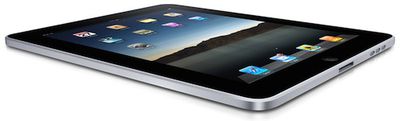
Apple yesterday announced sales of 4.19 million iPads in the June-September quarter, well ahead of the 3.27 million iPads sold in the previous quarter but below the nearly 5 million units that had been expected by Wall Street analysts.
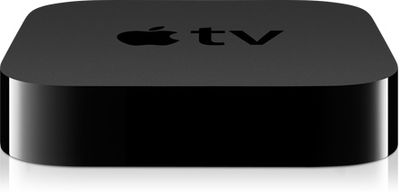
During today's earnings conference call, Apple CEO Steve Jobs noted that the company has sold over 250,000 units of the revamped Apple TV that was unveiled at the company's September 1st media event and began shipping at the very end of September.
Responding to a question about how the device is performing in the marketplace and whether users can expect Apple to shift to a streaming model for other products, Jobs noted that Apple doesn't discuss unannounced products but that it's been "thrilled" with the performance so far. Jobs also pointed to the AirPlay capabilities in iOS 4.2 set to debut next month as another reason for customers to look to the "very enticing" $99 Apple TV.
One analyst estimated earlier this month that Apple was selling the new Apple TV at a rate of about one million units per quarter, although it will take some time for the true demand to become apparent as the initial wave of orders tapers off and supply constraints experienced at the launch begin to ease.
Steve Jobs made a surprise appearance at today's financial results conference call for Apple's Q4 2010 results. Jobs commented on a range of topics including the fragmentation seen on Android as compared to the iPhone.
Of particular note, Jobs commented on the influx of tablet competitors that are flooding the market, and criticized the 7" tablet size, saying that it was too small.
Commenting on avalanche of tablets heading to market. Just a handful of credible entrants. Almost all use 7" screen, compared to iPad at nearly 10" screen. 7" screen is only 45% as large as iPad's screen. Hold an iPad in portrait view and draw a horizontal line halfway down. What's left is a 7" screen...too small. There are clear limits to how close elements can be on the screen before users can't touch accurately. We believe 10-inch screen is minimum necessary.
This effectively kills persistent rumors that Apple was planning on creating a 7" iPad in the near future. Apple has been known to experiment with different form factors and has even been suspected of creating multiple prototypes to throw off competitors.
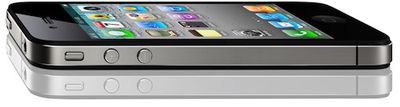
Boy Genius Report claims to have received information from a source who reports that a tweaked version of the iPhone 4, known internally as "iPhone3,2", as entered the final field testing stage before production, indicating that a release may be coming in the next several months.
One of our solid Apple sources has just let us know some pretty interesting (and exciting) information surrounding Apple's upcoming iPhone devices. For starters, we have been told that iPhone model 3,2 - what everyone is assuming to be the Verizon (or at least CDMA-compatible) phone - just hit the "AP" testing stage. This is the very last stage before retail release; final hardware, almost final software.
But according to the source, the iPhone3,2 carries a SIM card slot similar to that used by the existing iPhone 4, a feature not required for a straightforward CDMA-only phone. Boy Genius Report offers three theories as to what this device might be then, given that it possesses a SIM card slot:
- A "global" mode phone offering support for both GSM and CDMA that would be compatible with all carriers. The design could obviously carry a tweaked antenna design to address reception issues and serve as a mid-cycle upgraded model around the world while also introducing new CDMA support.
- A CDMA phone with SIM support for global roaming, although this scenario seems overly complicated.
- A tweaked version of the existing iPhone 4, with no support for CDMA networks. This could simply be an updated version to addresses antenna issues.
The source also indicates that the fifth-generation iPhone has entered the "engineering verification test" (EVT) stage, a phase the CDMA-based iPhone 4 was said to have entered back in May. Additional claims of the CDMA iPhone 4 being in the EVT stage surfaced in mid-August. The first software references to iPhone3,2 appeared in iPhone OS 3.2 back in early April.
Apple today announced financial results for the third calendar quarter and fourth fiscal quarter of 2010. For the quarter, Apple posted revenue of $20.34 billion and net quarterly profit of $4.31 billion, or $4.64 per diluted share, compared to revenue of $12.21 billion and net quarterly profit of $2.53 billion, or $2.77 per diluted share, in the year-ago quarter. Gross margin was 36.9 percent, compared to 41.8 percent in the year-ago quarter, and international sales accounted for 57 percent of the quarter's revenue.
Apple shipped 3.89 million Macintosh computers during the quarter, a unit increase of 27 percent over the year-ago quarter. Quarterly iPhone unit sales reached 14.1 million, up 91 percent from the year-ago quarter, and the company also sold 9.05 million iPods during the quarter, representing 11 percent unit decline over the year-ago quarter. Apple also sold 4.19 million iPads during the quarter.
"We are blown away to report over $20 billion in revenue and over $4 billion in after-tax earnings - both all-time records for Apple," said Steve Jobs, Apple's CEO. "iPhone sales of 14.1 million were up 91 percent year-over-year, handily beating the 12.1 million phones RIM sold in their most recent quarter. We still have a few surprises left for the remainder of this calendar year."
Apple's guidance for the first quarter of fiscal 2011 includes expected revenue of $23 billion and earnings per diluted share of $4.80.
Apple will provide live streaming of its Q4 2010 financial results conference call at 2:00 PM Pacific, and MacRumors will update this story with coverage of the conference call highlights.
Conference Call Highlights: - CFO Peter Oppenheimer with summary: New all-time records for Mac, iPhone and iPad sales. - New Mac sales record by over 400,000 - double overall market growth. Double-digit growth in both desktop and portables, led by iMac, MacBook Pro, and MacBook. - Nearly 9.1 million iPods sold. Market share remains over 70% per NPD. - iTunes Store revenue over $1 billion for the quarter. - "Extremely pleased" with 14.1 million iPhones sold. iPhone revenue reached $8.82 billion, up 92 percent. Average selling price of $610. - iPhone has 166 carriers in 89 countries. Very pleased with response in China since recent launch. - Enterprise adoption of iPhone 4 continues to grow. 80% of Fortune 500 companies, up from 60% before iPhone 4 launch. - iPhone sales very strong, but could have sold more if supply had been available. - iPad sales strong. 65% of Fortune 100 companies using iPad. Expanding retail distribution and filling sales channels, but still below desired levels. - Have now passed 125 million total iOS devices sold. - iOS 4.2 coming in November with AirPrint and other features. - App Store: Over 200,000 registered developers. "Very happy" with iAd performance. - Retail store revenue at $3.75 billion. 874,000 Macs sold, up 30% year-over-year. 50% of sales to customers new to Mac. - First-day sales at new Beijing and Shanghai stores set new records. - Average revenue per store $11.8 million, up 52% year-over-year. - 74.5 million visitors during the quarter, up 62% year-over-year. - Fiscal 2011 will see focus on international expansion. 40-50 new stores, with over 50% outside U.S. Also replacing several U.S. stores. - Cash plus marketable securities at $51 billion, up $5.2 billion. - Fiscal 2010 saw over 13.6 million Macs sold, 40 million iPhones, nearly 7.5 million iPads, record revenue of over $65 billion. Earnings of $14 billion. 5x the revenue and 10x the earnings of five years ago. - Guidance: Revenue at $23 billion, gross margin at 36%, earnings of $4.80 per share.
Steve Jobs on the call: - I couldn't help dropping by for our first $20+ billion quarter. - Discussing iPhone performance. Handily beat RIMM in their last quarter. We just passed RIMM, and we don't see them catching back up. They must move beyond their comfort zone and become a software company, and we don't see them being successful at it. They have a high mountain ahead of them. - What about Google? Apple activates 275,000 iOS devices per day, sometimes over 300,000. Unfortunately, no solid data on how many Android handsets shipped per quarter. Gartner says 10 million in June quarter, and we wait to see whether iPhone or Android won in the most recent quarter. - Discussing Google claiming Android is "open". We find this disingenuous. Android is fragmented. - "TwitterDeck" (probably TweetDeck) revealed that it had to contend with over 100 different versions of Android in developing its app. Compare to Apple with two different versions. - Amazon, Vodafone, and Verizon have announced creating their own Android app stores. A mess for users and developers. Contrast with Apple's integrated App Store. - Even if Google was right, open doesn't always win over closed. See Microsoft's "Plays for Sure" system that they were forced to scrap. Google flirted with integrated approach with Nexus One. Google's claims are a smokescreen for what is best for customers: integrated or fragmented. We believe integrated will trump fragmented every time. Users and developers will agree. - Commenting on avalanche of tablets heading to market. Just a handful of credible entrants. Almost all use 7" screen, compared to iPad at nearly 10" screen. 7" screen is only 45% as large as iPad's screen. Hold an iPad in portrait view and draw a horizontal line halfway down. What's left is a 7" screen...too small. There are clear limits to how close elements can be on the screen before users can't touch accurately. We believe 10-inch screen is minimum necessary. - All of these tablets are using Android, but Google is telling them it isn't ready for tablets and to wait until next year. - Even with smaller, less-expensive screens, competitors are having a hard time matching iPad pricing. We have tons of experience in design...we've designed everything on ours. The 7-inch tablets will be dead on arrival. Their manufacturers will learn the painful lesson and abandon them for larger sizes next year, abandoning customers and developers. Sounds like a lot of fun.
Q&A: Q: Supply constraints on iPad...how severe? How fast will they improve? A: We got into balance in September. We got into situation at the end of the quarter where we can expand distribution. We'll be launching in new countries as the quarter goes on.
Q: Headwinds for gross margins? A: Margins came down about half of what we thought they would because commodity and other costs came down, and iPhone sales better than expected.
Q: How do you think about the iPad opportunity a year or two down the road in terms of size of business? A: Jobs: iPad is clearly going to affect notebook computers. It's a question of when, not if. Already seeing tremendous interest from education, and surprisingly, business. We haven't been pushing it with businesses, but they're tearing it out of our hands. We've got a tiger by the tail.
Q: Could iPad be second-biggest business behind iPhone? A: Jobs: I try to report, not predict. But it's already outselling Macs.
Q: What could true demand for iPhone have been? A: Demand is "absolutely staggering" in all countries. We had anticipated it going to a different level, but what we're seeing is even higher.
Q: You are the tablet market right now. Like RIMM with the smartphone, can you hold onto market share? A: Jobs: We have a hard time seeing the strategies of our competitors. They're not matching us in pricing, and lack of Flash doesn't seem to be causing us difficulties. We're out to win this one.
Q: Are smartphones a zero-sum game? A: Jobs: The vast majority of phones are non-smartphones. Many of those will convert to smartphones over the next few years. There will be room for some companies to have success, but will become closer to zero-sum game in time. It's a battle for mindshare right now, and iPhone and Android are winning that battle.
Q: How is Apple TV going? Are you going to build on that streaming model with other products? A: Jobs: I don't talk about unreleased products. Apple TV is complete streaming. We've already sold over 250,000 of them, and we're thrilled with that. $99 price point is very enticing. We're really happy with how it's turned out.
Q: Effect of bumper program on revenue and margin? A: Revenue deferral of $100 million; should be recognized in December quarter. Margin hit was not a surprise to us. High mix of iPhone 4 and iPad pinch margins a bit, but didn't better than we'd hoped.
Q: Steve, you believe Apple should be able to outship Android when looking at all devices. What are the key risks you are managing? A: Our goal is to be the best. We're not the biggest...that's Nokia. We admire them, but don't aspire to be them. We want to make the best devices. Android is our biggest competitor. They outshipped us in the June quarter when we were caught in a transition, and we'll see about the September quarter. We'll be competing with them for quite some time, but we have very different approaches and we believe in ours. We think that's the winning approach in the end.
Q: Aspirations for iPhone and iPad? Looking for a Mac-like model of lower market with higher prices and quality or iPod-like market dominance and low pricing? A: Jobs: Nokia makes $50 handsets. We don't know how to make great handsets at that price. So our goal is to make great breakthrough products but also drive costs down. As you know, we have low share in phones, and high share in tablets. But we don't think about it that way. We're not not making a 7-inch tablet because we don't want to hit a lower price point. We're just believe it's too small to hit the user experience people want. When we make decisions, it's not about cost, it's about value when you factor in the software. We're all about the best products at aggressive prices.
Q: If the market moves toward lower-functionality smartphones with lower price points and you can't make a great phone at those prices, will you cede share? A: Jobs: You're looking at wrong. You're looking at it from a hardware perspective and you assume that the software will just come alive, but it won't. App developers have taken advantage of these products that came before and changing assumptions on developers will result in them not following you.
Q: $50 billion in cash on your balance sheet. What is your aspiration for that cash and why not return some to shareholders? A: Jobs: Of course that's been proposed to us. We firmly believe that one or more unique strategic opportunities will present itself to us, and we'll be in a position to take advantage of it. We've been very disciplined, and will continue to be so.
Q: Opportunities in enterprise? Marketing or sales changes you need to make to push this? A: Cook: 2/3 of the Fortune 100 are deploying or piloting iPad. I've never seen an adoption rate like this in enterprise. iPad also seeing adoption in K-12. Early data points look great. Have built and are building additional capacity to call on businesses. Also enabling carrier partners to do the same. See announcement by AT&T last week. iPhone has followed a similar trajectory, with 85% of Fortune 100 deploying or piloting. This isn't a hobby...we put a number of enterprise features in the OS, and building sales capabilities as well. Mac is also increasingly getting pulled into enterprise where employees themselves have decision-making capabilities. Maintaining focus on consumer, and these "enterprise consumers" are pulling the Macs in. We're not targeting with different machines.
Q: Demand from new carrier to pick up iPhone 4? Pressure on subsidies? A: Cook: Pressure we're getting is on supply. Everyone we're doing business with wants more supply. We have 166 carrier relationships in 89 countries. That's a significant increase. Latest move was Germany, where we'll be launching with Vodafone and O2. iPhone 4 is in 85 of those 89 countries. I believe we will be in all 89 by end of the year.
Q: Moving from exclusive to non-exclusive, have you given up anything on subsidies? A: Cook: We don't give details, but you can see our average selling price as remained above $600 as we've expanded distribution.
Q: Where is your primary advantage in tablets? A: Jobs: We've designed everything from batteries to enclosures, and we've learned a lot from our prior experience. We know how to design and build in an efficient way. Others will have to source components from middlemen, while we design our own and build them directly.
Advertising Age today announced that it has selected Apple as its "Marketer of the Decade", removing the company from the running for its annual "Marketer of the Year" award to present it with a first-ever award recognizing Apple's prominence over the last ten years.
It seems fitting: Apple kicked off the aughts in 2001 with the iPod, an electronic device that went on to disrupt and forever change the music industry; then mid-decade it dropped the iPhone, a mobile device that changed the mobile-phone industry and added the word "apps" to the English vocabulary; and finally, in 2010 it debuted the iPad, a computing device with the potential to disrupt the media, publishing, entertainment and computing industries.
Yes, it has been a golden decade for Apple. And while one can certainly argue that its influence has been overstated -- it is No. 56 on the list of Fortune 500 by revenue -- Apple's influence on business models across industries from music and computing to entertainment and advertising, along with its impact on popular culture, media and, of course, marketing, has been indelible.
The report points to Apple's high-profile advertising campaigns over the years, from the "Switch" and "Mac vs. PC" ads for Mac to the dancing silhouette iPod ads and the latest iPad commercials, as examples of the company's instant recognizability in the industry.
From the brand loyalty shown by the company's customers to the money invested by Apple into its retail store initiative, Apple's "golden decade" has seen the company's marketing prowess help drive it to #56 on the list of Fortune 500 by revenue.
Apple won a nearly-identical award last December from AdweekMedia, which also broke its rankings down into a number of other categories and where Apple took home the lion's share of top honors.
As noted by 9 to 5 Mac, the page for iLife '09 on the German Amazon site has been updated to list an availability date of this Wednesday, October 20th, the day of Apple's "Back to the Mac" media event.
It is frequently difficult to assess the reliability of Amazon's item listings for unreleased Apple products, as the company frequently posts placeholders and other estimates based on its expectations for future releases rather than true inside knowledge. But with just two days to go before Apple's media event, the development is certainly being seen as an indication that we may see an iLife revamp.
Amazon has been a frequent source for iLife claims in recent weeks, including iLife '11 pages briefly appearing in early September, and iLife '11 book listings appearing on the German site earlier this month. iLife '09 and iWork '09 were also noted to be backordered at Best Buy over the weekend, adding further hints regarding a potential update. Rumors of iLife kicked into high gear in late July with rumors of a revamp coming in August, but the rumored timeframe obviously didn't come to pass.
9 to 5 Mac also notes that Amazon's U.S. site is showing a price of $49.99 for iLife, although it is difficult to gauge whether this represents a change in Apple's list price for the software from its current $79, as Amazon's prices have long varied significantly up and down over time while remaining below Apple's list price.
Update: Several readers have written in to point out that shipping estimates for virtually all of Apple's notebooks and desktops slipped over the weekend to "2 business days" in the company's European online stores, leading to speculation that new orders are being briefly held for the release of updated iLife software.
Update 2: Apple's UK online store is also showing 1-2 week shipping estimates for both single-user and family pack versions of iLife '09.
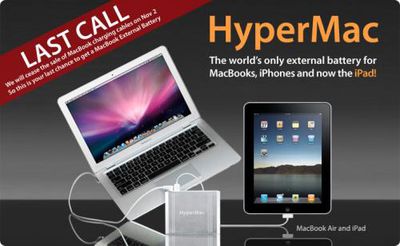
Engadget notes that Sanho, maker of the popular HyperMac line of external batteries for Apple notebooks, will halt sales of the MagSafe charging cables required for connecting its batteries to Apple's machines as of November 2nd. The move comes as the company attempts to work out a licensing agreement with Apple to offer the MagSafe interface.
As part of our ongoing comprehensive licensing negotiations with Apple regarding a wide array of technologies and issues, we have decided to cease the sale of the MacBook charging cables and car charger on November 2, 2010.
While we will continue to sell the same batteries together with the rest of our product line after November 2nd, they will not be able to charge MacBooks without the cables.
Apple filed suit against Sanho early last month over the accessory company's use of the MagSafe interface, alleging patent infringement. Sanho had hoped to escape the eye of Apple by utilizing official MagSafe connectors recycled from Apple adapters, but their incorporation into new products was deemed by Apple to be an inappropriate usage.
It is unclear if Apple and Sanho will be able to work out an agreement to allow the MagSafe-compatible HyperMac charging cables to return in the future, but negotiations are clearly underway to at least settle the lawsuit brought by Apple.
Apple's suit had also targeted Sanho for including Apple's USB-to-Dock cable with its external battery battery products for mobile iOS devices, but Sanho has apparently already discontinued that practice, with customers having to rely on their current cables or acquiring new ones from elsewhere.
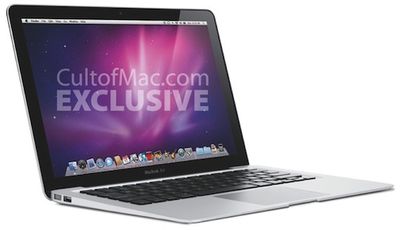
Cult of Mac's mockup of next-generation MacBook Air
Cult of Mac weighs in with claims from a new source regarding the new MacBook Air that has been receiving considerable attention in the days leading up to Apple's media event on Wednesday. The new report corroborates many of the claims coming from other sources, but also offers a few new details on what we might expect in the new machine.
- Battery life rumored to be 8-10 hours, up from 5 in the current MacBook Air. - Thinner and lighter form factor with fewer curves. - Two USB ports, SD card slot, straight-style MagSafe, Mini DisplayPort. - Base model with 2 GB of RAM, but upgradeable. SSD also upgradeable. - NVIDIA GeForce 320M graphics. - Unconfirmed CPU claims of 2.1 GHz and 2.4 GHz options, but no claim of a specific processor family is offered. - Suggestion of $999 for 11.6-inch model and $1100 for the 13.3-inch model, but Cult of Mac believes something like $1100/$1400 to be more likely.
As we approach Apple's "Back to the Mac" media event on Wednesday, October 20th, rumors are ramping up about what Apple is expected to introduce.
A leaked image of a prototype MacBook Air seems to confirm rumors that Apple is working on a new form of Solid State Drive (SSD) that could push notebook's size and cost down. Looking back at reports this past year, it seems many of these details (and one additional one) have been previously predicted through the supply chain.
As far back as July, DigiTimes reported that an 11.6" MacBook Air with a slimmer and lighter design was gearing up for production:
Kuo, citing discussions with upstream component makers, noted that the 11.6-inch MacBook Air will feature an even slimmer and lighter design than the previous-generation models and the technologies used for the design and concept are expected to be broadly used in the company's other product lines to boost their competitiveness.
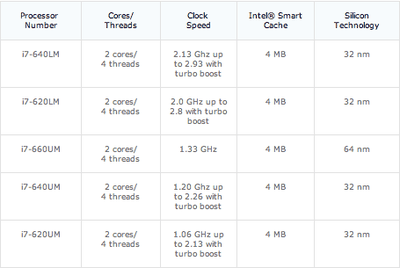
DigiTimes also specified that the new MacBook Air would use one of Intel's Ultra Low Voltage processors. While Intel offers multiple "Ultra Low Voltage" (ULV) Core 2 Duo processors, the Core i7 ULV seems the most likely candidate.
Intel also offers Core i3 and Core i5 ULV chips but those top out at only 1.2GHz. One analyst also predicted that the new MacBook Air would come in two models, and that based on high unit projections, the new Airs were likely to come in at a lower starting price. In fact, CNet has since described the starting price as "much lower" then the current $1499 entry level.
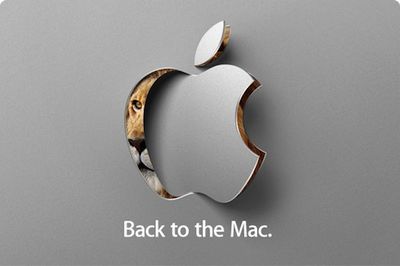
As for Mac OS X, Apple's invitation with the Lion image clearly hints that the next major revision of Mac OS X (10.7) will finally be revealed. Apple has long named their major Mac OS X releases after various cat names. Early rumors suggested that Apple might have introduced 10.7 earlier this year, but it seems the company's resources were focused on iOS at the time. The only real hint we've had at 10.7 was a very intriguing job description from July in which Apple was looking for someone to focus on a "revolutionary new feature" for Mac OS X.
Are you looking to help create something totally new? Something that has never been done before and will truly amaze everyone? Are you excited by the prospect that what you helped create would be used every day by millions of Apple customers? Then come and work on with the Mac OS X software engineering team to help build a new and revolutionary feature for Mac OS X.
The language of the job description seemed much more specific than Apple's usual recruitment language. Of course, it's possible that this amazing feature could be slated for the next version of Mac OS X, but the timing seems right for 10.7.
Apple's media event kicks off at 10am Pacific on Wednesday, October 20th. We'll provide ongoing coverage of the news and events.
With the booming popularity of Apple's iPad, it is no surprise that the device is making its way to markets around the world, both as Apple expands its own distribution and as private citizens go to sometimes-great lengths to obtain the device in areas Apple hasn't yet reached.
iPad with anchor of the Bounty
It is in that spirit that we share the story of Andrew Randall Christian, a seventh-generation descendant of Fletcher Christian, the leader of the famed Mutiny on the Bounty. Andrew is a resident of Pitcairn Island, the final landing spot for several of the mutineers in 1790 as they attempted to find a home where they could evade detection by the British Royal Navy.
Pitcairn Island is currently home to about 60 people and is one of the most remote and inaccessible inhabited locations in the world, with its only regular physical connection to the outside world coming from a cargo and passenger ship that makes a total of eight visits per year to the island. Rare visits from cruise ships also bring occasional visitors to the island.
iPad at Pitcairn Island's signpost for off-island destinations
So color us a bit surprised when Andrew contacted us to let us know that he is now the proud owner of a 16 GB Wi-Fi iPad, the only one on Pitcairn Island. Andrew tells us that he made contact with a woman from New York who had arranged for a visit to Pitcairn Island on a cruise ship traveling from Tahiti to Easter Island and who asked if there was anything she could bring him. As an Apple fan with a 17" PowerBook and Power Mac G5 already in his possession, Andrew requested an iPad. Two months later, the visitor arrived and presented Andrew with his iPad.
As Andrew notes, he ordered a Wi-Fi-only iPad because there was little point in springing for the 3G-capable model with no cellular service of any kind on the island. Telephone and Internet service is provided via satellite, with residents paying NZ$100 (US$75) per month for up to 2 GB of Internet data at 256 kbps. Despite the infrastructure limitations, Andrew tells us that he is "blown away" by the iPad, noting the "beautiful design" and ease of use of Apple's tablet device.
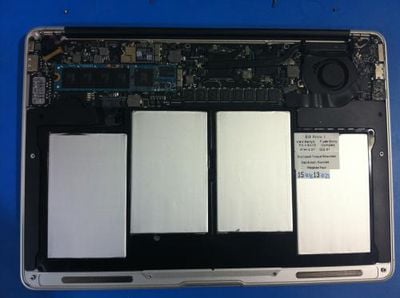
With the leak of an early MacBook Air prototype, it seems a few more details are emerging about Apple's upcoming release. - AppleInsider adds some claims which we've summarized here:
- The 11.6-inch MacBook Air won't replace the 13.3-Inch model but will complement it as a cheaper option - Both models will be unibody designs with single button trackpads - It will be slightly thicker than a standard USB port at its thickest point.
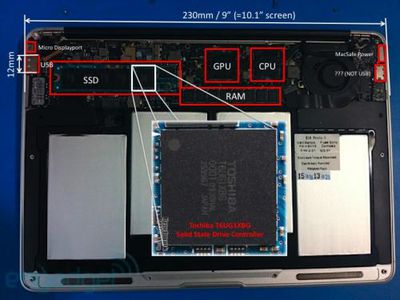
Forum user diddl14 has labeled the leaked picture with these notes and speculation from the forum thread:
- Despite the labeling above, the source of the image reports it is a 13" model, not an 11". - The chips above do represent an SSD controller/interface - The silver components are believed to be off-the-shelf batteries which may be replaced with a custom form-fitting battery in the final production - The prototype was using the same Core 2 Duo processor as the current MacBook Air - The port on the right is not believed to be another USB port - The prototype has 2GB of memory - The source of the leaked image reports a 1440x900 resolution to the 13" model.
Engadget posts a single shot of what is claimed to be a prototype MacBook Air dating back to April 2010. The image comes from a source who had been shopping the images around to several tech sites last evening. The prototype device is labeled "K16".
Based on our own professional squinting ability, there are USB plugs on the left and right sides, Mini DisplayPort and an SD card reader on the left, and a power plug on the right.
The prototype unit is said to have been discovered in April 2010 and retains a 13" screen size form factor. We ran the image by iFixit's Kyle Wiens who thought the component near the top looked to be user upgradable flash, and also identified non-upgradeable SDRAM (although there may be a slot on the other side), and slightly larger battery capacity.
On Friday, Apple had been rumored to be introducing a new SSD Card storage in their upcoming MacBook Air. The new storage was described as closely resembling a "stick of RAM". It's possible this early prototype represents some of the early research done on that feature. The prototype, however, was the same size as existing MacBook Airs, so is unlikely to represent next week's launch product if the 11.6" screen-size rumors are to be believed.
The Los Angeles Times reports that it has received information from a source claiming that Facebook CEO Mark Zuckerberg recently dined at Steve Jobs' home in Palo Alto to discuss how the two companies might be able to settle their differences and come to an agreement for working together on Ping, Apple's music-focused social networking feature rolled out in iTunes 10 last month.
They are two of Silicon Valley's most famous founders: Jobs created the world's must-have gadgets, Zuckerberg the world's most popular social networking service. These days they are often mentioned in the same breath. Now apparently the two also recently broke bread.
Apparently Jobs invited Zuckerberg for dinner at his house to talk about Ping two weeks ago. That's when a tipster spotted them on a stroll in Palo Alto.
According to earlier reports, Apple and Facebook had talked for at least 18 months about working together on Ping but were unable to come to an agreement, with Jobs citing "onerous terms" being insisted upon by Facebook. Apple attempted to roll out Ping with barebones Facebook integration in the form of Facebook Connect for helping users find their friends who had already created Ping profiles, but Facebook quickly yanked Apple's access to the feature.
While the two companies have apparently yet to reach an agreement for any level of integration with Ping now six weeks old, one Facebook executive recently noted that he is "very confident" that a deal will be struck.
iLounge reports that it has received word that warehouse club chain Costco will cease to carry Apple's iPods after the retailer lost out on the recent round of expansion of iPad availability that has seen rival Sam's Club and others begin carrying the tablet device.
Membership club Costco, the third-largest retailer in the U.S., is preparing to cease carrying iPods, according to an iLounge source who asked not to be identified. Based on the report, which notes that iPods have already disappeared from the company's web site, Costco will stop carrying the iPod after being unable to stock the iPad, which has just been offered to or become available at competing retailers including Target, Walmart, and, soon, Sam's Club.
A check of several Costco locations by iLounge revealed stock of the current iPod touch, but the report's source indicates that locations are simply selling through their remaining stock before discontinuing the line. Costco has not offered an official statement on the matter, and it is unknown whether Apple is considering Costco for iPad distribution or if Costco would consider restoring iPod sales in the future with or without the iPad.
NewTeeVee reports that Apple is developing the capability to offer "in-stream ads" for video content on its iOS devices, looking to entice content owners to take advantage of the monetization possibilities and bring their videos to the platform.
Many publishers have been slow to bring their videos to the iPhone and iPad, due in part to the lack of mature tools available for monetizing content on those devices. Because iOS devices don't support Adobe Flash, publishers need to do additional work to make their current ad-serving systems work with the HTML5 video delivery required for the iPhone and iPad. That's caused many publishers to think twice before delivering video to those devices.
Sources indicate that Apple's video ad product would work with both QuickTime and HTML5 video and offer a similar experience to the ads inserted in Flash video clips today.
The ad product would not only enable video publishers to serve their own ads against videos on the iPhone or iPad, but it would give Apple the ability to act as a video ad network for those that don't wish to sell their own inventory. The in-stream ad system is also expected to have some targeting capabilities built-in, with mobile location data and anonymous user behavior data to help deliver targeted ads to consumers.
Apple could introduce the new ad service in the first or second quarter of next year, initially targeting the iPad and iPhone, but looking toward the Apple TV as another platform for ad-supported video content.
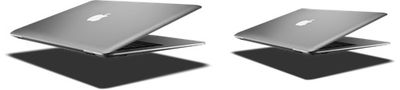
Mockup of current (left) and forthcoming (right) MacBook Air
AppleInsider reports that Apple is preparing to release a new MacBook Air at its "Back to the Mac" media event next Wednesday. The report agrees with reports dating back several months claiming that the new MacBook Air will offer an 11.6-inch display, down from the 13.3-inch display found in the current model. The report seems to agree with an earlier claim that such a model is already in manufacturing, suggesting that availability could come soon after next week's introduction.
Interestingly, the report indicates that Apple appears set to forgo traditional hard drive and even conventional solid state drive technology for storage on the new MacBook Air, instead opting to employ what appears to be proprietary "SSD Card" storage that would be embedded directly in the device rather than conforming to standard drive bay sizes used by other drives.
According to this person, the new models will do away with existing options for a conventional hard-disk drive (HDD) or solid state drive (SSD) in favor something described as an "SSD Card" that lacks a traditional drive enclosure and more closely resembles a stick of RAM, yet is not easily user-replaceable.
If accurate, AppleInsider believes the component may be a proprietary SSD drive alternative designed by Apple to be integrated in Macs in a similar manner to the way flash memory is embedded in iPods, iPhones and iPads. This approach would be less expensive than a standard package intended to fit the shape of conventional HD devices, allowing the company to drive down costs and pass the savings on to the consumer.
The report notes that offering a flash-only MacBook Air could allow Apple to offer significantly faster boot and wake times, and that the proprietary design for the flash storage could allow Apple to save space inside the slim computer's body and produce the storage at lower cost.
Sources indicate that the new MacBook Air will appear very much as a scaled-down version of the current model, although at least one source claimed that the new version might offer a slightly less curved and more wedge-shaped design.
Update: CNET is offering its own hints at what we might be able to expect, citing a price "significantly lower" than the current $1499 entry-level price point. CNET's source indicates that the new MacBook Air may continue to use an Intel Core 2 Duo processor and offer extended battery life compared to the current model.