Apple's Car Keys feature appears to be coming to TANK vehicles made by Chinese maker Great Wall Motor (GWM), based on code changes discovered by MacRumors in Apple's Wallet app backend.
GWM Tank is a dedicated off-road luxury SUV brand produced by the Chinese automaker.
Car Keys allows an iPhone or Apple Watch with NFC capabilities to unlock a vehicle through the Wallet app. A digital version of a car key is stored in Wallet, and unlocking can be done simply by holding an Apple Watch or iPhone near a compatible vehicle's NFC reader.
What can be done with Car Keys may vary by car manufacturer, but at a minimum, Car Keys can be used to unlock your car, lock your car, and start your car, which are the features available with a physical key.
Apple introduced Car Keys in 2022, and car manufacturers like BMW, Rivian, Kia, and Hyundai have all implemented support for Car Keys. Apple maintains a full list of vehicles that support Car Keys on its CarPlay model availability webpage.
WhatsApp has started rolling out its new username feature, reports WABetaInfo. Some users who reserved their username have started receiving a notification that their username is active, and that they can now use it to send and receive messages to other users without revealing their phone number.
When someone creates a username, WhatsApp will notify people who already have an active chat with that person. WhatsApp has no directory of usernames to browse, and no username discovery suggestions, so people will need to know a WhatsApp user's exact username to send a message.
If you installed iOS 27 Beta or iPadOS 27 Beta through Apple's Developer Program, you may decide you want to downgrade because of usability or stability issues. Keep reading to learn how it's done.
Apple's beta versions of its major software updates can be buggy, especially the early releases. While that isn't necessarily the case for the latest iOS 27 beta, you may still find apps not working properly, poor battery life, device crashes, and features that don't do what they're supposed to. Fortunately, you can restore your iPhone or iPad to the previous version of iOS.
If you made an archived backup before you installed the iOS 27 beta, you can remove the beta and restore the backup. If you don't have an archived backup that was created before installing the beta, you can still downgrade, but you'll need to set up your device as new or restore from an older compatible backup. Only an archived backup made before installing the beta can be restored after downgrading.
Also, bear in mind that if you've installed watchOS 27 beta on your Apple Watch, you won't be able to use it with your iPhone once you've gone back to iOS 26. And downgrading an Apple Watch to a previous version of watchOS can't be done manually – if you want to remove watchOS 27 beta, you'll have to send your watch in to Apple.
How to Downgrade From iOS 27 Beta or iPadOS 27 Beta
Launch Finder on your Mac. On Windows, open the Apple Devices app (or iTunes if you're using an older setup).
Connect your iPhone or iPad to your computer using a Lightning or USB-C cable.
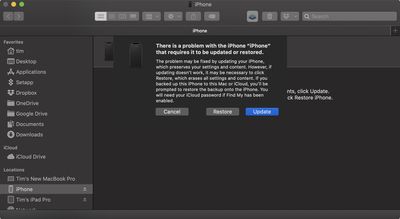
Put your device into recovery mode. The method of doing this depends on your device, so check the list below these steps to find your model. Apple also provides more information on Recovery mode in this support article.
A dialog will pop up asking if you want to restore your device. Click Restore when prompted. Your computer will erase the device and install the latest publicly available version of iOS or iPadOS that's still being signed by Apple.
Wait while the restore process completes.
How to Enter Recovery Mode on Your iOS Device
iPad models with Face ID or a Touch ID power button: Press and quickly release the Volume Up button. Press and quickly release the Volume Down button. Press and hold the Top button until your device begins to restart. Continue holding the Top button until your device goes into recovery mode.
iPhone XS or later: Press and quickly release the Volume Up button. Press and quickly release the Volume Down button. Then, press and hold the Side button until you see the recovery mode screen.
Once you've followed the above steps, you can restore a backup of your device from iOS 26 or iPadOS 26 using your Mac or iCloud.
Apple has reportedly sent legal letters to dozens of former Apple employees now working at OpenAI, telling them to preserve potentially relevant documents and communications as it continues to pursue its trade secret lawsuit against the AI company.
The Financial Times ($) reports that Apple has targeted around 40 former employees with legal preservation letters, acting on its belief that the alleged misappropriation of confidential information may extend beyond the individuals named in its original complaint.
The development follows Apple's lawsuit filed last week against OpenAI, in which the company alleges a coordinated effort to obtain confidential information relating to its hardware engineering and product development.
Apple claims OpenAI recruited key engineers, including former Apple executives Tang Tan and Chang Liu, and benefited from proprietary designs, manufacturing processes, and other trade secrets. Tan is OpenAI's Chief Hardware Officer and a 24-year Apple veteran who led product design, while Liu is on the hardware team at OpenAI after working as a senior system electrical engineer at Apple.
The complaint says that more than 400 former Apple employees now work at OpenAI and suggests that the alleged misconduct is broader than a few isolated actions by individual employees. OpenAI has denied the allegations, saying in a statement to Bloomberg this week that it is "not aware of any evidence that this complaint has merit."
Apple has requested an injunction requiring OpenAI to cease using any Apple information during the development of OpenAI's AI hardware device. Apple is also seeking damages and suing Tan and Liu for breach of contract for violating their employment agreements. The company believes the evidence uncovered so far may represent only the "tip of the iceberg," according to its lawsuit.
The European Commission today formally ordered Google to give third-party AI services the same access to Android device features that Gemini has. Europe's Digital Markets Act requires software makers like Apple and Google to grant equal interoperability to third-party apps and services, and the EC is enforcing it.
DMA interoperability rules are why Siri AI won't be available in the European Union when iOS 27 launches. While Apple tried to work out an agreement with regulators before launching Siri AI in Europe, Google did the opposite. Instead of asking, Google just launched Gemini integration on Android and opted to deal with the consequences afterward. Google's strategy gives Android users in Europe full Gemini access while it works on compliance with the DMA.
The European Commission is giving Google a full year to implement changes that will meet the Digital Markets Act requirements, and that's before any legal appeals Google might make.
The European Commission is making many of the same demands of Google that it made of Apple. Google must allow AI apps to access 11 features, such as:
AI services must be accessible through voice commands like "Hey Google" or through access points like the home button or another activation button.
AI services must be able to complete actions in and across apps, including completing long-running tasks in the background.
Google must allow AI services to access context from apps and device sensors so AI can offer proactive services and anticipate user needs.
Google has to give AI apps sufficient hardware and software resources, including access to its on-device AI models to execute tasks.
Google is required to implement the majority of the European Commission's changes by August 1, 2027.
Shortly after announcing Siri AI, Apple said EU regulators would not accept any of its proposed solutions to introduce the feature, and refused to engage on options that "preserve privacy and security." Apple wanted to use a Trusted System Agent that would allow third-party virtual assistants to safely access the same device capabilities as Siri AI.
Apple said the Digital Markets Act would require it to give any AI system "nearly unlimited access to a user's device," along with the ability to act on that information autonomously.
The European Commission claims Apple was "unable to develop interoperability solutions that meet essential EU privacy and security standards" and instead asked for a blanket exemption from the interoperability requirements, which the EC did not grant.
In response to the EC's mandate, Google said the requirements "risk undermining vital privacy and security guardrails for millions of Europeans." Google hasn't given information on its next steps, but it says it plans to "continue advocating for a balanced approach that protects privacy and security while supporting market goals."
Note: Due to the political or social nature of the discussion regarding this topic, the discussion thread is located in our Political News forum. All forum members and site visitors are welcome to read and follow the thread, but posting is limited to forum members with at least 100 posts.
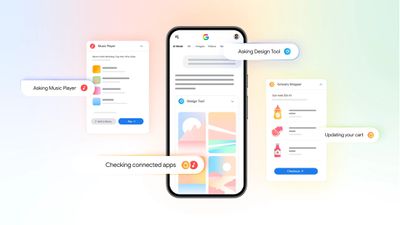
Google is expanding AI Mode in Search, allowing users to connect apps to improve search results and "get more done."
Instacart, YouTube Music, and Canva can be connected, and Google explains how the integrations can be useful:
Instacart - If you're using AI Mode to help you plan a grocery list, ingredients can be added right to an Instacart shopping cart for quick ordering.
Canva - If you're creating a flyer, you can get template options from Canva.
YouTube Music - You can use AI Mode to curate a playlist and save it to YouTube Music.
Instacart, Canva, and YouTube Music are the only apps that can be connected right now, but Google may add more in the future. Connected apps were previously available in Gemini, but the feature set is now being expanded to Search.
Connecting apps is limited to AI Mode in the United States, in English. Once an app is connected, users are able to access new features when making a request in Google Search AI Mode. Connected apps can be used in Search both on the desktop and through the Google Search iOS app.
Google suggests users turn on history and personalized recommendations to improve the Google Search experience. Google says it uses people's interactions with Search and the new AI features to develop and improve generative AI experiences.
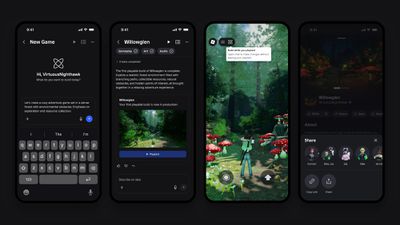
Online game platform Roblox today said it is adding a new Build tool that will let iPhone and iPad users create games using AI.
With the mobile-first Build option, Roblox users can write a text-based prompt and have AI turn it into a basic game. A single prompt will create a starting point that can be expanded with playtesting and further commands. The entire game-making process, from creation to uploading on the Roblox platform, can be done on a mobile device.
Right now, creating a game in Roblox requires a Mac or PC app, but Build will extend game creation to mobile users too. Roblox is also adding new AI creation tools to Roblox Studio, its desktop game creation software. Content created using the Build tool can be iterated on with Studio.
Roblox Build is set to roll out to the Roblox mobile app on July 28, beginning with a public alpha test for users in New Zealand. Build will roll out to additional regions in the coming months as Roblox improves the experience.
Roblox has 132 million daily active users, and user-created games like Brookhaven RP, Adopt Me, and Dress to Impress have been wildly popular.
Popular password management app 1Password today added Claude support, which means AI service Claude can access credentials stored in 1Password for completing browser tasks.
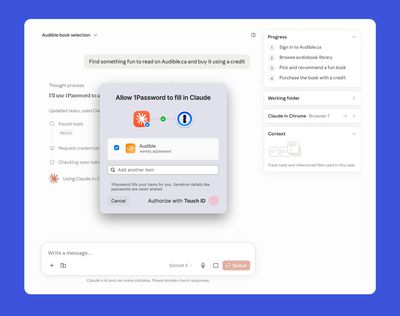
With the integration, Claude can use 1Password logins and one-time codes without the actual password being exposed to Claude. Passwords never reach Claude's context, memory, or Anthropic's systems.
When Claude wants to sign in to a website, 1Password shows the user which credential Claude wants access to and why. After the user approves the request, 1Password adds the credential directly to the page. Access is limited to the current task and ends when the task has been completed. The 1Password team says that after a password is autofilled, the app checks to make sure secrets were not exposed on the page.
Credit cards and identities in 1Password are not supported at the current time, so Claude's access is limited to logins and one-time codes.
The 1Password browser extension is also being updated with Agentic Mode, which gives users control over browser-based AI agents. When an AI agent takes over, the 1Password extension locks down so passwords are not exposed. The password interface is hidden, and the agent can use logins and one-time codes only when the user gives approval. Agentic Mode works to protect passwords from AI agents even if the integration is not set up.
1Password for Claude is available for Mac, and 1Password business, family, and individual plan subscribers can use it. A Pro, Max, Team, or Enterprise Claude plan is required. 1Password has a help document with detailed information on how to set it up.
Claude can use 1Password logins across sites where Claude in Chrome can complete actions. The 1Password desktop app and browser extension are required, as are the Claude desktop app and the Claude in Chrome browser extension.
Apple this week was sued over a reported "Hide My Email" flaw that could expose a user's real email address. The proposed class action lawsuit alleges that Apple violated California's false advertising law and other consumer protection statutes by knowingly offering a feature that does not work as advertised.
A security researcher disclosed the apparent "Hide My Email" vulnerability to Apple in June 2025, but there are no known instances of it being exploited, as the steps involved have not been shared with the public as a precaution.
Apple chip supplier TSMC has announced a $100 billion increase to its U.S. chip investment, bringing its total commitment to $265 billion.
The increase was confirmed by the White House and the Department of Commerce alongside TSMC's second quarter earnings call. Commerce Secretary Howard Lutnick said the investment would "create tens of thousands of American jobs," while TSMC chairman and CEO C.C. Wei told CNBC the new fabrication plants would support "our leading U.S. customers," a group that reportedly includes Apple, alongside Nvidia and Broadcom.
Apple CEO Tim Cook called Apple "TSMC Arizona's first and largest customer" when the company's third Arizona fab broke ground last year, and the company's first Arizona plant already produced some of Apple's A16 chips.
TSMC has historically reserved its most advanced manufacturing processes for its home plants in Taiwan, meaning Arizona made chips have trailed several generations behind whatever Apple ships at any given time. TSMC has since committed to building its own advanced packaging facilities in the US as part of its broader investment plan, according to a regulatory filing.
The new $100 billion is expected to fund up to four more plants, though the exact shape of the plan remains unsettled. The Department of Commerce says the total will reach 12 U.S. facilities, while an official told Bloomberg the eventual mix could be 10 fabrication plants and two packaging facilities, focused on 2 nanometer chips, TSMC's most advanced process commercially available today.
That timing could hinge partly on how much U.S. capacity Apple itself ends up needing, since the company has been separately exploring Intel and Samsung as backup chipmakers to reduce its reliance on TSMC amid the ongoing global chip crunch. Apple is reported to have secured an exemption from a proposed 100% semiconductor tariff partly by pledging its own U.S. manufacturing investment and agreeing to buy chips from Intel.
Note: Due to the political or social nature of the discussion regarding this topic, the discussion thread is located in our Political News forum. All forum members and site visitors are welcome to read and follow the thread, but posting is limited to forum members with at least 100 posts.
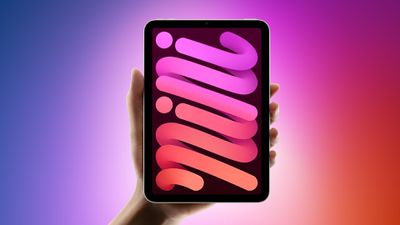
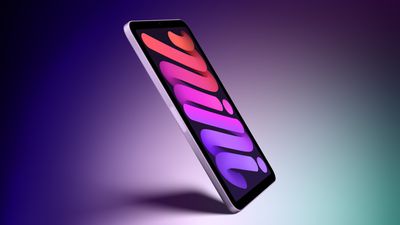
Apple today added the iPad mini with the A17 Pro chip to its refurbished store in the U.S. and Canada for the first time since the device was released in October 2024. Other key features include an 8.3-inch display, a 12-megapixel Center Stage camera, and a Touch ID power button. There is no availability in any other countries yet.
In the U.S., refurbished pricing starts at $509 for a Wi-Fi model with 128GB of storage, down from $599 for the equivalent brand-new model. However, keep in mind that a new iPad mini started at $499 until Apple raised prices last month, so unfortunately the refurbished model costs $10 more than a new model did just a few weeks ago.
Apple says the refurbished iPad mini models include a new battery and outer shell, a plain new box, and all accessories, including a 20W USB-C power adapter and a USB-C charging cable. Apple says it puts refurbished devices through a "thorough cleaning process and inspection," which typically results in a like-new condition.
All refurbished iPads are covered by Apple's one-year warranty. AppleCare+ is available.
In March, Bloomberg's Mark Gurman said a new entry-level iPad was "still coming this year," but apparently this is no longer the case. Today, he reported that the device is slated for release in the first quarter of 2027 at the earliest.
The main new feature will be a faster processor rather than major design changes, he said, so it sounds like nothing more than a spec bump. While the next iPad mini is expected to have an OLED display, the base iPad will stick with an LCD screen.
Gurman previously said the device would be powered by the A18 chip, but Macworld's Filipe Espósito said it would have an A19 chip. In any case, the device would gain support for Apple Intelligence, as both chips have the minimum 8GB of RAM required for those features. The current entry-level iPad has an A16 chip with 6GB of RAM.
Last month, Apple increased the entry-level iPad's starting price worldwide. In the U.S., for example, the device now starts at $449, up from $349.
Apple also plans to release new 11-inch and 13-inch iPad Air models early next year, according to Gurman. He said the iPad Air will eventually move to an OLED display, but he did not say if that is happening with the next models specifically.
All in all, he expects a new iPad mini by October this year, followed by updated entry-level iPad, iPad Air, and iPad Pro models in the first half of next year.
Amazon's prices on the 2026 MacBook Pro have now joined in on Apple's recent price hikes, meaning we're no longer tracking pre-hike markdowns on these devices. However, there are still notable sales to be found if you're shopping for a MacBook Pro this month, with up to $500 off new prices available right now on Amazon.
Note: MacRumors is an affiliate partner with Amazon. When you click a link and make a purchase, we may receive a small payment, which helps us keep the site running.
14-Inch MacBook Pro
Prices start at $2,349.00 for the 24GB/1TB 14-inch M5 Pro MacBook Pro, down from $2,499.00. The 24GB/2TB model is on sale for $2,997.50, which is a $201 discount on the new price.
In terms of the larger display models, we're tracking four total discounts on Amazon. These start at $2,818.34 for the 24GB/1TB M5 Pro configuration ($180 off), and reach up to $4,499.00 for the 48GB/2TB M5 Max device ($500 off).
If you're on the hunt for more discounts, be sure to visit our Apple Deals roundup where we recap the best Apple-related bargains of the past week.
Deals Newsletter
Interested in hearing more about the best deals you can find in 2026? Sign up for our Deals Newsletter and we'll keep you updated so you don't miss the biggest deals of the season!
Apple is planning to release a new iPad mini model with an OLED display by October this year, according to Bloomberg's Mark Gurman.
Apple already updated the iPad Pro with an OLED display in May 2024, but the iPad mini, iPad Air, and entry-level iPad are all still equipped with LCD screens. The move to OLED technology would result in the next iPad mini offering improved image quality, thanks to richer colors and higher contrast ratio with true blacks.
Given that OLED displays are generally more expensive than LCDs, the next iPad mini could have a higher starting price compared to the current model.
Apple has ramped up orders for vapor chamber cooling components said to be destined for its upcoming foldable iPhone and 20th-anniversary iPhone models, according to a Chinese leaker.
The Weibo account known as "Fixed Focus Digital" claims the increased order volume will first support the manufacture of Apple's book-style foldable, or "iPhone Ultra," which is expected to debut in September. Apple has reportedly asked suppliers to produce approximately 10 million foldable iPhones in 2026, up from an earlier forecast of seven to eight million units.
Fixed Focus Digital previously said Apple's first foldable iPhone would feature "impressive" vapor chamber cooling, claiming that the company is "going all out" with the device's thermal engineering. While there's no corroborating evidence, it's quite possible that the foldable design Apple is adopting could present unique cooling challenges because of its thinner internal structure and limited space for heat dissipation.
Apple introduced vapor chamber cooling to the iPhone lineup with last year's iPhone 17 Pro. The system uses a small amount of deionized water to move heat away from the A19 Pro chip and distribute it through the device's aluminum unibody frame.
Meanwhile, next year's 20th-anniversary iPhone will reportedly feature an edge-to-edge display with glass that curves around all four sides, with the aim of creating a nearly borderless appearance. If indeed we see such a device with a substantially redesigned enclosure, there's a good chance that it too will require a more advanced cooling system.
Apple is expected to offer two anniversary models in 2027 in sizes similar to the forthcoming iPhone 18 Pro and iPhone 18 Pro Max. The latter devices are rumored to retain the 6.3-inch and 6.9-inch dimensions of the current iPhone 17 Pro models, suggesting next year's commemorative lineup could use the same display sizes.
Earlier this week, Fixed Focus Digital claimed that Apple's "preferred approach" for the iPhone 20 is a return to glass, and that the relevant manufacturing facilities have already been renovated in advance of the project.
Apple has made the first macOS 27 Golden Gate public beta available for testing before the new Mac operating system's official release in the fall. Keep reading to learn whether you should install it on your Mac, and if so, how to go about it.
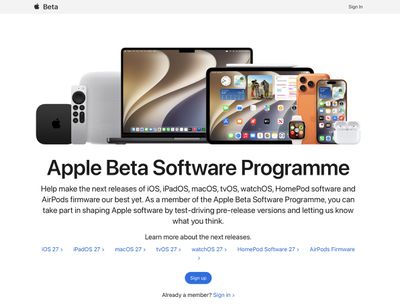
Getting access to the macOS Golden Gate public beta is simple, and can be done by enrolling your Mac in Apple's free Apple Beta Software Program. The steps you need to complete to install the software on your Mac are provided towards the end of this article, but before you jump ahead, here are a few things worth considering.
Should I Install macOS Golden Gate Public Beta?
With macOS Golden Gate, Apple includes the same Siri AI features as iOS 27 and iPadOS 27, accessed through Spotlight with the Command + Space keyboard shortcut. Siri can search the web, find information in your photos, emails, and messages, answer questions about what's on your screen with Visual Intelligence, and complete actions within and across apps. A dedicated Siri app also supports ongoing conversations.
Apple has also refined the Liquid Glass design introduced last year. A new transparency slider lets you adjust the overall system effect, while updated opacity improves readability by better diffusing complex content. Additional interface refinements also add depth and separation, making it easier to identify the active window. There are a lot more improvements beyond the above, so the availability of the public beta will no doubt generate a lot of interest among Mac users.
But before you commit, bear in mind that Apple does not recommend installing macOS beta updates on your main Mac. However stable you may have heard it is anecdotally, this is beta software, which means there are almost certainly bugs and issues that can prevent certain software from working properly or cause other problems with the system. Indeed, one of the reasons that Apple releases the beta early is so that users can feed back problems and help Apple debug them. If you have a spare Mac hanging around, by all means use that, otherwise consider holding off until the general release in the fall.
Is My Mac Supported?
The update confirms the end of Intel Mac support. Apple said last year that macOS Tahoe would be the final release to run on pre-Apple silicon machines, and macOS 27 makes that official – you'll need an Apple silicon Mac to install it.
Here are the Macs compatible with macOS Golden Gate:
MacBook Neo (2026)
MacBook Air with Apple silicon (2020 and later)
MacBook Pro with Apple silicon (2020 and later)
iMac with Apple silicon (2021 and later)
Mac mini with Apple silicon (2020 and later)
Mac Studio with Apple silicon (2022 and later)
Mac Pro with Apple silicon (2023 and later)
Four models that ran macOS Tahoe didn't make the cut this year. They include the MacBook Pro (16-inch, 2019), the MacBook Pro (13-inch, 2020, Four Thunderbolt 3 ports), the iMac (2020), and the Mac Pro (2019).
Don't Forget to Back Up Your Mac
Be sure to back up your Mac using Time Machine before installing the software using the method, otherwise you won't be able to revert back to the previous version of macOS if things go wrong.
How to Install macOS Golden Gate Public Beta
Head over to Apple's Beta Software Program website and sign up using your Apple Account credentials, then agree to the terms and conditions if required.
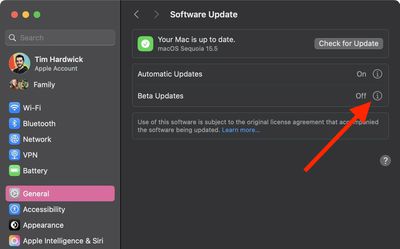
Next, open System Settings on your Mac and select General ➝ Software Update.
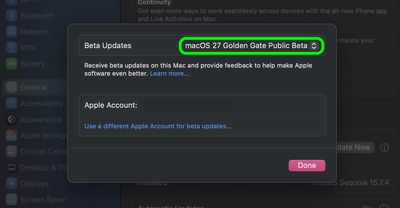
Look for "Beta Updates" and click the info (i) symbol next to it.
Choose macOS 27 Golden Gate Public Beta from the dropdown list.
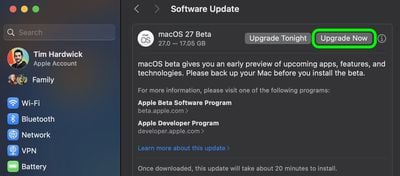
Click Upgrade Now to begin the update process to macOS 27.
That's all you need to do. The installation process will complete just like a standard macOS update, so sit back and let the installation finish, after which your Mac will boot directly into the macOS Golden Gate beta.
Apple's annual Back to School promotion is now live in the United States, Canada, and Mexico, following earlier rollouts in Asia. This year's promotion offers a free Apple gift card with the purchase of an eligible Mac or iPad.
Apple is offering a $150 gift card with any new MacBook Pro, and a $100 gift card with any new MacBook Air, iPad Pro, and iPad Air. The gift card can be used towards purchases of Apple products and accessories, App Store apps, subscriptions to services like Apple Music, iCloud+ storage, and more.
The MacBook Neo is not an eligible product. Neither are the iPad mini, entry-level iPad, or any desktop Macs.
The promotion runs through August 27, 2026, in the U.S., according to Apple's terms and conditions. The gift card is offered in addition to Apple's standard education pricing, which provides discounts of roughly 5% to 10% on most Macs and iPads.
The offer is available through Apple's online Education Store and Apple Store locations. Eligible customers include current and newly accepted higher-education students, faculty and staff at higher-education institutions, parents purchasing on behalf of an eligible student, employees of K-12 institutions, and select other qualifying customers.
Google and Epic Games this week withdrew their joint motion to modify an injunction requiring Google to support third-party app stores in Google Play. The two companies abandoned the request after it became clear the court was unlikely to allow it.
Google is now bound by a permanent injunction issued in October 2024 requiring it to allow alternative app stores on Android devices. In a court filing [PDF], Google said that it plans to begin supporting alternative app stores on July 22. In a statement to The Verge, Google said it decided to withdraw the motion to avoid a prolonged legal fight.
We've agreed with Epic to withdraw our motion to modify the US Court's injunction rather than prolonging this process which creates uncertainty for the ecosystem. This allows us to focus on executing our recently announced global business model evolution to deliver greater app store choice, lower prices, and more opportunities for developers and users. We remain committed to maintaining Android's industry-leading security and fostering a competitive ecosystem where every app store and developer has the freedom to compete. In parallel, we continue to comply with the US Court's injunction.
Epic Games sued Google at the same time that it sued Apple, but the cases had different judges and different outcomes. The lawsuit largely went in Apple's favor, but Epic Games came out ahead in the Google case after a jury found Google abused its power by operating an app store monopoly and charging developers fees that were too high.
Third-party U.S. app stores will now be able to distribute the Google Play catalog of apps, and Google has published a guide on the process. The app stores will be available through the Google Play Store, and Google will charge alternative marketplaces a $5,000 annual access fee. Apps downloaded through alternative stores will still use the Google Play system, and Google will collect its service fee on those transactions.
Google's agreement with Epic Games to lower fees for apps and accept alternative payment options is separate from the injunction requiring it to support third-party marketplaces in the Play Store, and it remains in place. Google is still adding support for outside payment methods and lowering its fees.
The injunction forcing Google to support third-party app stores doesn't have a direct impact on Apple, but it is a legal outcome Apple has been fighting worldwide. The European Union's Digital Markets Act requires Apple to support alternative app marketplaces and app sideloading in the EU, and Apple has repeatedly said the requirement weakens user privacy and protections. Google adding support for third-party app stores through the Android Play Store could eventually impact Apple's own Epic fight or future regulatory changes.
Though Apple largely won its legal fight against Epic Games, the case is ongoing. Apple was ordered to allow link-outs and alternative payment options in the U.S. in 2021, and compliance problems later led to a contempt ruling. Apple has now appealed to the Supreme Court, and the court will hear Apple's argument in late 2026 or early 2027.
Update: This article was updated to clarify that Google and Epic Games have not abandoned their settlement, but have withdrawn their joint motion to modify the injunction requiring Google to support third-party app stores on its Android platform.
Google asked the court to allow it to distribute third-party app stores on Google Play through the Registered App Stores program that it plans to roll out worldwide later this year, but Google will now support one program in the U.S. and one program in other countries.
The Epic Games and Google settlement is intact and will see Google lowering fees. The agreement addresses litigation in Australia and the UK as well as the U.S.
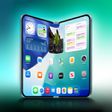
Apple's first foldable iPhone, with a book-style design featuring a ~5.5-inch outer display and a ~7.8-inch inner display with a minimal crease down the middle.



 WhatsApp has started rolling out its new username feature, reports

 Apple this week was

 Note: MacRumors is an affiliate partner with Amazon. When you click a link and make a purchase, we may receive a small payment, which helps us keep the site running.