As noted by Macworld, Apple has launched a new day pass program offering access to the company's Developer Compatibility Labs for Mac OS X developers. The new day passes, priced at $99, offer users access to Apple's facilities in either Cupertino, California or Tokyo, Japan to test their software or hardware products with a wide range of Apple products to ensure compatibility.
The Single Lab Day Pass, as its name suggests, offers developers access to one of the labs - located in Cupertino and Tokyo - for one day, between 9:00 a.m. and 5:00 p.m. There are three separate labs at Apple headquarters in Cupertino, containing a truly enormous amount of Mac hardware, from recent versions of many models to older Power Macs, PowerBooks, and iBooks - they even have G4 cubes. Apple says it has more than 500 configurations on hand for compatibility testing, along with plenty of accessories and networking hardware.
A single pass is valid for up to ten attendees, all of whom must be registered Mac developers. Participants are of course also responsible for their own travel and lodging costs.
Access to the compatibility labs was previously restricted to members of the company's ADC Select and Premier developer programs, but with Apple simplifying the developer program and lowering the cost of entry earlier this year, the company has rolled out the new day pass program to allow a broader array of developers access to the facilities.
AT&T today announced the launch of its revamped and renamed U-verse Mobile application [App Store], bringing customers of the company's U-verse television service the ability to not only schedule DVR recordings remotely but also to download selected TV content for viewing on their iOS devices.
U-verse Mobile replaces the popular Mobile Remote Access for iPhone app and incorporates the ability to browse the U-verse TV program guide, view program descriptions, schedule and manage your DVR recordings, while adding the ability to download available episodes over any Wi-Fi connection, and watch them in full-screen mode on your iPhone from anywhere. U-verse TV customers already enjoy the flexibility of remote DVR management. More than 100,000 U-verse TV customers use the Web and Mobile Remote Access apps every month.
"We're making it possible for you to watch TV shows on your iPhone at no extra charge. It's just one more valuable and innovative feature available on U-verse TV," said David Christopher, chief marketing officer, AT&T Mobility and Consumer Markets. "Our U-verse multi-screen promise is now a reality for millions of U-verse TV customers, with content available on U-verse TV, U-verse Online, and today, U-verse Mobile. No cable provider comes close to matching the cross-platform experience we're delivering today, and we'll continue to add unique features that further integrate these screens."
The new download service is available to customers subscribing to AT&T's U300 package or higher. Content is currently available from "several popular networks" with more networks to be added over time.
AT&T's U-verse application launched a little over a year ago and offered remote DVR scheduling. The company had been rumored to be working on a more substantial integration of U-verse with the iPhone. But even now, users are restricted to downloading content from AT&T's mobile library of shows rather than direct live integration with the customer's DVR.
The Baltimore Sun reports that Apple has signed an exclusive agreement with California-based company Liquidmetal Technologies for the firm's advanced "amorphous" metal alloys. The news comes as part of a filing made by Liquidmetal with the U.S. Securities and Exchange Commission, in which the company reveals that Apple has obtained the right to use essentially all of its intellectual property in the consumer electronics field while Liquidmetal retains usage rights in other fields.
On August 5, 2010, Liquidmetal Technologies, Inc., a Delaware corporation ("Liquidmetal"), entered into a Master Transaction Agreement with Apple Inc., a California corporation ("Apple"), pursuant to which (i) Liquidmetal contributed substantially all of its intellectual property assets to a newly organized special-purpose, wholly-owned subsidiary (the "IP Company"), (ii) the IP Company granted to Apple a perpetual, worldwide, fully-paid, exclusive license to commercialize such intellectual property in the field of consumer electronic products in exchange for a license fee, and (iii) the IP Company granted back to Liquidmetal a perpetual, worldwide, fully-paid, exclusive license to commercialize such intellectual property in all other fields of use (together with all ancillary agreements, the "Master Transaction Agreement").
According to Liquidmetal's description of its technology, the company has developed new metal alloys exhibiting an "amorphous" molecular structure differing from the crystalline structures of traditional metals.
This amorphous atomic structure leads to a unique set of characteristic properties for the family of Liquidmetal alloys.
These characteristic properties are:
- High Yield Strength - High Hardness - Superior Strength/Weight Ratio - Superior Elastic Limit - High Corrosion Resistance - High Wear-Resistance - Unique Acoustical Properties
The company also points to the advantages of using Liquidmetal alloys in consumer electronics, citing its ability to deliver stronger and harder device casings while also offering thinner designs of excellent durability and corrosion resistance. The relatively low melting temperature and other characteristics of Liquidmetal alloys also permit them to be easily cast into a variety of forms while retaining their strength and durability.
It is unknown exactly what Apple plans to do with Liquidmetal's technology, but Apple's focus on industrial design with extensive use of metal in its device casings suggests a number of opportunities for the technology to make its way into the company's products.
DigiTimes today offers a number of claims related to Apple's iOS platform, agreeing with other recent reports that the Verizon iPhone will launch in January, with new 9.7" and 7" iPads and iOS-based Apple TV also set for introduction early next year.
- iPad: DigiTimes claims that Apple will refresh its iPad in the first quarter of 2011, moving to a processor based on ARM's Cortex-A9 design, up from the current Apple A4 chip leveraging the Cortex-A8 design. The report also claims that the new iPad will carry the same 512 MB of RAM as the iPhone 4, up from the 256 MB found in the current iPad.
According to the report, the iPad will be available in both the existing 9.7-inch screen size and a smaller 7-inch size. The smaller version is, however, said to carry the same 1024x768 resolution of the existing iPad, resulting in an increase in pixel density to 183 ppi from 132 ppi. While not offering the same high resolution as the iPhone 4's Retina display at 326 ppi, content on the smaller iPad would appear a bit sharper than on the larger version.
DigiTimespreviously claimed that Apple was planning both 5.6" and 7" iPad models using OLED display technology, although even it cast doubt on its own sources' OLED claims. And just last week, another report claimed that a 7" iPad is on its way by early next year.
- CDMA iPhone: As previously reported, Pegatron is claimed to begin production of a CDMA-based iPhone in December for an introduction at CES in January and shipping during that same month. The report also claims that the CDMA-based iPhone, which will be targeted to Verizon in the U.S. and China Telecom in that country, will carry a metal back instead of the glass back found on the iPhone 4. DigiTimes also references an "integrated antenna" that will be part of the back plate, a seemingly significant redesign from the iPhone 4's antennas built into the edges of the device.
- Apple TV: Finally, the report claims that Apple is preparing to introduce a new Apple TV based on AMD's Fusion platform. The new device, which has been rumored for several months, is said to lack a hard drive and run an interface similar to, and presumably based on, iOS. Support for "social networking websites, network multimedia and the App Store" is said to be included. Mass production of the new Apple TV is reportedly set for December, with an introduction presumably planned for early 2011.
When Apple announced the new 2010 Mac Pros, they finally added support for two new ATI Radeon HD graphics cards for the Mac Pro. The new Mac Pros can be configured with either the ATI Radeon HD 5770 or 5870 cards. Existing Mac Pro owners had been hopeful that they would be able to easily upgrade their existing Mac Pros to these same cards.
Apple has finally started listing the standalone graphics card upgrade kits on their website, but it doesn't appear to offer existing Mac Pro users many new options.
The 5770 part is essentially a replacement part for the newly shipping Mac Pros and apparently does not officially offer an upgrade path to existing Mac Pro owners. Meanwhile, the 5870 card (which isn't shipping yet) does offer an upgrade path, but only for 2009 Mac Pro owners.
Apple still offers the ATI Radeon HD 4870 as an upgrade option for both 2009 and 2008 Mac Pros. The 4870, however, remains priced at $349 but is said to offer similar performance as the 5770 card.
As announced in July, Apple has started accepting orders for the new 12-core Mac Pros. The Mac Pro configurations now come in 3 different base configurations:
$2499 - (Quad Core) One 2.8GHz Quad-Core Nehalem Processor $3499 - (8-Core) Two 2.4GHz Quad Core Westmere Processors $4999 - (12-Core) Two 2.66GHz 6-Core Westmere Processors
Each configuration can be further customized with faster processors, SSD drive options and upgraded ATI Radeon graphics cards. All the changes were previously detailed in the press release of the announcement:
At the heart of the new Mac Pros performance are next generation quad-core and 6-core Intel Xeon processors running at speeds up to 3.33 GHz. These multi-core processors use a single die design so each core can share up to 12MB L3 cache to improve efficiency while increasing processing speed. These systems feature an integrated memory controller for faster memory bandwidth and reduced memory latency; Turbo Boost to dynamically boost processor speeds up to 3.6 GHz; and Hyper-Threading to create up to 24 virtual cores. The Mac Pro now comes with the ATI Radeon HD 5770 graphics processor with 1GB of memory and customers can configure-to-order the even faster ATI Radeon HD 5870 with 1GB of memory.
The Wall Street Journal provides some additional color on the departure of Apple's iPhone hardware engineering chief Mark Papermaster, citing "broader cultural incompatibility" rather than a direct link to the iPhone 4's antenna issues as reason for his exit.
Exactly how much the problems with the iPhone 4 played in Mr. Papermaster's exit is unclear. The iPhone 4, a key device for Apple, has been beset by issues such as antenna reception and delayed production of a white version of the gadget. Several people familiar with Mr. Papermaster's situation said his departure was driven by a broader cultural incompatibility.
Mr. Papermaster had lost the confidence of Mr. Jobs months ago and hasn't been part of the decision-making process for some time, these people said. They added that Mr. Papermaster didn't appear to have the type of creative thinking expected at Apple and wasn't used to Apple's corporate culture, where even senior executives are expected to keep on top of the smallest details of their areas of responsibility and often have to handle many tasks directly, as opposed to delegating them.
One of these people also said Mr. Papermaster had difficulty maneuvering Apple's internal politics.
Neither Papermaster nor Apple have yet offered any details on the circumstances behind his departure.
The report notes that it was Jobs who pressed forward with the iPhone 4's antenna design despite questions about its performance, suggesting that perhaps Papermaster does not bear as much blame as many have thought. In addition, Apple has claimed that the antenna design was in testing for two years prior to the launch of the iPhone 4, meaning that it had been designed and subjected to significant testing even before Papermaster officially joined the company in April 2009.
Yes, it's the subject that's been beaten to death: a Verizon iPhone. The ongoing rumors have been stoked in recent weeks by a claim from Bloomberg that the device will launch in January, with this week's announcement that Verizon CEO Ivan Seidenberg will offer the keynote address at CES 2011 sparking speculation that an iPhone introduction could occur there.
TechCrunch weighs in today with new claims that Apple has placed a large order for Qualcomm CDMA chips to be deployed in an iPhone production run scheduled for December. The claims come from a source reportedly familiar with the supply chain logistics for the CDMA-based chips that would be required for a Verizon iPhone.
Sources with knowledge of this entire situation have assured me that Apple has submitted orders for millions of units of Qualcomm CDMA chipsets for a Verizon iPhone run due in December. This production run would likely be for a January launch, and I'd bet the phone is nearly 100% consistent with the current iPhone 4 (with a fixed internal insulator on the antenna).
As the report notes, the evidence does not guarantee a Verizon iPhone launch in January, "but all of the signals point that way", adding another claim to the growing chorus of reports suggesting that a launch is coming early next year.
AT&T has already moved to downplay the risk to its bottom line posed by the loss of its exclusivity for the iPhone in the U.S., noting in its latest quarterly filing with the U.S. Securities and Exchange Commission that it expects no "material negative impact" from the expiration of its exclusive handset distribution agreements.
"We do not expect any such terminations to have a material negative impact on our wireless segment income, consolidated operating margin or our cash from operations," AT&T said in the filing with regulators on Friday.
AT&T also reiterated its position that AT&T customers will not defect to rival carriers in large numbers once the iPhone goes non-exclusive, claiming that 80% of customers are on family or business plans that make it difficult for them to switch.
The New York Times reports that Mark Papermaster, Apple's Senior Vice President of Devices Hardware Engineering, has left the company. Papermaster has been heading up Apple's iPhone and iPod engineering teams since he began work with the company in April 2009.
Mark Papermaster, the Apple executive in charge of hardware for the company's flagship iPhone, has left the company in the wake of widely reported problems with the antenna of the recently introduced iPhone 4.
It is not clear if Mr. Papermaster was ousted or left on his own accord.
Papermaster has been replaced by Bob Mansfield, who is an existing member of Apple's senior executive team in his role as Senior Vice President of Mac Hardware Engineering.
In retrospect, today's news explains what should have been seen as a curious aspect of Apple's iPhone 4 press conference last month. The Q&A portion of the press conference was conducted by Apple CEO Steve Jobs, Chief Operating Officer Tim Cook, and Mansfield. Papermaster, whose division designed the iPhone 4, was to our knowledge not in attendance at the event.
In fact, even Apple's promotional video for the iPhone 4 released at the device's introduction in early June and featuring a number of Apple executives talking about it does not include Papermaster. Mansfield is, however, featured with the job title of Senior Vice President of Hardware, dropping the "Mac" qualifier that had been part of his official job at that time. According to The New York Times, Mansfield was involved in the design of several aspects of the iPhone 4, including its A4 chip and Retina display.
Papermaster's curious invisibility in all aspects of iPhone 4 publicity suggests that he may even have been on his way out even before the iPhone 4 was released, but whether his departure is due to iPhone antenna design issues that might have been discovered prior to its launch or to other factors is unknown.
Papermaster was initially recruited to Apple from IBM in late 2008 to replace departing iPhone/iPod executive Tony Fadell, but IBM filed suit, claiming that Papermaster had violated his employment agreement with IBM by taking a position with a competing firm. Papermaster very briefly began work at Apple in early November 2008 before a judge ordered him to stop working until the IBM lawsuit was settled. In January 2009, Apple announced that the litigation had been settled and that Papermaster would officially begin work at Apple on April 24th of that year.
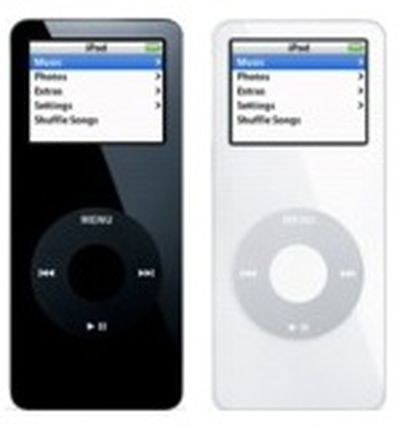
Reuters reports that Apple has been ordered by a Japanese regulatory agency to provide customers with information on receiving replacement batteries for their first-generation iPod nanos, citing fire risk from overheating batteries.
The ministry ordered Apple to publish an "easy to understand" statement online explaining how users of the devices -- responsible for four cases of minor burns in Japan -- can receive replacement batteries and obtain advice, a spokesman for the ministry said on Friday.
The Japanese government began pressing Apple on the issue last week, and the company has reportedly claimed that the issue has been traced to a single battery supplier.
The company said on Friday that safety is the highest priority.
"We've worked closely with METI to make sure first-generation iPod nano customers who are concerned with their battery have the latest information," said Apple spokesman Tom Neumayr.
Japanese officials first issued a warning about possible overheating in the first-generation iPod nanos nearly two years ago, but regulators have continued to receive from consumers reports of "fire-related" incidents, prompting the further investigation. The company has long maintained a support document informing users of how to have their concerns address, but the Japanese order goes a step further in making the information more visible and easily understandable.
The Wall Street Journal reports that China Unicom will begin selling Wi-Fi enabled iPhone models in that country beginning next week. The news comes a government regulatory body approved the device's frequency ranges in early May, but at the time the company was still waiting to receive a network access license in order to begin sales.
China Unicom (Hong Kong) Ltd. plans to start selling a version of Apple Inc.'s iPhone with Wi-Fi capability in China next week, a China Unicom official familiar with the situation said Thursday.
The iPhones that Unicom has offered in China so far have come with the wireless function disabled to comply with previous government regulations, but the missing function has made the phones less attractive to buyers.
The Associated Press confirms the report, adding that the Wi-Fi capable device will be Apple's new 8 GB iPhone 3GS and it will go on sale on Monday.
Unicom will sell eight-gigabyte iPhones with third-generation service and Wi-Fi throughout China starting Monday, a company spokesman, Wen Baoqiu, said Friday.
Apple and China Unicom have been rumored to be finalizing a deal to bring the iPhone 4 and iPad to China, but no official announcements have been made.
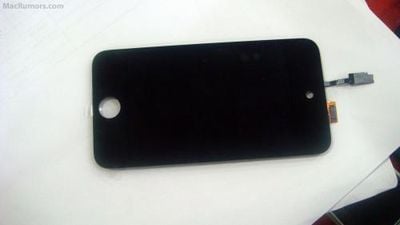
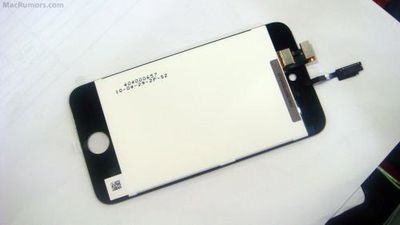
Claimed next-generation iPod touch LCD and front bezel showing apparent camera hole
MacMagazine reports (Google translation) that it has received information from a "reliable source within Apple" that the company is planning to hold its traditional September iPod-focused media event a bit early this year, with the middle of this month appearing to be the targeted date.
The MacMagazine today received information from a reliable source within Apple about a new event to the press that the company was planning to soon. Although the schedule cite the source as somewhere around 14 and 16, we bet our chips on a Monday or Tuesday - that is, 16 or August 17.
According to the source, the event will include a focus on the company's next-generation iPod touch, as well as information on an iOS 4 release for iPad. Revisions to other iPod models would also appear to be a reasonable expectation, although the report does not have confirmation as to whether they would be launched at the August event or held until the following month.
Rumors about the next-generation iPod touch have been circulating in recent weeks, with continuing evidence in both software betas and parts leaks suggesting that we can expect a front-facing FaceTime camera in the new iPod touch.
The rumored timeframe for Apple's media event also corresponds to a claimed August 17th release date for iLife '11. It is not immediately clear how an iLife update would directly relate to Apple's typically tightly-focused iPod events held around this time of the year, but rumors have also claimed that Apple will be introducing a new mystery application in the suite, and it is possible that the addition could be tied into iPod/iOS enhancements.
Apple's latest beta version of iOS 4.1 released earlier this week has offered the strongest evidence yet that the company is planning to roll out FaceTime video calling functionality to future non-iPhone devices based on the iOS operating system. A new option in the iOS "Contacts" application allows users to make FaceTime calls using either a phone number or an email address. This would allow FaceTime compatibility with devices not associated with a phone number such as future camera-enabled iPads and iPod touches.
The first evidence for email address compatibility with FaceTime was unearthed last month, with alleged screenshots showing settings offering the option to associate email addresses with the FaceTime functionality.
Apple is widely believed to be preparing to add at least a FaceTime-compatible front-facing camera to the next-generation iPod touch, rumored for introduction next month. Several photos of claimed next-generation iPod touch parts have surfaced showing a hole in the front LCD/digitizer assembly appropriate for a front-facing camera. Apple's iPad has also been the subject of speculation regarding a front-facing camera, although no substantial evidence of such hardware has yet surfaced and a timetable for a refresh of the device remains unknown.
Several readers have noted that Apple has rolled out a new "Genius" feature for its App Store application on the iPad. Similar to other Genius offerings from Apple, the new tab offers automatic suggestions on applications users might be interested in based on other applications that have already downloaded.
After activating the service by agreeing to the terms and conditions, which note that titles in users' application libraries will be anonymously uploaded to Apple to allow recommendations to be made, users are taken to a page offering the recommendations.
Two sections are offered: One recommending new applications and one recommending upgraded versions of applications the user already owns, such as full versions of free "lite" applications or pro versions of lower-level paid applications. The upgrade section seems to be part of a broader initiative undertaken by Apple, which includes a new Try Before You Buy section of the App Store that seeks to encourage users to test out free, lite versions of applications and then upgrade the ones they like to full, paid versions.
The iPad Genius Recommendations feature also allows users to note that they are "not interested" in a particular recommended title, an aspect that will allow the Genius feature to continually refine its recommendations for users.
Barron's reports on a new research note from BMO Capital analyst Keith Bachman claiming multiple new product releases for Apple next month, including several iPods as expected and two new MacBook Air models said to be scheduled to ship in high volumes.
For Apple's iPod line, Bachman reports that the company will launch a new iPod touch, as well as a smaller iPod nano that could see the elimination of the iPod shuffle.
For starters, he sees the company launching two new iPods in September - a new Touch, and a new Nano. He says the Nano will be "much smaller" than past versions, and won't have a physical track wheel.
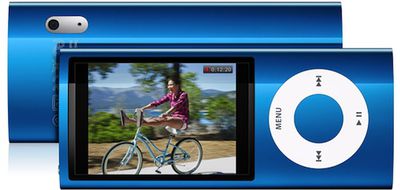
The elimination of a physical navigation wheel would imply a move to a touch screen, and it is unclear what sort of interface Apple would use on such a device. A claimed 1.7-inch Apple touch screen surfaced early last month, but that screen would be significantly smaller than the current iPod nano's 2.2-inch screen and its square aspect ratio would be a very significant departure from the current iPod nano's widescreen display useful for handling video shot with the device's integrated camera.
Bachman also matter-of-factly reports that Apple will launch two new MacBook Air models next month.
"We are not yet clear on all the specs, but supply chain checks suggest that unit shipments of the new Air products could far exceed the current Air, which we believe could suggest lower starting prices," he writes.
According to our Buyer's Guide, the MacBook Air is long overdue for an update, having last seen a refresh in June 2009. One report has claimed that the MacBook Air will see a shift to an 11.6-inch display from the current 13.3-inch screen size in a revision set to debut before the end of the year.
It seems that little has changed in the three months since the last update on negotiations between Apple and The Beatles to bring the legendary group's music to the iTunes Store, as John Lennon's widow Yoko Ono claims that there are still hurdles to overcome and that fans should not expect a resolution anytime soon.
"(Apple CEO) Steve Jobs has his own idea and he's a brilliant guy," Ono, the 77-year-old widow of John Lennon, told Reuters. "There's just an element that we're not very happy about, as people. We are holding out.
"Don't hold your breath ... for anything," she said with a laugh.
Ono declined to offer details on the sticking points in the negotiations, but noted that her concerns were not necessarily shared by Paul McCartney, Ringo Starr, and Olivia Harrison, George Harrison's widow. McCartney's comments earlier this year seemed to pin the blame on record label EMI, but Ono suggests that there may be a more fundamental disagreement between at least herself and Apple.
Apple and The Beatles have had an interesting relationship over the years, between their continued inability to come to an agreement for digital distribution of the band's music to a dispute over Apple's name, which came into conflict with The Beatles' holding company Apple Corps in multiple trademark disputes dating back to the late 1970s. While earlier agreements had resulted in Apple agreeing not to enter the music industry, the development of the iPod and iTunes again raised the ire of Apple Corps, leading to a lawsuit and eventually a revised trademark agreement that saw Apple acquiring all of the disputed "Apple" trademarks and licensing a portion of them back to Apple Corps for future usage.
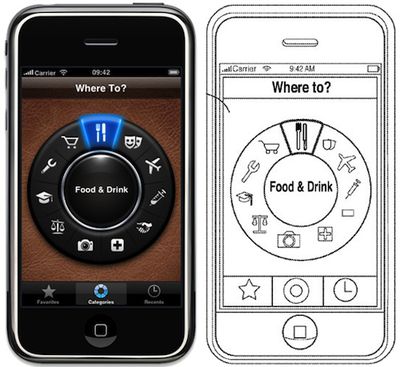
A bit of controversy has arisen over a patent application filed by Apple in December 2009 that was published by the U.S. Patent and Trademark Office last week. The patent application describes an integrated travel application for the iPhone offering users the ability to access a host of travel services, from airline bookings and check-ins to information on airport shops and social networking.
Where To? screenshot (left) and drawing from Apple patent application (right)
The controversy, which appears to have first been noticed and publicized by Rogue Amoeba developer Dan Wineman, involves a figure in the patent application showing a screen image that is essentially a direct copy of the interface found in the third-party application Where To?. While Apple's patent application was filed in December 2009 and claims association with a provisional patent application filed in January of that year, Where To? initially went live in July 2008 in the first wave of App Store apps. Where To?, initially developed by tap tap tap, was subsequently sold to FutureTap in late 2008.
While there were some initial questions over whether Apple was trying patent the inventions of third-party developers, an examination of the patent application reveals that Apple's ideas appear to be rather different that those utilized in Where To?, which is a GPS-based application for finding nearby businesses and other points of interest. Apple's application is focused on travel services, and while it can utilize GPS for positioning purposes, it is certainly not the main function of the application.
Consequently, it appears that Apple's designers and patent staff simply used the Where To? screenshot as an example of an interface a user might find when entering an airport, without claiming any invention of the interface's design itself or even the functionality behind it. But even if Apple is simply using the Where To? screenshot as an illustrative example to help describe a different technology, the move is not sitting well with the application's current developers.
At first, we couldn't believe what we saw and felt it can't be true that someone else is filing a patent including a 1:1 copy of our start screen. Things would be way easier of course if that "someone else" would be really an exterior "someone else". Unfortunately, that's not the case.
We're faced with a situation where we've to fear that our primary business partner is trying to "steal" our idea and design.
In an update to the post, FutureTap's Ortwin Gentz notes that he is not yet convinced that Apple isn't essentially describing his application's functionality in its patent application, but that even if it does not, the company's behavior still raises some questions. As one commenter notes, Apple's actions just don't feel right and leave the situation open to incorrect speculation and information.
The real problem, as I see it, is that no one thought to approach FutureTap, and let them know that they'd be doing so. I deal with patent applications a lot at work because they're often used as evidence in trials that I work on, and there's no way around the fact that they're hard to decipher. Bloggers are bound to read a lot into this, and a lot of the speculation is going to be based on a lack of information.
That's Apple's fault.
FutureTap notes that it became aware of the issue immediately after the patent application appeared last week, but that it held off from making a public statement as it attempted to contact Apple for clarification. With the issue being noticed by others and still no response from Apple, FutureTap is left to discuss its questions in public.
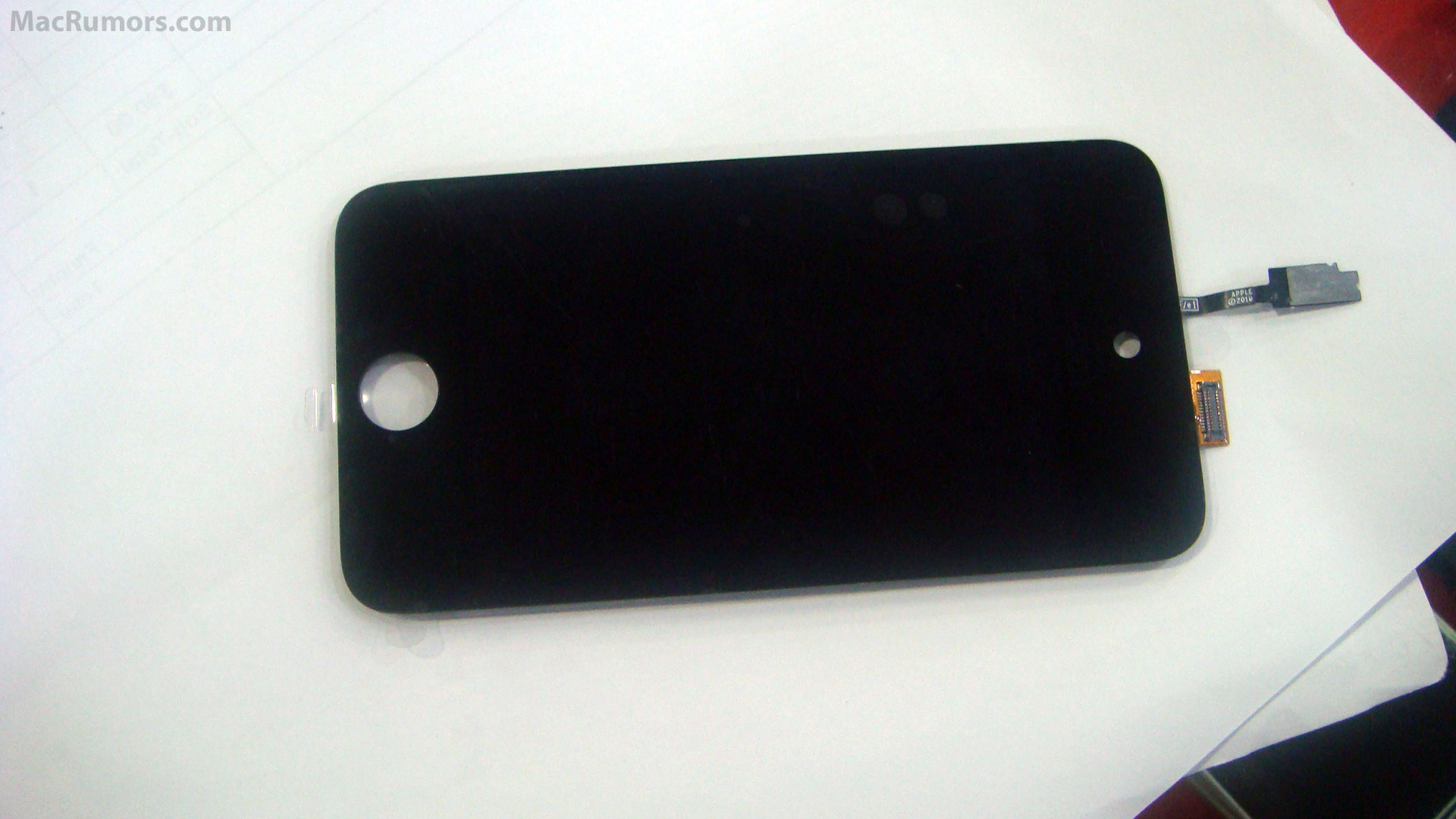
An iPhone parts supplier sent us these photos of what are claimed to be the front LCD and bezel of the upcoming 4th generation iPod Touch. The new part clearly shows a front-sided hole that would leave room for a front-facing FaceTime camera.
While we've seen similar parts before, this part is clearly marked as an Apple part "Apple (c) 2010". This stamp is visible in the full resolution image. The part is also stamped with April 29, 2010, indicating that the build date is relatively recent. We've seen other iPod Touch parts circulating in the past. In particular, a back-side camera model reached a late prototype stage last year but was never released.
Apple is widely expected to release new iPod Touch devices this fall. Rumors had already pegged the new Touch to likely carry a front-facing camera. Apple will be using email addresses instead of phone numbers to initiate FaceTime calls.