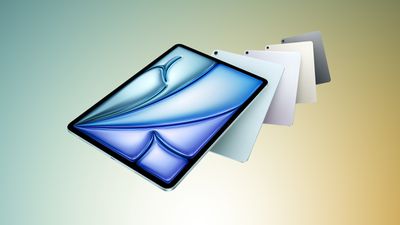
Amazon has expanded its sale on Apple's 11th generation iPad, with a few models now reaching as much as $62 off original prices, and with all models across the board at least hitting $50 off. Prices start at $288.39 for the 128GB Wi-Fi iPad, down from $349.00, a new record low price.
Note: MacRumors is an affiliate partner with Amazon. When you click a link and make a purchase, we may receive a small payment, which helps us keep the site running.


Additionally, Amazon has the 256GB Wi-Fi iPad for $388.39 and the 512GB Wi-Fi iPad for $599.00, the former of which is another new all-time low price.
There are also numerous discounts on cellular models, starting at $449.00 for the 128GB model. Amazon is providing an estimated delivery of mid May for free shipping, while Prime members should be able to get the tablets a bit sooner.
The 11th generation iPad is mainly a spec bump for the tablet line, now featuring the A16 chip and more storage, with the same design as the 10th generation iPad. The new iPad starts with 128GB of storage, and is also available in 256GB and a new 512GB configuration. The previous model was only available in 64GB and 256GB configurations.
If you're on the hunt for more discounts, be sure to visit our Apple Deals roundup where we recap the best Apple-related bargains of the past week.
Deals Newsletter
Interested in hearing more about the best deals you can find in 2025? Sign up for our Deals Newsletter and we'll keep you updated so you don't miss the biggest deals of the season!
AI technology is advancing so rapidly that the iPhone could be outdated in the next decade, Apple services chief Eddy Cue said today when testifying in the Google vs. DoJ antitrust case (via Bloomberg).
"You may not need an iPhone 10 years from now, as crazy as it sounds," Cue said. He was referring to the way that AI is likely to evolve in the coming years, and how wearables combined with intuitive AI functionality could replace traditional smartphones.
The iPhone is still Apple's key revenue driver, and Apple so far hasn't been able to find its next big product that could replace the iPhone as main money maker. Apple canceled its car project, and its first VR headset hasn't sold well. Apple is now focusing on robotics, and is continuing to work on wearables that could eventually lead to augmented reality smart glasses that would be a viable iPhone alternative.
Cue was, of course, just speculating, and Apple still has multiple iPhone innovations that are set to come out over the next several years. Apple could debut its first foldable iPhone as soon as next year, and in 2027, Apple is looking to introduce an all-display iPhone that has no cutouts for the camera or Face ID. So far, AI-based wearables have not successfully replaced smartphones. The Humane AI Pin was a failure, and the Rabbit R1 was also lambasted for poor performance when it launched last year. Other companies are also working on AI screen-free wearables, but none have caught on as of yet.
Cue was testifying due to Apple's search engine deal with Google, which is likely to be prohibited as part of the antitrust remedies that Google is facing to address its dominance in the search market.
Cue said that AI search solutions are poised to replace traditional search engines, and Apple is considering adding AI search tools from companies like OpenAI, Anthropic, and Perplexity to Safari in the future as options for people to select. Apple stands to lose at least $20 billion per year if Google isn't able to pay to be the default Safari search engine.
Shazam today announced the launch of its Viral Chart, which lists the fastest-growing songs of the week that were "discovered on screens and socials."
"Shazam's new Viral Chart playlist doesn't just track TikTok hits—it captures the full spectrum of songs blowing up right now, whether through streaming, socials, TV placements, or that random 2004 banger suddenly resurfacing at bars and baseball games," says Apple.
For example, Doechii's single Anxiety blew up on TikTok, while Billy Preston's Nothing From Nothing gained popularity after being featured in the season finale of HBO's The White Lotus. These are the sort of songs that will appear in the Viral Charts.
There is a global chart, along with individual charts for more than 40 countries, and all of them will be updated on a daily basis. The global chart ranks the top 50 songs of the week, while the per-country charts rank the top 25 songs.
Shazam uses "unique signals" to identify viral songs, which are then ranked by their weekly growth in Shazam identification requests.
Apple acquired Shazam in 2018, and it now powers the Music Recognition feature built into iOS, iPadOS, and macOS. Shazam is deeply integrated across Apple's software platforms, including in Control Center, Siri, as an Action button option on iPhone 15 Pro models and all iPhone 16 models, as a Smart Stack widget on the Apple Watch, and more.
Apple is looking at reworking Safari to directly support AI-powered search services, Bloomberg's Mark Gurmanreports.
Apple's senior vice president of services Eddy Cue today disclosed that Apple is "actively looking at" reshaping Safari around AI search as part of testimony in the lawsuit against Google from the U.S. Justice Department. The dispute centers on the $20 billion deal between Apple and Google that makes the latter the default search engine on Apple devices.
Cue said that searches on Safari dipped for the first time in April 2025—a change which he attributed to users switching to AI services. He added that he believes AI services such as ChatGPT, Perplexity, and Claude will eventually replace conventional search engines like Google. As a result, Apple will need to add them as options in Safari in the future. Cue said the company had already held discussions with Perplexity.
The AI options "probably won't be the default," Cue explained, but they will be added "to the list" of options. He said the services still need to improve further. He added:
You may not need an iPhone 10 years from now as crazy as it sounds. The only way you truly have true competition is when you have technology shifts. Technology shifts create these opportunities. AI is a new technology shift, and it's creating new opportunities for new entrants.
He said that AI services need to improve their search indexes, but, even if this does not happen quickly, users are still likely to switch rapidly because they have other compelling features that are "so much better." Large language models will continue to improve over time, giving users more reason to switch from traditional search to AI. "There's enough money now, enough large players, that I don't see how it doesn't happen," he said.
Nevertheless, Cue said he believes that Google should remain the default search option in Safari. He added that he lost sleep over the possibility of Apple losing the revenue share from the agreement between the two companies. The deal now includes Google Lens integration in Visual Intelligence.
OWC kicked off a new Spring sale this week, offering solid discounts on a variety of USB-C docks, memory cards, external drives and enclosures, and Mac accessories. Some of these deals won't be applied until you add the items to your cart, at which time an automatic coupon will be applied to your order.
Note: MacRumors is an affiliate partner with OWC. When you click a link and make a purchase, we may receive a small payment, which helps us keep the site running.
There are a few notable deals in this sale, including $120 off the popular 14-Port Thunderbolt Dock for Mac, available for $159.99, which beats last month's deal on the dock by about $20. If you purchase a qualifying new or used Mac at the same time as this dock, you can get an additional $20 off the accessory at checkout.
If you're on the hunt for more discounts, be sure to visit our Apple Deals roundup where we recap the best Apple-related bargains of the past week.
Deals Newsletter
Interested in hearing more about the best deals you can find in 2025? Sign up for our Deals Newsletter and we'll keep you updated so you don't miss the biggest deals of the season!
Apple's global smartwatch shipments declined by 19% year-over-year in 2024, marking the company's second consecutive annual drop and the fifth straight quarter of falling sales, according to new data from Counterpoint Research.
According to Counterpoint's Global Smartwatch Shipment Tracker for the fourth quarter of 2024, Apple experienced shipment declines in all major regions except India. The most significant drop occurred in North America, which accounts for more than half of Apple Watch shipments globally.
The report identifies multiple contributing factors behind the sustained downturn. Chief among them is the absence of a new Apple Watch SE model, which has historically served as Apple's most popular smartwatch in terms of volume during post-launch periods. The last SE model came out in the third quarter of 2022 and its continued absence throughout 2024 is cited as a key driver of weakened shipment growth.
The Apple Watch Series 10 was released in 2024, offering "fewer substantial upgrades" over its predecessor, which reduced consumer incentive to upgrade. The model was affected by ongoing legal issues in the United States, where Apple was required to remove the blood oxygen sensor feature from affected units due to patent litigation.
The lack of an Apple Watch Ultra 3 model in 2024 is also a contributing factor. The Apple Watch Ultra line had previously accounted for over 10% of Apple Watch shipments globally, but its share dropped to under 8% in the fourth quarter of 2024 in the absence of a new model. Counterpoint noted that this decline contributed measurably to Apple's overall shipment losses in the advanced smartwatch category, where Apple's market share fell by 8% points year-over-year.
Despite the contraction in shipments, Apple continues to dominate the advanced smartwatch segment by unit volume. However, the recent declines mark a reversal from earlier years of growth. According to previous Counterpoint data, Apple Watch shipments increased by 27% in 2021. In 2022, growth stalled and the company reported zero percent year-over-year change. This was followed by a 10% decline in 2023, which nearly doubled in scale in 2024.
The downturn coincides with stronger performance from rival smartwatch manufacturers. While Apple's global shipments contracted, all other major vendors in the advanced smartwatch category saw year-over-year growth, according to the report.
Rumors suggest that Apple is preparing to release a third-generation Apple Watch SE with a revamped design and potentially a lower price point, an Apple Watch Series 11 with new health monitoring capabilities and 5G connectivity, and an Apple Watch Ultra 3 with satellite connectivity. The new models should launch in the fall, likely alongside the iPhone 17 lineup.
When it comes to the MagSafe power bank marketplace, it's largely a sea of sameness. Not this one. Kuxiu's S2 stands apart with its semi-solid state battery technology that promises enhanced safety and longevity, albeit at a steeper price than conventional alternatives.
Design and Features
The Kuxiu S2 is a sleek, compact Qi2 unit with a premium construction that has four key components: a magnetic wireless charging area on top, a power button on the side, a USB-C input/output port (braided USB-C cable included), and LED indicator lights that display battery level. The aluminum alloy frame is paired with matte Corning Gorilla Glass panels, and the pack feels like it can take a whack – though it's not impervious to cosmetic scratches, as a couple of weeks' reviewing attest.
At just 143g (5.04oz) and measuring 106 × 69.5 × 10mm (4.17 × 2.74 × 0.39in), it's impressively portable and lighter than an iPhone 16. That said, when attached to my iPhone 16 Pro, the battery extends slightly beyond the phone's bottom edge, creating a minor asymmetry that likely isn't an issue when paired with the iPhone 16 Pro Max. The cameras remain unobstructed, at least.
The S2 has a handy LED indicator system, with four lights showing battery levels: 4 LEDs (>75%), 3 LEDs (>50%), 2 LEDs (>25%), and 1 LED (>10%). When battery drops below 10%, a single LED flashes. There's also a special LED pattern – four lights flickering like a running light – that indicates Small Current Mode is active (more on that below).
The Solid State Difference
In a departure from traditional lithium-ion alternatives, the S2's headline feature is its semi-solid state battery technology. This design eliminates leakage, explosion, and combustion risks. Kuxiu claims the battery can survive nail penetration tests without catching fire or exploding – and based on the company's own dramatic demonstration videos, it continues to function even after such extreme damage.
Despite some confusion on the labeling (which reads "Li Polymer Battery"), Kuxiu confirmed that the S2 does indeed use semi-solid state technology. The solid electrolyte inside can be made from various materials, including polymers – making both claims technically accurate.
Performance and Functionality
The 5,000mAh capacity power bank supports both 15W wireless charging for the iPhone 12 through iPhone 16 series and wired charging at up to 20W via USB-C. The USB-C input specs show it accepts 5V⎓3A/9V⎓2.2A for charging itself.
The manual recommends a first-use procedure: discharging the power bank completely until it shuts off (0%) before fully charging to 100%, preferably with a PD fast charger for optimal speed.
There are three main charging modes: wireless charging (with MagSafe activation), wired charging for other smartphones, and a dedicated Small Current Charging mode. This special mode is activated by double-clicking the power button, and is designed specifically for low-power devices like earbuds and smartwatches that might not draw enough power to keep the bank from auto-shutting off. I had no problems drawing power to charge AirPods Pro via MagSafe and Apple Watch via the charging port.
In my testing with an iPhone 16 Pro, the fully charged S2 brought my completely drained phone to 97% before depleting – slightly less than Kuxiu's claim of "approximately 1.2 full charges." The 16 N52 magnets provide a reassuringly strong connection that maintains its grip even when slipped into a loose pocket or bag. If your iPhone has a non-MagSafe case though, the bank is eventually going to slip off.
One particularly impressive aspect is the thermal management. Some slim power banks can become alarmingly hot during discharge (especially at low charge levels), but the S2 remained noticeably cooler in my experience.
Longevity and Value
Here's where the semi-solid state technology really shines. While the S2's $79.99 price tag is approximately 60% higher than comparable liquid-based power banks from companies like Anker or EcoFlow, the longevity benefits are substantial. Kuxiu claims the S2 will maintain 80% of its original capacity after 1,000 charging cycles, compared to just 300-500 cycles for traditional power banks. That's potentially double or triple the useful lifespan.
The efficiency is equally impressive. A full discharge offers 18-19Wh capacity power output, which is excellent after accounting for conversion losses. Looking long-term, this efficiency combined with extended cycle life makes the premium price more palatable.
Summing Up
The Kuxiu S2 feels like a genuine step forward in power bank technology. The $79.99 price tag initially stings, but when you consider the potential for double or triple the lifespan of conventional alternatives, along with enhanced safety and premium materials, the value proposition becomes clearer. For those who frequently rely on portable power, the investment should pay dividends over time.
What's missing? A kickstand would be nice. Some users might also miss the iOS widget integration that was available in Kuxiu's previous S1 model. Due to Qi2 certification requirements, the S2 doesn't offer the satisfying iOS integration that Apple's own MagSafe battery pack provided – no special animation on the lock screen or appearance in the battery widget. Don't get me wrong, it works flawlessly. It just doesn't feel as "Apple-like" as some might prefer. But these are minor quibbles against what appears to be a genuinely innovative product. If safety and longevity matter more to you than saving a few dollars upfront, the Kuxiu S2 deserves consideration.
Where to Buy
The Kuxiu S2 Qi2 5000mAh MagSafe Solid-State Power Bank is available in black or natural titanium colors for $79.99 from Kuxiu's website and authorized resellers.
Bang & Olufsen has just launched the Beosound A1, the third generation of its award-winning portable Bluetooth speaker offering enhanced performance features.
Created in collaboration with Danish designer Cecilie Manz, the new A1 maintains the speaker's distinctive minimalist aesthetic while introducing some notable improvements to its audio capabilities and environmental credentials.
The premium portable speaker features a pearl-blasted aluminum body with over 2,100 precision-milled holes and a soft waterproof leather strap. It comes in three finishes: the classic Natural Aluminium plus two nature-inspired additions – Honey Tone and Eucalyptus Green.
Sonic upgrades include what B&O claims is the largest woofer in its class, delivering deeper bass with a Bass SPL of 64dB – 2dB more than the previous model. Battery life has been extended to 24 hours, and the speaker retains Bluetooth 5.1 connectivity with Microsoft Swift Pair and Google Fast Pair support. The speaker also now comes with support for the aptX Adaptive Bluetooth codec.
The A1 3rd Gen carries an IP67 rating for dust and water resistance, so you can take it into the shower or to the beach. It also has a three-microphone array for using it as a speakerphone for calls.
The A1 features modular architecture designed for a 10-year lifetime and is the first Bluetooth speaker to receive Cradle to Cradle certification (Bronze level). B&O says the certification "aims to support a serviceable, upgradeable, and repairable approach to product design." The company offers a replaceable battery service and up to 5 years warranty with Beocare.
The Beosound A1 3rd Gen is available in the United States for $349 (£299 in the UK) from Bang & Olufsen brick-and-mortar stores and the company's website.
Apple is selling refurbished iPhone 15, iPhone 15 Plus, iPhone 15 Pro, iPhone 15 Pro Max models to its online store in the United Kingdom, around four months after introducing the discounted models in other European countries.
The iPhone 15 is priced starting at £589, while the iPhone 15 Plus is priced starting at £759. The iPhone 15 Pro is priced starting at £869, and the iPhone 15 Pro Max is priced starting at £949. Prices are discounted about 15 percent compared to brand new models.
Several color and storage options are available at the time of writing, but availability may change as Apple updates its inventory. If you're after a specific combination, it's worth checking back regularly to see what's in stock.
Apple first introduced iPhone 15 models in Europe back in January, while the models were added to Apple's refurb stores in the U.S. and Canada this week. Archived webpage snapshots indicate the iPhone 15 models were added to the regional UK online store sometime around late April.
Apple's refurbished iPhones are unlocked, meaning they work with any carrier. Each device comes with a brand-new battery, a fresh outer shell, and a new USB-C cable—making them virtually indistinguishable from brand-new models. Refurbished iPhones also include Apple's standard one-year warranty, with the option to add AppleCare+ for extended coverage.
Google this week targeted the upcoming iPhone 17 in an ad for the Pixel 9 Pro, mocking Apple's design plans and suggesting that Apple often copies Android features.
The iPhone 17 isn't released, of course, so Google's ad is based on rumors that the iPhone is going to get a horizontal camera bar at the back, which is a Pixel-esque design. Dummy models and mockups of the iPhone 17 depict a thick horizontal camera bar for the iPhone 17 Pro models, and a slimmer, more Pixel-style camera bar for the iPhone 17 Air.
Google's Pixel lineup has long used a horizontal camera bar, but it has lenses arranged in a horizontal line. Apple plans to continue to use a triangular arrangement for the iPhone 17 Pro models, and will simply expand the camera bump.
In the ad, Google points out that the Pixel had a horizontal camera bar first, before delving into other features that Apple has allegedly copied. The video is positioned as a "podcast" featuring a Pixel phone and an iPhone.
Pixel: Hi, I'm Pixel, and this is my friend, iPhone. iPhone: Good day. Pixel: There are a lot of rumors circulating about iPhone's upcoming redesign. iPhone: It's crazy. Can you imagine me doing the same thing you did first years later?
Google highlights Night Mode, Clean Up, and widgets as examples of features that were available on Android first. The video wraps up with the iPhone copying a line that the Pixel says first: "We want to remind everyone that these rumors are just rumors."
"Please don't go repeating everything you see," reads the video description. Google has used the iPhone and Android ad format in the past to mock Apple's iPhone design decisions, most recently targeting Apple's switch to USB-C.
It has cost Epic Games more than $100 million to challenge Apple's App Store rules in the ongoing Apple vs. Epic Games legal battle, Epic CEO Tim Sweeney said today in an interview with Business Insider.
Sweeney said that Epic Games has paid "legal bills" in excess of $100 million, but that the dispute has cost the company a lot more.
But if you look at lost revenue, that's another story. We can't predict exactly how much we would have made on iOS, but in the two years that we were on the platform, Fortnite had made about $300 million on iOS. So you could have projected hundreds of millions of dollars of lost revenue as a result of the fight.
Sweeney went on to say that one could "easily imagine" that the total cost to Epic Games was a billion dollars or more based on lost revenue from iOS users, and lost revenue from people who didn't play because their friends on iOS weren't able to play.
While Epic Games largely lost its court case against Apple when a judge found that Apple did not have a monopoly, Epic Games scored a win because Apple was forced to drop its anti-steering App Store policies.
As part of the Epic Games vs. Apple legal battle, Apple was given an order to allow developers to direct customers to purchase options outside of the App Store. Apple was able to put off implementing the functionality for several years, but in 2024, did so in a way that still involved fees.
Just last week, the judge overseeing the Apple vs. Epic Games legal fight said that Apple was in contempt of court for failing to properly comply with the injunction. Apple was ordered to immediately implement new U.S. App Store rules allowing developers to add links to external websites where customers can make purchases. Apple is not allowed to collect commissions for purchases made using these links, nor can it control the look of the links or buttons that developers use.
Apple is appealing the decision, but in the meantime, it's a win for developers, and a win that was funded by Epic Games. Sweeney said last week that Epic Games would be bringing Fortnite back to the iOS App Store in the U.S. as a result of the ruling, and in the interview with Business Insider, he said that Fortnite would be taking advantage of Apple's new policies "later this week."
Apple banned Epic Games' U.S. developer account, but the company has an account in Sweden that it will use to bring Fortnite back to the U.S. App Store. Sweeney said that he would be "very surprised" if Apple "decided to brave the geopolitical storm of blocking a major app from iOS." He confirmed that Epic Games has informed Apple of what its plans are, so Apple is presumably aware that Fortnite will soon be submitted to the U.S. App Store.
Later this year, Epic Games also plans to launch Epic Games Store Webshops, a feature that will let developers launch digital storefronts that are hosted by the Epic Games Store. Webshops will be free for developers making under $1 million annually per app, and for bigger developers, Epic will collect a 12 percent fee.
Google today said that it's adding a new "Simplify" feature to the Google app for iOS, with the addition aimed at making search results easier to understand.
Google says that Simplify is meant to help users understand "jargon" or unfamiliar technical concepts, including medical words that the average person would not know, and technical terms. It uses AI to make "dense text on the web" simpler to comprehend without the user having to leave a website to do more research.
To use Simplify in the Google app for iOS, users can select any complex text on a webpage and then tap on the "Simplify" icon to see a new, simpler version.
Simplify uses a prompt refinement approach that was developed by Google Research, taking advantage of Gemini to make complicated text more digestible without losing key details. In a research paper, Google said that users selected to test the feature were better able to understand complicated medical, financial, legal, and technical websites when queried after using the Simplify feature.
Samsung this month will begin supporting a new peer-to-peer Tap to Transfer feature through the Samsung Wallet, providing another way for users to tap their smartphones together to send one another cash without the need for an app.
Tap to Transfer is similar to Tap to Cash, a feature that Apple introduced in iOS 18, and Apple's Tap to Pay on iPhone. With Tap to Cash, Apple users with an iPhone or Apple Watch can send or receive Apple Cash by holding two devices next to each other. The transfer happens using NFC, and no personal information like phone number or email is shared.
Tap to Pay on iPhone is an option that allows independent sellers, small businesses, and larger merchants to use an iPhone as a contactless payment terminal to accept payments from other iPhone users, debit and credit cards that support tap payments, and other digital wallets. Tap to Pay on iPhone does still require a payment app like Shopify, Square, or Clover, but Tap to Transfer from Samsung does not.
Samsung's Tap to Transfer option lets Samsung users quickly send payments to anyone with a debit card that supports tap features, even if that debit card is stored in another digital wallet like Apple Wallet. As long as the Samsung user has a Samsung Wallet with an eligible Visa or Mastercard debit card, they can send money over NFC to another person without a Samsung Wallet.
Through Samsung's collaboration with Visa and Mastercard, you can use a debit card stored in your Samsung Wallet to send money to friends and family members' bank accounts without needing to download an additional app. Instead, Samsung Wallet uses NFC technology to connect to the recipient's debit card stored in their digital wallet. Plus, you can even transfer money to people without a digital wallet as long as they have a physical debit card with tap-to-pay capabilities.
With Tap to Transfer, a Samsung user can easily send payments to anyone, including an iPhone user, but there is no equivalent feature for an iPhone user to send a payment to a Samsung user because Apple Cash is more limited, and Tap to Pay on iPhone requires a secondary payment service.
Samsung users will also be able to tap two Samsung devices together to send payments, similar to the iPhone's Tap to Cash option.
The United States Justice Department wants Google to make major changes to its ad business in order to restore competition, with the government suggesting that Google divest both Ad Exchange (AdX) and Ad Manager (often referred to as DFP).
The DoJ made the recommendation in an updated filing submitted as part of its ongoing antitrust fight with Google. Last month, Google was found to have an illegal monopoly in online advertising, manipulating the market to cause harm to advertisers, publishers, and consumers. The court is now mulling remedies to curb Google's behavior, and it is considering suggestions from the DoJ.
AdX is Google's ad exchange marketplace where advertisers can purchase ad space from publishers in real-time through auctions, while DFP is an ad management platform that publishers can use for ad inventory management, selling, scheduling, and managing ad inventory. The DoJ wants Google to sell off AdX right away, and do a phased divestiture of DFP.
The DoJ also suggests that Google's AdWords product should deal with all third-party ad tech tools on non-discriminatory terms for bidding, matching, and placement of ads, and that Google should be prohibited from preferentially routing buyside demand from AdWords to any as exchange or publisher ad server. Google may also be required to share key ad server data and prohibited from using data gathered from Google Search, Gmail, and other Google properties to evaluate digital ad inventory on third-party tools and websites.
Google is also facing off with the Department of Justice over search, as the company was found to have an online search monopoly as well. Google could be forced to sell off the Chrome browser and make major changes to data sharing that would impact Google Search's market dominance.
Apple today seeded the release candidate version of iOS 18.5 to developers and public beta testers, giving us a look at the final version of the update that will be provided to the public next week.
With the release candidate, Apple provided release notes, so we have a more complete look at the new features that are included in the update, including those that weren't found during the beta testing period.
The update adds a new wallpaper that matches this year's Pride Apple Watch Band, along with a new parental alert when a child is able to bypass the Screen Time passcode. Apple also added support for carrier-provided satellite services on the iPhone 13, and a feature for using an iPhone to purchase content within the Apple TV app on a third-party device.
This update also includes the following enhancements and bug fixes:
A new Pride Harmony wallpaper
Parents now receive a notification when the Screen Time passcode is used on a child's device
Buy with iPhone is available when purchasing content within the Apple TV app on a 3rd party device
Fixes an issue where the Apple Vision Pro app may display a black screen
Support for carrier-provided satellite features is available on iPhone 13 (all models). For more information visit: https://support.apple.com/122339
Some features may not be available for all regions or on all Apple devices. For information on the security content of Apple software updates, please visit: https://support.apple.com/100100
Should no bugs be found in the iOS 18.5 release candidate, we expect to see iOS 18.5 released next week alongside iPadOS 18.5 and macOS Sequoia 15.5.
Apple todayannounced it has renewed two acclaimed comedy series, with Trying and The Studio each set to return for an additional season on Apple TV+.
Trying is a feel-good series that follows British couple Nikki (Esther Smith) and Jason (Rafe Spall), on their journey to adopt a child and beyond. The series has achieved an average score of 95% from critics on Rotten Tomatoes, and a 93% score from the public. The series will be returning for a fifth season, but a timeframe was not disclosed.
The Studio is a satirical series about Hollywood's film industry. In it, Seth Rogen stars as Matt Remick, the newly-appointed head of the embattled Continental Studios. The show's first season is still underway, with three episodes remaining, and now it will be returning for a second season at some point in the future. The Studio has a 93% critics' score on Rotten Tomatoes, but its audience score lags behind at a respectable 70%.
Apple TV+ still lacks mass appeal compared to some other streaming services, but many of the original series available through the service are highly rated. In the U.S., Apple TV+ costs $9.99 per month, or $99 per year. Apple TV+ can be accessed through the Apple TV app on a wide variety of devices, and on the web at tv.apple.com.
Apple today added refurbished iPhone 15, iPhone 15 Plus, iPhone 15 Pro, iPhone 15 Pro Max models to its online store in the United States and Canada, offering the smartphones at a discounted price.
The iPhone 15 is priced starting at $619 in the United States, while the iPhone 15 Plus is priced starting at $699. The iPhone 15 Pro is priced starting at $759, and the iPhone 15 Pro Max is priced starting at $929. Prices are discounted about 15 percent compared to brand new models.
Multiple colors and capacities can be purchased as of the time of writing, but stock will fluctuate over time as Apple refreshes what is available, so you may need to check back often if you're looking for a specific color or capacity. Note that the iPhone 15 Plus is not available in Canada at the current time, but it will likely be added soon.
Apple introduced refurbished iPhone 15 models in Europe back in January, but this is the first time Apple has offered discounted iPhone 15 models in the U.S. since the devices came out in September 2023.
Refurbished iPhones from Apple are unlocked and can be used with any carrier. Apple outfits all refurbished iPhone models with new batteries, outer shells, and a new USB-C cable, so they are essentially identical to new in the box iPhones.
Apple offers the same one-year warranty on refurbished iPhone models, as well as the option to purchase extended AppleCare+ coverage.
The iOS 18.5 update that Apple plans to release next week will enable carrier-provided satellite features on iPhone 13 models, adding satellite connectivity to iPhones that do not support Apple's built-in satellite functionality through Globalstar.
Apple says that satellite connectivity provided by carriers will be enabled on all iPhone 13 models, including the iPhone 13, iPhone 13 mini, iPhone 13 Pro, and iPhone 13 Pro Max. To use the feature, iPhone 13 users will need cellular service that offers a satellite connectivity option, and there are several carriers that have been rolling out the functionality.
In the United States, T-Mobile has partnered with SpaceX to provide customers with Starlink Direct service for connecting to Starlink satellites when Wi-Fi and cellular connectivity are unavailable. au and One NZ have also introduced satellite connectivity, as has Verizon, though Verizon's satellite option does not currently work with iPhone.
Apple has included built-in satellite connectivity in all iPhones dating back to the iPhone 14 lineup, with connectivity provided through a partnership with Globalstar. Satellite connectivity is useful in rural and remote areas where cellular towers are not available.