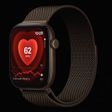
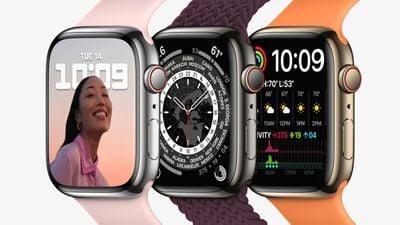
Apple Watch Series 7 models are currently widely unavailable from Apple's online store, with only a handful of model and watch band configurations available to order as Apple clears stock of existing models to make way for new Apple Watches next week. Depending on case size, finish, and watch band, customers may find a few select Apple Watch models available for purchase.
The widespread unavailability of the current latest Apple Watch comes just days ahead of when Apple is expected to significantly expand the Apple Watch lineup with the addition of the Series 8, a new "Pro" Watch, and an updated second-generation Apple Watch SE. Alongside new Apple Watch models, Apple is expected to announce the iPhone 14 and iPhone 14 Pro during its "Far Out" event on Wednesday, September 7.
Content creator Sam Kohl, known as "iupdate" on YouTube, returns on The MacRumors Show podcast this week to talk through our final expectations for Apple's long-awaited "Far out" event.
We discuss the iPhone 14 Pro's rumored pill-shaped cutout, always-on display mode, satellite connectivity, and 48-megapixel Wide camera with 8K video recording. We also explore some of the key rumors around the "iPhone 14 Plus," Apple Watch Series 8, Apple Watch "Pro," second-generation Apple Watch SE, and tenth-generation iPad, and touch on debates around Apple event invites, naming conventions, USB-C replacing the Lightning port, and more. See Sam's work on his YouTube channel "iupdate" and follow him on Twitter @iupdate.
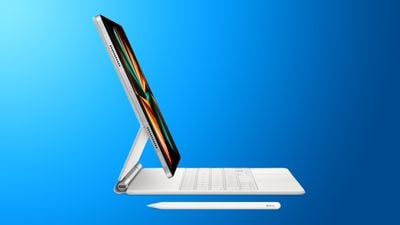
Today we're tracking a set of deals on accessories for the iPad and iPad Pro, including the best-ever price on the Apple Pencil 2, as well as solid markdowns on the Magic Keyboards for the iPad Pro.
Note: MacRumors is an affiliate partner with some of these vendors. When you click a link and make a purchase, we may receive a small payment, which helps us keep the site running.
Apple Pencil 2
The Apple Pencil 2 has returned to $99.00 on Amazon today, down from $129.00. This remains the best price we've ever tracked for the Apple Pencil 2, and right now only Amazon is offering the discount.
The accessory is available to ship today, with a delivery estimate between September 4 and 7 for most places in the United States.
Magic Keyboard
Additionally, a few Magic Keyboard accessories for the iPad Pro lineup are on sale on Amazon. You can get the 11-inch iPad Pro Magic Keyboard for $249.00, down from $299.00.
You can also get the 12.9-inch iPad Pro Magic Keyboard for $299.00, down from $349.00. Both of these accessories launched in 2021 and feature a trackpad, USB-C port, backlit keys, and a floating cantilever design.
For even more iPad deals, head to our full Best Deals guide for iPad. In that guide we track the best discounts online for iPad, iPad mini, iPad Air, and iPad Pro.
We're just a few days away from when Apple is expected to announce the Apple Watch "Pro," an entirely new Apple Watch explicitly designed for athletes and customers who want a more robust and durable Apple Watch.
The Apple Watch "Pro" has been described as a "rugged" Apple Watch that will feature a new design, a larger display and battery, and more durable materials to make it more suitable for athletes and those who are active. Those improvements won't come without an additional cost, however, with the new model priced above most versions in the current lineup.
The new Apple Watch will likely sit at the higher end of the Apple Watch lineup, likely replacing the Apple Watch Edition as the more expensive model in the lineup. To make things easier, we've put together a quick comparison chart comparing the Apple Watch Edition and the Apple Watch "Pro" below.
Apple Watch Series 7 Edition
Case Material: Titanium
Case Design: Rounded edges and curved display around the sides
Sizes: 41mm or 45mm
Display Material: Sapphire front crystals
Health Features: ECG, Blood Oxygen, Heart Rate notifications
Special Features: None
Price: $799 - $849
Apple Watch 'Pro'
Case Material: Stronger titanium alloy with improved impact resistance
Case Design: "An evolution of the current rectangular shape," according to Bloomberg'sMark Gurman
Knowing what you know now, we want to know how much you would be willing to pay for an Apple Watch "Pro." Let us know in the comments below, and check out our guide for everything we know about the upcoming Apple Watch lineup.
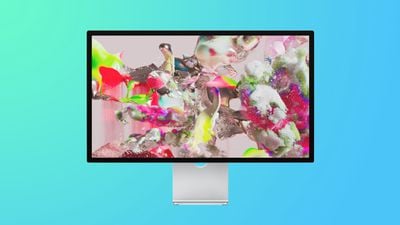
Some Apple Studio Display owners have taken to online forums to complain that their monitors make a high-pitched buzzing sound that appears to be emanating from the top of the screen or behind it, and may be being caused by electrical interference.
There are complaints on Twitter, Reddit and the Apple Support Community dating back to June, and more recently on the MacRumors forums, about the issue, which is variously described as an "electrical buzzing" and "constant ringing" that is "loud," "high-pitched," and "very annoying."
Several owners have found that the sound is not fan-related and only happens when a MacBook Pro or iPad is plugged into the Studio Display. Some have also noted that the noise can vary in intensity and pitch depending on the time of day, suggesting an electrical shielding issue may be the cause of the fault.
"I'm experiencing a very annoying high-pitched buzzing sound with my Studio Display, I've spoken to others on Twitter who also have the problem and I've had Apple support on the case but nothing was resolved.
[...]
"It's not the fans, it's a distinct (and very annoying) sound that emanates from the rear area of the display, roughly where the power supply is positioned.
"I'm 90% certain the display is picking up interference from somewhere and amplifying it, maybe through the house power circuit but I can't be sure. Someone I spoke to believes the PSU is poorly shielded but I have no idea if that's true either."
Some users have suggested the Apple Studio Display picks up interference from electric car chargers. In the case of MacRumors reader Indominus, they tracked the source of the interference back to Lutron Caseta light dimmers that are installed in their house.
"Whenever the dimmer is turned on, the buzzing noise starts coming out from the ASD. The dimmers are not even on the same breaker as my ASD. The only thing I can think of is that the dimmers are creating electrical noise that is propagating to the electrical panel which then propagates to the ASD.
Now it's one thing that the dimmers are creating electrical noise. But it's another thing that only the ASD is reacting to this noise. I don't hear this electrical noise coming out of any other thing in my house. It appears to be an issue with the ASD power supply. Whether it's a problem with the specific display I have or the choice of components in the design of the ASD power supply, I do not know.
MacRumors reader uller6 relayed a similar experience:
"I had the same issue unfortunately. I spent a couple hours on the phone with Apple support/engineering, and we came to the exact same conclusion you did: the ASD is poorly shielded against dirty RF line noise, which is propagated through the power supply to the fan control circuit, producing an audible buzz. In my case running my air conditioning on a different circuit caused the ASD to buzz loudly. I ended up returning my display and have not purchased another."
Other users say they have tried electrical power filters to resolve the issue but to no avail, and some have received one or more replacement units from Apple that were similarly affected.
It's not clear how widespread the issue is, but Apple appears to be aware of the problem affecting some Studio Display owners, although a solution has not yet been found. It's worth noting that this is a separate Studio Display issue to the widespread speaker problem that Apple eventually fixed with a firmware update. Have you found the display to be over-sensitive to electrical interference? Let us know in the comments.
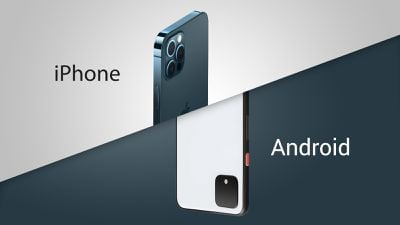
Apple's iPhones have overtaken Android devices to account for more than half of all smartphones used in the United States, according to data from Counterpoint Research (via Financial Times).
The active installed base of iPhones passed the 50% landmark in the quarter ending in June, while around 150 other mobile brands using Google's Android operating system, led by Samsung and Lenovo, accounted for the rest.
"Operating systems are like religions — never significant changes. But over the past four years the flow has consistently been Android to iOS," said Counterpoint's research director, Jeff Fieldhack. "This is a big milestone that we could see replicated in other affluent countries across the globe."
Compared to annual sales, the active installed base is an even more significant competitive marker representing Apple's slow burn in the smartphone market, as it takes into account users brought into the Apple ecosystem through the used phone market as well as those who use iPhones that were purchased years ago.
Android phones appeared on the market in 2008, a year after the iPhone debuted, and overtook the iOS-installed base in 2010, according to NPD group. In the three years previous, phone sales were dominated by the likes of Nokia, Motorola, Windows, and Blackberry.
The iPhone has made Apple the largest company in the world, with a market capitalization of $2.5 trillion. In 2020, the installed global base for iPhones surpassed 1 billion devices. CEO Tim Cook recently said that Apple had "set a June quarter record for switchers," or consumers leaving Android for iOS.
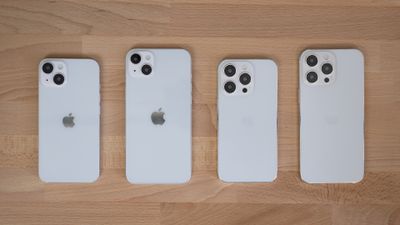
Apple will unveil the next-generation iPhone 14 series at its "Far Out" media event on Wednesday, September 7, where it is also expected to debut the Apple Watch Series 8. We are expecting a 6.1-inch iPhone 14, a 6.7-inch iPhone Max, a 6.1-inch iPhone 14 Pro, and a 6.7-inch iPhone 14 Pro Max. There will be no 5.4-inch iPhone "mini" this year, with Apple instead opting for larger devices.
In a new ad, Samsung is throwing shade toward the lack of "innovation" on the iPhone while promoting features such as a 108-megapixel camera and 100x "Space Zoom" available in its latest devices.
The ad, titled "Buckle Up," is aimed toward current iPhone users and promotes the Galaxy S22 Ultra, the new Z Flip 4, and features not available to iPhone customers. "Buckle up for Apple's latest launch," the ad says. "As you enter a world where heads will turn, just none in your direction." A world where "the highest resolution in a smartphone will be in someone else's pocket. And that epic moon shot that's getting all the likes won't be yours." "This innovation is not coming soon to an iPhone near you," the 30-second ad concludes.
The ad comes just six days ahead of Apple's "Far Out" event, where it's expected to announce the iPhone 14 and iPhone 14 Pro. Apple is planning major new features on the Pro camera systems for its higher-end devices, including an all-new 48-megapixel camera and possible 8K video recording. Alongside camera improvements, the iPhone 14 Pro is rumored to feature an always-on display and a new pill-shape notch replacement.
Prominent developer Kosta Eleftheriou has settled his 2021 lawsuit against Apple over its App Store review actions that he said hindered his ability to distribute apps on the platform while allowing copycat competitors to flourish, reports TechCrunch.
In his lawsuit, Eleftheriou complained that Apple repeatedly threw up "roadblock after roadblock" against his FlickType keyboard app for the Apple Watch, only to then allow copycat apps from other developers onto the store. Eleftheriou said that he had been in discussions with Apple about the company acquiring FlickType, and he believes Apple was intentionally targeting his app in the review process to try to force him to sell it at a discount.
Following the filing of the case last year, the two parties participated in court calls with a judge, the court docket shows, including as recently as this spring. A request for dismissal of the lawsuit was subsequently filed on July 21, 2022, after Apple and Kpaw (Eleftheriou’s business) came to an agreement.
Eleftheriou was unable to comment on the terms of the settlement. Apple was not immediately able to comment on the dismissal either.
Eleftheriou has been one of the higher-profile critics of Apple's App Store policies, repeatedly pointing out App Store scams that have slipped through the review process and even into the store's charts of top-performing apps without Apple taking action.
Apple has taken some steps to improve the ability for users to flag problematic apps, such as by bringing back the "Report a Problem" button on App Store listings, but Eleftheriou says he continues to find scam and copycat apps with only minimal effort.
USB4 Version 2.0 is in the works and when launched, it will allow for double the speeds of the current USB4 specification with existing USB-C cables. It will support up to 80Gb/s operation with both 40Gb/s USB-C passive cables and newly defined 80Gb/s active cables.
The updated specification was announced today by the USB Promoter Group, comprising Apple, Microsoft, Intel, HP, STM, and others. USB Type-C and USB Power Delivery specifications will be updated to enable the higher level of data performance, and updates are being made to enable higher performance USB 3.2, DisplayPort, and PCIe data tunneling to better take advantage of the bandwidth improvement.
As outlined in the announcement, the updated USB4 specification will include the following:
Up to 80 Gbps operation, based on a new physical layer architecture, using existing 40 Gbps USB Type-C passive cables and newly-defined 80 Gbps USB Type-C active cables.
Updates to data and display protocols to better use the increase in available bandwidth.
USB data architecture updates now enable USB 3.2 data tunneling to exceed 20 Gbps.
Updated to align with the latest versions of the DisplayPort and PCIe specifications.
Backward compatibility with USB4 Version 1.0, USB 3.2, USB 2.0 and Thunderbolt 3.
The USB Promoter Group says that the updated specifications are expected to be published ahead of the USB DevDays developer events that are planned for November. The update is targeting developers at this time, with branding and marketing guidelines to be updated at a future date to include USB 80Gb/s for identifying certified products and cables.
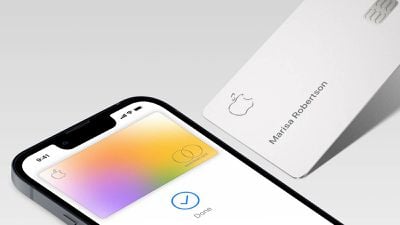
As part of a limited time promotion, Apple Card users can receive 6% Daily Cash on select Nike purchases through October 15.
In an email to customers, Apple said 6% Daily Cash is available for Nike shoes, apparel, and sports equipment purchased with the Apple Card via Apple Pay at Nike stores, in the Nike app, and at Nike.com. The extra cashback is applied automatically.
Nike usually offers 3% Daily Cash, which is already higher than the standard 2% Daily Cash for Apple Card purchases completed via Apple Pay.
Apple's credit card launched a little over three years ago and remains exclusive to the U.S. The card can be managed completely through the Wallet app on the iPhone, with a physical version available for use at stores that do not accept contactless payments.
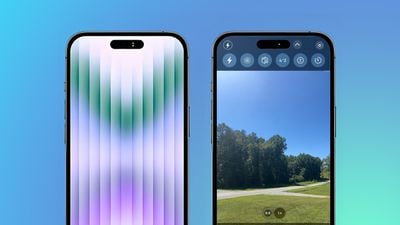
Last minute rumors have suggested that the two planned cutouts on the iPhone 14 Pro will be displayed as a single large pill-shaped cutout, with Apple also using that space for the green and orange camera and microphone privacy indicators.
The privacy indicator information comes from a source on the MacRumors forums who appears to have inside knowledge on what the display will look like. The source provided additional details to MacRumors on what the indicator lights will look like.
The indicator dots are described as "much brighter than the rest of the display," something that will be noticeable specifically in bright situations. The source describes the indicators as being "some sort of HDR content" to make them easy to see even when it's sunny outside and the display is at maximum brightness.
The dots will appear in the space between the two cutouts that Apple is using for Face ID hardware, and the overall look will be much like the green indicator light that is displayed on the Mac when the webcam is activated. Apple uses a bright green indicator light for Macs and it sounds like the indicator lights on the iPhone 14 Pro models will be at a similar brightness.
At the current time, the green privacy indicator for the camera and the orange privacy indicator for the microphone are displayed to the right of the notch on iPhones that have Face ID. The lights are not particularly bright and can be easy to miss, so making the indicators brighter and moving them to the middle of the display will make them easier to see.
When the indicator lights are not on, the space between the two hardware cutouts will be black, merging them into a single cutout. The pill-shaped cutout will take up a similar amount of screen space as the notch, but it will not connect to the top of the display and it gives Apple extra real estate for indicator lights.
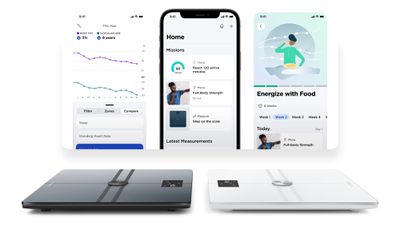
Withings, known for its range of health-related smart devices, today announced the launch of the Body Comp scale. The Body Comp is described as a complete body assessment scale that is able to measure a number of different biomarkers. Withings says that it offers novel sensors, exclusive algorithms, and patented electronics for accurate weight and body composition measurements.
It is able to determine full body composition, including weight, muscle mass, fat mass, water percent, bone mass, BMI, and visceral fat (the fat around organs), plus it provides a cardiovascular assessment that determines standing heart rate and provides a vascular age based on Pulse Wave Velocity, a measurement based on arterial stiffness. It also includes a nerve health assessment that offers a nerve health score computed from electrochemical skin conductance through the feet.
Withings says that this is the first scale that is able to measure body fat, visceral fat, vascular age, and nerve health in a single consumer device.
The Health+ service that Withings is launching alongside the scale is designed to unlock additional features in the Health Mate app used with Withings smart devices. It offers new details and metrics for a more complete overview of health, along with six-week habit building modules to help users achieve health goals.
Health+ can be used for logging mood, food, and sleep, with Withings providing daily plans that include suggested recipes and workouts. Health+ also allows users to correlate data to see how and when different metrics evolve when using the information obtained from the scale.
The Body Comp scale with Health+ integration will be available from the Withings website starting on October 4, and it will be priced at $209.95. That price point includes the scale and a 12-month Health+ subscription.
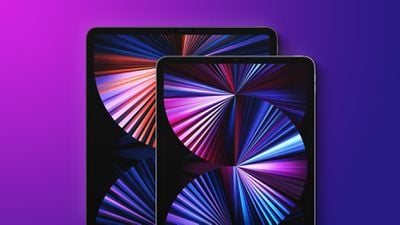
At least one major retailer is preparing for the launch of 2022 iPad Pro models by adding the device to its systems, MacRumors has found.
Apple's current 11-inch and 12.9-inch iPad Pro models launched in April 2021, making them the longest-lasting iPad Pro models to date. Refreshed iPad Pro models have been rumored for some time, and now, Australian carrier Optus has added 2022 iPad Pro models to its internal stock keeping system, distinct from 2021 iPad Pro models. For example, SKUs for a Space Gray fourth-generation 11-inch iPad Pro with 512GB of storage and cellular connectivity have been added to Optus's system. At present, there is no fourth-generation 11-inch iPad Pro, with the latest model from 2021 being a third-generation model. The current, third-generation models are still listed as expected on Optus's system.
According to Optus staff, the 2022 iPad Pro models are not currently in stock. Despite this, order invoices seen by MacRumors show that some staff have accidentally placed orders for the 2022 iPad Pro instead of the 2021 iPad Pro for some customers. One such customer told MacRumors that two days after receiving order confirmation for the 2022 iPad Pro model, they were contacted by a customer service representative who said that the fourth-generation 11-inch iPad Pro was out of stock, and that Optus could only offer the third-generation 11-inch iPad Pro at the current time – resulting in the creation of a new order confirmation for the 2021 model.
This customer was initially told that the first iPad Pro model, believed to be the 2022 model, that had been ordered for them would take two weeks to arrive at a local store – but it is not clear if this is meaningfully related to the device's launch date or simply a standard timeframe given by employees for orders sent to retail locations.
Optus's system does not yet have specifications for the new iPad Pro models, but staff are anticipating an update that will provide further information. They have not been notified of when this update will occur and do not yet have visibility of a date when the device will come in stock.
Optus is listing 2022 iPad Pro models at a higher price point than 2021 models with the same amount of storage. For example, the listed total monthly installments come to around $2,100. This is approximately $200 ($137 USD) more than the $1,899 price of the current equivalent iPad Pro model in Australia. It is not clear if these prices represent a price hike for the upcoming iPad pro or are simply provisional figures on Optus's system.
It is not unusual for retailers to quietly add placeholder listings for upcoming Apple devices before they are even announced, but the confirmation that 2022 iPad Pro models are now in major carriers' systems could indicate that the devices will launch sooner rather than later. Apple is now expected to launch updated iPad Pro models at an event in October, not least because the official release of iPadOS 16 has been delayed until October.
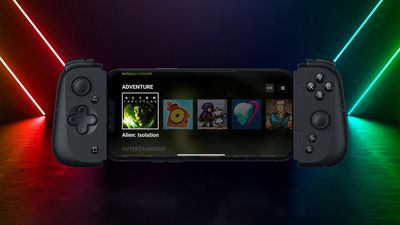
Key new features of the Kishi V2 include a more "ergonomic" design, "console-quality controls" with improved responsiveness for the A/B/X/Y buttons and d-pad, two programmable multifunction buttons (L4/R4), and an "extendable bridge" for compatibility with the iPhone 6s and newer, including all iPhone SE models.
The controller has a built-in Lightning connector for a direct, low-latency connection to an iPhone, which it draws power from. An additional Lightning connector on the bottom of the controller allows for pass-through charging of the iPhone itself.
The new Kishi V2 controller is available to order now on Razer's website, with pricing set at $99.99 in the United States. There is also a version of the Kishi V2 for Android smartphones that was released in June for the same price.
Another popular iPhone game controller is the Backbone, while iPhones have also supported PS5 DualSense and Xbox Series X/S controllers via Bluetooth since the release of iOS 14.5 last year and gained compatibility with Nintendo's Joy-Cons with iOS 16.
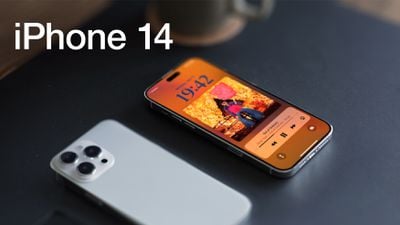
We're six days away from the launch of the iPhone 14 and iPhone 14 Pro, and as is almost typical, there has been a flurry of new rumors and reports in the last few days about the upcoming iPhones. To make things easier for MacRumors readers, we've compiled the latest rumors about the upcoming iPhones below so you can get all caught up.
Two Cutouts Turn Into One
Apple is expected to replace the notch on the iPhone 14 Pro lineup with a pill-shape and hole-punch cutout, as has been rumored repeatedly. One major new detail of the notch replacement that surfaced this week is that when the iPhone 14 Pro is in use, the pill-shape and hole-punch holes will digitally merge into one longer pill-shaped cutout, according to a post on the MacRumors Forum citing an Apple engineer.
Concept of the iPhone 14 Pro cutouts based on information from an Apple engineer shared on the MacRumors Forums
According to the post, Apple will digitally black out the space between the two physical holes and use that space to showcase iOS privacy indicators currently shown in the top right-hand corner of the iPhone. Additionally, according to the post, Apple will use the extra space at the top of the display to rearrange controls in the Camera app.
iPhone 14 Max Turns Into iPhone 14 Plus
While we were expecting Apple to name the 6.7-inch low-end iPhone 14 the "iPhone 14 Max," it could turn out to be the "iPhone 14 Plus." Apple last used the Plus name with the iPhone 8 Plus, since reverting to "Pro Max" for its largest iPhone model. The 6.7-inch "iPhone 14 Plus" will be one of two 6.7-inch iPhone models in the 2022 iPhone lineup, with the other "iPhone 14 Pro Max" sitting at the highest end of the lineup.
Unlike the iPhone 14 Pro Max, which will feature a new hole-punch and pill-shape notch replacement, a 48MP camera, and an always-on display, the "iPhone 14 Plus" will retain the same notch and processor as the iPhone 13 but in a larger form-factor.
No More Sierra Blue and More
A rumor this week suggested that Sierra Blue, a color option introduced with the iPhone 13 Pro and iPhone 13 Pro Max, will not be available with the iPhone 14 Pro series. Instead, Apple will replace the blue with a new green and purple color in the lineup, according to the rumor. That rumor also listed out other expectations for the iPhone 14 and iPhone 14 Pro, including:
Pro iPhone models to start with 256GB of storage, not 128GB like before
No high-end titanium iPhone model, despite Apple having tested the new material
A new "exclusive MagSafe battery pack" to accompany the stronger MagSafe system
Improved performance and heat management thanks to the A16 Bionic chip
Conclusion
Apple is widely expected to announce the iPhone 14 and iPhone 14 Pro, the Apple Watch Series 8, the Apple Watch "Pro," and a new Apple Watch SE during an event planned for Wednesday, September 7. Stay tuned to MacRumors for full coverage of Apple's event set to take place in a little over six days.
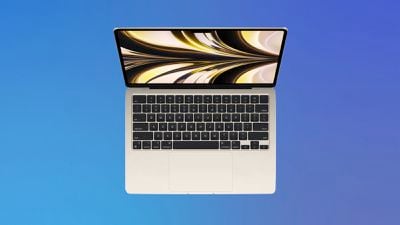
Today on Amazon you can get the all-new M2 MacBook Air (256GB) for $1,099.00, down from $1,199.00. Only the Space Gray color is on sale at this price.
Note: MacRumors is an affiliate partner with Amazon. When you click a link and make a purchase, we may receive a small payment, which helps us keep the site running.
At $100 off, this is a match of the all-time low price on this version of the MacBook Air. Current shipping estimates provide a window between September 3 and 6 for most places in the United States.
You can find even more discounts on other MacBooks by visiting our Best Deals guide for MacBook Pro and MacBook Air. In this guide we track the steepest discounts for the newest MacBook models every week, so be sure to bookmark it and check back often if you're shopping for a new Apple notebook.
Update: this deal has now expired. Update x2: it appears the MacBook Air is back in stock.
Twitter has officially started testing an edit button for Twitter Blue subscribers, allowing users to edit their tweets for typos and mistakes even after they've already been published, according to a tweet from the company's official account today.
Twitter had previously confirmed it was working on an edit button but offered no details on when it may be available to users for testing. According to a Twitter blog post, the new edit button will be available to small groups of Twitter Blue subscribers later this month following "internal testing" at Twitter.
Tweets that have been edited will be clearly marked as edited, and users will be able to see past versions of the tweet. Tweets will remain editable for up to 30 minutes after they've been tweeted.
For this test, Tweets will be able to be edited a few times in the 30 minutes following their publication. Edited Tweets will appear with an icon, timestamp, and label so it's clear to readers that the original Tweet has been modified. Tapping the label will take viewers to the Tweet's Edit History, which includes past versions of the Tweet.
Twitter says testing of the edit button will be "localized to a single country at first" and will expand over time. The company notes it will pay close attention to how the new functionality will "impact the way people read, write, and engage with Tweets."
Smartphone manufacturers supplying the EU will be required to provide spare parts for at least five years from the date of a device's introduction and ensure longer battery life, according to new draft proposals published by the European Commission.
The Financial Times reports that the proposals would require at least 15 different component parts to be made available and that batteries should survive at least 500 full charges without deteriorating to below 83 percent of their capacity.
Phones sold in the EU would also have to display an energy efficiency label, similar to those used for washing machines and dishwashers, showing expected battery life and other characteristics such as the device's drop resistance.
The draft regulations cover tablets and mobile phones, and are based on the claim that by making hardware more repairable and recyclable, the energy consumption involved in a device's production and use would be cut by a third.
Currently, owners of iPhone, iPad, iPod, Mac or Apple TV products can obtain a service and parts from Apple service providers, including Apple Retail Stores and Independent Repair Providers, for a minimum of five years from when Apple last distributed the product for sale.
After five years, iPhones are typically classified by Apple as "vintage" and Apple can still service these devices if it has the parts. After seven years, devices are classed as "obsolete" and hardware servicing is no longer available.
Apple in April launched its own Self Service Repair program, which allows users to complete their own repairs via a new online store dedicated to parts and tools, but the service is currently only available in the United States, although it will be expanding to additional countries, including Europe, later in 2022.
The new proposals also cover software, and require manufacturers to provide security updates for five years after devices leave the market and functionality updates for three years. Apple has typically offered software support to iPhones for almost a decade after they are released, but owners of Android phones typically receive only a few years of software updates, so the regulations are likely to greatly impact Google.
Smartphone makers critical of the draft proposals have argued that making more parts available actually increases the consumption of plastic, resulting in wasted resources, but the EU has warned that products which do not meet its sustainability requirements "will go off the market."
The latest draft EU proposals follow a requirement introduced in June for smartphones to use a standardized charger by 2024, despite years of opposition from Apple.
Note: Due to the political or social nature of the discussion regarding this topic, the discussion thread is located in our Political News forum. All forum members and site visitors are welcome to read and follow the thread, but posting is limited to forum members with at least 100 posts.


 Note: MacRumors is an affiliate partner with some of these vendors. When you click a link and make a purchase, we may receive a small payment, which helps us keep the site running.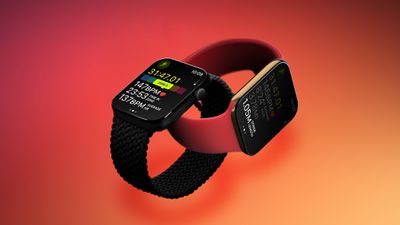
 Note: MacRumors is an affiliate partner with Amazon. When you click a link and make a purchase, we may receive a small payment, which helps us keep the site running.