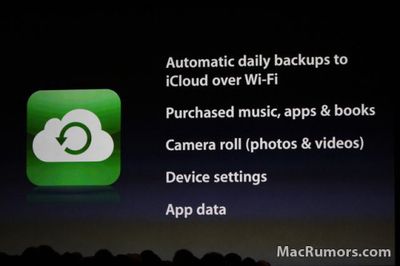
Fifty percent of iPhone owners who have iPhones swapped at the Genius Bar have never plugged them into a computer to backup or sync. That's according to a "little birdie" that former Macworld Associate Editor David Chartier (now at AgileBits) knows. It also suggests iCloud will save a lot of headaches and lost data.
This is a big reason, according to this birdie, for why Apple Store Geniuses are excited about iCloud.
Backupophobes can get away with never touching iTunes after activating an iOS device. But folks obviously need to plug them into some kind of power source to recharge which, combined with a reachable WiFi network, is what triggers iCloud's automatic backup feature. Sure, these customers can manually reinstall apps one by one from the store, but they have no way to recover any of their data or media purchased on the device. That holds true for contacts, too, if users didn't sign up for MobileMe or even Google's free (and, in my experience, terrible) contact sync.
Apple's iCloud, with automated wi-fi sync and instant backup to the cloud will be a welcome feature for those millions who never sync or backup their current iOS devices.
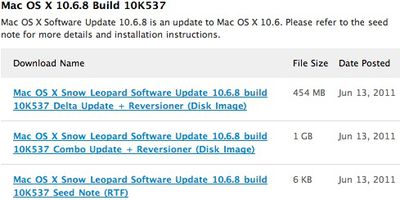
Apple today seeded Mac developers with a new version of Mac OS X 10.6.8, termed Build 10K537. The new build, which continues to weigh in at about 1 GB as a combo update and is approaching 500 MB as a delta update, is the first to be pushed out to developers in over three weeks as Apple's team has undoubtedly been focused on WWDC.
Apple's documentation requests that developers focus their testing on the same six areas as in previous builds: AirPort, Graphics Drivers, Mac App Store, Networking, QuickTime and VPN.
With OS X Lion set for a public launch sometime next month, Mac OS X 10.6.8 could be the final maintenance update to Snow Leopard.
Soon after Apple released the first developer preview version of OS X Lion back in late February, we noted that Apple appeared to have dropped support for Rosetta, the system that allowed Intel-based Macs to run applications written for earlier PowerPC-based systems.
Apple of course made the transition to Intel-based processors five years ago, and Rosetta is an optional install under Snow Leopard, but some users are still hanging onto old PowerPC applications that either have not been updated at all or have updated versions to which the users do not wish to upgrade for one reason or another.
With OS X Lion now on its fourth developer preview version and a public release set for next month, it is clear that Rosetta will not be making an appearance in Apple's next-generation Mac operating system, finally leaving those legacy applications out in the cold.
As Macworld notes today in trying to help a user hoping to hold on to an old PowerPC version on Quicken, users who wish to upgrade to Lion while still retaining compatibility with their old applications will need to get creative.
Broadly, you have a couple of options. One is to create a dual-boot Mac -- one that can boot from two volumes. One volume contains Lion and another runs an older version of the Mac OS. When you need to spend some quality Rosetta time, you boot into the older OS. And yes, this is a pain.
The other option is to simply not update to Lion. Your Mac will continue to work just as well as it does today. How acceptable this is to you depends on how desperate you are for Lion's features and iCloud (some of iCloud's features will require Lion).
Macworld also suggests the possibility of running Quicken for Windows either in Boot Camp or using virtualization software such as Parallels or VMware Fusion. Quicken is a particularly interesting case given Inuit's recent revamp of its product line that has essentially left the Mac platform without a current equal to the Windows version or even earlier Mac versions, a move that has left many longtime Quicken users hoping desperately to keep their old Mac versions going.
And of course one final option is to simply abandon use of the old PowerPC applications and find substitute offerings that will run natively on Intel-based processors. Ideal substitutes may not exist for all software, particularly specialized titles, and thus users will have to weigh the pros and cons of each solution.
After five years of offering Rosetta as a solution to allow users to keep running PowerPC applications on Intel-based machines, it is no surprise that Apple has finally made the move to discontinue support. Apple's decision does mean, however, that some users will finally have to make decisions about how best to move forward with the current architecture.
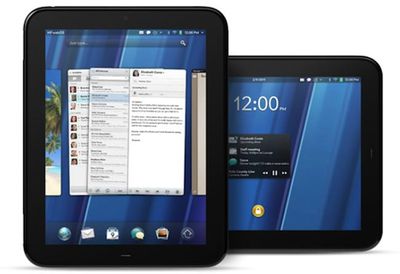
HP finally appears set to make its splash into the tablet market, announcing late last week that its webOS-based TouchPad will go on sale July 1st and match the iPad's price points of $499.99 for a 16 GB model and $599.99 for a 32 GB model. The pairing of HP and Palm has been seen as one of the most interesting contenders in the tablet market, although none of Apple's other primary competitors have yet made a serious dent in the iPad's dominant market position.
But an iPad competitor (alongside several webOS-based smartphones) may not be HP's only attempt to take Apple head-on, as Billboard reports that the company is also talking to major music labels about developing its own cloud-based music service that could eventually expand to include movies and TV.
While the music industry focuses on Apple, Google and Amazon, Hewlett-Packard is quietly making plans -- again -- for its own locker-based service. Multiple sources at the major labels report that the discussions are heating up.
The Palo Alto, Calif.-based computer and technology company is engaged in conversations with the majors about building a cloud service that would eventually offer music, movies and TV shows. Those discussions began a few months ago.
The report summarizes HP's past efforts at developing its own music service, a history that doesn't necessarily instill confidence in the company's ability to put together a quality product this time around, although a number of industry observers have noted that players such as Amazon and Google (and now HP) may have an easier time negotiating the complex music industry now that Apple has created a template with its own iCloud/iTunes Match service.
Meanwhile, sources are unsure about how quickly HP could come to market, with some saying that nothing would be likely for at least six months. Moreover, sources say that HP has been on the backburner for the majors while they place most of their attention on negotiations with Apple, Google and Amazon. But if HP decides to go forward it wouldn't necessarily be the last to market with a full-blown service, as all three of the aforementioned companies have a way to go to achieve that very goal too.
While HP has long played a leading role in the computer industry, it had not made a significant push into mobile until its acquisition of Palm last year. But with mobile now appearing set to become a focus for the company, cloud-based media services immediately become a more important piece of the puzzle as the company seeks to catch up with iOS, Android, and BlackBerry in the rapidly-growing market.
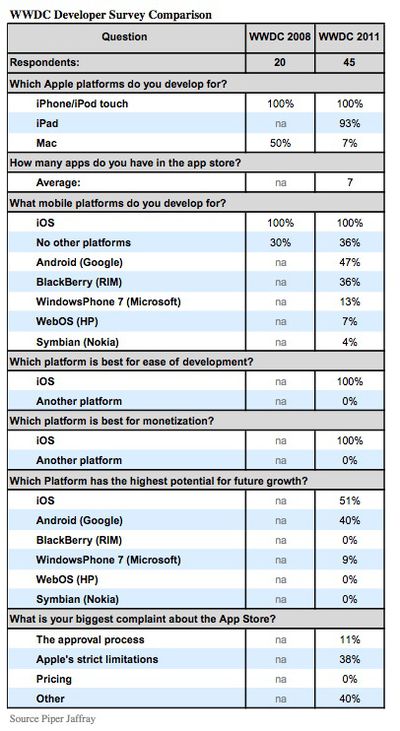
Fortune reports on a new survey conducted by Piper Jaffray analyst Gene Munster at Apple's Worldwide Developers Conference last week in which he surveyed a number of developer attendees to gain an understanding of their development interests. Interestingly, nearly half of the 45 developers surveyed reported that they are also developing for Android, while only a third revealed that they are developing BlackBerry applications.
Only 7% of surveyed developers reported that they are also developing for OS X, indicating that Apple's new Mac App Store and integrated Xcode development tools still have a significant market on the OS X side that remains untapped. A full 93% of iPhone developers unsurprisingly reported also developing for iPad, tapping into the rapidly-growing tablet market as a natural extension of their iPhone and iPod touch businesses.
While the developers unsurprisingly (given their attendance at WWDC) unanimously chose iOS as the platform that is easiest for development and best for monetization, only approximately half of the developers regarded iOS as having the highest growth potential. Even among these dedicated iOS developers, 40% of respondents cited Android as having the highest potential for future growth.
Munster attempts to compare his results to a similar survey of 20 developers conducted at WWDC 2008, but with only a handful of results from that earlier survey providing little detail and the wholesale changes in iOS and the smartphone industry since that time, it is difficult to make comparisons. For example, iOS developer interest in the Mac platform appears to have plummeted from 50% to 7% over the past three years, but it is important to remember the context of 2008 when Apple was just launching the App Store and iOS developers were commonly Mac developers who had begun dabbling in iOS applications. The reverse is now true, with over 400,000 iOS applications available and a number of developers finding that iOS development is a sustainable business on its own.
With rumors of deep integration of Nuance's voice recognition technology in iOS 5 and evidence that such tools are hidden but included in current developer builds, there has been considerable interest in determining the extent to which the two companies are working together. Nuance technology has also been showing up in OS X Lion in the form of new text-to-speech voices and has been rumored to be being used in Apple's new North Carolina data center.
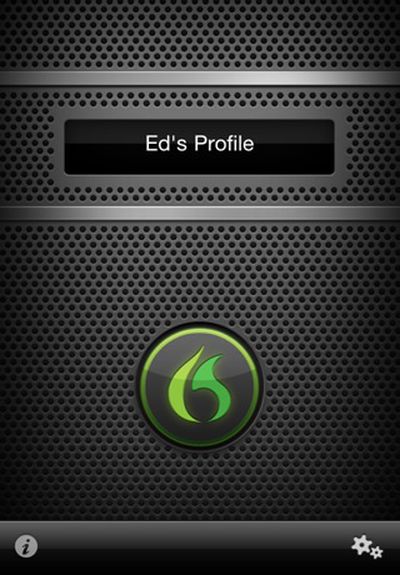
Nuance is certainly not new to the iOS platform, having released the high-profile Dragon Dictation and Dragon Search for the iPhone in late 2009. But a new, albeit simple, application called Dragon Remote Microphone released by Nuance today demonstrates how the company is seeking to link up iOS users with the company's flagship Dragon NaturallySpeaking voice recognition software as part of a new version 11.5 release. The new app serves as a wireless microphone for the voice recognition software via Wi-Fi, allowing users to use their iOS device instead of the microphone included with the software for input.
In conjunction with the launch of Dragon NaturallySpeaking 11.5, Nuance introduced the Dragon Remote Mic App, a free application on the Apple iOS app store which makes it possible to use an iPhone, iPod touch, or iPad as a wireless microphone for Dragon via a Wi-Fi network connection. Many customers have requested to use their smartphones and other mobile devices with Dragon to have more flexibility with how and where they dictate with Dragon. The new Dragon Remote Mic App takes advantage of the nearly 200 million iOS devices in use today, and transforms the device into a wireless microphone that easily captures dictation and controls applications on your PC.
Dragon NaturallySpeaking is Windows-only voice recognition software available in a variety of packages ranging from $99.99 for the basic home package up to $799.99 for the high-end legal package. The company's Mac offerings come in the form of several MacSpeech products, a line the company acquired in early 2010. The new remote microsphone app does not, however, appear to be compatible with MacSpeech products at this time.
Apple was careful about managing expectations heading into the WWDC keynote. A week before the keynote, they spelled out exactly what they would talk about (OS X Lion, iOS 5, and iCloud) and also specifically omitted any reference to new hardware. We believe the reason for the candor was the public expectation that the WWDC keynote has always been the launchpad for the new iPhone.
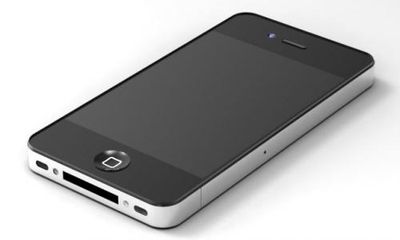
iPhone mockup by blkr
Instead, rumors have been persistent that the next iPhone would be released in the September timeframe. Reuters detailed the timeline back in April:
Apple Inc suppliers will begin production of its next-generation iPhone in July this year, with the finished product likely to begin shipping in September, three people familiar with the matter said on Wednesday.
Right on schedule, we are now hearing from 9to5Mac that the iPhone 5 has reached the final testing stage and should be ready in time for a September launch.
Their source must be based in Verizon as they claim that it's not clear when Verizon will support 3G FaceTime, and reportedly some negotiations about the details of over-the-air updates remain ongoing. Verizon iPhones have strangely been left somewhat behind in software updates, still only able to support iOS 4.2.8 as the highest version. iOS 5 will consolidate the codebase across all iPhone models when it is released this fall.
Final Cut Pro X must be in late testing as even more screenshots from the upcoming release have been leaked to the internet. Twitter user @MortGoldman2 has posted a sequence of screenshots said to be from the upcoming Final Cut Pro X. The series of over 30 shots shows grabs of various tools/views including histogram, color balance, exposure, color grading and more.
Apple demoed Final Cut Pro X back in April at the Final Cut Pro User Group Network SuperMeet held in conjunction with the National Association of Broadcasters' NAB Show 2011 in Las Vegas. At the time, the company announced that Final Cut Pro X would launch via the Mac App Store in June priced at $299
Since last week's unveiling of Apple's new iCloud service and the transitioning of the company's existing MobileMe service into iCloud, many users have been wondering about the fate of some of the MobileMe services that were not mentioned in the transition discussion. In particular, users have been concerned about iWeb, Apple's website creation software included with iLife that can be integrated with site hosting via MobileMe.
One concerned iWeb/MobileMe user emailed Apple CEO Steve Jobs to ask about the fate of the offering, and reportedly received confirmation that users will indeed need to find alternative hosting for their sites once MobileMe is officially discontinued. All existing MobileMe users have received free subscription extensions through June 30, 2012, at which time the service will cease to exist and the transition to iCloud will be complete.
Q: Dear Mr. Jobs,
Will I need to find an alternative website builder and someone to host my sites?
I have invested a lot of time and effort and the thought of re-training sucks more than mobileme ever did.
A: Yep.
Sent from my iPhone
As usual, the authenticity can not be confirmed with absolute certainty, but we have examined the email headers and believe them to be legitimate. Replies from Jobs' account are not particularly unusual, and he has in the past acknowledged being personally responsible for at least some, if not all, of the correspondence.
Apple's iWeb software saw its last major update with the release of iLife '09 in January 2009. The application did not receive a major update with the release of iLife '11 late last year, although Apple has continued to bundle it with the new iLife suite. The company has continued to periodically issue minor bug fixes for iWeb, most recently in February of this year.
Since the release of first iOS 5 Beta last week, people have been diligently documenting all the new features Apple has introduced in the upcoming version. Apple claims over 200 new features have been added, but have only spelled out a fraction of those. On our iPhone/iOS Blog we've already covered some of the biggest changes. These include:
MacRumors forum user hellomoto4 has compiled a longer list with screenshots of many of the new findings, such as:
iCal in landscape mode
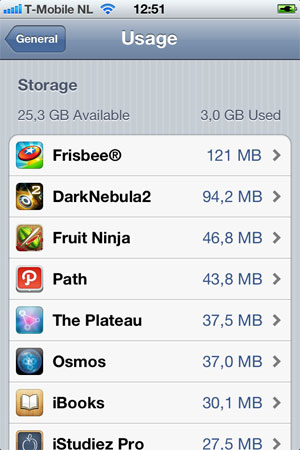
Storage space for Apps
The most complete list of changes we've seen, however, is from forum user benna who has compiled 153 changes/features as of this writing. There are some duplicates and only a few screenshots, but it's the most exhaustive list we've seen. Here are some excerpts of some of the more interesting changes:
- You can choose what applications to be included in Notifications Center - Ability to Set Left or Right for Mono Audio - You can create additional @me.com email address within the Mail settings - New Private Browsing option in Safari - Set custom text tone for each contact. - You can use your phone while its being synced with iTunes. - Multitasking Gestures in iPad. Use four or five fingers, swipe up to reveal the multitasking bar, pinch to return to the Home screen, and swipe left or right to switch between apps. - Camera, use two-finger spread/pinch gesture to zoom in/out accordingly (Thanks @Alan) - When your alarm goes off you can snooze it from lockscreen or slide to turn off - Ability to set maximum messages downloaded through email to 1000 instead of 250 - Links can be opened in the background
iOS 5 is presently in developer beta release and will be released to the public in the fall of this year.
For the third time in the past four weeks, we're hearing rumors of the imminent launch Apple's Back to School promotion. The first claim expected the promo to kick off the last week of May as it had in previous years. Then, WWDC was listed as the possible launch day. Both dates have come and gone with no mention of Apple's popular promotion.
Now, @Chronicwire, the same source as the MacBook Air rumor, claims that Back to School is going to kick off on the same day.
LEAK: Apple Store displays will be updated Tuesday night for the Back To School promo, starting Wednesday, alongside the new MacBook Airs.
We've also heard whispers, as has 9to5Mac, about the Tuesday night visual refresh at Apple retail stores, but haven't had any confirmation on the contents.
@Chronicwire is a relatively new source for Apple information, though its believed they do have legitimate sources for information. We'll find out on Wednesday. The Back to School promotion typically offers students a free iPod with any Mac purchase.
While all the focus has been the many new features found in iOS 5 Beta, Apple also released a new developer beta of Mac OS X Lion last week.
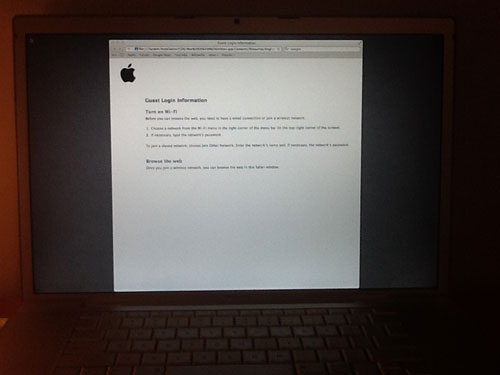
Many of Mac OS X Lion's features have been known for months, but Apple has snuck in at least one interesting new feature called "Restart to Safari". On Mac OS X Lion's user lock screen, you are given the option to "Restart to Safari" rather than logging in. This allows you to boot the computer into just the web browser and nothing else. This browser only mode allows unauthorized users to simply browse the web through Safari rather than having access to any personal files or other applications on the machine. Of course with Lion's new auto-save and application restore feature, returning users will find themselves back at the same place they were before the restart. This browser-only mode is reminiscent of Google's lightweight Chrome OS which is designed to offer the user a web-only based operating system.
Apple's motivations for offering such a browser-only mode differs from Google's. Google is partnering with manufacturers in order to build Chrome OS only laptops that offer cheap browser-only machines. Apple's not likely to be going that route with Mac OS X Lion but is instead offering a nice sandboxed mode so Lion can easily act as a secure and anonymous web kiosk.
Mac OS X Lion will become available for $29.99 on the Mac App Store in July.
Update: This feature seems to be part of the "Find My Mac" feature set which allows users to get access to the internet. Though the premise appears to be to give your Mac a chance to phone home, the feature seems very useful for day to day use.
On the heels of the Nuance speech screenshots, @ChronicWire claims that Apple will be releasing the new MacBook Air this wednesday.
Apple has been said to be prepping the new Sandy Bridge/Thunderbolt MacBook Airs for June-July. The most recent reports claim that Apple has been ramping up production ahead of the launch. The new MacBook Airs are expected to finally adopt the latest generation Intel processors which should provide a significant performance boost over the existing models. @Chronicwire has been known to have reliable sources in the past.
Update: We've heard confirmation that MacBook Airs are on their way to Apple Stores for a Tues or Wed launch. New Part numbers for MacBook Airs are MC603, MC604, MC605, MC606.
Update 2: Those part numbers are said to be for unlocked iPhones, so nothing definite on the MacBook Air.
Update 3: It seems Chronicwire was also confused about those same part numbers. In an update:
CORRECTION: Source had mixed up part numbers, it is unlocked iPhones that will be headed to US Apple Stores for Wednesday, NOT MacBook Airs.
The beta version of iTunes 10.5 released to developers last week is the first version of iTunes to run in 64-bit mode. The distinction is perhaps a bit minor for an app like iTunes, but has been the source of much discussion over the years. What's perhaps of more significance is the belief that this 64-bit support must mean that iTunes has been ported from Carbon to Cocoa, though that line seems to be rather blurred.
The primary advantage afforded 64-bit applications is the ability to address more than 4GB of memory which can be a distinct advantage for applications which use large data sets. Adobe, for example, received some criticism in 2008 that their Photoshop products were slow to adopt 64-bit mode on the Mac. 64-bit Photoshop for Mac ultimately arrived with CS5.
The reason for the long delay was the fact that Apple dropped support for 64-bit mode in Carbon back in 2007, requiring developers to port their existing Carbon applications to Cocoa in order to take advantage of 64-bit mode. This primarily affected older applications such as Photoshop and iTunes which had existed prior to Mac OS X and were still using Carbon, Apple's legacy API. Meanwhile, Cocoa was Apple's native API for Mac OS X and offered some additional user interface advantages. For better or worse, many users saw Cocoa applications as superior to their Carbon counterparts due to historic baggage of many of the Carbon applications.
The latest iTunes 10.5 developer beta does run in 64-bit mode in Mac OS X Lion, but still runs in 32-bit mode in previous versions of Mac OS X. Discussions in the forum, however, point out that there is still some debate about the "Cocoa vs Carbon" status. Despite the changeup, iTunes reportedly feels very similar to the previous versions, and doesn't come with dramatic changes. So those hoping for a complete revamp will be disappointed.
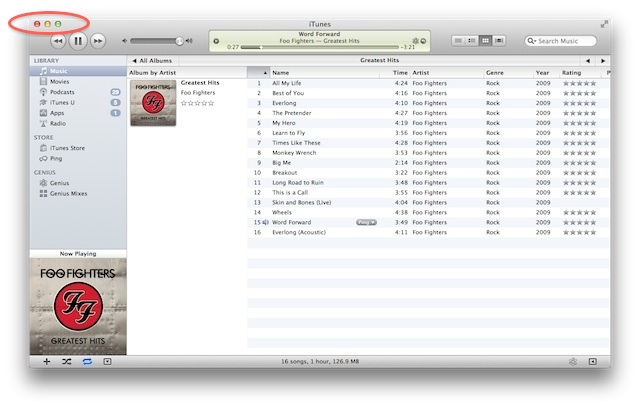
A couple of notable changes, however, include the fact that iTunes for Lion now supports Full Screen Mode and also returns the close/minimize/maximize buttons to their usual horizontal location.
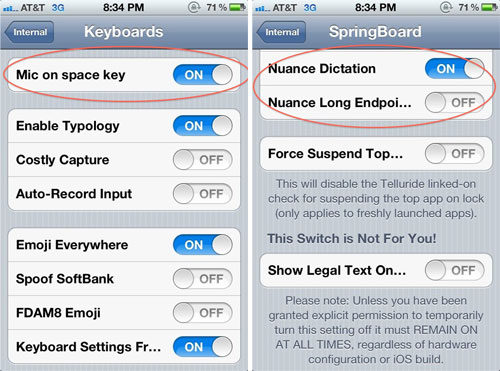
A couple of screenshots posted on Twitter by @ChronicWire reveals hidden Nuance preferences found in the latest internal iOS builds that confirms that Apple has been actively working on building in speech recognition into iOS.
Rumors of a Nuance-Apple partnership had been heavy in the weeks prior to WWDC, though no announcements were made during the keynote. Later, comments by Robert Scoble indicated that the deals were simply not completed in time for WWDC but were still in the works:
I was told weeks ago by my source (same one who told me Twitter would be integrated deeply into the OS) that Siri wouldn't be done in time. Maybe for this fall's release of iPhone 5? After all, they need to have some fun things to demo for us in August, no?
The source of the screenshots (@Chronic / @SonnyDickson) has been known to have legitimate sources in the past. So, it seems certain that Apple is actively working on bringing Nuance speech recognition into iOS, perhaps as early as iOS 5 this fall.
As rumored earlier today, Apple is recalling some Verizon/CDMA models of the iPad 2 because of a manufacturing glitch that caused some of the devices to carry a duplicate identification number, causing issues with 3G service. Apple told the Wall Street Journal that the number of iPads affected was "extremely small".
We have gotten several reports of iPads being suddenly "returned to shipper" by FedEx, with some even being pulled from the delivery truck on the way to their final destination.
News of the recall surfaced earlier, with a number of reports from Apple's support forums mentioning Verizon iPads being rerouted during shipping and even a few owners of new iPads who were having trouble getting their Verizon 3G service to work.
As reported by The Next Web, a company by the name of iCloud Communications has filed suit against Apple, alleging infringement over the company's new iCloud service. Apple of course acquired the iCloud.com domain name from Swedish company Xcerion and undoubtedly assisted that company in rebranding its cloud-based services as CloudMe, but Apple apparently did not engage iCloud Communications in any sort of discussions surrounding the name.
Specifically, iCloud Communications is claiming that Apple's heavy promotion of the iCloud product is damaging to its business and has all but removed the branding of the name from itself and placed it onto Apple.
To make matters somewhat worse, there's some accusation that Apple's services are nearly identical to the ones being offered by iCloud Communciations.
The suit seeks an injunction barring Apple from using the iCloud name, destruction of all promotional materials and other items bearing reference to Apple's iCloud service, and monetary damages including forfeiture of profits obtained using the iCloud name.
Unlike Xcerion, iCloud Communications does not appear to hold any registered U.S. trademarks related to the iCloud name. Trademarks are not, however, required to be registered, although registration conveys substantial benefits toward protecting those marks.
The trademark dispute between Apple and Amazon over the term "App Store" continues to play out, with Computerworld noting that a new filing by Apple clarifies the company's stance that it fears a tarnishing of its reputation by association with the "inferior" Amazon Appstore for Android.
In a filing on Wednesday, Apple countered Amazon's claim that "app store" is a generic label, and repeated its demand that the court issue a preliminary injunction barring Amazon from using the similar "appstore" to market its Android app download center.
"Amazon mischaracterizes Apple's tarnishment claim," Apple said in the June 8 reply to an earlier Amazon filing. "Apple has not asserted that the Android operating system is inferior. Rather, Apple has asserted that Amazon's service is inferior and will tarnish Apple's mark."
In its filing, Apple also expresses concern over the Amazon Appstore's offering of apps that bypass security mechanisms built into the Android platform, as well as a number of cases of malicious or pirated apps that have appeared in Android app marketplaces. Apple fears that having the word "app store" associated with such types of applications will tarnish the reputation of Apple's relatively tightly-regulated App Store.
Apple has also taken the opportunity to point to Amazon's new Mac download store as an example of how Amazon can offer application download services without using the "app store" term.
Apple has been trying since July 2008 to have the U.S. Patent and Trademark Organization grant its trademark application for the "App Store" term. In the process, Apple has reached out to companies it believes are infringing on the mark, as would be required for a granted trademark lest it become considered a generic term and thus unprotect-able. Microsoft has been leading the fight to have Apple's trademark application denied, arguing that the term is too generic in the first place to receive trademark protection.



 Since last week's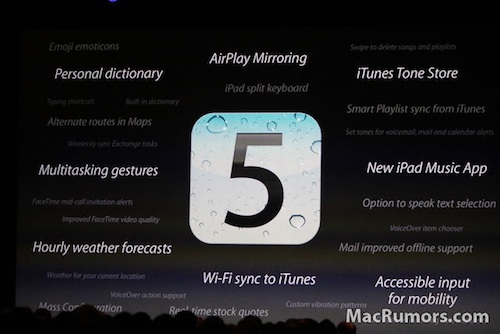





 The
The