Steve Jobs will remain on the board of directors at The Walt Disney Company, according to Bloomberg TV.
Jobs owns more than 7 percent of Disney from its acquisition of Pixar in 2006 and received a seat on the board in that deal. He is Disney's largest shareholder.
Tim Cook, Apple's new CEO following the resignation of Steve Jobs, graduated from Auburn University in 1982 with a degree in Industrial Engineering. Cook is a huge Auburn fan and has lots of memorabilia in both his home and office.
My most significant discovery so far in my life was the result of one single decision, my decision to join Apple. Working at Apple was never in any plan that I'd outlined for myself, but was without a doubt the best decision that I ever made.
He gave this commencement address to Auburn's graduating class in 2010.
In the wake of the news that Steve Jobs has resigned as Apple CEO, the Wall Street Journal spoke with their sources who said that Jobs has remained actively involved, and that is not expected to change.
People familiar with the situation have said that Mr. Jobs continues to be active at Apple and is closely involved in the company's product strategy. Apple watchers don't expect that to change even after Mr. Cook takes over.
Tim Cook has been made Apple CEO at the recommendation of Jobs.
Update: AllThingsD also reports a similar sentiment:
Extremely well-informed sources at Apple say he intends to remain involved in developing major future products and strategy and intends to be an active chairman of the board, even while new CEO Tim Cook runs the company day to day.
Steve Jobs has resigned as CEO of Apple in a letter to Apple's Board of Directors. In his letter, Steve asks to remain Chairman of the Board and appoints Tim Cook as his successor. The board has approved these requests, effective immediately. Jobs will still be "active" at Apple and is expected to continue to be involved with company strategy.
To the Apple Board of Directors and the Apple Community:
I have always said if there ever came a day when I could no longer meet my duties and expectations as Apple’s CEO, I would be the first to let you know. Unfortunately, that day has come.
I hereby resign as CEO of Apple. I would like to serve, if the Board sees fit, as Chairman of the Board, director and Apple employee.
As far as my successor goes, I strongly recommend that we execute our succession plan and name Tim Cook as CEO of Apple.
I believe Apple’s brightest and most innovative days are ahead of it. And I look forward to watching and contributing to its success in a new role.
I have made some of the best friends of my life at Apple, and I thank you all for the many years of being able to work alongside you.
Steve
Art Levinson, chairman of Genentech and an Apple board member for more than 10 years, issued this statement on behalf of the board:
Steve's extraordinary vision and leadership saved Apple and guided it to its position as the world's most innovative and valuable technology company. Steve has made countless contributions to Apple's success, and he has attracted and inspired Apple's immensely creative employees and world class executive team. In his new role as Chairman of the Board, Steve will continue to serve Apple with his unique insights, creativity and inspiration.
Jobs was diagnosed and treated for pancreatic cancer in 2004. He's taken three separate leaves of absence for medical reasons during and since that time. In 2009, Jobs had a liver transplant at Methodist University Hospital in Memphis, TN. He has been away from his day-to-day duties since January of this year.
Regarding Tim Cook's appointment as CEO, Levinson wrote:
The Board has complete confidence that Tim is the right person to be our next CEO. Tim’s 13 years of service to Apple have been marked by outstanding performance, and he has demonstrated remarkable talent and sound judgment in everything he does.
Apple's stock was paused in after-hours trading at 4:19PM for approximately 35 minutes. The final trade was at $375.56. When trading resumed at 4:55, Apple's stock was down more than 5% to $351.
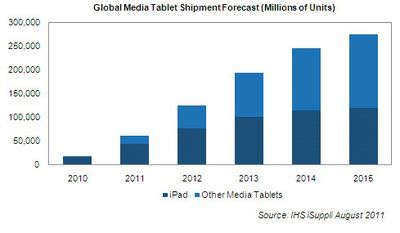
Research firm IHS iSuppli has released updated projections for tablet sales through 2015, showing Apple maintaining its leadership position longer than previously expected as rivals continue to be unable to make a significant dent in the iPad's position.
According to the report, Apple is projected to ship 44.2 million iPads this year, up 500,000 from the firm's previous estimate. That previous number had, however, been lowered from earlier projections after Apple posted lower-than-expected sales early figures for the iPad 2 as it struggled to ramp up production. The new 44.2 million figure for 2011 is expected to represent 74% of the total tablet market, up from 64% in the previous report.
“All the momentum in the media tablet market is with Apple right now,” said Rhoda Alexander, senior manager, tablet and monitor research for IHS. “The competition can’t seem to field a product with the right combination of hardware, marketing, applications and content to match up with the iPad. Furthermore, Apple’s patent litigation is serving to slow or complicate competitors’ entry into some key regional markets. With Apple lapping its competitors, many of whom are still struggling to get out of the starting gate, this remains a one-horse race.”
Looking out even further, IHS iSuppli now sees Apple holding onto its majority share of the tablet market through 2013, one year longer than previously anticipated. At the far end of its projections, the report sees Apple shipping 120 million iPads in 2015, up from previous projections of 97.9 million units. Even at that extended timeframe, Apple is projected to hold 43.6% of the tablet market, up significantly from earlier estimates of 32%.
Documentary film producer and web developer Steve Rosenbaum's "The 9/11 Memorial: Past, Present and Future" app is an interactive look at the history of the World Trade Center. It chronicles the original development of the towers, the 9/11 attacks, and the lengthy rebuilding process of the memorial and museum.
The New York Observer reports the app will have 400 still photographs and hours of video clips. Rosenbaum says the app lays out the experience in bold chunks: "here's the story before, when the World Trade Center was being built, and then after it was built, and the day of the attacks, and what's happened since."
Aside from the moving content, Rosenbaum picked the iPad for the project because he felt it was the best overall device to display it.
“I wanted it to be more of an immersive experience,” he said. “The nature of the photographs are so powerful, so to render them in anything but full color seemed wrong to me. And I didn’t want it to be viewed on a phone. I wanted it to be big and glossy.”
Apple apparently liked the idea... he submitted his app last week expecting it to take several weeks to get through the company’s notoriously opaque vetting system. “It got approved in a day and a half.”
He’s hoping for some significant promotion in the app store, since apps that aren’t featured can easily be overlooked, but he noted that there are no guarantees. “I’ve asked around, and apparently they have a bunch of people that have a meeting every week on Thursday or Friday, and they pitch. But it’s a closed system. They may choose it and they may not.”
Autodesk just released Motion FX, a nifty app that lets users apply dozens of real-time effects to videos, like smoke, fire or rainbow plasma. The software grabs live video, either from the Mac's built-in iSight or FaceTime camera, or via an external camera. Motion FX does the rest.
Simply select your favorite preset effect, and create an incredible visual experience by moving in front of your computer’s camera. A preset cycling mode lets you automatically cycle through effects without lifting a finger. You can also use the Face Tracking technology of OS X Lion to emit effects from any faces visible to your camera.
Motion FX applies real-time fluid dynamics technology from Autodesk's Maya visual effects and compositing software. There are five different video modes:
- Motion Detect: Effects are created based on motion detected by your computer’s camera - Face Detect: Emit effects from all visible faces - Color Detect: Choose the color to emit effects from the video feed - Effect Paint: Paint effects using your mouse or trackpad - Video Warp: Warp live video using your mouse or trackpad
The Mac team at Autodesk has been very busy lately, last week introducing new versions of AutoCAD LT and its flagship AutoCAD product for Mac, including offering AutoCAD LT on the Mac App Store for $899.99.
Apple today released Boot Camp Software Update 3.3 for Windows, an update to the company's software to enable Intel-based Macs to natively run Windows operating systems.
About Boot Camp Software Update 3.3 for Windows
The Boot Camp 3.3 update includes critical bug fixes and hardware support. It is recommended for all Boot Camp 3.2 users.
The update weighs in at 199.75 MB and requires Windows 7 (32 bit or 64 bit) and an existing installation of Boot Camp 3.2.
Apple today released iMac Graphic FW Update 3.0, a new firmware update to address issues which could cause users' machines to freeze up.
About iMac Graphic FW Update 3.0
This firmware update fixes a graphics issue that may cause an iMac to hang under certain conditions.
Do not shut off the power on your iMac during this update. Loss of power could result in your iMac failing to start up.
The update weighs in at 482 KB and requires OS X Lion. Apple does not specify exactly which iMac models require the update, so users should run Software Update to see if the download appears for their specific machines.
Discussion forums on Apple's site and elsewhere have been filling with numerous reports of freezing issues on iMac models under OS X Lion. It is unclear if this update is designed to target the exact issues being reported in those complaints, but it seems reasonable to speculate that Apple is indeed looking to solve at least some of those problems.
In the wake of yesterday's report that Sprint will begin offering the iPhone in the United States with the launch of the iPhone 5, apparently scheduled for "mid-October", MacTrast now reports that T-Mobile USA will also be gaining access to the iPhone. The addition of T-Mobile, which AT&T has announced its intent to acquire, alongside Sprint would bring the iPhone to all four of the major U.S. carriers.
Following our report yesterday that Apple’s upcoming iPhone 5 will be arriving on the Sprint network, a contact within T-Mobile who claims to have been briefed on the matter has informed us that, in addition to arriving on Sprint at launch, the iPhone 5 will arrive on T-Mobile’s network at launch as well.
The informant, who requested to remain anonymous, went on to claim that the iPhone 5 would also operate at 3G speeds on T-Mobile US network. Current unlocked iPhone 4 units can only operate at at 2G “edge” speeds on T-Mobile’s network, and lack certain network-dependent features, such as Visual Voicemail.
T-Mobile USA claimed earlier this year to already have one million iPhones running on its network, despite the devices being limited to EDGE speeds and missing other features.
Apple and AT&T have reportedly been testing iPhone prototypes compatible with the carrier's 3G network, making a deal to bring the device to T-Mobile a realistic possibility. Research analysts and other sources have periodically claimed that T-Mobile USA will be gaining the iPhone, but rumors have been quiet in recent weeks even as other iPhone-related rumors have ramped up as the iPhone 5 launch reportedly nears.
RetailSails compiles (via 9to5Mac) a list of the top 20 U.S. retail store chains, revealing that Apple easily leads the pack with sales of well over $5,000 per square foot. Second-place Tiffany & Co. came in well behind at under $3,000 per square foot.
It’s not surprising Apple leads the pack, as there have been numerous articles such as this, but it is quite shocking by how far ahead of the competition they are, especially considering the company only has 10 years of retail experience.
RetailSails' report analyzed over 160 U.S.-based retail companies, reporting sales information and calculated sales per square foot on a global basis.
Some of Apple's flagship locations understandably generate sales significantly above the average, with performance at the company's Fifth Avenue store in Manhattan being pegged at approximately $35,000 per square foot several years ago.
Last week, we noted that a Dutch court was weighing an infringement claim by Apple against Samsung over the Galaxy line of smartphones and tablets, with Apple requesting a complete ban on the sale of Samsungs products in the European Union. A decision in that case was to be handed down on September 15th.
FOSS Patents and Tweakers.net [Google translation] now report that the case has been decided ahead of that timeline, with the judge ordering that Samsung's subsidiaries be banned from selling Galaxy smartphones (but not tablets) in many European Union countries as of October 13th. The ban applies to the Samsung Galaxy S, Galaxy S II, and Ace phones.
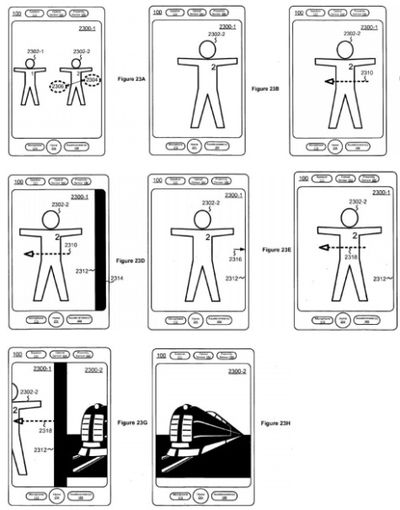
Figures from Apple's photo-swiping patent judged infringed upon by Samsung
The judge's decision was relatively narrow compared to the claims brought by Apple, which included a number of assertions that Samsung had copied Apple's product designs and functionality. The judge rejected most of those claims, finding only that Samsung had violated an Apple patent related to using swiping gestures to switch between photos in a gallery application. The ban will apply in any country where that specific patent is valid, although documentation suggests that the patent has lapsed in a number of countries due to a failure by Apple to provide necessary documents or fees.
In line with reports that the iPhone 5 will debut in "mid-October", AppleInsider reports that Apple and its longtime advertising partner TBWA/Chiat/Day are beginning work on an advertising campaign to support the new device, with production on the first round of television commercials said to be wrapping up in the first week of October.
More specifically, one person familiar with the matter says that filming for the television spots is taking place out in Los Angeles in conjunction with the iPhone maker's long-time ad agency TBWAChiatDay.
However, a second person with a proven track record notes that the production schedules for the first-run campaign isn't slated to wrap up until the middle of the first week of October.
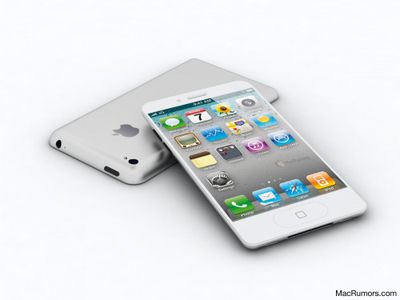
iPhone 5 rumors seem to be coalescing around a late September to mid October timeframe, with Apple potentially holding a media event near the early end of that window and product availability coming on one of the first two Fridays in October: the 7th or the 14th.
The Wall Street Journal reports that Sprint will offer the iPhone 5 when it launches later this year, becoming the third U.S. carrier to offer the iPhone. According to the report, the iPhone 5 will launch simultaneously on Sprint, Verizon, and AT&T in "mid-October".
Sprint Nextel Corp. will begin selling the iPhone 5 in mid-October, people familiar with the matter said, closing a huge hole in the No. 3 U.S. carrier's lineup and giving Apple Inc. another channel for selling its popular phone.
The timing, however, indicates Apple's new iPhone will hit the market later than expected and too late to contribute to sales in the company's fiscal fourth quarter, which ends in September. Most observers had expected the device to arrive next month.
The iPhone 5 will debut on AT&T and Verizon at the same time, and Sprint is said to also be gaining the iPhone 4.
AT&T was the exclusive iPhone carrier in the United States until earlier this year, when Apple released a CDMA version of the iPhone 4 for Verizon. Sprint also operates a CDMA network.
The iPhone on Sprint has been a popular topic for rumor and speculation, especially since Verizon landed the iPhone earlier this year. Several analysts had claimed that the iPhone would be coming to Sprint by the end of this year, and an Apple job posting located near Sprint's Kansas headquarters back in May further fueled speculation that Apple was working with the carrier to launch the iPhone.
The update should mean that users newly purchasing OS X Lion will receive 10.7.1 directly rather than having to install the base 10.7.0 version and then update to 10.7.1.
With previous major releases of Mac OS X released on disc, Apple has only rarely updated its retail packaging to include more up-to-date versions of the operating systems. For example, Apple's original Mac OS X Snow Leopard discs were eventually supplanted by discs shipping with Mac OS X 10.6.3, but work continued on Snow Leopard after that time, topping out at version 10.6.8.
As we've noted in a number of reports in recent months, Apple and Samsung are currently engaged in a high-stakes intellectual property battle, with Apple seeking injunctions in a number of countries to prevent Samsung from selling its Galaxy Tab and other Android-based products. Apple claims that Samsung has infringed upon Apple's intellectual property rights by copying the designs of popular Apple devices such as the iPhone and iPad.
In a curious turn of events noted by FOSS Patents, Samsung has turned to the film industry in its defense against Apple's request for an injunction in the United States.
According to court filings, Samsung has presented a scene from Stanley Kubrick's 1968 film 2001: A Space Odyssey as evidence of prior art that should invalidate Apple's design claims on the iPad. From the filing:
Attached hereto as Exhibit D is a true and correct copy of a still image taken from Stanley Kubrick's 1968 film "2001: A Space Odyssey." In a clip from that film lasting about one minute, two astronauts are eating and at the same time using personal tablet computers. The clip can be downloaded online at //www.youtube.com/watch?v=JQ8pQVDyaLo. As with the design claimed by the D’889 Patent, the tablet disclosed in the clip has an overall rectangular shape with a dominant display screen, narrow borders, a predominately flat front surface, a flat back surface (which is evident because the tablets are lying flat on the table's surface), and a thin form factor.
The patent in question is a design patent covering the ornamental design of the iPad, with Apple claiming that the Samsung Galaxy Tab is substantially identical to that design. By pointing to an example of a similar design made public in 1968, even if not an actual functioning tablet device, Samsung hopes to demonstrate that there is little variation possible when designing a tablet and show that the general concept used by Apple for the iPad has actually been circulating for decades.
Reuters reports that Apple and China Telecom continue to be engaged in talks regarding bringing the iPhone to China's third-largest carrier. China Telecom currently has over 100 million wireless subscribers, making it larger than either AT&T or Verizon in the United States.
"We have a confidential agreement with Apple and can't tell you anything as of now," Wang told a news conference after the company announced its first-half results.
China Unicom is the only carrier selling the popular iPhone in China, the world's largest mobile phone market, although the two other operators have been aggressively negotiating with Apple to be next.
China Telecom's 3G network operates on the CDMA standard, meaning that Apple could bring its CDMA iPhone 4 introduced on Verizon earlier this year to the carrier.
Reutersreported last month that Apple and China Telecom were close to a deal to introduce the iPhone by the end of the year, but the two sides have apparently yet to come to an official agreement or at least publicly acknowledge that one has been reached.
Apple has been expanding rapidly in China and continues to look to the market as key to the company's continuing growth. Both China Telecom and China Mobile have been courting Apple for the iPhone, with the China Mobile talks said to have involved Steve Jobs himself. China Mobile offers over 600 million subscribers, but operates on a specialized TD-SCDMA standard that would either require Apple to develop custom iPhone hardware or restrict China Mobile users on current iPhone hardware to the carrier's slower 2G network.
Over the past several months, we've made severalmentions of commercial airlines testing the iPad as a replacement for flight bags used by pilots. The testing programs have been looking to replace bulky and heavy flight bags full of navigational charts and other materials with iPads in order to reduce the weight of pilots' bags and save fuel on flights.
United Airlines today announced that it has gone a step further, committing to a full transition to using iPads as electronic flight bags and rolling out 11,000 iPads to United and Continental pilots.
Each iPad, which weighs less than 1.5 pounds, will replace approximately 38 pounds of paper operating manuals, navigation charts, reference handbooks, flight checklists, logbooks and weather information in a pilot's flight bag. A conventional flight bag full of paper materials contains an average of 12,000 sheets of paper per pilot. The green benefits of moving to EFBs are two-fold--it significantly reduces paper use and printing, and, in turn, reduces fuel consumption. The airline projects EFBs will save nearly 16 million sheets of paper a year which is equivalent to more than 1,900 trees not cut down. Saving 326,000 gallons of jet fuel a year reduces greenhouse gas emissions by 3,208 metric tons.
The report notes that the iPads will streamline pilots' work by eliminating the need for thumbing through sheafs of paper or waiting for pages to print. The iPads will reduce clutter on cramped flight decks and offer quick and easy access to required data at all times.
Apple's first foldable iPhone, with a book-style design featuring a ~5.5-inch outer display and a ~7.8-inch inner display with a minimal crease down the middle.








 Apple today released