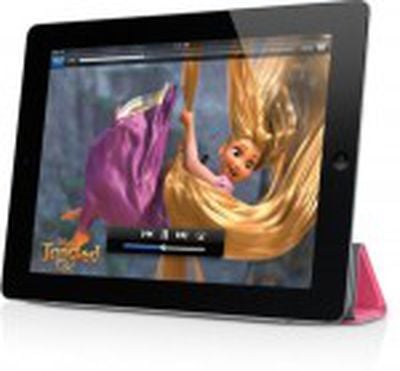
Last week, DigiTimesreported that Apple would be targeting shipments of 12-14 million iPad 2s during the third quarter of 2011, and a new report backs up that conclusion with claims that Apple's touch panel suppliers pushed out five million units in June and plan to produce another five million in July.
Five million touch sensors for the iPad 2 will be shipped in July, according to sources with Apple's supply chain.
Shipments in June were also five million, with TPK Holding and Wintek supplying 1.4-1.6 million units each and the remaining by Cando, Sintek Photronic and Chimei Innolux (CMI), the sources indicated.
Display production has been one bottleneck for Apple in meeting iPad customer demand, even dating back to the original iPad. Wintek and TPK were Apple's initial suppliers for the touch components, but the company was forced to add additional suppliers such as Cando in order to meet its production goals.
Apple has been said to be soaking up 60% of the global supply of touch panels for 2011, putting pressure on smaller manufacturers who are having a difficult time securing components for their own devices.
DigiTimes claims that Pegatron Technology has received orders for 15 million iPhone 5 devices from Apple and is set to start shipping in September 2011.
The sources pointed out that as the iPhone 5, which does not seem to have any major update from iPhone 4, is already set for shipment in September, they are already started supplying components to Pegatron with Pegatron's plants in Shanghai, China also recently started hiring for manpower.
DigiTimes is a frequent source for production and order rumors from Apple. They had previously predicted that Pegatron received an order for CDMA iPhone 4s for the fourth quarter of 2010. The actual Verizon (CDMA) iPhone was announced in January of 2011 and shipped the following month.
Apple skipped the usual yearly upgrade cycle this year and made no iPhone hardware announcements at this year's WWDC. Instead, the iPhone 5 has been rumored to be launching in September.
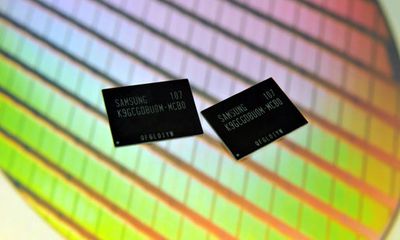
Mac Otakara claims that Apple will be adopting a new Toggle DDR 2.0 type of NAND Flash Memory for the basis of the new MacBook Air's SSD drive. The Japanese website cites an "Asian electronics component person" as the source of the information. (via AppleInsider)
Current SSD device Blade X-gale supporting SATA 2.6 will be abolished and new 19nm flash memory will be packaged into smaller chip and will be soldered on base circuit directly.
The move would be a rapid departure by Apple from the current SSD stick format that was just introduced in last year's MacBook Air. Instead of a replaceable part, the new Flash chips would be soldered directly onto the MacBook Air's motherboard.
The new format supports speeds of 400Mb/s and in conjunction with a new ONFI 3.0 standard will allow future controllers to run faster or similar performance to today's SSDs with "half the number of channels, providing both a cost and space savings".
Samsung also touted another major feature of this new technology last year, claiming that a low-power mode could extend a notebook's battery life for an hour or more.
The resulting power throttling capability enables the drive’s high-performance levels without any increase in power consumption over a 40nm-class 16Gb NAND-based 256GB SSD. The controller also analyzes frequency of use and preferences of the user to automatically activate a low-power mode that can extend a notebook’s battery life for an hour or more.
Given the market positioning of the MacBook Air, the potential battery improvements and cost savings may be driving Apple's adoption of this technology more than the performance advantages.
Last week we reported that there was no Welcome video that had become custom on new installations of Mac OS X. While that is technically true, it seems Apple has replaced it with a similar "Welcome" animation for some installations (presumably clean):
The intro animation similarly displays the word "Welcome" in a variety of languages, but no accompanying soundtrack. Beta testers of iOS 5 might find the animation familiar, as it is also the setup animation for iOS 5 on the iPad:
AT&T has informed customers that the iPhone (all models) will be eligible for their Mobile Insurance program starting on July 17th. AT&T's mobile insurance program offers protection against loss, theft, accidental physical or liquid damage and mechanical and/or electrical failure. The program costs $4.99/month and a $50 or $125 deductible for each claim depending on the particular model.
*Please Note: AT&T Mobile Insurance Update: Effective July 17, 2011, the Apple iPhone (all models) will be eligible for coverage with the AT&T Mobile Insurance program (formerly Wireless Phone Insurance). Enrollment restrictions apply. Customers can only enroll within 30 days of a new activation or upgrade, prior activations or upgrades outside of 30 days are not eligible.
AT&T has long treated iPhones differently than other devices on their network when it comes to insurance. The original iPhone was unable to be insured at all from AT&T. Then in 2010, AT&T partnered with an external company to offer more expensive coverage for the iPhone at $11.99/month and $199 deductible.
The choice of getting any insurance at all is always up for debate -- especially since Apple is known to replace accidentally broken and out-of-warranty iPhones for a flat $199 repair fee, though this doesn't cover loss or theft.
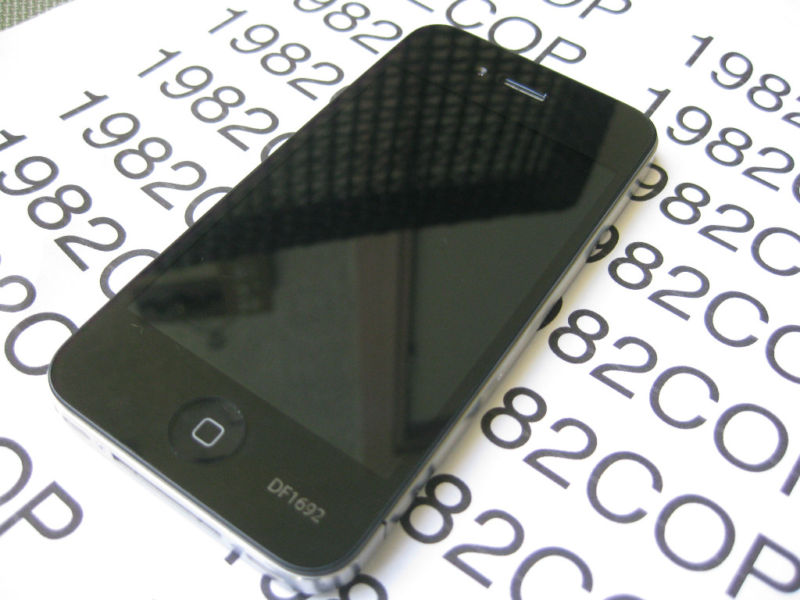
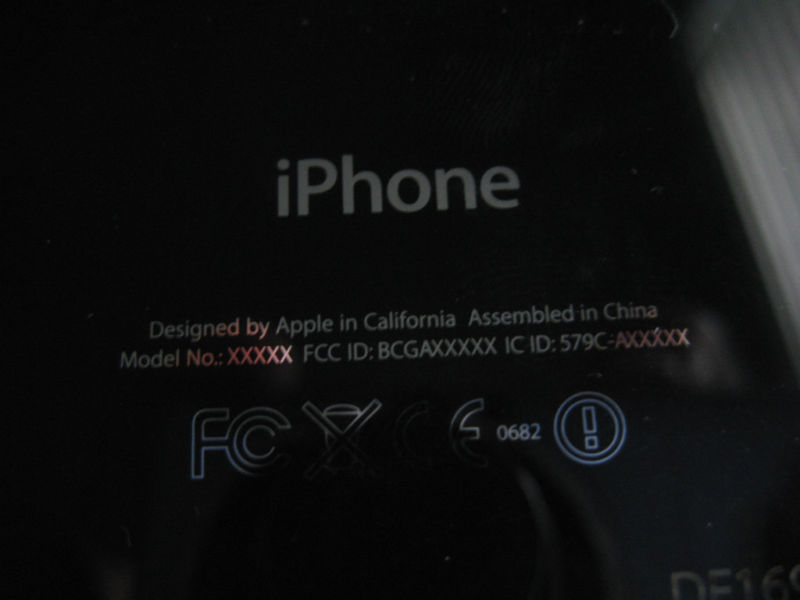
As noted by ThisIsMyNext, a prototype iPhone 4 appeared on eBay this weekend. This prototype iPhone 4 has many of the signs that it is a pre-release device. The volume buttons don't have the + and - markings as the production models have, and the FCC ID, Size and Model numbers are X'd out on the back casing. The eBay description details the findings:
1. iPhone has wear on the frame, some small marks on the rear cover, small marks on the screen. No cracks and no deep scratches. 2. Volume buttons don't have the usual + for upper button and - for lower volume button 3. Phone will not activate on at&t and when syncing with iTunes it says that this phone can not be activated with at&t sim card it won't activate (please review picture #10) 4. On rear cover Model No.: XXXXX FCC ID: BCGAXXXXX IC ID: 579C-AXXXXX (please review picture #8) 5. Front screen and rear cover has some type of numbers printed on the inside.
The iPhone 4 prototype is notable for being one of the most leaked Apple devices ever. A prototype of the device was said to be found in a bar, after which it was sold to gadget blog Gizmodo. The site then did a tear down and analysis of the device well before its launch.
Update: As is frequently the case with Apple prototypes appearing on eBay, the auction has been shut down.
Robert Cringely claims to have some details of the deals that were in place for the $4.5 billion acquisition of Nortel's patent portfolio. The patents were ultimately won by a consortium that included Apple. The auction drew interest of many of the major players in mobile today due to Nortel's large portfolio of Long Term Evolution (LTE, also known as "4G") related patents.
Reuters recapped some of the behind the scenes maneuvering amongst the players. The bidding began with 5 different parties: Apple, Intel, Google, a consortium of Ericsson, RIM, Microsoft and EMC, and a consortium led by RPX. As the bidding increased, partnerships formed and Apple joined up with the Ericsson/RIM/Microsoft/EMC consortium. Meanwhile, Intel partnered with Google whose bidding "tapped out" over $4 billion. The patents were ultimately won for $4.5 billion.
Cringely claims that within the consortium were different arrangements for each party. RIM and Ericsson reportedly put up $1.1 billion together and includes "fully paid up" license rights to the portfolio. Microsoft and Sony also put up another $1 billion with unspecified terms, while EMC contributed $400 million for a subset of patents.
Meanwhile, the largest contributor of the consortium was said to be Apple who put up $2 billion "for outright ownership of Nortel's Long Term Evolution (4G) patents as well as another package of patents supposedly intended to hobble Android." Apple obviously has a large interest in LTE/4G for future iPhones and iPads. Apple recently settled with Nokia and agreed to a license of their patents for use in Apple's mobile devices. Nokia is also said to have a significant number of LTE related patents. Ownership of such patents could give Apple leverage and/or provide licensing fees from other mobile manufacturers that offer LTE technology.
With Apple having seeded the Golden Master (GM) version of OS X Lion earlier today, users are finally getting a look at what the OS X Lion experience should be like in the shipping version.
One staple of Mac OS X installations over the past several versions has been the welcome video that displays at first boot, displaying an animation of the word "Welcome" in a number of different languages and set to the song "Exodus Honey" by Honeycut [iTunes link]:
Unfortunately for fans of the video, neither the previous welcome video nor a new one appears to be included in the GM version of OS X Lion. While a welcome video could conceivably still be added at the last minute, previous OS X releases have seen the video included in GM seeds.
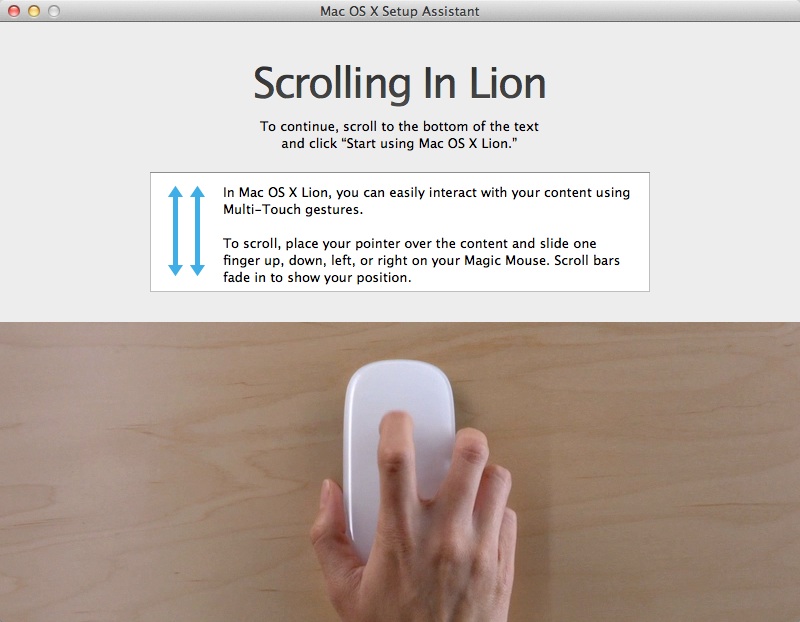
Instead, OS X Lion boots straight into Setup Assistant to help users get up and running. And one new addition to Setup Assistant is an introduction to Multi-Touch scrolling, offering users a glimpse at the enhanced Multi-Touch features included in the new operating system.
The text and image are customized depending on the input device being used, such as a Magic Mouse or built-in trackpad.
OS X Lion is set to be released to the public later this month and will be available exclusively through the Mac App Store for $29.99.
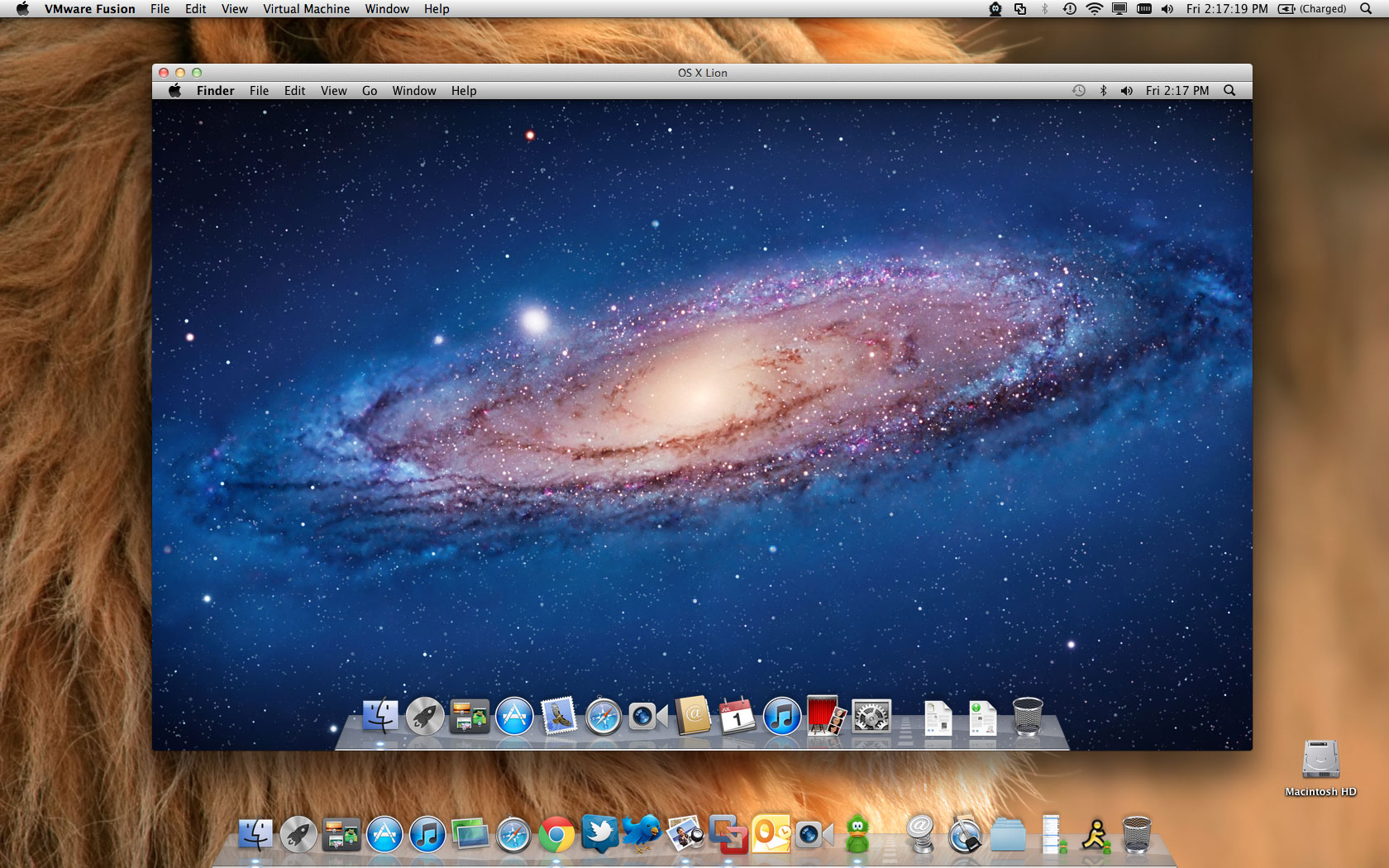
For the first time, Apple is allowing owners of OS X (client version) to run multiple virtual copies on the same machine. Previously, Apple extended this ability to Mac OS X Server only. Running separate instances of Mac OS X should be possible under virtualization solutions such as VMware Fusion and Parallels. This functionality allows you to deploy different sandboxed installations of OS X, typically for enterprise purposes. As reported in 2007, Apple first extended this capability in Mac OS X Server 10.5:
[The 2007 Mac OS X 10.5 Server EULA] permits OS X Server to run in a virtual machine (VM) as long as each VM is stocked with a different license and the physical system is Apple-made. The new rules don't apply to the client edition of Apple's operating system, which is still barred from being virtualized.
The Golden Master version of OS X Lion (10.7) just released to developers includes the final end-user licensing agreement (EULA) which reveals that users can run up to two additional instances of OS X Lion on their same machine without a need for extra licenses. From the 10.7 EULA:
(iii) to install, use and run up to two (2) additional copies or instances of the Apple Software within virtual operating system environments on each Mac Computer you own or control that is already running the Apple Software.
The shift in policy likely reflects the blurred distinction between OS X Server and OS X Client starting with Lion. OS X Server will be sold as an App Store add-on pack for OS X Lion.
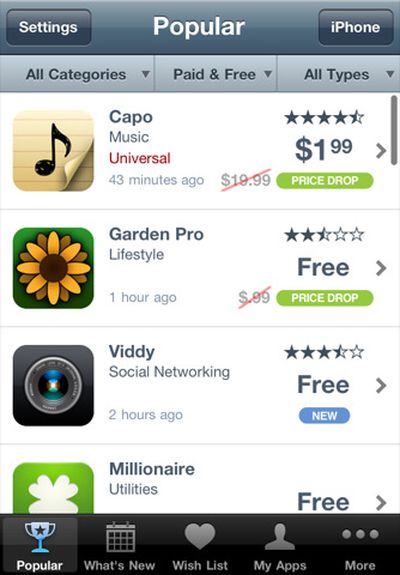
Heading into the 4th of July weekend, many developers are using the holiday as an excuse to cut prices on their Apps. Prominent developers such as EA and Gameloft are amongst the participants. A running list of all App Store price drops can be seen here.
Meanwhile, sister site AppShopper.com, which tracks all App Store sales and updates, has updated their iOS App with a number of new features, including App Store ratings, and links to 3rd party reviews.
- Top 200 rankings - App Ratings - Links to 3rd party app reviews - Automatically loads apps when scrolling to the bottom of a list - New filters for search - Email notification settings - Disable push notifications during certain times of the day - In-app AppShopper account registration - Share an app’s info via Twitter, Facebook, email and more - Various bug fixes
The AppShopper app is available for free in the App Store [Link].
Yesterday, we noted that Apple's new rules for in-app purchases and subscriptions for iOS were going into effect, and certain high-profile apps such as Amazon's Kindle app had yet to be updated to comply with the new terms. But with the calendar now having rolled over to July 1st and Kindle and other similar apps still apparently out of compliance, some have been wondering what Apple's plans are.
Macworld now reports that Apple is indeed planning to enforce the requirements, but has provided some additional time as it works with some high-profile developers to ensure that their apps are updated.
Macworld's sources can confirm that Apple has been working with various prominent developers to help them ensure their apps comply with the in-app content policies; expect to see updates to these apps in the near future.
Some less prominent apps will likely be pulled from the App Store as Apple starts to enforce the rule changes, but developers ought to be able to return to the store simply by updating their apps to comply.
Last week, Hulu updated its Hulu Plus application to comply with Apple's new rules by removing an external link to sign up for the subscription service. And Macworld notes that Netflix appears to have complied by leaving in a notice about visiting Netflix.com to sign up for the service but formatting it as plain text rather than a link. And earlier today, The New York Timesactivated in-app subscriptions for its content.
Apple appears almost ready to released OS X Lion to the general public. A Golden Master (GM) release of OS X Lion was seeded to developers this afternoon, with a build number of 11A511, according to 9to5Mac.
A GM release is typically the final build before a piece of software ships to consumers. If no major bugs are found, Lion should be ready for customers. Rumors have suggested that Apple has been waiting for OS X Lion to reach its final state before launching new MacBook Airs. The new MacBook Airs are also expected in July.
Update: Apple has also seeded a GM version of the OS X Lion Server components, Xcode 4.1 Developer Preview 7, and iCloud for OS X Lion Beta 3. Finally, Apple has pushed out a Java for Mac OS X 10.7 release via Software Update.
Update 2: 9 to 5 Mac is reiterating its earlier claim that Lion is tentatively scheduled to launch on Thursday, July 14th, potentially alongside the updated MacBook Air.
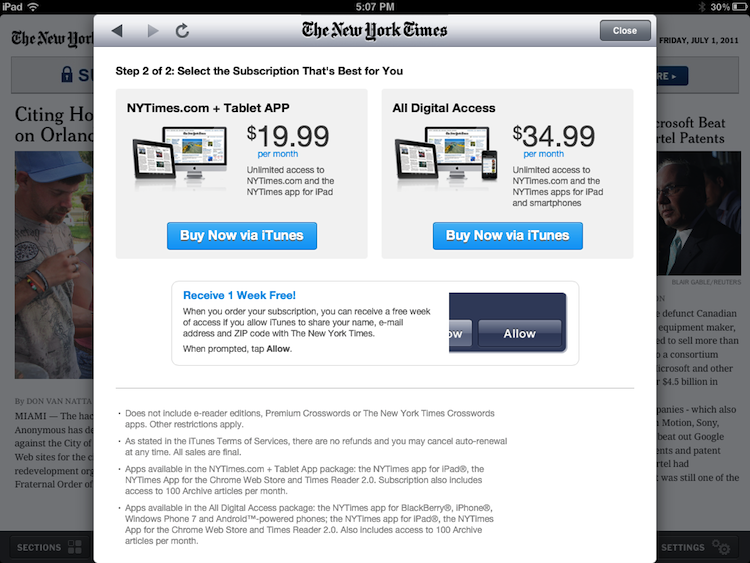
The Times is now the highest profile app to work with Apple's requirements surrounding subscriptions. Current NYT subscribers can login and access their content, and non-subscribers can quickly sign up using their iTunes accounts.
For new users signing up through the app, the Times is charging $14.99/month for NYTimes.com + iPhone App access, $19.99 for website + iPad, and $34.99/month for website + iPhone + iPad. Apple will receive a 30% cut of these subscriptions.
These prices are similar to those offered via the Times website, though NYTimes.com offers a $0.99 promotional price for the first month. In-App subscribers will receive a week-long subscription for free if they share their name, email address and ZIP code with the Times.
Though the deadline for compliance with the new In-App Subscription guidelines came and went yesterday, Apple is reportedly helping developers update their apps to work within the guidelines and allowing some additional time for them to come into compliance.
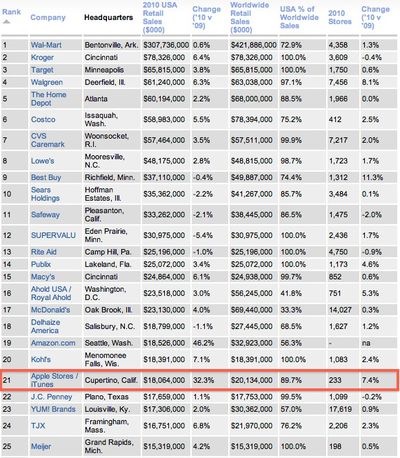
In its annual ranking of the largest retailers by U.S. sales, the National Retail Federation has pegged Apple in 21st place in 2010 with over $18 billion in sales between its retail and iTunes stores (via The Next Web).
Apple's retail sales grew 32.3% year-over-year in 2010, second only to Amazon's 46.2% growth among the top 100 U.S. retailers. Interestingly, Apple's $18 billion in U.S. sales places the company one spot ahead of department store chain J.C. Penney, which will soon be led by current Apple retail store chief Ron Johnson.
The National Retail Federation's 2009 rankings published last year had Apple in 53rd place with only a little over $6.5 billion in sales. Those numbers would put Apple's annual growth at 175% instead of 32.3%, and thus it is unclear if something has changed in the methodology of the rankings or if there is an error in the data for Apple.
Update: We have heard back from the National Retail Federation, which reports that the methodology for Apple has indeed changed between 2009 and 2010. The new numbers include iTunes Store sales and direct-to-consumer sales through apple.com, whereas the previous numbers had excluded those sales. Consequently, the 32.3% annual growth is calculated as if iTunes and apple.com sales had been included in the 2009 data.
Adobe today announced a new "switcher" promotion clearly designed to take advantage of the significant amount of criticism being levied against Apple's new Final Cut Pro X. The new program offers a 50% discount on either Creative Suite CS5.5 Production Premium or Premiere Pro CS5.5 to current users of Apple's Final Cut Pro or Avid's Media Composer. Certain current Adobe users are also eligible for the promotion.
"We're hearing from video professionals that they want pro level tools that address cutting edge work but also allow them to use legacy footage and workflows," said Jim Guerard, general manager and vice president of professional video and audio, Adobe. "At Adobe we've been in the trenches with video pros for years and with Adobe Premiere Pro CS5.5 and CS5.5 Production Premium we've delivered professional-grade tools that are already being battle-tested by some of the most innovative filmmakers, broadcasters and video pros."
Adobe's switcher program is limited to commercial customers and is valid through September 30th.
Avid has also taken advantage of Apple's issues, once again offering Final Cut Pro users more than 50% off of its Media Composer software, pricing it at $995 compared to the usual $2,295 download price and $2,495 boxed price. The discounted pricing is available for existing pre-Final Cut Pro X users.
We are listening. And one of the things you have clearly said is that you want Media Composer to be more accessible. In response to your feedback, we are extending the cross-grade to Media Composer - through September. Final Cut Pro (excluding FCP X) users can get Media Composer 5.5 at the promotional price of $995 USD. You can order the cross-grade as of next Tuesday, July 5th.
Avid had offered the crossgrade promotion from mid-April through June 17th after Apple took over the Final Cut Pro User Group SuperMeet at NAB to preview Final Cut Pro X, kicking out Avid and other sponsors of the event in order to have the stage for itself. Avid's decision to renew the crossgrade the program through September is clearly an effort to attract Final Cut Pro users disappointed in the official release of Final Cut Pro X.
DigiTimes reports that upstream suppliers in Apple's manufacturing chain have been given orders to begin preparing for production of next-generation iPhone and iPad models, with a debut expected in the September-October timeframe.
Taiwan-based companies included in the supply chain for iPhone 5 and iPad 3 have begun to prepare materials for the production of the two devices, which are likely to make their debuts in September and to hit the market in October, according to industry sources. ... The sources pointed out that Apple only plans to launch one model of the new iPhone, while iPad 3 has just recently been added to the production schedule with both set to be produced in small volumes in August and the volume will start picking up in September and October.
While Apple has been widely rumored to be preparing to launch its next-generation iPhone within that timeframe, a new iPad has been a controversial topic. A number of sources have reported that Apple may introduce an updated iPad just months after the release of the iPad 2 as the company seeks to maintain its stranglehold on the tablet market in the face of rapidly-increasing competition, but those claims have been met with skepticism by others expecting Apple to roughly stick to its usual annual update cycle.
According to today's report, the new iPad will likely be thinner and lighter than the current iPad 2 and will support a display resolution of approximately 250 dpi, which would be double that of the iPad and iPad 2.
Nortel announced that they had concluded an auction to sell of its patents and patent applications to a consortium consisting of Apple, EMC, Ericsson, Microsoft, RIM and Sony. The final winning bid was $4.5 billion and includes over 6,000 patents and patent applications covering wireless, 4G, networking optical, voice internet, semiconductors and more.
"Following a very robust auction, we are pleased at the outcome of the auction of this extensive patent portfolio", said George Riedel, Chief Strategy Officer and President of Business Units, Nortel. "The size and dollar value for this transaction is unprecedented, as was the significant interest in the portfolio among major companies around the world."
We had previously reported that Apple had been interested in buying up the patents off Nortel Networks which had filed for bankruptcy in 2009. The interest in the portfolio was significant due to the broad reach of the patents, especially in the area of wireless networking and LTE technology. Google was also said to be one of the early interested parties by placing an opening bid of $900 million on the patents.
One research firm has estimated that there are 105 patent families deemed essential to deployment of LTE (4G) technology, with Nokia controlling 57 of those families. Ericsson is said to control 14 families, while Nortel, Qualcomm, and Sony are each reported to control about seven families. The companies that are part of the winning bid will presumably provide access to these patents to those companies.
During the keynote address at Apple's Worldwide Developers Conference earlier this month, Phil Schiller noted that Apple's Mac App Store, launch in early January, has rapidly risen to become the top selling distribution channel for computer software, beating out Best Buy, Walmart, and Office Depot. According to Schiller:
In the last six months, something incredible has happened. In the last six months, the Mac App Store has now become the #1 PC software channel for buying software. That's incredible.
But questions have remained about just how successful the Mac App Store has been, given the smaller installed base compared to iOS and long-standing alternative methods for purchasing software.
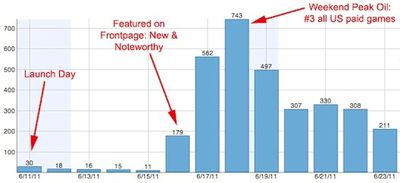
Developer Martin Schultz has, however, now provided a look at sales figures for his Hard Rock Racing app, which managed to peak as the #3 paid game and #14 overall paid app in the U.S. earlier this month after being featured by Apple in the "New and Noteworthy" section on the front page of the Mac App Store. According to Schultz, that stellar ranking translated into only 743 sales on the peak day.
While that one-day performance resulted in a solid $2,500 payday for Schultz after Apple's 30% cut of revenue, it's clear that Mac App Store sales fall far short of those seen for iOS apps. We spoke with John Casasanta of iOS developer taptaptap, who shared that his Camera+ application typically pulls in 8,000-12,000 downloads per day when it is ranked around #14 in the overall paid apps for the iOS App Store. Of course, 743 sales on peak day may be better than Schultz might have done through traditional channels or direct online sales. The average sales price for iOS apps also appears to be much lower than Mac Apps, which may also contribute to the volume discrepancy.
Apple is of course working hard to drive adoption of the Mac App Store, opting to distribute its forthcoming OS X Lion exclusively through the store. The company has also released its new Final Cut Pro X apps and other titles such as Aperture, iWork, and iLife through the store. With the Mac App Store set to take on an even larger role in OS X Lion with the addition of such features as in-app purchases and push notifications, Apple is clearly pushing forward in its attempts to replicate the success of the iOS App Store on the Mac platform.


 Last week, DigiTimes reported that Apple would be targeting shipments of 12-14 million iPad 2s during the third quarter of 2011, and a new report backs up that conclusion with claims that Apple's touch panel suppliers pushed out five million units in June and plan to produce another five million in July.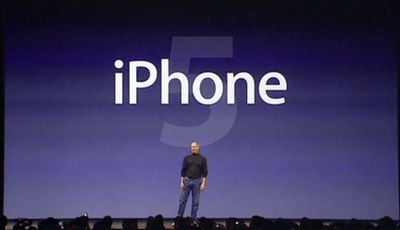



 Yesterday, we
 Adobe today
  Avid has also