Apple today released Aperture 3.0.1, addressing several issues with the latest version of its professional photo editing and management application released earlier this month.
This update improves overall stability and addresses a number of issues in Aperture 3, including:
- Upgrading libraries from earlier versions of Aperture - Importing libraries from iPhoto - Importing photos directly from a camera - Memory usage when processing heavily-retouched photos - Face recognition processing - Adding undetected faces using the Add Missing Face button - Printing pages containing multiple images - Printing photos and contact sheets with borders and metadata - Editing photos using an external editor - Display of images with Definition and Straighten adjustments applied - Zooming photos in the Viewer and in the Loupe using keyboard shortcuts - Accessing Aperture libraries on a network volume Selecting and moving pins on the Places map - Adding and editing custom locations using the Manage My Places window - Switching between masters when working with RAW+JPEG pairs.
Full release notes for the update, which weighs in at 29.41 MB and requires Aperture 3 and Mac OS X 10.5.8 or 10.6.2, are also available.
Apple yesterday began promoting on its home page the release of its annual Supplier Responsibility progress report, describing the company's commitment to responsible business practices on the part of its suppliers and other partners around the world.
Apple requires suppliers to commit to our comprehensive Supplier Code of Conduct as a condition of their contracts with us. We drive compliance with the Code through a rigorous monitoring program, including factory audits, corrective action plans, and verification measures.
Among the key highlights touted in the report is Apple's commitment to audits of its suppliers. The company reports having audited 102 facilities in 2009, up from only 39 just two years ago, and has trained over 133,000 workers, supervisors, and managers on such topics as workers' rights and management responsibility. Apple notes that representatives of most of the audited facilities have reported that Apple is the only company to have audited them regarding supplier responsibility.
Apple also notes that is has developed thorough guidelines in seven areas (Dormitories, Juvenile Worker Protections, Medical Non-Discrimination, Pregnancy Non-Discrimination, Prevention of Involuntary Labor, Wages and Benefits, and Working Hours) clarifying how suppliers can meet the standards outlined in the company's code of conduct.
According to the report, Apple in 2009 found a total of 17 instances of what it considers "core violations" of its code of conduct, representing about 2% of core issues assessed by its auditors. The violations involved such incidents as overcharging of agency recruitment fees to employees, hiring of underage workers, improper disposal of hazardous waste, and falsification of records related to underage labor and working hours, and in each case Apple reports having worked with the suppliers to address these issues.
As Apple's business has grown, the company has come under increasing scrutiny for the practices of its suppliers and manufacturing partners. The apparent suicide of a Foxconn employee who lost an iPhone prototype and a more recent report on the security at Apple's partners' facilities including a description of the physical assault of a reporter outside a Foxconn compound have added to the publicity surrounding Apple's control over its partners, increasing the need for the company to visibly share the steps it is taking to ensure compliance with company standards.
Just days after Apple removed over 5000 "overtly sexual" applications from the App Store, the company appears to have taken a curious turn that could result in the reinstatement of many of these applications.
Cult of Mac reports and MacRumors has confirmed that Apple has added a new "Explicit" category in the iTunes Connect system for App Store submissions. The category is included in drop-down menus that allow developers to select categories for their applications to be placed in, and appears alongside the traditional App Store categories such as "Books", "Entertainment", and "Games".
The reason for Apple's addition of the new category is unknown, although it seems possible that the company may have reconsidered its decision to remove the "overtly sexual" applications in the face of backlash from developers and users and has decided to create a dedicated category in an attempt to find a middle ground in the controversy. The use of a dedicated category for explicit material could supplement the age-rating system used for all App Store applications to easily make the entire category invisible to certain users using Parental Controls.
Update: Gizmodo reports that the "Explicit" option is no longer appearing as a category option in iTunes Connect. It is currently unknown why it appeared only briefly today and whether it will return in the future.
According to the developer, Apple said that, while they are thinking about it, "it's not going to happen anytime soon."
Today marks MacRumors.com's 10 year anniversary. It's a shocking realization that I've been doing this now for a decade. For those unfamiliar with the history of the site, I started it as a hobby back in early 2000 as a place to consolidate interesting news and rumors about Apple. I was finishing my 4th year of medical school at the time and kept the site running as I completed my medical training. But it wasn't until July 2008 that I finally gave up medicine to go full time.
With the growth of Apple, and success of their products, the interest in Apple rumors has grown substantially in the past few years, and MacRumors is stronger than ever. I feel the main strength behind MacRumors beyond tracking rumors has always been the community and discussion about the latest news and happenings. I hope to emphasize that more in the future and continue to build on our strengths.
So, thanks to our readers, staff and volunteers who have made 10 years possible.
Unfortunately, we already know how this story ends. Apple introduced the iPad in late January and made no mention of a camera - either on the front or back of the device. So that means no video conferencing or even photos are possible on the first generation device.... and yet, it seems like they had everything in place for it already. For example, the enclosure has an empty space for the camera and the SDK has accept/decline video chat references.
Here are some even more tantalizing pieces of information found in the latest Beta 3 iPad SDK. We've been told that if you go digging into Apple's private framework which controls the camera, the iPad SDK tests for 3 additional camera characteristics that are not found in the iPhone 3.x SDK. For comparison, Erica Sadun has a code listing of iPhone 3.x PLCameraController.h on her site. The Beta 3 iPad SDK version adds these additional test conditions for the device's capabilities.
It seems Apple built in API support to test to see if your iPad had a Front Facing Camera, Zoom and a Camera Flash. The front facing camera would, of course, be used for video chat, while Zoom and Camera Flash are often requested features for the iPhone's camera.
Further investigation (via 9to5Mac) even reveals the following icons which clearly show an interface to accept or decline a video chat:
Given the size of these buttons, they were intended for use on the the iPad's screen rather than the iPhone. We're not sure why these features were dropped on the first version of the iPad, but we hope to see it again in future versions of the iPad or even iPhone.
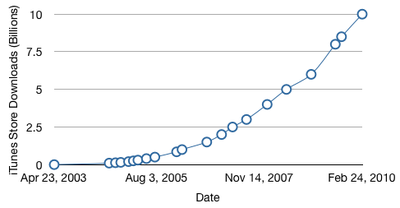
Apple's iTunes Store today reached 10 billion music downloads since its inception in 2003, and along with the milestone comes the end of the company's "Countdown to 10 Billion Songs" promotion. The winner of the promotion, who is yet to be announced, will be awarded a $10,000 iTunes Store gift card.
Apple Chief Operating Officer Tim Cook today participated in a Q&A session at the Goldman Sachs Technology & Internet Conference, and while he did not offer any major revelations, some of his comments offered a bit of perspective on Apple's business, including comments on the Apple TV, iPad sales channels, exclusive carrier relationships, and other topics. Here is a paraphrased summary of some of the key points:
Q: Where do you see things going with the Apple TV? A: It's still a hobby, but our gut tells us there's something there. The go-to-market model is difficult, and we have no interest in being in the TV market. But we have continued to invest in the Apple TV and will keep doing so.
Q: Are all pieces of the iPhone OS platform complete or is there more to come? A: The word "complete" isn't in our dictionary. We're always innovating and always looking to obsolete ourselves. The ecosystem and platform are really good, and the foundation is in place, but clearly it will continue to get better.
Q: How will you sell the iPad? A: We'll start with Apple's direct channels, such as online, retail, education, etc. We'll also pursue indirect sales channels like Best Buy's store-in-a-store concepts. Internationally, we have a very good premium reseller program that we'll also use. Over time, sales channels will expand.
Q: What are the advantages and disadvantages of Apple's exclusive relationship with AT&T for iPhone and iPad? A: Simplicity, and the ability to work with the carrier on new features such as visual voicemail on original iPhone. For multi-carrier models, in some countries, carriers have very "sticky" relationships with customers and thus a multi-carrier model greatly enhances potential sales. In Apple's top ten iPhone countries last year, five were single-carrier countries. Three were by contract, and two were by choice where we could add additional carriers at any time. In 2009, we added carriers in France, UK, Singapore, Scandinavian countries, Canada. In every single country, our units increased significantly. So we made really good decisions. But I'm not saying it would be the case in every country. We look at things on a country-by-country basis.
Q: Would other carriers have to match AT&T's pricing on the iPad service to even have a shot? A: AT&T's pricing is truly revolutionary. But I wouldn't want to speculate on what someone else might have to do to join the party.
Q: Where do you see retail store expansion going? A: Early on, we set a range of 25-50 new stores per year as our goal. We've been at the high end of that range and the low end, but we like that pace. In 2008, the world started to fall apart with the economy. We thought it would be better to slow down and wait for great properties to come on the market. That did happen, and we're ready to take advantage. We're turning the dial back up and will be near the high end of the range this year.
Q: Why did you launch your own processor for the iPad? What was missing? A: Apple has for years been in the silicon design business. On PowerPC, Apple always personally crafted the northbridge and southbridge chipsets. It's not new to us. For the iPad, we felt we had the best knowledge of what we wanted the silicon to do and were in the best position to do it ourselves rather than going to someone else offering something that wasn't really exactly what we wanted. At the end of the day, we want to make the world's best products. By doing it ourselves, we were putting ourselves in the best position to do so.
Q: How would you describe your corporate acquisition strategy? A: Technology and talent. Typically small companies. We've looked at big companies, but nothing has totally fit. If we find a large one, we won't be shy about it, but we won't do it to do it. We're not about having the highest market share or revenue...we want to make the best products. Acquiring a company simply to boost our revenue wouldn't be something we'd consider.
Q: Is there a chance of hubris creeping into the company? A: People are our number one asset, and the executive team spends a lot of time thinking about recruiting and retaining great talent. We've said no to a lot of good products, great products even, in order to remain focused. That focus is so ingrained that the management team would never let hubris take hold. That's not what we're about. Focus on people and ensure that it's a small list of things to work on. That's the magic behind us.
While this shouldn't be much of a surprise to most, Apple has confirmed that the iPad uses the same family of graphics chip as the iPhone and iPod Touch. According to reports, Apple's latest iPad SDK Beta 3 documentation confirms this, though falls of short of detailing exactly which chip it is:
Using OpenGL ES on iPad is identical to using OpenGL ES on other iPhone OS devices. An iPad is a PowerVR SGX device and supports the same basic capabilities as other SGX devices. However, because the processor, memory architecture, and screen dimensions are different for iPad, you should always test your code on an iPad device before shipping to ensure performance meets your requirements.
There was some confusion about the actual hardware that Apple had used due to an erroneous report by Bright Side of the News which claimed that Apple used a far less powerful ARM-based GPU.
Apple is a licensee and major investor in Imagination Technologies who creates the PowerVR SGX chips and has used them throughout the iPhone and iPod Touch designs. Apple's new A4 chip from Apple incorporates both the ARM processor as well as the PowerVR SGX GPU in a single chip.
Apple today released an update to its iPhone SDK 3.2 for developers looking to create applications for the company's forthcoming iPad tablet device. The new update is the third beta version of the SDK, and there is no word yet on changes included in the update.
The initial version of the SDK was released late last month alongside the iPad introduction, and was last updated two weeks ago.
Update: Apple appears to have pulled the Beta 3 release, and several readers who were able to download the update before it was removed have reported that it contains a major bug that is the likely cause of the removal.
Update 2: 9to5mac posts a screenshot of the Photos app which is now included:
Update 3: Mac4Ever notes that the Photo app also has a Camera tab, which we've seen before referenced in the iPad SDK.
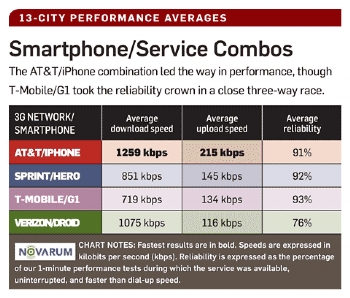
PCWorld reports on the results of its recent 13-city performance tests of wireless carriers in the United States, and Apple's iPhone partner AT&T came out well ahead of the pack in both upload and download speeds while also faring well in reliability.
After registering the lowest average download speeds in our 3G performance tests last spring, AT&T's network turned in download speeds that were 84 percent better than the numbers from eight months ago; in our latest tests, AT&T's download speeds were 67 percent faster on average than those of the other three largest U.S. wireless providers--Sprint, T-Mobile, and Verizon.
In looking specifically at the iPhone, AT&T again fared well compared to flagship handsets on other carriers, offering significantly higher download and upload speeds with 91% reliability, only marginally lower than the G1 on T-Mobile and the HTC Hero on Sprint.
AT&T's efforts to address performance issues in the New York City and San Francisco markets also appear to be paying off, with PCWorld's testing revealing average download speeds tripling over a previous survey in New York City and jumping 40% in San Francisco.
Overall reliability also improved for AT&T, with successful connections achieved on 94% of attempts, up from only 68% on the previous survey and on par with results for Sprint and ahead of T-Mobile and Verizon on an overall basis. PCWorld's testing did, however, reveal significant reliability weaknesses in San Francisco, with only 55% of connections being successful in its smartphone testing.
Complete data and analysis is available in the article, which covers results from twenty locations in each of thirteen cities: Baltimore, Boston, Chicago, Denver, New Orleans, New York City, Orlando, Phoenix, Portland, San Diego, San Francisco, San Jose, and Seattle.
Fidelity Investments today announced the release of a new, free iPhone application allowing brokerage customers to monitor their portfolios and execute trades directly from their iPhone or iPod touch.
"At Fidelity, we recognize the growing popularity of the iPhone and iPod touch, and in fact, nearly half of the customers using our current mobile trading application, Fidelity Mobile, log in from an iPhone," said James C. Burton, president of Fidelity's retail brokerage business. "Our new app takes full advantage of the revolutionary technologies of iPhone and iPod Touch to allow us to deliver powerful trading and account management services in a very user friendly format."
With the new app, customers can also access their Fidelity account information and watch lists; stay updated on domestic and world markets via up-to-the-minute news; receive real-time quotes; and compare the performance of multiple stocks all on one screen with interactive charting capabilities.
Fidelity customers using the new iPhone application to manage their accounts can take advantage of the company's new $7.95/trade pricing and also engage in commission-free trading of 25 iShares exchange-traded funds. Users who are not Fidelity customers can access most of the application's functions, including charting, market research, stock watch lists, and news feeds.
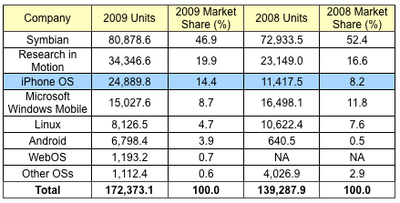
Earlier this month, research firm IDC released sales figures for 2009 showing Apple holding 14.4% of the smartphone market for the year on nearly 82% sales growth over 2008, with the company grabbing third place among smartphone vendors behind Nokia and Research in Motion.
Gartner today released similar results taking a slightly different look at its data by opting to rank smartphone sales by operating system rather than handset manufacturer. Gartner's data for Apple is consistent with IDC's for 2009, showing the iPhone OS holding third place with a 14.4% share, but Gartner's data more clearly shows the significant-but-slipping lead held by Symbian OS, as well as the iPhone's surge past a slumping Windows Mobile. The data also reveals tremendous growth from Android in 2009, surging more than tenfold in unit sales to grab nearly 4% of the smartphone market.
Worldwide Smartphone Sales in 2009 in Thousands of Units (Source: Gartner)
Gartner also presented data for worldwide sales of all mobile phones for 2009, which came in at over 1.2 billion, down slightly from 2008. But with smartphone sales accounting for only 14% of the total market and the iPhone holding only 14% of that smaller market, Apple was unable to break into the top five total mobile phone vendors.
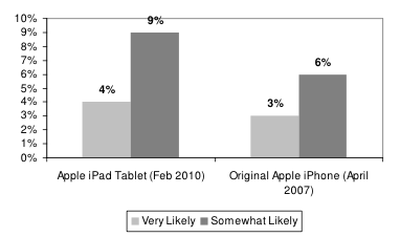
In research note released this morning, RBC Capital Markets analyst Mike Abramsky shares the results of a ChangeWave survey of over 3,200 respondents earlier this month revealing pent-up demand for Apple's forthcoming iPad, with demand even exceeding that for the original iPhone in 2007. According to the survey, 13% of respondents are either somewhat or very likely to purchase an iPad, compared to only 9% in a similar survey conducted prior to the launch of the original iPhone.
Percentage of respondents likely to buy iPad (Feb 2010) and iPhone (Apr 2007)
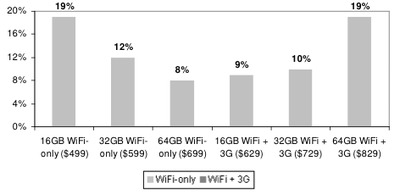
The survey also provides an interesting glimpse at model preferences for potential iPad buyers, with the highest percentages of buyers planning to purchase the low-end 16 GB Wi-Fi-only model at $499 and the high-end 64 GB Wi-Fi + 3G model at $829. Demand for the various capacities among the two iPad lines clearly shows opposing relationships, with budget-conscious customers focused on the Wi-Fi-only model opting for only 16 GB of storage while those springing for the added 3G connectivity are also preferring to max out on storage at 64 GB.
Model preferences for potential iPad buyers
The report also notes that only 8% of customers have balked at iPad pricing, significantly lower than the 28% who were unwilling to pay Apple's prices for the original iPhone prior to its launch.
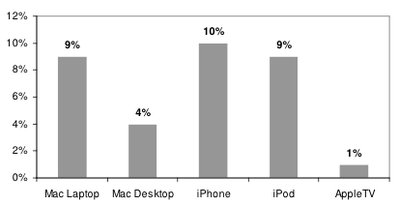
In examining probable cannibalization of existing Apple products, the RBC/ChangeWave survey found 25% of respondents planning to delay purchasing one or more other Apple products in favor of obtaining an iPad, with the iPhone, iPod, and Mac notebooks all seeing potential hits in the 9-10% range. Cannibalization appears significantly lower for Mac desktop machines and the Apple TV.
Percentages of planned iPad buyers delaying purchases of other Apple products (Sums to 33% due to some respondents delaying purchase of more than one product)
While the survey results suggest possible strong early adoption of the iPad and upside compared to previously-estimated customer purchasing plans, RBC continues to predict a base case of five million iPads sold for calendar year 2010, adding $2.4 billion in revenue and an additional $0.33 per share of earnings to Apple's bottom line.
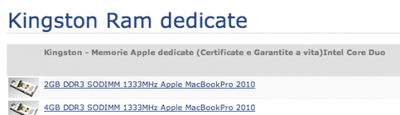
ThesMac.gr(translation) claims that they have spotted evidence of new memory modules marketed for the upcoming "MacBook Pro 2010".
The site doesn't list the source for the image, though a quick search shows a site called Adl.it listing the same part. The same parts were spotted at Kingston last week but were not labeled as "MacBook Pro 2010" modules at the time. The "MB" part numbers, however, do match up with Kingston's other MacBook RAM parts.
While new MacBook Pros are expected, there are a few inconsistencies in the listings that make them hard to take at face value. The photo above labels the processor as the outdated Core 2 Duo. Also, the bus speed of 1333MHz doesn't really match up with the expected processors to be found in the MacBook Pro. Still, the part numbers seem real and have been propagated to other resellers.
Apple is widely expected to launch new MacBook Pros any day now.
The NY Times reports on Apple's new policy blocking overtly sexual apps. Apple's head of worldwide product marketing Phil Schiller explained the reasoning behind the decision, citing an increasing number of apps with objectionable content:
"It came to the point where we were getting customer complaints from women who found the content getting too degrading and objectionable, as well as parents who were upset with what their kids were able to see," Mr. Schiller said.
When asked about the needs of the developers who were affected by the policy shift, Schiller said that while they cared about developers, in the end "have to put then needs of the kids and parents first". Analysts suspect the upcoming iPad was in part a reason for the policy change. The iPad is expected to be popular amongst families and schools which could object to such applications.
Schiller does explain that well established brands are given a pass such as Sports Illustrated's Swimsuit app or Playboy's app:
"The difference is this is a well-known company with previously published material available broadly in a well-accepted format"
Just a day after Apple released a pair of new iPhone commercials, a third ad entitled 'Family Travel' has begun airing on television and been posted to the company's ad gallery.
Although the new ad returns to Apple's common theme of featuring individual iPhone applications, it is notable because it utilizes a female first-person narration rather than the standard male voice-over used for Apple's other commercials of this type in the past. The new ad features three App Store applications plus a clip of the Pixar film Finding Nemo shown accessed through the built-in iPod application in a narrative of a family heading to the airport for a trip. Featured applications include:
TechCrunch reports that iPhone game developer has secured $25 million more in venture capital funding and has also acquired Freeverse for an unspecified price.
Freeverse began as a Mac shareware company in 1994 and has since expanded to other platforms. Their iPhone division has been particularly successful with a number of top hits including Skee-ball, Flick Fishing and Days of Thunder. Meanwhile, Ngmoco was one of the original iFund funded iPhone startup companies that has focused on iPhone gaming. They have recently made the switch over to a "freemium" model in which they give their games away and make their money on in-app purchases. Games such as Eliminate Pro and Touch Pets Dogs have seen success with this model.
Computerworld points to an Apple job listing posted last week which suggests that Apple is looking to expand the iPhone OS beyond the iPhone, iPod touch, and iPad to additional platforms. The position, entitled "Engineering Manager (Platform Bring-Up)", requires that the employee lead a team of software engineers working with hardware and "custom silicon" teams on new platforms and protoypes.
The Core Platform team within Apple's Core OS organization is looking for a talented and inspired manager to lead a team focused on bring-up of iPhone OS on new platforms. The team is responsible for low level platform architecture, firmware, core drivers and bring-up of new hardware platforms. The team consists of talented engineers with experience in hardware, firmware, IOKit drivers, security and platform architecture.
The report suggests a number of products, both existing and merely envisioned, that could benefit from an ARM-based architecture and iPhone OS, including Apple TV, MacBook Air, enterprise-class Time Capsule micro-server offerings and others.
Two years down the road, other low ends of the Apple Mac line might get eaten up by the Apple processor/iPhone OS. Mac Mini and Mac Book, I am looking directly at you. Once there is an iPhone OS running the TV and the MacBook Air segments, it isn't a great leap to expect to see it in low end Macs.
Obviously any such suggested offerings are based purely on speculation, but it seems clear that Apple is interested in leveraging iPhone OS and its hefty investment in ARM architecture for future products.