Research firm IDC yesterday released results for global mobile phone unit sales in the third quarter of 2010, highlighting Apple's leap into the top five vendors to grab the fourth spot behind Nokia, Samsung, and LG, and ahead of Research in Motion.
Apple leapt ahead of several vendors in 3Q10 including RIM, which it surpassed by 1.7-million units, and Sony Ericsson by 3.7-million units. The company's record shipment performance can be attributed to the introduction of the iPhone 4 in 17 new countries last quarter. The record performance came despite "Antennagate," the name used to describe the controversy around alleged iPhone reception problems, in July.
The report points to the key role smartphones are playing in the growth of the broader mobile phone industry, with Apple and Research in Motion both having joined the top five overall mobile phone vendors over the past few quarters and showing the strongest growth among those companies. Based on expectations of a continuation of that trend, IDC projects that the smartphone market will grow by 55% this year.
This update delivers improved general stability and compatibility.
Issues addressed with 9.1.3 include:
- Resolves problems related to the support of Hyper-Threading
Under Logic 9.1.3's audio preferences, users can specify the number of audio rendering threads the software will open at any one time. While the option is set to "automatic" by default and the maximum number of available threads is determined by the number of processor cores and support for Hyper-Threading on the user's computer, the setting allows users to manually adjust the number of threads to best fit their workflow.
The updates weigh in at 193.01 MB (Logic Pro 9.1.3) and 139.68 (Logic Express 9.1.3) and require Mac OS X 10.5.8 or later.
Apple today released Mac Pro EFI Firmware Update 1.5, bringing fixes for several issues on the latest version of Apple's professional workstation.
This update is recommended for all Mac Pro (Mid 2010) models and addresses the following issues:
- Resolves an issue that prevented the firmware password prompt from being displayed - Resolves an issue that prevented the Boot Picker from being presented if Ethernet is connected to a network without DHCP
The update weighs in at 1.96 MB and requires Mac OS X 10.6.4.
Back in late May, Apple passed Microsoft to become the second-largest U.S. company as measured by market capitalization. Just a few months later, Apple has reached another milestone lined to its longtime rival: For the first time in nearly 15 years, Apple has brought in more quarterly revenue than Microsoft, as Apple's $20.34 billion quarter announced last week topped that of Microsoft, which today reported revenue of $16.20 billion for the third calendar quarter of 2010.
Comparison of AAPL and MSFT quarterly revenues for Q4 2000 - Q2 2010 (Source: YCharts)
While revenue is only one measure of the size of a company and Microsoft's high profit margins achievable through its primary focus on software mean that it still generates more profit than Apple, today's news offers yet another sign of Apple's resurgence over the past decade.
iPhone 4 in Apple's Chinese online store: "No Supply"
Earlier this week, Apple debuted its Chinese online store, offering consumers in that country the ability to order the full range of Apple products directly from the company. M.I.C gadget reports, however, that the store's supplies of the iPhone 4 completely sold out within 10 hours of the store going live, with Apple refusing to even offer shipping estimates or permitting customers to place future orders.
As with recent incidents in Apple's retail stores in China, scalpers are being blamed for rapid depletion of Apple's online store stocks. With Apple employing more stringent standards for in-store iPhone 4 sales, including reservations, purchase limits and ID requirements, the new online store appears to be scalpers' latest target.
Here's what a scalper tells us,
"You will not have a chance to buy one. We have an auto-refresh system to place order, and we are watching it for 24 hours, can you do this?"
Demand from legitimate customers appears to remain very high, but they continue to struggle to compete against scalpers working to soak up the entire country's supply as quickly as it can be released.
As far as we know, there's a high demand for iPhone 4 in China, especially Beijing and Shanghai. The people here do not mind about the price, they just wish to buy one and tell their friends that they have got an iPhone 4. So, consumers no longer need to buy an iPhone 4 through China Unicom, the only telecom operator offering Apple's iPhone in China, they just need to learn how to act faster than those irritating scalpers and place an order on China online Apple Store before a scalper does.
The iPhone 4's quick disappearance from the Chinese online store comes after all iPhone models became unavailable in Apple's Hong Kong online store. Hong Kong was a popular source for grey market iPhones before the iPhone launched in China and has continued to remain a profitable option for smugglers due to lower taxation and thus lower prices in Hong Kong coupled with continued tight supplies in China.
Apple's retail store at the Roseville Galleria outside of Sacramento, California has reopened as part of the first wave of stores just one week after an arsonist barricaded himself inside a mall store and set fire. Due to concerns over whether the arsonist carried an explosive device in his backpack, firefighters were unable to directly combat the fire for some time, resulting in over $50 million in damage to the mall.
Apple's store is at the opposite end of the 250-store, 1.5 million square-foot mall from where the fires were set, enabling it to be in the first wave of 35-40 stores and restaurants reopening today after construction workers were able to seal off the more heavily damaged portions of the mall and government authorities were able to ensure that the undamaged portion of the mall was fit to resume operations.
Walt Mossberg, the influential tech columnist for The Wall Street Journal, has published his review of the new MacBook Air, which comes after testing both the 11.6-inch and 13.3-inch models over the past week. Overall, Mossberg finds the new MacBook Air to be a true hybrid between Apple's traditional Mac portables and the iPad in many ways.
I've been testing both versions, but especially the 11.6-inch model, and I find that, despite a few drawbacks, they really do offer the different, more iPad-like experience Apple claims they do. Battery life is strong, and the wake up from sleep is almost instant, even after long periods of being unused.
In Mossberg's battery tests under harsh usage conditions, he found the 11-inch model offering 4 hours and 43 minutes of runtime while the 13-inch model offered 6 hours and 13 minutes. As his report notes, those figures should allow users to reach Apple's stated battery life of 5 hours (11-inch) and 7 hours (13-inch) under more reasonable usage battery and with a minimum of energy-saving techniques.
On the negative side, Mossberg dings the MacBook Air for its "paltry" 64 GB of storage on the low-end 11-inch model and notes that the entry price rises quickly once users start upgrading storage and RAM, as well as adding peripherals such as an external SuperDrive and Ethernet adapter.
But overall, Mossberg finds the machines to be remarkably capable for their size, finding them likely to be satisfactory as a primary machine for many light-duty users, while heavy users may find them to be handy secondary machines.
I was surprised to find that even the base $999 model was powerful enough to easily run seven or eight programs at once, including Microsoft Office, iTunes and the Safari browser with more than 20 Web sites open. It also played high-definition video with no skipping or stuttering.
So, if you're a light-duty user, you might be able to adopt one of the new Airs as your main laptop. If you're a heavy-duty user, who needs lots of power and file storage, they're likely to be secondary machines.
Those users who are considering the new MacBook Air for frequent traveling may also be interested to know that the U.S. Transportation Security Administration has determined that the 11-inch MacBook Air does not need to be removed from passengers' bags when passing through airport security, ruling it to be smaller than a traditional notebook. The status of the 13-inch MacBook Air remains unclear, however, as the agency is still deciding whether the machine qualifies as a full-fledged notebook computer that would require separate examination or if its thinness and reduced complexity achieved through the lack of an optical drive and traditional hard drive would allow it to slip through as a smaller electronic device.
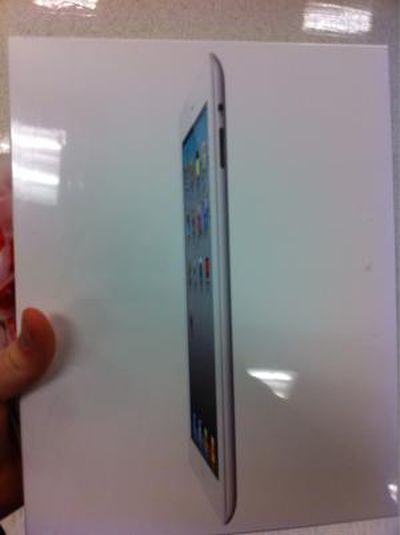
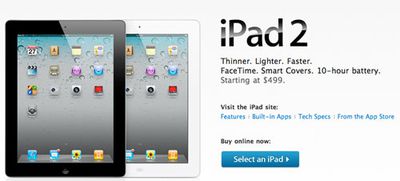
Following the announcement earlier this month that AT&T and Verizon would begin offering the iPad in their retail stores, both wireless carriers have followed through and launched the device on schedule today.
AT&T is offering only the three Wi-Fi + 3G models, priced at Apple's standard $629/$729/$829. The company also continues to offer its two no-contract monthly data plans at 250 MB ($14.99) and 2 GB ($25.00). Monthly international data plans are also available for those traveling outside of the United States, although at significantly higher prices than domestic data.
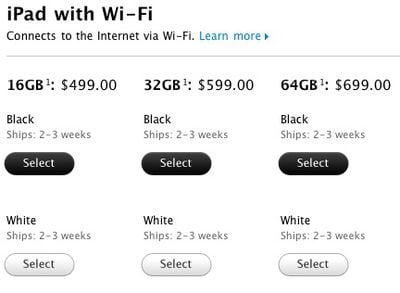
For its part, Verizon is offering the the Wi-Fi-only iPad models, promoting bundles with the carrier's MiFi mobile hotspot for $629.99/$729.99/$829.99, effectively offering an over-50% discount on the MiFi's standard no-contract price of $269.99. No-contract monthly data plans for the iPad/MiFi bundle are offered at 1 GB ($20), 3 GB ($35), 5 GB ($50) and 10 GB ($80). The carrier is also offering unbundled Wi-Fi iPads for $499.99/$599.99/$699.99.
Following another delay until spring 2011 for the white iPhone 4 and rumors that the device has been canceled altogether, Apple has now removed mention of the model from its primary ordering page for the iPhone 4 in all localizations of its online store.
Apple's online store had previously depicted both the white and black iPhone 4, with text under the image of the white model noting that it was unavailable for ordering or in-store pickup. Apple continues to use a white iPhone 4, however, in promotional images for the company's bumpers. The white model is also still shown in Apple's iPhone 4 image gallery.
Following on a report from earlier today claiming that Foxconn/Hon Hai will assist in the production of CDMA-based iPhones to the tune of 15 million units in 2011, DigiTimes now reports that Pegatron will be contributing ten million of its own units next year, yielding a total of 25 million CDMA-based iPhones for 2011.
Pegatron Technology internally expects its Apple CDMA iPhone shipments to reach 10 million units in 2011 and the company has recently started to gear up and is installing new equipment as well as hiring about 10,000 new employees at its plant in Shanghai, China, according to sources from component makers.
Pegatron was tabbed as Apple's CDMA iPhone manufacturing partner as long ago as February, with several reports in subsequent months reiterating the claim. Today's report regarding Hon Hai was the first, however, to claim that the two companies will split the manufacturing duties.
Valve Software today announced the release of an update to Left 4 Dead that brings Mac support to the popular game, which now joins Left 4 Dead 2 on the Mac following the sequel's release earlier this month.
Valve had noted when it announced the Left 4 Dead 2 launch date that the original game was seeing a few delays but that they hoped it would be available before Halloween, a target the company met with today's release.
As a promotion coinciding with the Mac release, Valve is offering 50% discounts on several Left 4 Dead packages: single license ($9.99), four-pack ($29.99), and Left 4 Dead/Left 4 Dead 2 bundle ($14.99). As with all of Valve's other Mac releases, the Steam Play functionality allows users to purchase each game only once, yet still play them on multiple platforms.
Apple today filed its 2010 annual report with the U.S. Securities and Exchange Commission, and the document reveals a few interesting tidbits of information:
- Apple noted that it had approximately 46,600 full-time equivalent employees as of September 25th, an increase of over 35% since last year's annual report. The company has an additional 2,800 full-time equivalent temporary employees and contractors on its payroll, up from 2,500 last year.
- As noted by TechCrunch, Apple's advertising budget for fiscal 2010 was $691 million, up 38% from last year's $501 million and a much larger increase than in previous years. Even so, the report notes that Apple's rapidly-growing revenues allowed the company to reduce its percentage of revenues spent on advertising from 1.37% to about 1.06%.
- Apple noted in several locations within the report pertaining to risk factors that could impact the company's performance going forward that it expects lower gross margins in the future due to increasing sales of new products with higher production costs.
The Company expects its gross margin percentage to decrease in future periods compared to levels achieved during 2010 and anticipates gross margin levels of about 36% in the first quarter of 2011. This expected decline is largely due to a higher mix of new and innovative products that have higher cost structures and deliver greater value to customers, and expected and potential future component cost and other cost increases.
While Apple has routinely offered modest expectations regarding gross margins in its financial discussion, the apparent longer-term pressure on margins disclosed in the report is being cited as the reason for a slight dip in Apple's stock price in after-hours trading following the release of the report.
In a follow-up to its benchmarks for the new 11-inch and 13-inch MacBook Air models yesterday, Macworld has now gotten its hands on the "ultimate" configurations of the two sizes, allowing for testing on the higher-powered models offering faster processors and more RAM.
Our Speedmark 6.5 results show the BTO 11-inch MacBook Air topping its standard configuration version by 12 percent, overall. The biggest individual test gains were in iTunes encoding and our multitasking test, which were both 16 percent faster on the BTO 11-inch MacBook Air. Aperture was 14 percent faster, and iPhoto and HandBrake were both 13 percent faster.
The 13-inch MacBook Air BTO configuration was 10 percent faster than its stock configuration. Individual application highlights include Aperture and our multitasking tests that were both 15 percent faster, and iPhoto was 14 percent faster.
In the context of Apple's broader lineup, maxing out the 11-inch MacBook Air brings it within 5% of the current white MacBook on the Speedmark suite, while the top-end 13-inch MacBook Air healthily beats the standard 13-inch MacBook Pro despite the Air's slower processor. The maxed-out 13-inch MacBook Air remains about 10% slower than the standard 15" MacBook Pro with its significantly more powerful Core i5 processor, although that deficit is about half as wide as that seen with the standard 13-inch MacBook Air.
CNET reports that Swedish music streaming service Spotify appears to be getting closer to locking in deals with the major U.S. record labels that would allow the company to launch its free and paid services in the United States. Just yesterday, a rumor surfaced claiming that Apple was in early-stage negotiations with Spotify about an acquisition, but the claim was quickly denied by Spotify representatives.
Spotify is still without signed contracts to license music from any top label and there are still numerous points to be negotiated, but the company has never been closer to finalizing deals than now, said multiple sources with knowledge of the talks.
One of the ways that Spotify has stirred the labels is by offering big advanced money, the sources said. The amount could not be verified.
Spotify is also said to still be looking for ways to entice more users of its free service to upgrade to its paid premium service offering no ads, better music quality, and other features. The conversion rate is said to be below 10%, with record labels hoping to see that rate closer to 15%.
Spotify has already missed several U.S. launch date goals as it has struggled to convince labels that have seen many music startups fail to buy into its strategy. The company is currently racing to meet its latest goal of a U.S. launch by the end of 2010. Spotify has also reportedly had to deal with Apple's own efforts to torpedo the U.S. deals by arguing that the service would be a losing proposition for all sides of the digital music industry.
GigaOM reports that Apple has partnered with digital security firm Gemalto to create a custom SIM card that would exist as a built-in chip inside the iPhone to allow users to activate their devices with a broad array of carriers without requiring extensive interactions directly with the carriers.
It is rumored that Apple and Gemalto have created a SIM card, which is typically a chip that carries subscriber identification information for the carriers, that will be integrated into the iPhone itself. Then customers will then be able to choose their carrier at purchase at the Apple web site or retail store, or buy the phone and get their handset up and running through a download at the App Store as opposed to visiting a carrier store or calling the carrier.
The report notes that the new technology would be of most use in Europe, where there are many competitive carriers operating on similar technologies within a relatively compact geographic area.
The Gemalto SIM, according to my sources, is embedded in a chip that has an upgradeable flash component and a ROM area. The ROM area contains data provided by Gemalto with everything related to IT and network security, except for the carrier related information. The flash component will receive the carrier related data via a local connection which could be the PC or a dedicated device, so it can be activated on the network. Gemalto will provide the back-end infrastructure that allows service and number provisioning on the carrier network.
Sources for the report have indicated that executives from several French carriers have traveled to Apple's Cupertino headquarters in recent weeks to discuss the development, which could allow Apple to significantly simplify the iPhone sales and distribution process while offering customers the flexibility to easily activate service and switch carriers on their own.
Apple's iPhone currently utilizes a removable SIM card, issued by the user's carrier to allow the device to operate on its network.
Business Insider reports that Apple is hosting a secret three-day conference at its Cupertino headquarters next week, bringing in an unknown number of iOS developers to meet with Apple staff.
Apple is hosting an event for iOS developers in California next week, we've heard from an industry source. The event begins next Tuesday, and runs for three days, we've heard.
We are short on details, and we have not seen any public information about it, but it sounds like this will be a more intimate version of the iPhone Tech Talks that Apple hosted around the world last year.
According to the report, Apple is likely seeking to help select developers improve the quality of their App Store applications in the face of continued growth by Google's Android platform and to take advantage of the unification of iPad and iPhone/iPod touch operating system versions with the release of iOS 4.2 next month.
What we don't know: Who's attending, how big this event is, what sort of sessions will be held, and whether Apple will host any sort of media event for the iOS 4.2 launch, which could potentially include demos of some of the apps that were worked on at the summit.
Apple has in the past worked with select developers ahead of its iOS-related media events to prepare their applications for demonstrations. As noted, however, it is unknown whether this conference is related to a possible iOS 4.2 media event sometime next month.
Security alert dialog box generated by malware's installation attempts
Yesterday, Mac antivirus firm SecureMac issued an alert regarding a new piece of malware capable of infecting systems running Mac OS X by using a trojan horse method of entry to deploy a Java-based payload enabling a wide variety of nefarious functions.
The trojan horse, trojan.osx.boonana.a, is spreading through social networking sites, including Facebook, disguised as a video. The trojan is currently appearing as a link in messages on social networking sites with the subject "Is this you in this video?"
When a user clicks the infected link, the trojan initially runs as a Java applet, which downloads other files to the computer, including an installer, which launches automatically. When run, the installer modifies system files to bypass the need for passwords, allowing outside access to all files on the system. Additionally, the trojan sets itself to run invisibly in the background at startup, and periodically checks in with command and control servers to report information on the infected system. While running, the trojan horse hijacks user accounts to spread itself further via spam messages. Users have reported the trojan is spreading through e-mail as well as social media sites.
Rival antivirus firm Intego responded with a notice of its own, downplaying the imminent threat from the malware due to the fact that it does not appear to be functioning as intended.
While Intego has evidence of several infections in the wild, we are not currently able to go beyond this step, as either the malicious malware has bugs preventing it from running correctly, or the servers it contacts are not active or are not serving the correct files.
Potentially, if it installs correctly, it functions the same as the Koobface worm running on Windows. It runs a local web server and an IRC server, acts as part of a botnet, acts as a DNS changer, and can activate a number of other functions, either through files initially installed or other files downloaded subsequently. It spreads by posting messages on Facebook, MySpace and Twitter, usually trying to get people to click a link to view some sort of video.

While this is an especially malicious piece of malware, the current Mac OS X implementation is flawed, and the threat is therefore low.
Both companies have conveniently noted that they offer products capable of identifying and eliminating the malware, although users without protection software should be alerted by the malware installation generating a Mac OS X dialog box regarding the attempted action.
News about Apple's much-delayed white iPhone 4 continues to fly fast and furious, with a new claim from Boy Genius Report suggesting that the model has been canceled entirely instead of merely delayed until next spring as the company announced yesterday.
According to a previous source of ours, we have been told that Apple in fact has no plans to release the white model iPhone 4. Our source hypothesizes another "delay" communicated around March leading us into an iPhone 5 release time-frame in June / July.
Initial reactions to Apple's announcement yesterday ran along a similar vein, with many forum posters wondering whether Apple truly would release a white iPhone 4 not more than a few months before the company presumably refreshes the entire lineup with the fifth-generation iPhone next June or July.
The source of the latest report also speculates that relative silence from his or her manufacturing contacts could suggest something other than a manufacturing issue is responsible for the delays. Numerous reports over the past few months have made claims regarding possible reasons, with the most recent coming just today and asserting that Apple is experiencing difficulties with light leaking into the iPhone through its white body and affecting camera performance.