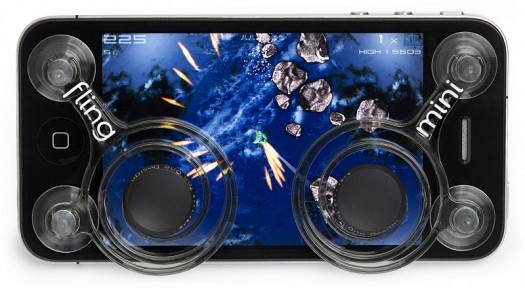
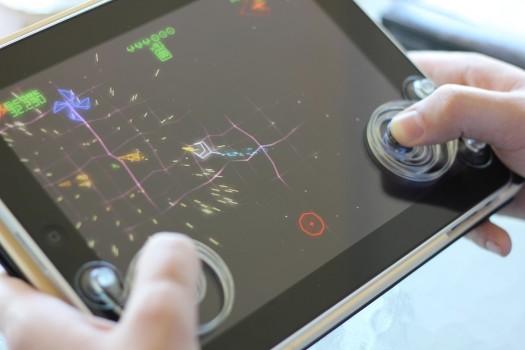
TouchArcade points out that TenOneDesign has posted new miniaturized versions of the Fling joysticks designed for the iPhone and iPod Touch. We covered the original version made for the iPad back in January and even tried them out at CES. The springy controllers work surprisingly well for any joystick or dual-stick controller games such as Geometry Wars. From an earlier review:
The Fling is a cleverly designed device with two suction cups on one side connected to a plastic ring. Inside of the plastic ring is a spiral that suspends an electrically conductive joystick in the center. This spiral works like a spring, always returning the joystick to the center, and providing more resistance the closer you get to the edge of the plastic ring.
A pack of two costs $24.95 and start shipping in July.
The speculation began last week when iPhoneinCanada posted that it believes that mobile developer Peter Hajas has started working for Apple. A developer getting a new job at Apple would not be newsworthy in itself, but Hajas was the developer of a popular jailbreak notification add-on for iOS. iPhoneinCanada describes how earlier versions of the MobileNotifier add-on works:
Now, there's a hot tweak called MobileNotifier (beta 3 release) via Cydia that makes notifications unobtrusive and allows you to keep using existing apps. An elegant bar appears up top of your homescreen and with one tap you can choose to close or open the notification. Alerts will also appear on your lockscreen. When you double tap the Home button, you'll see a list of your recent alerts via the AlertDashboard.
And associated video:
Peter Hajas doesn't come right out and say that he's now working Apple but did post a cryptic update to his blog saying that he will be taking a break from MobileNotifier for a while due to other opportunities.
RedmondPie has since discovered a (now deleted) Tweet posted in early May by Hajas saying that he would be heading off to work in California at a "fruit" company. Meanwhile, we've also independently confirmed that Hajas is now an employee at Apple.
Apple is rumored to be improving iOS's notification system in the next version of iOS to be detailed at WWDC, and a report from mid-February had indicated that Apple was hiring an unnamed outside developer to revamp notifications, although it is unknown if that person was indeed Hajas. Regardless, Apple has certainly already worked heavily on such a system prior to this hire, but it's still interesting nonetheless.
Proof from Apple's internal employee directory app:
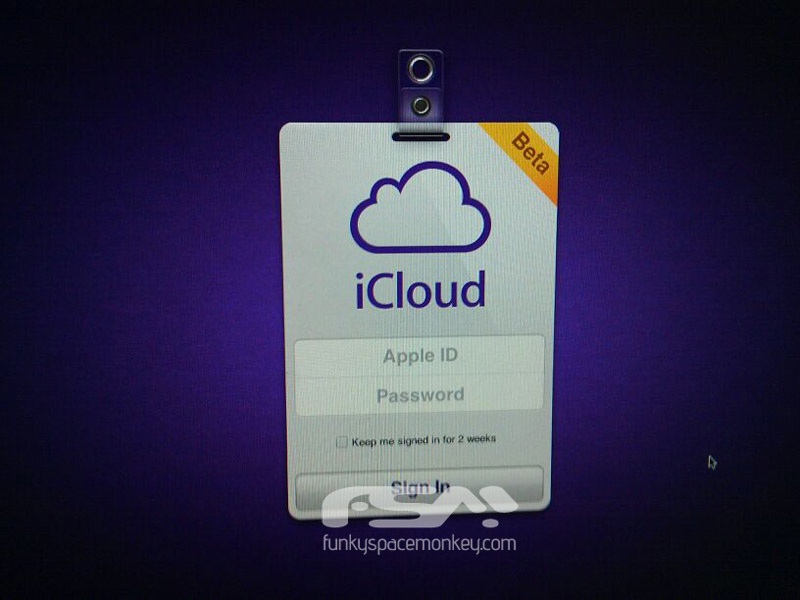
FunkySpaceMonkey.com posts a screenshot of what it claims to be the login page for a beta version of Apple's iCloud service, claiming to have obtained the image from "Apple's internal server".
If you want all the rumors about they'ree [sic] easy to find on every site. But here's the first fact about it. We got a first look at the beta login page of iCloud, from Apple's internal server.
The meaning behind use of a "name badge" style window for the login is not entirely clear, although it could be construed to be offering users the feeling of gaining access to Apple's data centers.
FunkySpaceMonkey.com does not have a significant track record of posting Apple-related rumors, and so we are hesitant to put too much faith in it. We also do tend to see significant numbers of questionable claims and images showing up in the lead-up to major Apple events, but we felt that this one was interesting enough to publish.
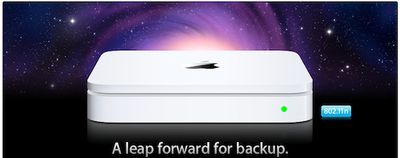
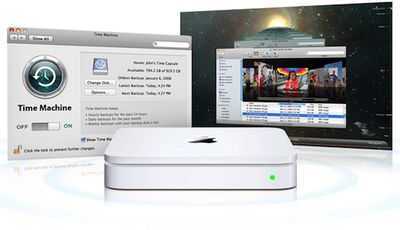
Earlier this week, we noted that a number of Apple's retail stores have run dry of stocks of Time Capsules, AirPort Extremes, and in some cases AirPort Expresses, leading to speculation that a refresh could come at next week's Worldwide Developers Conference. Reports quickly arose claiming that Apple has been known to have at least internally tested new Time Capsules capable of caching software updates for Macs and iOS devices, delivering them quickly to the machines for updating.
In a separate report, Ars Technica briefly notes that it has received word that the new Time Capsule may actually follow the pattern of the Apple TV, taking on an A4 or A5 processor from Apple and running iOS to manage the more advanced functions that could appear in the device.
Our own source tells Ars that the revised hardware is believed to be built around Apple's own A4 or A5 processor, and will run iOS much like the most recent Apple TV model.
Harnessing the power of iOS directly within the Time Capsule device, even if on a scaled-down basis as in the Apple TV, naturally opens the door to further speculation of how Apple could tie together iCloud services with local storage on users' own networks, whether it be caching some iCloud content to the Time Capsule for faster access when on the local network or even pushing some of the Time Machine functions included on the current Time Capsule out to iCloud itself.
Separately, we've heard an unconfirmed tip that iOS 5 may finally be bringing wireless syncing to iOS devices, including the intriguing claim that the wireless syncing could be performed directly with the new Time Capsules, bypassing the need to sync with a specific computer.
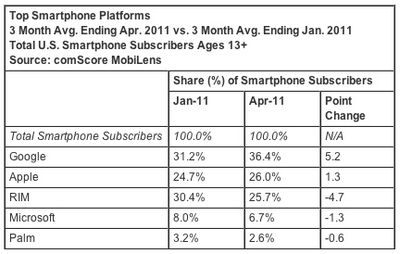
comScore today released the results of its April survey of mobile phone usage in the United States, finding that Apple has nudged past Research in Motion to claim the second spot among smartphone platforms behind Android. According to the data, Android continues to widen its lead and now holds 36.4% of the market, while Apple's iOS holds 26.0% and Research in Motion's BlackBerry operating system has slipped to 25.7%.
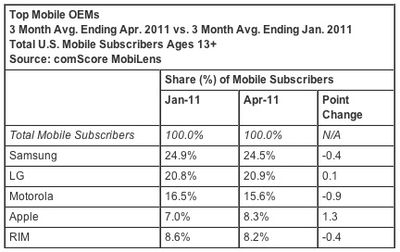
When looking at mobile phone manufacturers overall, Apple is now the fourth most-popular vendor with 8.3% of the market, once again barely beating out Research in Motion.
comScore's surveys of over 30,000 mobile phone subscribers examine installed user base rather than quarterly sales as with many other sources. Consequently, comScore's data examines a slightly different metric that is slower to respond to shifts in sales trends. Apple passed Research in Motion in quarterly U.S. shipments late last year, but the BlackBerry maker's historical lead had enabled it to hold off Apple in installed user base share until recently.
MyFOX8.com reports that a man wearing what was referred to by witnesses as a "white ninja suit" crashed a car into Apple's Friendly Center retail store in Greensboro, North Carolina this morning. The incident appears to have been a robbery attempt, although the man reportedly fled the scene without stealing anything.
Police described the suspect as a white male wearing a white shirt and hooded mask. According to 107.5 KZL, a security guard said the suspect was wearing a white ninja suit.
Police said the car involved in the accident was reported stolen around 6 a.m.
The store will be closed at least through the remainder of the day as staff work to clean up the site.
When Apple released the initial developer preview for Mac OS X Lion back in late February, some observers were surprised to hear that Apple had moved to bundle the Mac OS X Server components in with the standard release, potentially lowering the price of deploying server capabilities on the Mac by a significant margin. Apple details the inclusion on its Lion features page:
Lion Server is now part of Mac OS X Lion. It's easy to set up your Mac as a server and take advantage of the many services Lion Server has to offer.
But with the second developer preview of Lion released a month later, Apple split the server components out into a separate download, leading to questions about whether the company still intended to bundle client and server content together for the public release.
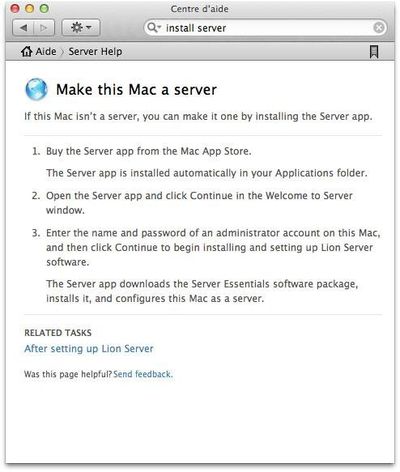
Now, as noted by Hardmac, a discovery in a help file for a Mac OS X Lion developer build suggests that users will be required to download a paid app from the Mac App Store in order to activate the server components of Lion.
Snow Leopard Server currently ships at a price point of $499 for an unlimited client license, but it is unclear how much Apple intends to charge for the "Server" app associated with Lion. Apple has in the past charged nominal fees for certain software downloads due to accounting requirements relating to unlocking new capabilities, so it is possible that the fee for activating Mac OS X Lion features could simply be a very minor one.
The New York Post reports that Apple is paying the four major music labels up to a total of $150 million for the rights to include their music in its iCloud music streaming service set to be introduced on Monday. The revelation comes just as Apple reportedly finalized a deal with Universal, the last of the four major labels to sign on to the deal.
Apple will fork over between $100 million and $150 million in advanced payments to the four major music labels in order to get its iCloud off the ground, three separate sources told The Post.
The Cupertino, Calif., tech giant has agreed to pay the labels between $25 million to $50 million each, as an incentive to get on board, depending on how many tracks consumers are storing.
The report also claims that Apple has finalized deals with the corresponding music publishers, officially opening the door for a launch. Previous reports had indicated that Apple was putting the final touches on agreements with the publishers.
Multiple news outlets have reported since yesterday that iCloud will debut as a free service, with Apple eventually looking to charge in the neighborhood of $25 per year for the service. Sources have also claimed that iCloud will be limited at first, supporting only content purchased from the iTunes Store, but that Apple is working to expand iCloud to support music obtained from other sources in the future.
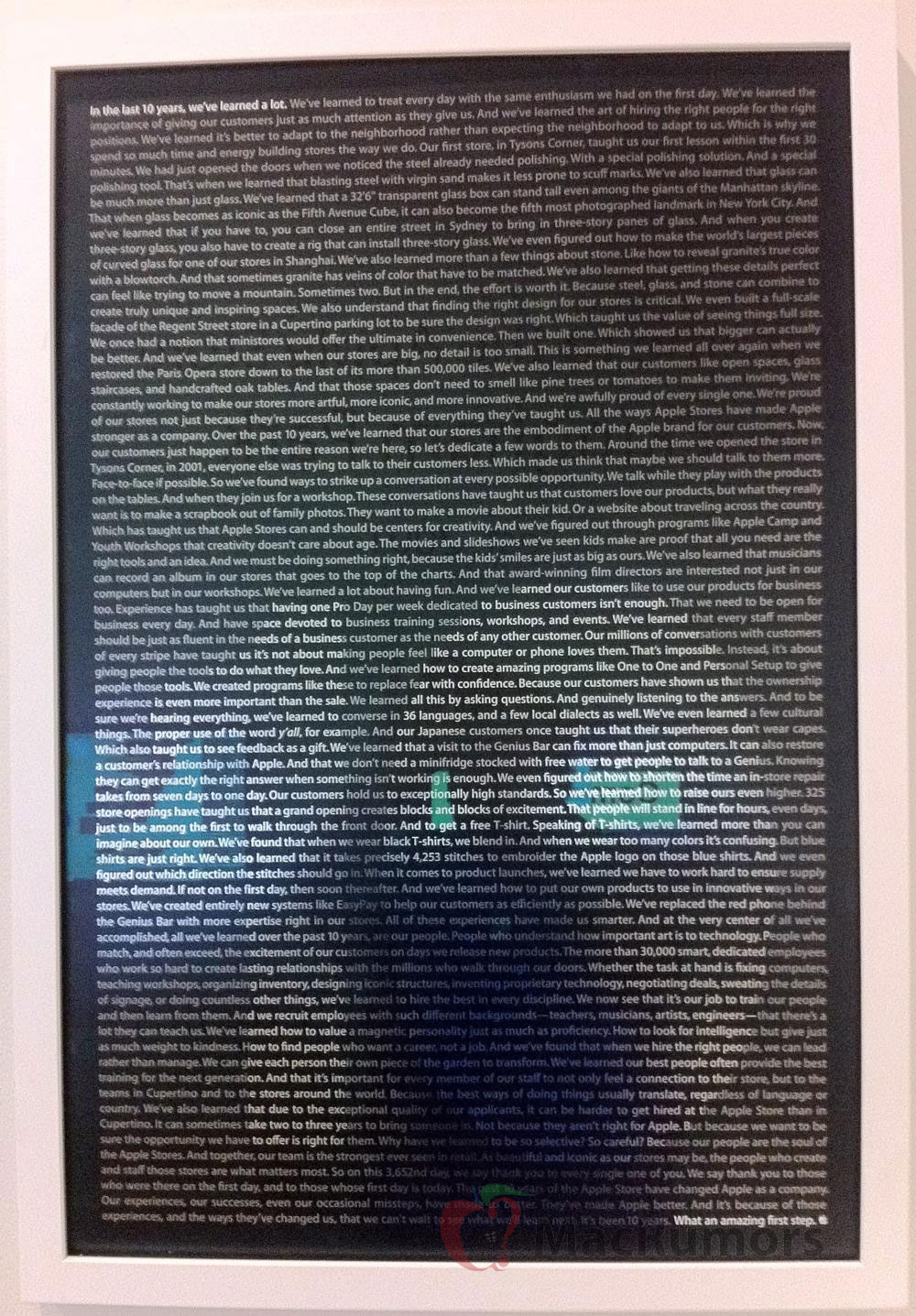
The most public celebration of Apple Retail's tenth anniversary was the rollout of iPad interactive shopping guides, something Apple calls the "Smart Sign". But behind the scenes, in the retail back-of-house area, Apple posted a very moving poster celebrating all the company has learned over the past 10 years, embedded above. The poster begins:
In the last 10 years, we've learned a lot. We've learned to treat every day with the same enthusiasm we had on the first day. We've learned the importance of giving our customers just as much attention as they give us. And we've learned the art of hiring the right people for the right positions. We've learned it's better to adapt to the neighborhood rather than expecting the neighborhood to adapt to us. Which is why we spend so much time and energy building stores the way we do.
Throughout it's full of interesting tidbits of knowledge:
• Our first store, in Tysons Corner, taught us our first lesson within the first 30 minutes. We had just opened the doors when we noticed the steel already needed polishing. With a special polishing solution. And a special polishing tool. That's when we learned that blasting steel with virgin sand makes it less prone to scuff marks.
• We even built a full-scale facade of the Regent Street store in a Cupertino parking lot to be sure the design was right. Which taught us the value of seeing things full size.
• Speaking of T-shirts, we've learned more than you can imagine about our own. We've found that when we wear black T-shirts, we blend in. And when we wear too many colors it's confusing. But blue shirts are just right. We've also learned that it takes precisely 4,253 stitches to embroider the Apple logo on those blue shirts. And we even figured out which direction the stitches should go in.
The full text of the poster is transcribed in the discussion thread.
Rumors are flowing fast in the days before WWDC. LATimes reveals some additional details about Apple's iCloud service.
The iCloud service will function as many have expected. Offering iTunes users the ability to save their purchases to iCloud and then being able to listen to it from any web browser or Apple device. Apple will be offering a free trial for those who buy music from iTunes and later expects to charge "about" $25/year for the service.
The LATimes also adds without detail that "Apple would also sell advertising around its iCloud service." It's not clear in what form this advertising would be, and whether it would be present for only free or also paid customers.
Finally, Apple expects to extend the iCloud concept to movies, TV shows and other digital content. Apple will be announcing iCloud at next week's WWDC.
CNet reports that Apple has signed the last of the four major record labels to its iCloud service which will be officially announced next week.
The agreement means that Apple now has the rights to offer recording rights from all of the major labels. In addition, Apple has reached agreements with some of the large publishers, the sources said.
This represents the final step before Apple is able to launch its iCloud service which is believed to offer music streaming to iOS and Mac users. Apple has already announced that they will be detailing iCloud at next week's WWDC keynote which takes place on Monday, June 6th.
CNet reports that labels will get 58%, publishers 12%, while Apple retains 30%. They also add that streaming won't be available on Monday but will be offered "soon". And at first, Apple will only store music in iCloud that was purchased in iTunes, but Apple is looking to include songs outside iTunes "sometime in the future".
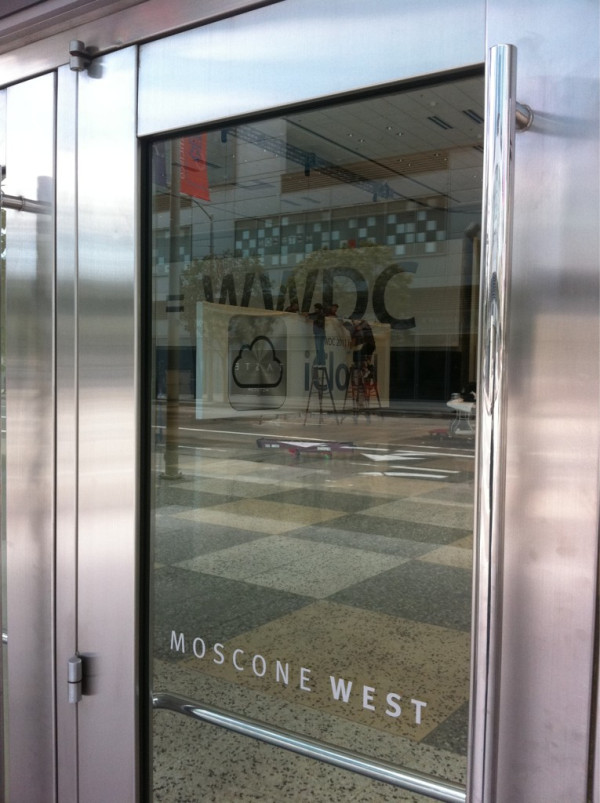
Apple has started decorating the Moscone West conference center in San Francisco with iCloud banners, revealing the icon for the first time. Photo by @stop.
Apple has announced that it will be discussing iOS 5, Mac OS X Lion and iCloud at next week's Worldwide Developers Conference (WWDC) to be held at the facility. Steve Jobs will be delivering the keynote on Monday, June 6th. Apple has been wrapping up deals with music labels and publishers to allow users to stream purchased music to their computers and other devices using the service, and has also been reported to be racing to include movie and TV content as well.
A flood of MacRumors readers have reported in saying that they are having difficulties downloading content from Apple's online download stores, including the App Stores for both iOS and Mac OS X as well as iTunes Store content. The issues appear to be widespread although not universal, as others have reported that they are having no problems downloading content.
The reason for the downtime is not currently known, although speculation has of course centered around potential preparations for Apple's new iCloud service set to be introduced on Monday at the company's Worldwide Developers Conference. Such preparations could involve the company shifting content around such as to its North Carolina data center, moves that could result in some issues with access to the content. Alternatively, Apple could simply be experiencing some sort of network problems unrelated to new product and service launches.
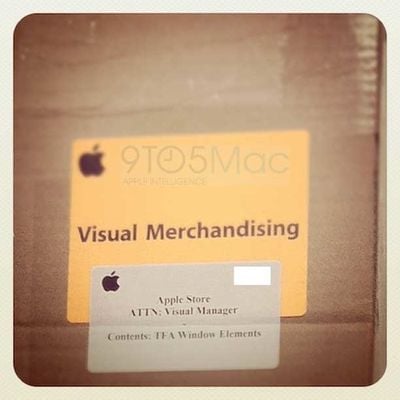
9 to 5 Mac reports that Apple's retail stores are receiving shipments of new promotional materials that are set to remain sealed until Tuesday, suggesting that Apple will indeed have something new to show off in its stores following its Worldwide Developers Conference (WWDC) keynote on Monday.
Whether the promotional materials are for new software and services such as Mac OS X Lion and iCloud or for hardware products such as new AirPort and Time Capsule base stations is unknown.
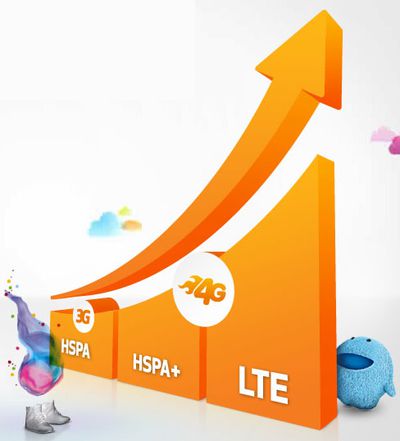
Barron's reports on a new research note from Hudson Square analyst Todd Rethemeier, who claims that the fifth-generation iPhone due this fall will indeed support HSPA+ technology, a development that will allow the device to offer faster data speeds on GSM networks such as AT&T. (The currently shipping iPhone supports standard HSPA.) Despite the fact that HSPA+ is slower than the LTE standard being rolled out by major carriers, AT&T has begun marketing its HSPA+ network as "4G", meaning that the carrier could position the next iPhone as a 4G device despite it failing to offer LTE compatibility.
The implications of an HSPA+ iPhone are significant in the United States, where Apple presently offers a separate CDMA iPhone running on Verizon. Even with both current models of the iPhone 4 limited to 3G networks, AT&T's HSPA data network is already faster than Verizon's EVDO data network. That disparity will be magnified with the next iPhone as AT&T users will be able to experience download speeds in the range of 5-10 Mbps under HSPA+ while users on Verizon will remain stuck on the carrier's current 3G network running in the neighborhood of 1 Mbps.
And that advantage would continue to be significant even for the expected LTE-enabled sixth-generation iPhone until LTE networks are essentially built out, as AT&T users would be able to fall back from LTE to HSPA+ while Verizon users would fall all the way back to basic 3G when out of LTE coverage areas.
For AT&T iPhone 5 users, this could mean download speeds of 5-10 Mbps, compared to less than 1 Mbps for a Verizon user. Certainly, when an LTE iPhone is introduced AT&T would lose some of its marketing advantage. However, even when that happens, the phone will be backwards compatible, so the AT&T iPhone 6 would be able to roam onto the HSPA+ network when an LTE network is not available, giving AT&T an advantage in suburban and rural areas for several more years, we believe.
AT&T notes that it is currently seeing "4G" speeds of up to 6 Mbps for HSPA+ devices connected to cell towers utilizing the enhanced backhaul connections needed to support such speeds. The carrier touts HSPA+ as an intermediate step on the way to LTE, a move that will enable it to be the only U.S. carrier to offer two layers of "4G" speeds on its network.
Early reports have seen some users of "4G" HSPA+ devices on AT&T experiencing speeds slower than that seen on 3G, particularly when it comes to upload, although the carrier is still finishing building out its full HSPA+ capabilities. Consequently, it remains to be seen exactly just how wide the disparity would be between an HSPA+ iPhone running on AT&T versus one running on Verizon's network.
Verizon executives have claimed that the next-generation iPhone will be a single "world-mode" model capable of operating on both GSM and CDMA networks. The CDMA iPhone 4 and iPad 2 already include a Qualcomm chip capable of supporting both HSPA+ and CDMA 3G standards, meaning that Apple would primarily have to focus on integrating sufficient antenna capabilities to support the number of frequencies required for both CDMA and GSM compatibility in a single device.
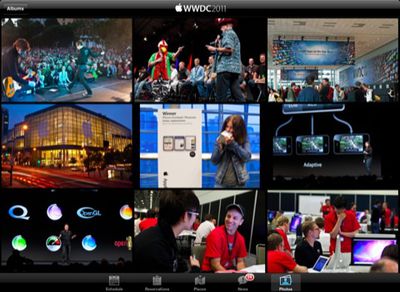
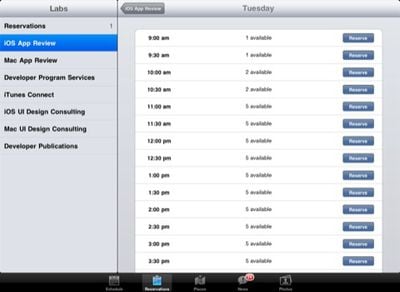
Apple today released a new iOS app [App Store] to assist attendees at the company's Worldwide Developers Conference next week. The app provides a number of scheduling and informational items including news and photos from the conference, as well as the ability to make reservations to meet with Apple staff at various labs throughout the conference.
The WWDC 2011 app is your mobile guide to the Apple Worldwide Developers Conference. Access a range of conference information on-the-go from your iPhone or iPad. You can quickly search the conference schedule, make a reservation at the User Interface, App Review, iTunes Connect, Program Support, or Developer Publications lab, view floor diagrams of Moscone West, and create a custom schedule of the sessions, labs, and events you plan on attending.
WWDC is a universal application supporting all iOS devices running iOS 4.2 or later.
Business Insider reports on a new research note from Goldman Sachs analyst Bill Shope covering a recent meeting between Shope and Apple executives Tim Cook, Ron Johnson, and Peter Oppenheimer. According to Shope, the executives expressed considerable optimism regarding the future of iOS, particularly when it comes to the iPad. In fact, Apple Chief Operating Officer Tim Cook reportedly noted that the company expects tablet sales to surpass PC sales over the next several years.
Shope says, "the company appeared more overtly optimistic on the long-term prospects for the iOS platform than it has been in quite some time."
Why?
For one, Cook said, "he sees no reason why the tablet market shouldn't eclipse the PC market over the next several years," according to Shope's note.
Apple's iPad of course currently dominates that tablet market, and while its share will almost certainly shrink as more competitors come to market, most observers expect Apple to continue to lead the market for years to come.
According to a separate article relating information from the note, Shope reports that Apple is once again touting its preference for an "integrated" ecosystem for iOS over the "fragmented" one it sees for Google's Android platform. Apple's executives reportedly suggest that while the Android approach may yield market share gains over the short term, but the the fragmentation will ultimately weaken the platform and degrade the user experience.
To that end, Apple argues that the true measure of a platform's value should be measured by how well it supports the entire ecosystem surrounding it, and with the company having paid out over $2 billion to App Store developers so far, it believes that it offers the most successful and sustainable model among mobile platforms.
While we noted yesterday that an apparent tightening of supplies of AirPort and Time Capsule products in Apple's retail stores may heighten anticipation for a possible update at next week's Worldwide Developers Conference, 9 to 5 Mac reports that it has received word that Apple has at least been internally testing new Time Capsule models capable of caching software updates for users' machines in order to speed the download and update process.
What we do know is that Apple has been internally testing Time Capsules to cache Software updates for both Mac and iOS devices. The way we've heard it works is that the new Time Capsule learns which devices connect to it via Wifi. It then goes out to Apple's servers and downloads Software Updates for those products.
When the user wants to install the software update, the Time Capsule, which is also the router, routes you to the locally stored update, rather than downloading the whole thing over the Internet.
A smarter version of the update capabilities found in Mac OS X Server, the new Time Capsules would know exactly which machines it needed software updates for and download only those packages.
And with Apple's latest iMac and MacBook Pro models already supporting 450 Mbps Wi-Fi, distributing software updates downloaded quietly in the background by a Time Capsule to the actual machines could be accomplished with lightning speed.
As for potential tie-ins to Apple's iCloud service scheduled for introduction next Monday, new Time Capsules could integrate with the service to cache certain large or frequently-accessed files for faster access when on the local Wi-Fi network. Those files would of course instead be distributed directly from the iCloud servers when off the local network.
Apple's first foldable iPhone, with a book-style design featuring a ~5.5-inch outer display and a ~7.8-inch inner display with a minimal crease down the middle.






 Rumors are flowing fast in the days before WWDC.