Building on his earlier claims that Apple is preparing a subscription video streaming service to take on Netflix, Jefferies analyst Peter Misek today issued a new report claiming that Apple already has deals in place with the major video studios and TV networks to support such a service.
Apple might be ready to roll out its own video subscription service similar to Amazon and Netflix, Peter Misek at Jefferies reports in a note this morning.
Specifically, he says, "As part of Apple's roll-out of cloud video services (and eventually an iTV), we believe Apple has unannounced deals with all/most of the studios/TV networks that are similar to the subscription streaming deal between Amazon and CBS."
Apple earlier this week expanded its nascent iCloud service to include the re-downloading of purchased TV shows, including allowing Apple TV devices to stream the purchased content directly from the cloud. And with another claim today suggesting that Apple may finally be preparing to launch its "iTunes Replay" service that would fold the cloud-based TV show offerings in with a similar program for movies to support re-downloads and streaming, Apple appears to be making a significant push into bringing video to iCloud.
Back in 2009, AppleInsider reported that Apple was developing an on-demand video service that would allow users to stream their purchased iTunes movies and TV shows from Apple's servers for playback on personal devices. The service was called "iTunes Replay", and would eliminate the need to store large media files on your iPod or iPhone.
AppAdvice now claims that they have been able to confirm that Apple is about to finally launch this "iTunes Replay" service to customers.
In a nutshell, iTunes Replay is an extension to what Apple is already doing with iCloud and free re-downloads of previously purchased music. As Apple secures the remaining rights, TV Shows as well as Movies in iTunes will be given little arrow indicating whether they’re “iTunes Replay eligible”, that is, available to be downloaded subsequent times.
Apple has just recently started allowing users to re-download television shows to their Mac and iOS devices, and allowing Apple TV owners to stream previously purchased content. So, it's no stretch to believe that Apple might start allowing the same for movies.
AppAdvice indicates that there may be a re-download limit of 5 times for some content and they seem uncertain how streaming counts against this limit. Apple would certainly have had to renegotiate with content providers for this change in service, and may explain why it is only launching now.
In the weeks prior to WWDC, countless reports had suggested that Apple was in deep negotiations with Movie providers about offering a "digital locker" of streaming content. From May:
In the past several weeks, Apple executives have stepped up their attempts to convince some of the major Hollywood film studios to issue licenses that would enable Apple to store its customers' movies on the company's servers, two sources close to the negotiations told CNET. Apple began discussing a cloud service with the studios over a year ago.
When iCloud was officially announced, there was no mention of this sort of "digital locker" streaming service that had been so heavily rumored. It seems perhaps the negotiations for the service had not yet completed in time for a WWDC launch.
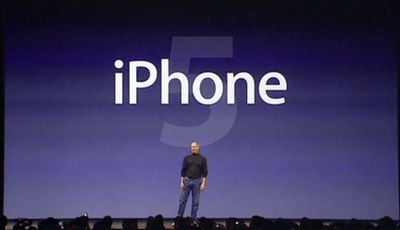
This isn't a new piece of information, but Digitimes reiterates a previous claim that Pegatron will begin shipping the iPhone 5 in September.
Pegatron Technology has landed orders for 10 million units of iPhone 5 to become the second ODM of the smartphone. Shipments will start in September, according to industry sources.
The most recent rumors have suggested that Apple will not be launching the iPhone 5 until October, though they will presumably have to start ramping production prior to that date.
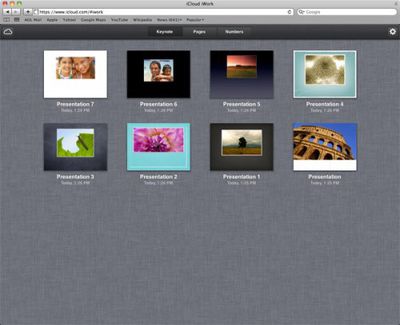
Engadget publishes a hands on with iCloud.com and the iWork beta. iCloud works as we described, acting as a replacement for MobileMe with Mail, Contacts, Calendar and Find My iPhone interfaces.
They go into a little more detail about how the iWork interface works on the web. iWork in iCloud is primarily a sync and download service, rather than an editing service:
You can't create iWork files using the iCloud web interface, but if you've enabled sync on your iOS device, documents you create will appear almost instantly on each app's respective webpage. From the Keynote tab, you can view and download each presentation as a Keynote file, PDF, or in PowerPoint format. Pages documents can be downloaded as Pages files, PDFs, or in Word format, and Numbers spreadsheets can be exported to the desktop version of Numbers, PDF, and Excel.
The following video show iWork editing and creation between the iOS apps and the iCloud web interface:
One interesting addition, however, is that users can upload documents to iCloud/iWork. This lets you quickly upload documents that will instantly sync back via iCloud to your iOS apps.
AppleInsider also notes that Apple is actively recruiting for an iWork web developer which could indicate they are working to further expand their web support for the iWork suite.
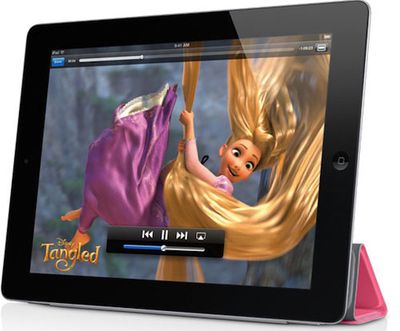
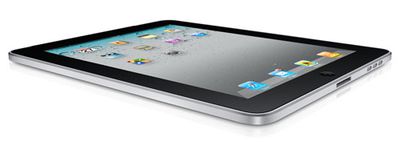
Apple's control over the iPad's hardware and software gives it "design efficiencies" other tablet manufacturers can't match, says Wayne Lam, an analyst at iSuppli.
“These efficiencies become obvious in areas like the memory and the battery, where Apple maintains advantages in cost, space savings and performance compared with every competitor in the business.”
Other tablet makers employ operating systems from third-party firms—such as Google Inc., which provides the Android software used in most competitive products on the market today. Many of these tablet makers also outsource the blueprints of their products to third parties, employing reference designs and design services from contract manufacturers.
This contrasts with the model employed by Apple, which uses its own operating system and maintains tight control of its design, components and contract manufacturers.
Lam argues that comparing the amount of RAM between the iPad and other manufacturers misses a key point: because Apple writes the software specifically for hardware they have custom built, it doesn't need as much horsepower as competing tablets.
In the current-generation iPad 2, the density of synchronous dynamic random access memory (SDRAM) is 512 megabytes—half that of the 1 gigabtye used in competitive designs... Likewise, the original iPad contained half as much SDRAM as comparable competitive devices with single-core applications processors.
“The iPad’s efficient memory usage stems from the fundamental difference in the architecture of the operating system,” Lam said. “Apple’s iOS handles multitasking differently than other tablet operating systems, allowing it to reduce the amount of memory required to support the microprocessor.”
It also helps that Apple has the cash to secure favorable terms from suppliers, like in 2010 when it spent $3.9 billion on LCD panels, most likely for the iPad.
Apple currently has the second highest market capitalization in the world, second only to ExxonMobil. Like XOM, Apple has grown its profits by controlling the entire pipeline, from conception to delivery.
ExxonMobil handles exploration, drilling, pumping, refining, and delivery of petroleum products, and captures profits at every step. ExxonMobil eliminates inefficiencies in the market by having one company handle everything instead of having four different companies combining forces to deliver a product -- like Google and the Android hardware manufacturers do.
Apple designs the software (iOS), the hardware (A4 and A5 chips), controls the sales channel (Apple Retail and Online Stores), and decides the fate of how buyers use the iPad via the App Store. The company streamlines pricing and the experience to such a degree that no other company can even come close.
Back in June, it was reported that the iPhone 5 was in carrier testing, with high-level executives at Apple and some of its carrier partners said to be carrying the device around for testing purposes.
In addressing a new claim that the next iPhone won't debut until October, later than the September timeframe that has been the focus for some time now, The Guardian offers some details on the carrier testing process that is said to indeed be underway.
My carrier sources tell me that the boxes in which the new iPhone hardware is encased have been transported to carriers for testing. This is an important step in the release cycle for any phone. ... The next iPhones go for their testing inside locked and sealed boxes so that the carriers can carry out checks on their network compatibility in their labs. It's very high security, as you could guess; my understanding is that barely anyone inside the carriers gets to open those boxes, and even when they do the hardware is encased in a dummy body which means there's no clue to what the actual phone will do.
The report suggests that with the iPhone 5 now in final carrier testing, a process that should take only weeks, Apple is in prime position to ramp up manufacturing to meet a September launch.
Other sources are also skeptical of the October launch claim, with RBC Capital Markets analyst Mike Abramsky noting that Apple during its last earnings conference call noted that it would be experiencing a "future product transition" affecting the current quarter, which ends in late September. Abramsky also cites channel checks that continue to point to an August/September build ramp for the new iPhone to meet a September launch, as well as increased retail staffing and vacation blackouts at Apple and its carrier partners for the September timeframe.
Steve Jobs has been on medical leave for more than six months and in that time Apple's stock price has risen more than 20 percent. Since he's been gone, according to the San Jose Mercury News, Steve Jobs has relaxed and focused on the big picture -- rather than micromanaging every tiny detail:
"They tell me he calls in regularly. He talks to Tim, he talks to the top guys, he talks about the Apple stores," [analyst Tim Bajarin with Creative Strategies] said. "But while he used to micromanage everything in ways that most CEOs would not, right down to issues with the company cafeteria, the big change with his latest leave is that there's less micromanagement and more management of his executive team and the big-picture issues."
Corporate CEOs are traditionally concerned with big-picture issues. Jobs, though, is famous for being a micromanager: insisting on overseeing even the smallest of details. His detail-oriented focus has seen him actively participate in a number of projects at Apple, efforts that have even resulted in his name appearing on dozens of Apple patent applications.
Since Steve Jobs has been on medical leave, he's leaving more of the day-to-day work to Tim Cook and Apple's hand-picked upper-management team. If Apple's growing stock price is any suggestion, shareholders think having Jobs focus on the big picture is just fine.
The U.S. International Trade Commission (ITC) today announced that it has agreed to investigate claims of patent infringement made by Apple against Samsung.
The U.S. International Trade Commission (USITC) has voted to institute an investigation of certain electronic digital media devices and components thereof. The products at issue in this investigation include mobile phone handsets and tablet computers, in addition to components such as software, touchpads, and hardware interfaces.
The investigation is based on a complaint filed by Apple Inc. of Cupertino, CA, on July 5, 2011. The complaint alleges violations of section 337 of the Tariff Act of 1930 in the importation into the United States and sale of certain electronic digital media devices and components thereof that infringe patents asserted by Apple. The complainant requests that the USITC issue an exclusion order and cease and desist orders.
Apple kicked off the dispute with a lawsuit filed against Samsung in mid-April claiming that a number of Samsung's smartphone and tablet devices had copied Apple's designs and functionality. Apple did not file a complaint with the ITC at that time.
The dispute escalated after that time, with Samsung filing a number of countersuits and Apple filing additional suits against Samsung in a number of countries. Samsung also took its case to the ITC in late June, a move which prompted Apple to follow suit a week later. The ITC last week agreed to investigate Samsung's complaint against Apple.
The maneuvering comes as Bloomberg reports that Samsung has delayed the launch of the Galaxy Tab 10.1 in Australia after reaching an agreement with Apple related to the iPad maker's request for an injunction against the release of the Galaxy Tab. Samsung has publicly stated that it still intends to release the Galaxy Tab 10.1 in Australia in the "near future" and that it never intended to release the U.S. version that is the topic of the injunction proceedings in Australia. The company has not, however, denied that there has been a delay in the device's launch and that Apple will have access to the Australian version a week before its scheduled debut so that Apple can determine whether to amend its injunction request to include the variation.
Rumors regarding the iPhone 5 continue to fly fast and furious, and a couple of reports from earlier today are making the rounds with more claimed details on the next-generation device.
Sterne Agee analyst Shaw Wu today reported in a research note related by AppleInsider and Business Insider that the iPhone 5 update looks to be "bigger than expected", with the device said to be bringing a larger display and thinner bezel in addition to a dual-core processor. The form factor is said to otherwise be "similar" to the iPhone 4.
What is different is that in addition to a dual-core processor that we have talked about before, our supply chain sources indicate that it will sport a slightly larger display than the current 3.5-inch retina display that is already industry leading. We are picking up that it will retain a similar form factor and size but with thinner bezel. We believe this makes sense to improve the iPhone experience without making it too bulky as we have seen with models from competitors.
Consistent with other reports, Wu says that the iPhone 5 will not offer 4G LTE compatibility, as chipsets of acceptable size and power draw are not yet available and network coverage remains low.
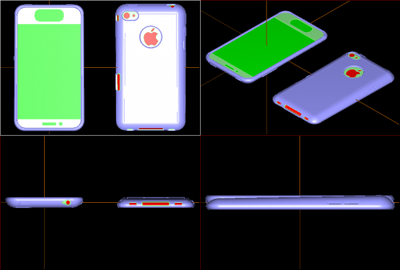
Wu does not have a terribly good track record when it comes to iPhone rumors, and some of the case designs floating around and said to have been designed based on the iPhone 5's form factor instead show a slightly teardrop shape with rounded or tapered edges, with the latter feature much more akin to earlier iPhone models than the iPhone 4. Those cases also suggest that the iPhone 5 may be slightly longer and wider than the iPhone 4, supporting the notion that the device could see a larger display.
Mockup created by bikr
Meanwhile, BGR reports that a "reliable source" at Canadian carrier Telus has revealed that an internal document at the carrier lists an October 1st release date for the iPhone 5. While the listed date could simply be a placeholder, BGR and its source believe that the date could actually be a genuine one given that listings for other upcoming devices do appear to be specific ones rather than placeholders. The report also notes that October 1st is a Saturday, reported to be the busiest day of the week for mobile phone retail stores.
We have significant doubts about this speculation, however, and find the October 1st date to most likely simply be a placeholder given that the date is merely a convenient first of the month and that Apple has not been known to launch new iPhones on Saturdays. In addition, Apple works very hard to keep its carrier partners in the dark about its device plans, with even senior executives at Apple's biggest carrier partners not being clued in to the details of the company's roadmap.
Over the weekend, several reports arose suggesting that retailers Target and RadioShack would be dropping their pricing on the iPhone 4, potentially signaling that the stores are looking to pare down their stocks ahead of an expected update to the line. Ars Technica now confirms that the price drops have indeed taken place, with RadioShack offering a temporary $30 discount on both iPhone 4 capacities while Target is offering $50 off.
We verified Monday morning that Radio Shack has a current promotion running through Saturday, offering the iPhone 4 for $169.99 and $269.99 for the 16GB and 32GB models, respectively. Radio Shack is also offering up to $100 credit for the trade-in of a previous iPhone model, dropping the price to as low as $69 with contract.
We also spoke to contract phone sales representatives from Chicago-area Target stores, who confirmed that the iPhone 4 can be had for $149.99 or $249.99 for 16GB or 32GB models with a two-year contract.
Apple and its partner carriers in the U.S., AT&T and Verizon, continue to offer the iPhone 4 at its usual $199/$299 price points.
RadioShack has been known to offer discounts on the iPhone in the past, most notably knocking $50 off of all models for a week last December.
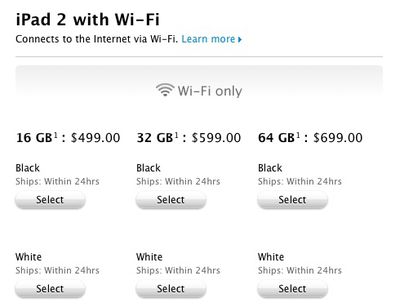
Continuing a months-long trend of improving shipping estimates for the iPad 2, Apple today finally reach its quickest possible turnaround time for the device, moving to "within 24 hours" for shipping through the company's online stores for the United States and Canada. Adding engraving bumps the window out to 1-3 business days.
Shipping estimates in Apple's online stores for most of its other markets appear to remain at 1-3 business days, although they too may be updated in the near future to shift to the faster turnaround.
Apple's online store shipping estimates for the iPad 2 quickly ballooned to 4-5 weeks just as the first deliveries of the device began back in mid-March. Estimates slowly dropped over the following months as Apple began to catch up with demand, finally moving to 3-5 business days just under a month ago and then 1-3 business days the following week.
Earlier this year, major GPS navigation firm Garmin released its first turn-by-turn navigation app for iOS. But rather than having all map data included within the application, Garmin StreetPilot relied on data access to download maps as needed. Garmin touted the decision as offering smaller and quicker downloads with the most up-to-date mapping data, but it also required users to tap into their data plan to use the application and could result in poor navigation in areas of poor or no cell coverage.
To address those issues, Garmin today announced the release of several "StreetPilot Onboard" apps offering full map data bundled within the apps to allow for offline navigation.
Garmin StreetPilot Onboard puts the vast preloaded database and intuitive interface of a Garmin nüvi into the iPhone you use everyday – without tapping into your dataplan. With ultra-fast map drawing, panning and zooming, the preloaded maps and Points of Interest offer peace of mind in knowing that wireless coverage and dataplan usage are not required to access maps or calculate routes. So just as with a nüvi, the maps and directions are always there when you need them most – especially when you can’t get cell or Wi-Fi signals or your dataplan is running low.
Three versions of StreetPilot Onboard are available:
- Garmin U.S.A. ($39.99): Lower 49 states plus a number of Caribbean islands - Garmin N. America ($49.99): United States, Canada, Mexico, and a number of Caribbean islands - Garmin UK & Ireland (£44.99): Full maps of Great Britain, Isle of Man, and Channel Islands, with coverage of major cities in Northern Ireland and the Republic of Ireland.
Real-time traffic and fuel price data are also available as separate in-app purchases.
Just last week, Garmin announced that it had completed its acquisition of German GPS firm Navigon, which itself offers a full suite of two dozen GPS applications for iOS covering various countries and regions.
Apple launched its iCloud.com beta tonight. The beta is intended for developers to test their iCloud syncing functionality, though there has been some confusion about who exactly had access. Early on, it seemed that Apple inadvertently allowed access to more than just developers, but we now hear that Apple has started shutting out these non-developer users.
iCloud is Apple's upcoming syncing and storage service for both iOS 5 and OS X Lion. iCloud (the service) stores your music, photos, apps, calendars, documents and keeps it in sync across multiple devices. iCloud.com (the website) represents Apple's MobileMe website replacement that gives users online access to their Calendar, Email, Address Book, Find My Phone and iWork data. The entire interface borrows heavily from iOS and Lion and incorporates many nice graphical flourishes and animations.
This quick walkthrough video by helpfulmactips2010 shows the different pieces in place:
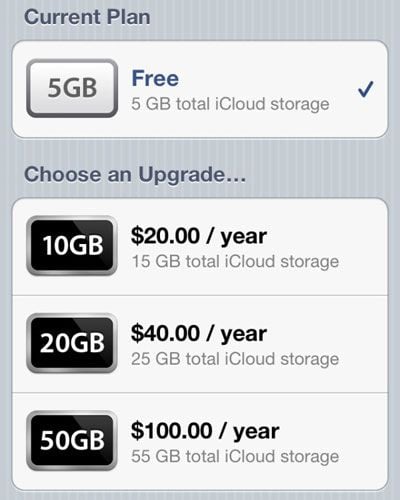
Apple has also revealed the pricing for additional iCloud storage. iCloud comes with 5GB of free storage, and the additional pricing is as follows:
Apple has said that purchased music, apps, and books, as well as Photo Stream, don’t count against your free 5GB storage.
Much more about iCloud should be revealed as the launch nears. Apple has promised that iCloud will launch this fall alongside iOS 5. OS X Lion will also need an update to fully support iCloud.
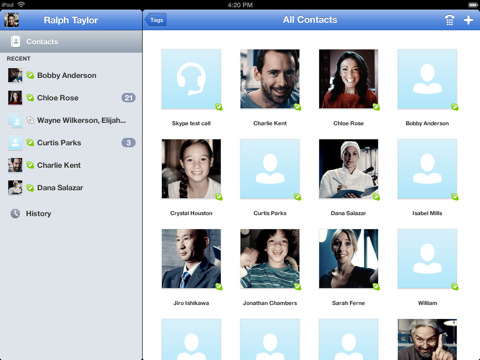
After a brief appearance in the New Zealand app store, Skype for iPad has now launched internationally, including the U.S. The much anticipated iPad app offers Skype users 3G and Wi-Fi phone calls and video conferencing. From the release notes:
• Send and receive video using front or back camera on iPhone 4, iPad 2nd Generation, and iPod Touch 4th Generation. • Send and receive video using rear camera of iPhone 3GS • Receive video only on iPad 1st Generation and iPod touch 3rd Generation
Skype for iPad is a free download [App Store]. Skype for iPhone and iPod Touch remains available as a separate free download [App Store].
Update: Skype says the app was released prematurely, so they've pulled it.
Update 2: As noticed by Macerkopf.de, Skype for iPad has returned to the App Store. Skype has yet to issue an official announcement about the release, however, so it is unclear if this is the official launch or if it is once again being made available prematurely.
TUAW notes that Skype for iPad is finally available in the New Zealand App Store. The release is expected to roll into other countries over time. A promo video for the iPad version of the app was leaked in June and confirmed to be coming to the App Store.
The app was announced over a month ago in late June, but for unknown reasons its release was delayed until now. The iPad version of Skype supports the same features as the iPhone version, and it seems that all features other than two-way video chat are supported on the original iPad. The iPad 2, of course, will have full support for video conferencing via either of its cameras.
Here's the original promo video:
We'll post more when the app becomes available in the U.S. This App Store link will take you to the NZ version for now.
Apple's first foldable iPhone, with a book-style design featuring a ~5.5-inch outer display and a ~7.8-inch inner display with a minimal crease down the middle.









 Apple launched its