MacRumors

airport iconApple today released AirPort Utility 5.5.3 for both Mac (10.8 MB) and Windows (10.1 MB). The updates to Apple's software for managing the AirPort Express Base Station, the AirPort Extreme Base Station, and Time Capsule primarily address an issue that may cause the application to crash during setup.

This update contains bug fixes including the following:

Resolves an issue that caused the AirPort Utility to unexpectedly quit during setup

The Mac version requires OS X 10.5.7 or later, while the Windows version requires a minimum of Windows 7 SP1, Vista SP2, or XP SP3.

Related Forum: Networking

Apple's patent licensing deal with Nokia may have some additional consequences beyond the immediate effects of the settlement. By agreeing to a long-term licensing agreement with Nokia, Apple gets a lengthly, defensive legal fight out of the way. This allows Apple to focus all its legal energies on major battles with Samsung, HTC and Motorola.

Speaking with the NYTimes, Apple indicates that the settlement is actually a cross-licensing one:

Apple and Nokia have agreed to drop all of our current lawsuits and enter into a license covering some of each other’s patents, but not the majority of the innovation that makes the iPhone unique. We are glad to put this behind us and get back to focusing on our respective businesses.

There a larger, much more strategic victory here as well. By agreeing to pay royalties for Nokia's patents, Apple has set a market price -- and given Nokia's patents serious legitimacy. Apple wouldn't pay anything if they didn't have to, and other companies may not want to fight over turf Apple has already acquiesced to Nokia.

jobs
Other companies, notably Android handset manufacturers, may now have to play ball with Nokia on these patents -- and they don't necessarily have the margins to send 1% of gross revenues to Nokia as easily as Apple can. In fact, because Apple has so many of its own patents (some of which it cross-licensed to Nokia) other manufacturers may have to pay even more for the same licenses.

Florian Mueller has suggested just that at FOSS Patents:

Given that Android is in many ways a rip-off of Apple's operating software, Android-based devices are highly likely to infringe on largely the same Nokia patents that Apple now felt forced to pay for.
[...]
This is a sweet defeat for Apple because its competitors -- especially those building Android-based devices -- will also have to pay Nokia, and most if not all of them will likely have to pay more on a per-unit basis because they don't bring as much intellectual property to the table as Apple definitely did.

Apple pays off Nokia, but exposes the competition as well. Competition that doesn't have as much money or intellectual property to barter with.

(Photo by Acaben/Flickr)

3D iPad?
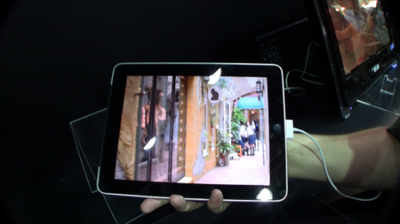
Could Apple shove a high-resolution 3D display in the iPad? Maybe! And that's just what Netbook News claims to discovered at the Display Taiwan tradeshow. They've got pictures and video of what is claimed to be an iPad 1 with a different, 3D, "very high resolution display".


We're pretty skeptical, but wanted to give you a chance to decide for yourself.

Related Roundup: iPad
Buyer's Guide: iPad (Caution)
Related Forum: iPad

nokialogoDeutsche Bank analyst Kai Korschelt today estimated that Nokia will be receiving on the order of a 420 million euro ($608 million) lump-sum payment from Apple as part of a patent litigation settlement between the two companies.

The estimate, based on previous patent-related settlements in the industry, assumes a 1 percent royalty rate on all iPhones sold through the first quarter -- 110 million phones at an average selling price of $550. Korschelt also says that Apple would likely send Nokia recurring revenue payments covering future iPhone sales at the same rate, payments that would come in at around 95 million euros ($137.6 million) per quarter based on current sales, to cover ongoing licensing.

It's a significant sum for Nokia. The Finnish company is feeling tremendous pressure in the market as it abandons its old Symbian-based smartphone strategy and transitions to Microsoft's new Windows smartphone OS.

A report from Japanese analyst house Nomura, which got quite a bit of coverage yesterday, stated that the situation at Nokia was so poor that Samsung -- and perhaps even Apple -- would pass the Nokia in smartphone shipments this quarter. Of course, Nomura's numbers are based on an expectation of a massive drop in sales from Nokia as it transitions operating systems -- think the entire continent of Europe suddenly not buying Nokia phones -- plus a near doubling in smartphone sales by Samsung over the previous quarter. Samsung's mobile phones have been booming on the strength of Android, but that much growth in one quarter seems unlikely. Nokia is in trouble, but almost certainly not that much trouble.

Robert Cozza, mobile devices analyst at Gartner, poured water on Nomura's report, telling MacRumors:

In 1Q11 Nokia smartphone sales were double those of Samsung, so it seems optimistic to see this overtake in 2Q. If Nokia's new Symbian devices will fail with consumers over the next couple of quarters then we could see this overtake from Samsung on Nokia happening in 3Q.

MacRumors also spoke to Ramon Llamas at IDC about Nokia's chances:

Nokia is very fast at turning things around. They're currently in transition mode, and anytime you're going to be transitioning from the way things have been to the way things are going to be, it's not going to be without some series of dips in revenue.

Nokia has just provided the overall smartphone market with a gift: it's exposed itself and its vulnerabilities to everyone else. Lots of vendors are going to be able to turn up the heat.

And now Nokia gets to enjoy a little bit of the spoils from Apple's success as well. Time will tell if they can turn it around themselves.

Related Forum: iPhone

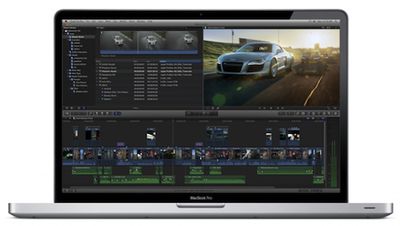
Japanese blog Mac Otakara reports that Apple is apparently set to launch its new Final Cut Pro X offerings next week, to be accompanied by the release of a number of new Thunderbolt-equipped accessories from third-party vendors.

fcp x mbp
Apple demoed Final Cut Pro X back in mid-April, announcing that the professional video production software would launch on the Mac App Store in June priced at $299. Apple has yet to release any official word on the other components of its Final Cut Studio package or its lighter-weight Final Cut Express software. A number of screenshots from Final Cut Pro X and related applications have also leaked in recent days just ahead of the software's launch, but the full details remain unknown.

Apple debuted the new Thunderbolt high-speed data and display connectivity standard on revamped MacBook Pros back in late February, extending the feature to its iMac line just last month. Third-party vendors have been showing off new Thunderbolt-equipped peripherals, but few have made it to market so far. If today's report is true, it seems that Apple will be taking advantage of the Final Cut Pro X debut to also roll out new Thunderbolt peripherals, devices that video professionals will almost certainly find useful in moving large files around quickly.

ron johnsonThe Wall Street Journal is reporting that Apple Senior Vice President of Retail Ron Johnson is leaving the company to take the position of president at department store chain J.C. Penney, a move that will put Johnson in position to become CEO at the company within the next few months.

J.C. Penney Co. is tapping Ron Johnson, head of Apple Inc.'s iconic retail stores, as its new president and eventual chief executive, people familiar with the situation said.

The company is expected to announce Mr. Johnson's appointment later today. Mr. Johnson will become CEO in the next few months, succeeding long-time leader Myron "Mike" Ullman.

Johnson, who came to Apple eleven years ago from Target, has been credited with being the driving force behind Apple's runaway success in its retail store initiative that has grown to include 325 stores worldwide. Johnson has also been a fixture at many of Apple's highest-profile retail store openings around the world.

Johnson's philosophy for Apple's retail stores has been to "create a place that people will love", focusing on the customer experience rather than simple square footage or sales metrics, although Apple's retail stores are of course performing extremely well by sales measures as well. During his tenure at Apple, he oversaw the entire retail store development process, from the original stores in Tysons Corner, Virginia and Glendale, California to the iconic buildings now located in a number of cities around the world.

Update: J.C. Penney has officially announced that Johnson will assume the CEO position on November 1st and that Johnson will personally make a long-term $50 million investment in J.C. Penney as a sign of his confidence in the future of the company.

Mr. Johnson said, "I've always dreamed of leading a major retail company as CEO, and I am thrilled to have the opportunity to help J. C. Penney re-imagine what I believe to be the single greatest opportunity in American retailing today, the Department Store. I have tremendous confidence in J. C. Penney's future and look forward to working with Mike Ullman, the Executive Board and the Company's 150,000 associates to transform the way America shops."

Update 2: J.C. Penney's stock is up over 10% on news of Johnson's appointment. Apple's stock has been fluctuating a bit, but is only down slightly since the news broke.

Update 3: Apple has issued a statement to All Things Digital wishing Johnson well and noting that the company is "actively recruiting" for his replacement.

"Ron is excited about this opportunity and we hope it goes well for him," a spokesperson said. "We've got a great retail team in place and are actively recruiting for his replacement."

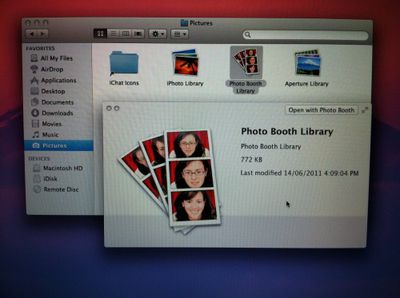
Recent versions of iPhoto and Aperture have ditched the open folder system for a more secure "Library" format and, in Lion, Photo Booth takes the plunge as well.

Photo Booth Library
The main reason for the switch from an open folder system to a closed, self-contained library is to keep more inexperienced users from breaking iPhoto by trying to "clean up" their computers.

The old iPhoto library was a mass of confusing folders, with dozens and dozens of folders. There were folders organized by date, with thumbnails, by master versions and more. Users who didn't know any better would frequently try to delete photos by going directly to the iPhoto Library folder and erasing files en masse. All they would do was break iPhoto.

Now all Apple's photo apps: iPhoto, Aperture, and Photo Booth have self-contained "libraries" to keep users out. The photos inside are only supposed to be opened by the applications that created them -- it's just like the file system on the iPad. Invisible, unalterable, and only to be opened by the application that created them.

Steve Jobs' quest to eliminate the file system continues.

Thanks Henry!

Late last month, Samsung attempted to escalate its patent dispute with Apple by requesting to see Apple's next-generation iPhone and iPad models, ostensibly to help it defend itself against Apple's charges of copying and other infringement. The request was made after Apple requested and was granted access to unreleased Samsung hardware, although that hardware had already been extensively advertised and demoed by Samsung.

samsung logo
FOSS Patents now reports that Apple has filed a response to Samsung's request, referring to the move as an "improper attempt to harass" Apple by requesting to see secret hardware that bears no relevance to Apple's claims against Samsung. From Apple's filing:

Samsung's Motion to Compel is an improper attempt to harass Apple by demanding production of extremely sensitive trade secrets that have no relevance to Apple's likelihood of success on its infringement claims or to a preliminary injunction motion. Apple made a compelling showing in its motion to expedite discovery that Apple needs samples of products that Samsung has already announced, distributed, and described, so that Apple can evaluate whether to file a preliminary injunction motion against those products, which look strikingly similar to the distinctive trade dress of Apple's current products. Samsung has made no such showing about Apple's future products. Therefore, Samsung's Motion to Compel should be denied.

Samsung has until this Friday to produce the samples of unreleased hardware to Apple, after which time Apple will decide whether to proceed with a request for a preliminary injunction barring Samsung from selling the new products, a move that could give Apple significant leverage in extracting a settlement from Samsung. This Friday should also see a ruling on whether Samsung will be permitted access to Apple's next-generation hardware.

unlocked
As predicted, Apple has started selling unlocked (GSM) iPhone 4 devices in the U.S. early this morning.

If you don't want a multiyear service contract or if you prefer to use a local carrier when traveling abroad, the unlocked iPhone 4 is the best choice. It arrives without a micro-SIM card, so you'll need an active micro-SIM card from any supported GSM carrier worldwide.

Pricing starts at $649 for a 16GB model and $749 for 32GB model. Both White and Black models are offered.

The main advantage of buying an unlocked iPhone is for international travel, as the device is not dependent on any particular carrier. The U.S. only has one network (AT&T) which fully supports all the features of an unlocked GSM iPhone. T-Mobile is compatible with voice calls, but the 3G network is not compatible. The higher price of the iPhones reflect no-contract pricing as well as the unlocked status of the device. While the iPhone 4 had been sold unlocked in other countries, this is the first time Apple has offered them in the U.S.

Related Forum: iPhone

nokia
Reuters and Engadget report that Nokia has entered into a patent license agreement with Apple. From the press release:

Nokia announced that it has signed a patent license agreement with Apple. The agreement will result in settlement of all patent litigation between the companies, including the withdrawal by Nokia and Apple of their respective complaints to the US International Trade Commission.

The financial structure of the agreement consists of a one-time payment payable by Apple and on-going royalties to be paid by Apple to Nokia for the term of the agreement. The specific terms of the contract are confidential.

Nokia first filed a patent suit against Apple in October 2009 and the dispute has escalated since then with the two companies filing multiple new claims against each other. This should end one of the Apple's biggest patent disputes, but many others remain active.

While FOSS Patents sees this as a clear win for Nokia, they also suggest it may help Apple a bit as Android manufacturers are likely to also be affected.

Nokia emerges victorious, but this is a sweet defeat for Apple because its competitors -- especially those building Android-based devices -- will also have to pay Nokia, and most if not all of them will likely have to pay more on a per-unit basis because they don't bring as much intellectual property to the table as Apple definitely did.

Buried in a Reuters report this evening about the imminent launch of the MacBook Air, there was a single sentence nonchalantly stating that the iPad 3 would launch in the fourth quarter of this year with a screen resolution "5-6 times" higher than the iPad 2.

The numbers seemed absurd so we tracked down the original Economic Daily News report which only made it sound slightly less unbelievable. Thanks to translation assistance from @wayyuen, @wongwil, @agleung and Micah Fisher-Kirshner, here's the relevant portion in English:

Apple dominates the tablet computer market in the year of 2010; In 2011, a huge number of tablet computers have been introduced and given a general threat to Apple's leading status, Apple is thinking to give an aggressive counteroffensive.
....
Apple, in order to maintain a leading position, plans to launch iPad 3 in the fourth quarter by shortening the iPad Product life cycle. And also, try to push the screen resolution of iPad 3 to 2560x1920 , which is the ultimate resolution a 9.7 Inch Panel can achieve and doubles "Full HD".

The reasoning behind a second iPad update in 2011 is that Apple's competitors have been purely reacting to the launch of the iPad 2, and while they are ramping up their launches for later this year, Apple plans to trump them again by launching the iPad 3 quickly.

123254 ipad 4 2 profile

While we might have just dismissed the report in its entirety, this actually isn't the first time we've heard this line of reasoning. In February before the launch of the iPad 2, both DaringFireball and TechCrunch seemed to believe that Apple would make such a move. DaringFireball wrote at that time:

Thus, my gut feeling is that Apple will move the iPad to a September release schedule, alongside the iPods. But they wouldn't want to wait over a year and a half from the announcement of the original iPad to announce the second one -- not with these stakes, and not with so many serious competitors trying their best to catch up.

Perhaps the most unbelievable part of the story, however, is that Apple might try to reach a resolution of 2560x1920 in the new device. That resolution would be over 6x the number of pixels of the current iPad, and 2.5x the linear resolution in each dimension. The closest display we've heard of is Samsung's announcement of a 2560x1600 10.1" LCD display in May. Apple has been rumored to be bringing a "Retina" display to the iPad 3, though there has been little talk of it recently. To further add to the doubts, component manufacturers seem to be expecting the iPad 3 to arrive in 2012.

Economic Daily Times has been a spotty source of Apple rumors, so we don't have much confidence in this report, but felt it an interesting discussion piece given the previous "iPad 3 in 2011" rumors.


Related Roundup: iPad
Buyer's Guide: iPad (Caution)
Related Forum: iPad

itunes music card 100
Following a couple of missed rumored launch dates, a report surfaced over the weekend indicating that Apple will finally be launching its annual Back to School promotion this Wednesday. A new report from 9 to 5 Mac corroborates that claim and adds a new wrinkle -- instead of a free iPod as in years past, Apple will be offering $100 iTunes gift cards to education customers purchasing new Macs.

In year's past, Apple's Back to School promotion offered students their usual educational discount plus a free iPod with any purchase of a Mac. This year, 9to5Mac has been told, will be very different. In fact, Apple will not be offering free iPods during this promotion but will instead offer a $100 iTunes gift card.

Such an offer will likely be a letdown for a number of users who have been holding out on Mac purchases in hopes of picking up a free iPod. The free iPod offer has typically been good for the low-end iPod touch, which usually comes in in the $200-$230 range, meaning that this year's offer would contain considerably less value and be for media rather than hardware.

Tag: 9to5Mac

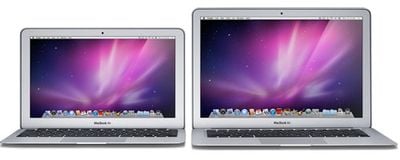
094654 mba

A brief Reuters report relays information from Taiwan's Economic Daily that claims that the new MacBook Air will go on sale in late June.

The paper seems to cite the same production numbers from an analyst report earlier this week, but adds the "late June" timeframe for launch.

The new Sandy Bridge-based MacBook Airs have been rumored to be coming in the June-July timeframe.

Related Roundup: MacBook Air
Related Forum: MacBook Air

We're not sure the motivation behind it, but it appears that Apple will be launching unlocked version of the iPhone 4 to Apple Retail stores sometime this week. The rumors started with some confusion over the weekend when there was a claim that Apple would finally be releasing the new MacBook Airs this Wednesday.

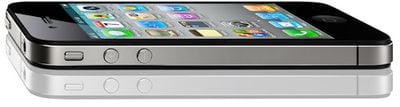
iphone 4 side shot

As it turns out, there was a misinterpretation with the parts numbers that Apple sent to retail stores. The part numbers actually correspond to unlocked iPhone 4s, not new MacBook Airs. Apple has sold unlocked iPhone 4s internationally but never in the U.S. Unlocked mobile phones are simply less in demand in the U.S. due to the fragmentation in service amongst U.S. carriers.

"Unlocked" simply means that a mobile phone is not tied to any particular carrier. In Europe, customers can buy an Unlocked phone and easily switch between carriers by simply replacing the SIM card. In the U.S., users could theoretically switch between AT&T and T-Mobile in this manner for voice calls, but 3G service is not compatible between the two carriers. This is what makes the sale of unlocked iPhone 4s in the U.S. so strange.

But the word we've received is that they've shipped to Apple Stores this week and that they will be priced at $649 and $749 for 16GB and 32GBs, respectively. The higher price reflects the lack of long term contract that normally accompanies a mobile phone purchase as well as the unlocking.

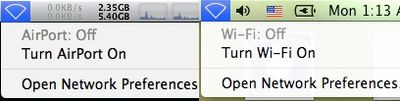
Not all the updates in Lion are huge, world-altering features, but for those switching from Windows to Mac, this one might make life a little easier. Apple appears to be dropping "Airport" from its preferred vocabulary, instead adopting the more widespread "Wi-Fi".

Airport vs. Wi-Fi: Before and After
Left: Snow Leopard, Right: Lion

Apple Stores have been running low on AirPort Extreme, AirPort Express, and Time Capsule wireless base stations recently and new devices have been anticipated for several weeks. It is possible that a name change will accompany a product refresh.

Wi-Fi has been the preferred term for wireless internet connectivity for most of the tech world , and, notably, iOS applications, for a long time, but AirPort has been Apple's name for the various 802.11 standards since 1999 when Steve Jobs introduced the first iBook with Wi-Fi capabilities.

The AirPort name has never really been used outside Apple, but the term Wi-Fi has become more and more popular over the years and it seems Apple has finally acquiesced to popular vernacular.

Thanks Oded!

Related Forum: Networking

While Apple's iCloud introduction at WWDC offered a lot of new information, Apple has been quiet as to exactly what this means to the future of MobileMe's web apps such as email and calendar. In fact, it took a Steve Jobs email to find out the fate of Apple's iWeb hosting services.

Today, ThisisMyNext posted a somewhat controversial clarification they received from Apple PR indicating that MobileMe's web apps will no longer be maintained come June 30th, 2012.

Let's be clear about what happens when iCloud goes live -- according to what was described on stage at the event, and what I've confirmed with Apple PR —--the service will effectively replace the current web offerings of MobileMe. That means that when the cutoff date of June 30, 2012 comes around for users, the web-based email client, calendar, contacts app, and other components of the web suite will cease to exist.

But it seems that isn't the entire story. Apple has already started mirroring at least some of the existing MobileMe functionality on iCloud.com as well.

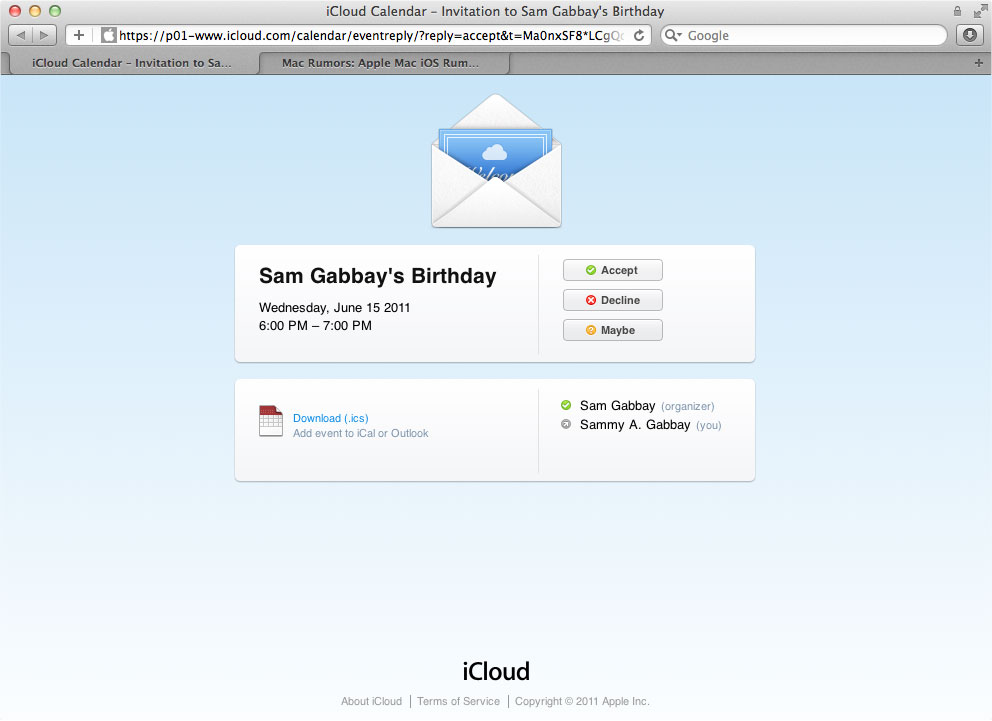
One reader was able to send themselves a Calendar invitation in iOS 5 and found themselves linked to the iCloud.com domain. The invite (pictured below) is visually identical to current MobileMe invitations but carries the iCloud branding and is hosted on the iCloud.com domain:

icloud
Following this iCloud link shows an iCloud based error page in the same theme.

So, Apple does appear to be working on the web support interface for iCloud but isn't ready yet to talk about it, and at least some of the functionality appears to be based on the existing MobileMe codebase.

A few of the hundreds of "new" features in iOS 5 were "appropriated" from other developers. One, the ability to trip the iPhone camera shutter by pressing the Volume Up button instead of pressing a soft-button on-screen, came from a hidden feature that iOS developer tap tap tap included in a version of Camera+, an iPhone camera replacement app.


As an added bonus, if you press the Volume Up button on the Apple Earphones with Remote and Mic that comes with every iPhone that will trip the shutter as well.

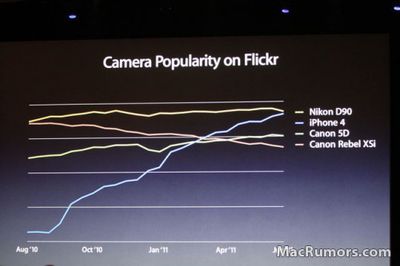
It's a pretty clever trick, and for those who use the iPhone to take pictures -- of which there are many (see below) -- it might come in handy. Combine the iPhone and headphone remote with a simple tripod/stand like the Glif, and you've got a cheap-and-functional camera rig.

camerapopularityflickr

Hat tip to Cult of Mac, and Charles for the video.

Related Forum: iPhone

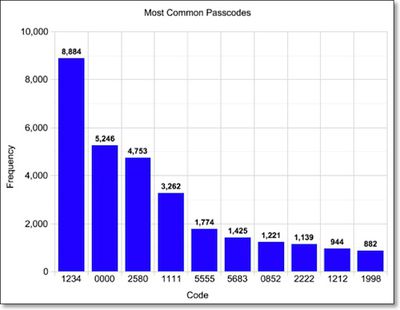
passcode frequency
iOS developer Daniel Amitay today took an interesting look (via The Next Web) at iPhone passcode trends as revealed by usage of his popular Big Brother Camera Security application.

In my last update to Big Brother Camera Security (Free), I added some code to record common user passcodes (completely anonymous, of course). Because Big Brother's passcode setup screen and lock screen are nearly identical to those of the actual iPhone passcode lock, I figured that the collected information would closely correlate with actual iPhone passcodes.

Perhaps unsurprisingly, the most popular passcode for the app was "1234", a choice made by about 4.3% of users. Other popular codes include ones with repeating numbers (such as "0000" and "1111") and patterns on the keypad (such as "2580" and "1212"). All told, Amitay discovered that 15% of the over 200,000 passcodes captured by his app were represented by just ten different passcodes.

The implication? A thief (or just a prankster) could safely try 10 different passcodes on your iPhone without initiating the data wipe. With a 15% success rate, about 1 in 7 iPhones would easily unlock--even more if the intruder knows the users' years of birth, relationship status, etc.

Beyond the passcodes representing repetitive and patterned entries, Amitay found a higher-than-expected frequency of passcodes in the 1980-2000 range, suggesting that users are prone to using their birth years or years of other significant events in their lives as their passcodes.