According to a new report from DigiTimes, Apple has pushed orders with its suppliers for iPad production well beyond two million units for the month of July, marking a continued increase in supplies as the company seeks to keep up with demand in existing markets as well as expand into new countries.
Apple is estimated to have outsourced 2.3-2.35 million iPads to Taiwan players in July with 58-60% for the Wi-Fi and 3G hybrid model despite Wi-Fi only models having stronger sales in the first half of 2010, Kuo noted.
It was less than a month ago that DigiTimesestimated iPad production at having ramped to 1.2 million per month, with plans to move to 2.5 million per month by the end of year. If DigiTimes' latest report is correct, Apple appears to already be approaching its planned monthly production capacity nearly six months early.
After limiting initial availability to the United States, Apple launched the iPad in an additional nine countries in late May. The company's next round of international launches, set for later this month, includes Austria, Belgium, Hong Kong, Ireland, Luxembourg, Mexico, Netherlands, New Zealand and Singapore.
While Apple's iPhone 4 signal loss issues have been receiving significant attention since the device's launch late last month, a number of other problems have been seeing sporadic reports, and one of the most prevalent of late has been problems with the device's proximity sensors designed to sense when the phone is held up to the user's face and deactivate the device's screen, thus preventing unintended activation of buttons on the display.
Noted early on, the topic has received considerable attention on Apple's support discussions and in our own forums (1, 2, 3), with users reporting either that the proximity sensors fail to turn off the display during calls, resulting in unintended hangups and other actions, or that the sensors failed to turn the display back on after a call, resulting in a black screen.
Macworld has summarized the effort of those seeking to address the issue, with some users reporting success with resetting some of their iPhone's settings.
Many affected users report that either a Settings reset or a hard reboot fixes their problem. One Apple support thread recommends that users open the Settings app, then go to General -> Reset, and choose "All Settings" at the top (note: this will not erase your apps, media, or other data -- that's what the "Erase All Content and Settings" button just below this option is for. "Reset All Settings" just reverts any Settings preferences you've customized back to their factory defaults). One Twitter follower, Brian Partridge, reported that AppleCare told him to just use Reset -> Reset Network Settings, not all settings, and it worked.
While many users have reported being unable to replicate the issue, suggesting that it may not be a universal fault, a significant number of users are experiencing proximity sensor-related problems. Apple has yet to comment on the issue, and it is unclear whether it is a hardware or software problem, although the majority of observers are leaning toward the software explanation. If so, users can hold out hope that a simple software update, such as that planned for the signal strength issue in the next few weeks, may be able to fix the issue.
The Financial Times offers an interesting piece highlighting the views of Lenovo CEO Liu Chuanzhi on Steve Jobs and Apple's efforts to penetrate the rapidly-growing Chinese market where Lenovo leads in PC sales with 30% of the market. In particular, Liu notes that Lenovo is lucky that Apple "doesn't care about China" or else it could see itself being "in trouble".
Speaking of Apple's chief executive, Lenovo's founder and chairman, told the Financial Times: "We are lucky that Steve Jobs has such a bad temper and doesn't care about China. If Apple were to spend the same effort on the Chinese consumer as we do, we would be in trouble."
Evidence is mounting, however, that Apple may be beginning to take the Chinese market more seriously, with the company announcing earlier this year that it plans to open up to 25 Apple retail stores in the country within the next two years. In fact, the company is planning a grand opening this weekend for its first store in Shanghai, the company's second store in the country following the Beijing store opened in time for the 2008 Summer Olympics there.
As Silicon Alley Insider points out as well, Apple executives noted during the company's most recent earnings conference call that revenue from "greater China" including Hong Kong and Taiwan totaled $1.3 billion for the first six months of fiscal year 2010, up over 200% year-over-year.
Earlier today a report on TheNextWeb claimed that the App Store had been hacked and that a rogue developer had gamed the system by artificially driving sales to their eBooks. The rise in ranks were noted by competing developers who thought the rise strange given that the books all represented poorly coded Vietnamese-based books.
A couple of reviews left on one of the books revealed that at least two customers had their iTunes accounts compromised to purchase the books. This led to theories that a widespread attack specifically tied to this developer could be the cause of the rise in ranks. Which then led to a cascade of headlines suggesting that everyone's iTunes account was suddenly vulnerable to a coordinated attack. While we do believe that this developer had been trying to game the iTunes ranking system, it's hard to believe that their efforts affected more than a few hundred accounts worldwide.
The Book category in which we found these apps (note, they've been pulled from the App Store) is one of the lowest trafficked categories in the App Store. Based on sales reports we've received from developers, the number of daily sales required to hold a book in the #10-#50 rank seems to range from 50-250 sales a day. That means that even if every sale was based on a compromised account (unlikely), the actual number of accounts involved are minuscule compared to the 100 million active iTunes accounts.
Now, on a separate note, the issue of hacked or compromised iTunes accounts is a major issue, and one not to be dismissed. However, this issue has been ongoing for years and we're not convinced there has been a major spike in activity. iTunes accounts are easy targets since they are so common. In our forums we have had a running thread on the topic since January 2008. A few reports appear every few months. There do seem to be a higher number of reports arising the past day or two of other iTunes accounts being hacked. It's certainly possible there has been an acute rise in the past few days, but the added press coverage will certainly attract more stories. Meanwhile, a blog post from 2009 similarly attracted a number of "me too" reports. The cause of the iTunes accounts to be compromised are almost certainly due to phishing attempts and the like rather than any insecurity on Apple's iTunes, itself.
It's still a good idea to make sure your accounts are safe, and especially important to make sure you have good (and different) passwords on all your sensitive accounts. Common mistakes include easy to guess passwords and shared passwords across multiple accounts.
A couple of discoveries have revealed early Mac support for the high end ATI and NVIDIA graphics cards, raising hopes that Apple will soon be updating their desktop computers. Both the Mac Pro and iMacs are overdue for product refreshes with no solid timeframe for either update.
The newly released Mac mini has revealed a new set of ATI drivers buried within its default Mac OS X installation. New Macs always have a slightly newer version of the system software installed that provides support for the new hardware. In this case, the software also revealed early support for the ATI Radeon 5 series. Some tinkerers have been able to use the software to drive an ATI Radeon 5870 on an actual Mac Pro. Meanwhile, a recent NVIDIA Driver release have shown references to NVIDIA GeForce GTX 400 series support.
For the masses, neither release is particularly useful, but does remind us that Apple's desktop line is overdue for update. There has been talk of Mac Pro updates for months, but no clear timeframe when it might happen.
Addressing yesterday's report of cloud-based iTunes streaming coming "soon", CNET's well-connected Greg Sandoval reports that things still may not be as far along as many observers would like, as music labels have reportedly yet to sign on to the deal.
While it's hard to say what Boy Genius' source meant by "soon" it's worth noting that Apple has yet to obtain necessary licenses from the top four recording companies, according to multiple music industry insiders. They added that Apple has indeed engaged in discussions with the music labels but the record execs haven't even seen all of the details yet.
The way some at the major labels see the situation, Apple could enable iTunes users to stream songs from a home computer to other gadgets without requiring new negotiation, but for Apple to stream music from the company's servers to computers and other gadgets, the labels would require CEO Steve Jobs to cut a new deal, the sources said.
The report notes that Apple could try to press the issue and roll out a cloud-based streaming service without negotiating new deals with the music labels, although it would likely find itself in court to address whether such usage is permitted under current licenses.
So, unless Apple is ready to go to war over this, don't expect an iTunes cloud service--at least one offering music--anytime soon. Music insiders say that while that the whole sector would welcome an iTunes cloud service, negotiating the licenses will likely take months.
The possibility of a cloud-based streaming service for iTunes has been a hot topic of conversation since Apple's acquisition of music streaming firm Lala Media late last year, as users look forward to the ability to access their music on a variety of Internet-connected devices without the need for manual syncing of content or significant local storage requirements.
The New York Times reports that Apple is preparing to launch a significant revamp of its television-related offerings, targeting at least a software overhaul for the company's Apple TV while an entirely new hardware product remains a possibility. According to the report's sources, Apple has recently hired a number of new user interface designers with backgrounds in television broadcast design as the company seeks to modify its iOS platform for use in the living room.
They said it was not clear whether the company would create an entirely new product as well as updating the software. They also said Apple might base a new television design on its iOS operating system, which is on the iPhone, iPad and iPod Touch.
Notably, one former Apple employee reported that much of the work has been taking place outside of the company's Apple TV group, suggesting that an entirely new hardware product might be in the works.
Just over a month ago, Engadgetreported that Apple is preparing a dramatic overhaul of the Apple TV hardware, planning to offer a new device "based directly on the iPhone 4" with the capability for 1080p HD output and only limited onboard storage, as the device would primarily stream media from the Internet. The revamped Apple TV was also said to be set to carry a price tag of only $99.
On a separate note, Piper Jaffray analyst Gene Munster today released a report continuing to beat his drum predicting a future Internet-connected television from Apple. He sees the inclusion of an HDMI port on the new Mac mini and the rumors of a revamped Apple TV set-top box as part of a progression that will lead to the launch of an actual Apple television with integrated iTunes/Internet access within two to four years.
Apple today released a public statement regarding user complaints of reception issues on iPhone 4, noting that the issue is simply a software one relating to how the number of bars of signal strength displayed is calculated. The apparent significant drop in signal while touching the lower left corner is actually a result of the phone reporting too many bars while not being held.
We have discovered the cause of this dramatic drop in bars, and it is both simple and surprising.
Upon investigation, we were stunned to find that the formula we use to calculate how many bars of signal strength to display is totally wrong. Our formula, in many instances, mistakenly displays 2 more bars than it should for a given signal strength. For example, we sometimes display 4 bars when we should be displaying as few as 2 bars. Users observing a drop of several bars when they grip their iPhone in a certain way are most likely in an area with very weak signal strength, but they don't know it because we are erroneously displaying 4 or 5 bars. Their big drop in bars is because their high bars were never real in the first place.
To address the issue, Apple will be issuing a software update "within a few weeks" that will adjust how signal strength bars are calculated and displayed. The change will adopt a recently recommended formula from AT&T that will more accurately display actual signal strength at any given time. The update will also increase the size of the smaller bars (1, 2, and 3) to make them easier to see.
The update will also be available for the iPhone 3GS and 3G, which are also affected by the miscalculated signal strength indicators.
We have gone back to our labs and retested everything, and the results are the same - the iPhone 4's wireless performance is the best we have ever shipped. For the vast majority of users who have not been troubled by this issue, this software update will only make your bars more accurate. For those who have had concerns, we apologize for any anxiety we may have caused.
Finally, the company notes that it is allowing customers still unsatisfied with iPhone to return their device for a full refund within 30 days of purchase, provided that the phone is undamaged.
The conversation was published Thursday by The Boy Genius Report and linked to by more than three dozen other sites. In it, a writer pretending to be Apple's CEO tries several times to mollify a customer called "Tom" who is furious about the iPhone 4's widely reported signal attenuation problem. In separate e-mail messages Jobs purportedly tells "Tom," who grows angrier with each exchange.
Boy Genius Report had originally published and vouched for the emails claiming the exchange was legitimate. Apple PR says the entire conversation was fabricated. The statements originally attributed to Steve Jobs included:
"No, you are getting all worked up over a few days of rumors. Calm down." "You are most likely in an area with very low signal strength." "You may be working from bad data. Not your fault. Stay tuned. We are working on it." "Retire, relax, enjoy your family. It is just a phone. Not worth it."
Note that even before Apple PR's response, BGR had already retracted the last statement that they had originally attributed to Steve Jobs. The "Retire, relax, enjoy your family. It is just a phone. Not worth it." statement was later attributed to the customer, not Steve Jobs. Though, now it appears the entire exchange was fabricated. Adding further doubt to the motivation behind the original email poster, AppleInsider reports that the emailer had shopped the story around to several sites. It's not clear if BGR paid for the the rights to publish the story.
TechCrunch reports that Palo Alto-based iOS development firm Tapulous has been acquired by Disney. Tapulous, the company beyond the popular Tap Tap Revenge series of rhythm tapping applications, was reported last December to have a staff of 20 employees and be bringing in nearly a million dollars per month in sales.
Tapulous has been acquired by Disney. The iPhone gaming startup with several hits on its hands was founded by Bart Decrem, who will join Disney as a VP. COO Andrew Lacy is also joining Disney as a VP. Disney is very interested in social and mobile gaming, having recently invested in Playdom's $33 million round.
Long an App Store staple on the iPhone, Tapulous moved onto the iPad earlier this year with the release of Tap Tap Radiation.
The acquisition is notable not only as an example of small development firms being able to see significant enough success to appeal to major media players, but also for Disney's connection to Apple CEO Steve Jobs, who is the company's largest individual shareholder.
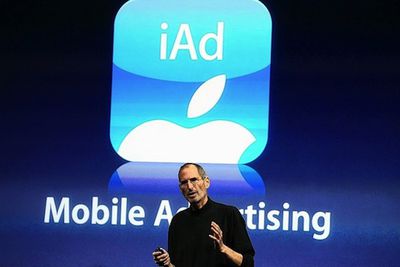
Last week, we noted that developers had begin incorporating support for Apple's iAd mobile advertisements into updates for their applications, with a few applications starting to show placeholder banners and test ads ahead of the program's official launch on July 1st. Right on time, iAd advertisements have begun to go live, although their presence appears to be very spotty on iAd-compatible applications at the moment with banners appearing only occasionally while at other times the apps simply show blank space in the banner location.
One iAd we've run across (in Tiptitude) is for the Nissan Leaf, a forthcoming electric car set to launch in December of this year but already receiving considerable buzz and reservation interest. The ad should be no surprise, as it was demoed by Apple CEO Steve Jobs during his keynote at the company's Worldwide Developers Conference early last month.
The ad appears as a small banner in compatible applications and carries a distinctive "iAd" mark in the lower right corner for identification purposes. Tapping the ad launches a full-screen interactive experience, and users may exit the ad at any time and return to their application by clicking the "X" button at the top left of the iAd.
As with the demonstration version shown by Jobs, Nissan's official iAd offers a video and audio intro before launching into an interactive interface where users can learn more about the Nissan Leaf and register their interest in the vehicle.
Update: Nissan and ad agency Chiat/Day have released a video overview of the new Leaf iAd.
Ten One Design, the makers of capacitive styluses such as the Pogo Sketch, have released a demo video showing pressure sensitive drawing on the iPad.
The demo uses a standard Pogo Sketch stylus and pulls additional data from the iPad's touch screen to simulate pressure differences by measuring area of contact between the stylus and the iPad itself. They also incorporated palm rejection algorithms from their Inklet product to prevent detection of extraneous touches from your palm.
Unfortunately, they utilize private frameworks to access the data. Typically, Apple does not allow App Store apps to take advantage of private frameworks as they may change over time. Ten One Design is hopeful that the public UIKit framework could be updated to allow access to the additional data. If that happens, they plan on releasing their code as a free software library so it can be included in any App Store app.
Boy Genius Report claims to have received information from an Apple source noting that the company is finally gearing up to launch its cloud-based iTunes initiative, a program that will also included wireless syncing for devices.
We have been told iTunes will be getting a huge cloud capability that many people have been asking for (and logically thought would happen sooner or later). These new capabilities are broken down into three groups:
1. Streaming music and movies from Apple's servers to your computers, devices, etc. 2. Streaming music and movies from your home computers to your other computers, remote devices, etc. 3. Wireless iTunes syncing with devices
The report claims that Apple's cloud-based streaming service will allow "pretty much any" Apple device with Wi-Fi capabilities to stream purchased content stored on Apple's servers. Home-based streaming is expected to work in a similar fashion, allowing users to access content stored on other devices as is supported in a limited fashion for some devices today. Apple CEO Steve Jobs addressed the topic of syncing media to the cloud at the All Things Digital conference last month, noting that the company is "working on it".
As for wireless syncing, which Jobs also recently promised "someday", the report claims that apps purchased on iOS devices will immediately sync back to the devices' host computers, with syncing of calendars, notes, and contact also supported as can be accomplished by MobileMe syncing today.
Finally, the source adds in a brief hardware claim, pointing to Apple's traditional iPod-focused media event, usually held in September, as a venue for the introduction of at least "two new devices with camera/camcorder capabilities". It is unknown what exactly the source is referring to, although Apple's iPod touch is widely expected to gain camera functionality after having the feature appear in prototypes of the current generation of the device but be axed from the final released design. Apple's iPod nano also currently sports video camera capabilities, albeit at a relatively low resolution.
Apple CEO Steve Jobs has been busy in recent days responding to customers emails, many of which have been addressing signal issues on the company's new iPhone 4. Boy Genius Report shares a new conversation between Jobs and a customer on the issue containing several interesting aspects.
First, it appears that contact was initiated by an Apple engineer who reached out to the customer after seeing a YouTube video regarding the issue posted by the customer. The engineer reportedly informed the customer that Apple does not consider it a problem and asked him not to post any additional videos.
The customer followed up with an email expressing frustration at the situation and sent a copy to Jobs, who responded, "No, you are getting all worked up over a few days of rumors. Calm down." With the customer arguing that the situation is much more than just rumors, Jobs again replied, claiming that the customer is "most likely in an area with very low signal strength."
Unappeased, the increasingly agitated customer continued to press the issue by claiming that the entire country must have low signal strength. Not willing to give up the fight, however, Jobs replied yet again to claim that the customer "may be working from bad data" and reiterate his earlier suggestion that customers should "stay tuned." Jobs also noted that Apple is "working on it", although it remains unclear exactly how the company is planning to address the issue.
Jobs also sent one final message, encouraging the customer to "retire, relax, enjoy your family. It is just a phone. Not worth it."
Update: The final quote was actual written by "Tom" rather than Steve Jobs, according to an update by Boy Genius Report.
Additionally, AppleInsiderreports that it had also been approached by the customer regarding the story, with the customer requesting an unspecified amount of money for the rights to publish it.
Amongst the emails that Steve Jobs has been responding to, he also responded to an inquiry by a MacRumors reader Siva about future of Blu-ray on the Mac. While Blu-ray has been a long requested feature for Macs, Apple has described Blu-ray licensing as bag of hurt and hasn't made any moves to incorporate the drives into their desktop Macs.
That seems unlikely to change in the near future if Steve Jobs' recent email replies are any guide. Siva emailed Jobs about being disappointed that the recently revised Mac mini didn't include a Blu-ray drive. To this, Steve Jobs replied:
Bluray is looking more and more like one of the high end audio formats that appeared as the successor to the CD - like it will be beaten by Internet downloadable formats.
Siva responded that even though this may be true in the long run, he argued the medium term benefits were substantial, including high density backups and high quality video. He also argued that high-end video formats have had a much higher uptake and points out the lack of DRM was in part what made MP3 take off. Jobs' final response, however, offered little hope:
No, free, instant gratification and convenience (likely in that order) is what made the downloadable formats take off. And the downloadable movie business is rapidly moving to free (Hulu) or rentals (iTunes) so storing purchased movies or TV shows is not an issue.
I think you may be wrong - we may see a fast broad move to streamed free and rental content at sufficient quality (at least 720p) to win almost everyone over.
Mozilla today announced that it has submitted its Firefox Home browser syncing app to Apple for App Store review. Rather than developing its own iOS browser as Opera has done, Mozilla has chosen to make it easier for iOS users to move between Firefox on their desktop computers and Safari on their mobile devices.
Firefox Home is a free application that provides access to your Firefox desktop history, bookmarks and open tabs on your iPhone. Firefox Home enables access to the websites you need on the go by picking up where you left off with your desktop browsing. Firefox Home uses your browser data, securely synced from Firefox on your desktop to the cloud, to let you search and browse it quickly and efficiently. You can view the sites you want directly in Firefox Home, open them in Mobile Safari or share them with friends via e-mail. Your Firefox data is private and only you have access to it.
Use of Firefox Home will require users to have the Firefox Sync add-on installed on their desktop browser.
One of the key features of iPhone 4 is its ability to record high-definition video in 720p. Users have found, however, that getting the HD video off of the device requires connecting it to a computer for download. While Apple offers users simple options for sharing videos directly from the iPhone via email or MMS, or by uploading the videos to MobileMe or YouTube, those mechanisms result in compression of the files, losing significantly quality in the process.
MacDailyNews reports that one of its readers emailed Apple CEO Steve Jobs to ask about this issue and express disappointment at the inability to directly upload HD content to the web while on the go. In an email reply, Jobs notes that the ability to upload HD content over the air is coming "in the future".
You can upload them via a Mac or PC today. Over the air in the future.
Sent from my iPhone
While Jobs gives no timeframe for when we might see such a feature, it does give users looking for this capability some hope for the future. HD video uploads via 3G would obviously place a greater strain on carriers' networks and also eat further into customers' data limits. For that reason it might make sense for Apple to either roll out the feature as a Wi-Fi-only at first, and perhaps offering it via 3G further down the road with user-selectable options for varying export quality.
As it has done on a monthly basis for the past several years, AdMob today released a new Mobile Metrics Report for May 2010. The report highlights worldwide trends in mobile requests to its ad network from over 23,000 mobile websites and applications.
This month's report shows continued strength for the iPhone and other iOS devices during the lead-up to the iPhone 4 launch just last week. Google, AdMob's parent company, is making strong inroads with its Android operating system, however, growing rapidly from a negligible share of the mobile ad request market only a year ago to approximately 25% today.
Android's overall strength, however, results from its inclusion on a wide variety of smartphones from a variety of manufacturers. That is in contrast to Apple, which offers essentially only a single iPhone that currently leads the pack by a wide margin with nearly 40% of worldwide ad requests compared to only 6.8% for the second-place Motorola Droid.
AdMob's data also offers an interesting glimpse into the geographic distribution of Apple's "iOS" family of devices. Among the interesting pieces of data included in the report is a note that fewer than half of all iOS devices are located in North America, with 43% residing in the United States and 5% in Canada. When it comes to the iPad specifically, however, the U.S. sees a full 58% of the devices, an unsurprising result given that Apple is still working to roll the device out to its international markets.
In comparing iOS and Android devices, the report shows that Android is rapidly approaching the iPhone's ad request share in the U.S., with 11.2 million unique iPhones registering there during May while 8.5 million Android devices appeared on the company's network. As many have argued, however, Apple's iPod touch and iPad also contribute significantly to the "iOS ecosystem" and, while not true smartphones, should be counted in some way as important players in the mobile web and application market. Adding in iPod touch and iPad data boosts iOS devices to 19.3 million in the U.S., giving iOS a 2-to-1 advantage over Android. Worldwide, the data leans even more strongly in Apple's favor as Android has yet to catch on significantly in most international markets, with iOS devices out-numbering Android devices 3.5-to-1 on a global basis.
With today's release AdMob also noted that its monthly metrics reports will be going on hiatus for at least the next several months as the company looks to rethink the best way of sharing information on the rapidly-growing mobile market with the public.