It only works for users who already subscribe to CNN via AT&T, Comcast, Cox, DISH Network, Suddenlink and Verizon. Time Warner Cable is the notable, ironic exception, mostly because CNN is owned by Time Warner -- a company that once was the parent of Time Warner Cable. The two are related only in name at this point.
In addition to streaming CNN and Headline News, CNN will also offer up to 4 other streams of breaking news and events. Today, CNN was streaming live coverage of the US Senate, and video of the Atlanta and New York City skylines.
Lion may be the first release of the Mac OS to be delivered as a digital download, but there has been a circulating method to burn the Lion download onto a bootable DVD. The process still works for the Golden Master version of Lion and is a pretty straightforward process for Mac users who are comfortable making their way around the Finder.
An email from Steve Jobs suggested the only way to perform a completely clean install of Lion was to first install Snow Leopard, then install Lion on top of that. That is a pain in the neck, to say the least. By burning your own Lion disc, you can painlessly do clean installs on all your machines.
Another reason to have a physical install disc is if you have Macs in an area with poor or no Internet. Apple has suggested that Mac owners come into Apple Retail Stores and download Lion on the store Internet connection -- useful for some, but some people live hours from the nearest Apple Store. By burning a disc, users can download Lion only once, and install it easily on all their Macs. Here's how to do it.
As posted by Egg Freckles, this method should work in the final retail release of Lion:
- Once Lion is released, purchase and download it from the Mac App Store.
- Locate the OS X Lion installer and right-click on it. Select 'Show Package Contents'.
- Inside the 'Contents' folder, there is a 'SharedSupport' folder. Inside that is the Lion Installer. It's called 'InstallESD.dmg".
- Copy 'InstallESD.dmg' to the Desktop by clicking and dragging it while holding down the Option-key. You should see a little green plus icon if you did it right.
- Open Disk Utility. Head to the Go menu in the Finder and select 'Utilities'. Disk Utility should be in there.
- Click the burn button.
- Select 'InstallESD.dmg' from the Desktop, insert a blank 4.7GB DVD and wait. Once it's finished, you'll have a shiny new Lion install DVD.
You can now install Lion on whatever machines you like, just as if you'd purchased the install disc from your local Apple Store. Lion is expected to launch on the Mac App Store this week.
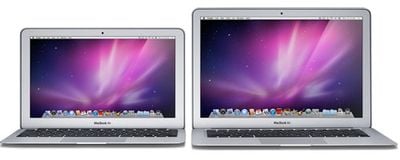
AppleInsider reports that this Wednesday may finally be the day that OS X Lion and new MacBook Air models finally begin shipping as consumers have been anxiously awaiting the releases.
According to people with proven track records who would be in a position to know, the new product launches are set to occur later this week. Specifically, one person said the products would be released on Wednesday at 8:30 a.m. Eastern.
Circulating rumors have claimed that the updated MacBook Air models will sport a minimum of 128 GB solid state drives and 4 GB of RAM, and will also see the return of a backlit keyboard.
Apple has been reported to be holding new hardware launches until OS X Lion is ready so that it can ship the machines with the latest operating system pre-installed. A number of other new hardware updates are said to be pending, including a Mac mini refresh and an updated LED Cinema Display. New Mac Pro models have also been rumored for release later this month or early next month. All of the new releases are said to support the new Thunderbolt high-speed data connectivity standard.
BGR reports that it has received information from an "incredibly solid source" claiming that Apple will be introducing its next-generation iPhone "by end of the Summer, late August-ish" and taking advantage of the opportunity to expand its iPhone line to three models by selling the new handset alongside the existing iPhone 4 and potentially continuing to offer the iPhone 3GS as a low-cost device available for $349 without a contract.
The source reports that the next-generation iPhone isn't likely to sport a major redesign compared to the iPhone 4, suggesting that case manufacturers should have already leaked the new design if it was in fact different from the iPhone 4. With other sources adamantly reporting in recent weeks that the next-generation iPhone will receive an external redesign, the "will it/won't it" debate remains unsettled.
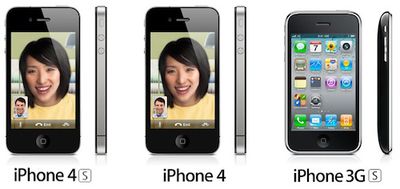
If this turns out to be true, it will mean there would be an iPhone 4S in addition to the prepaid iPhone 3GS available within the next month to two. Let's do one better, though. In addition to that news, we are told that Apple will continue to sell the current iPhone 4 as well, finally giving the company a full range of devices in the lower, mid, and high-end price segments.
Rumors of Apple releasing a low-cost iPhone carrying an unsubsidized price in the range of $350 have been circulating in recent weeks, with one analyst claiming that Apple will in fact be using the iPhone 3GS to fill that role, slashing its price to free on-contract and $399 without contract. The 8 GB iPhone 3GS currently retails for $449 unsubsidized.
Rumors of Apple bumping the iPad up to a higher-resolution display received a new boost today with The Korea Times reporting that Apple has been working with Samsung and LG on new LCD technology to produce displays with a resolution 2048x1536, double that of the existing iPad in each dimension.
The report notes that Samsung and LG are currently in the testing process for the new displays, which would push the resolution up over 260 pixels per inch, below that of the iPhone 4 and fourth-generation iPod touch, but perhaps high enough for Apple to still consider it a "Retina" resolution given the somewhat further distance at which the iPad is typically viewed.
By limiting the resolution increase to a doubling of the current displays, Apple will provide an easy transition for developers, whose existing content can be displayed via pixel doubling to appear naturally on the higher-resolution display until it can be upgraded to the higher resolution. A similar system was used when the iPhone and iPod touch transitioned to double-resolution displays to minimize disruption to the app ecosystem of the platform.
Apple has started quality testing Samsung and LG's LCDs at one of its laboratories in China. Samsung and LG were required to produce screens with better picture quality and density, according to sources, who anticipate the testing process will be completed during the third quarter.
"Apple's upcoming iPad 3 will feature an improved display to support quad extended graphics (QXGA), a display resolution of 2048×1536 pixels with a 4:3 aspect ratio to provide full high definition (HD) viewing experience," said a source close to the talks.
"Apple has traditionally preferred to use the same providers of the same parts for the same device, even as they evolve to different versions. I don't see any fundamental change to that approach."
With the third quarter of the year already underway, quality testing on the new displays could be completed at any time if the report is correct, paving the way for either a rumored "iPad 2 Pro" to be sold alongside existing iPad 2 models or a full-fledged iPad 3, both of which have been the subject of rumors for a release later this year.
ChangeWave Research today announced the results of a survey of over 4,000 professional and early-adopter smartphone users, primarily focused on the North American market. According to the survey, consumers looking to purchase a smartphone over the next 90 days are increasingly preferring the iPhone over Android by a count of 46%-32%, even with Apple holding off on introducing a iPhone in June as it has done every year since its original debut.
Historical tracking of consumer preference shows an interesting pattern, with Android rapidly gaining favor with consumers in the latter half of 2009 and equalling the iPhone by early 2010. And while the release of the iPhone 4 in mid-2010 gave Apple a temporary 20-point edge, it quickly returned to a neck-and-neck race over the remainder of 2010.
But 2011 has seen Apple suddenly open up a decent-sized margin over Android, as Apple has continued to expand availability and introduced the CDMA iPhone running on Verizon. The survey also points to Apple's iCloud announcement as a positive for the iPhone with 21% of current Apple product owners and 13% of non-owners reporting that iCloud has made them more likely to purchase Apple products going forward.
Apple also continues to lead in consumer satisfaction with 70% of iPhone owners reporting that they are "very satisfied" with the device, although that number has dropped slightly over the device's four-year lifetime. Android and Windows Phone 7 sit in the 50-60% range for "very satisfied" scores, while Research in Motion's BlackBerry platform has fallen to a new low with only 27% of owners registering as very satisfied with their devices. The loss of customer satisfaction with BlackBerry has also bled over into future purchasing plans, with only 4% of consumers looking to purchase a smartphone within the next 90 days planning to turn to a BlackBerry device.
Taiwanese site Apple.pro republishes some photographs originally posted to Weibo, a Chinese microblogging service similar to Twitter.
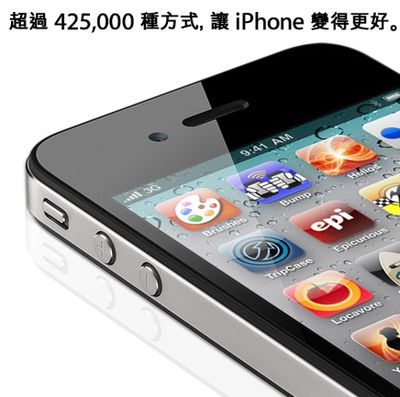
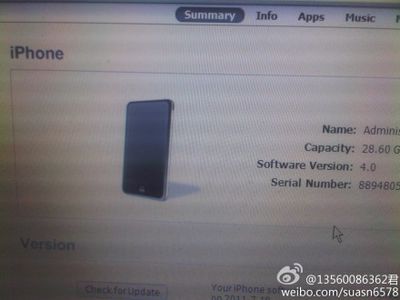
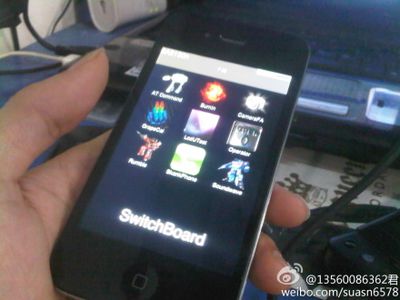
The images claim to be of an "iPhone 4GS" test model running iOS 4.0. The unit appears to be identical to the iPhone 4 with a reported 5 megapixel camera based on the diagnostic software. The iTunes artwork looks different but as some readers have pointed out -- no camera and looks to simply be the original iPod Touch artwork.
Beyond that information, there is little else that seems remarkable about the device, and due to the difficulties in translation, we can't even be sure of all the claims, nor the creditability of the original source. As such, we are posting for discussion and interest alone, and not necessarily that these represent accurate images.
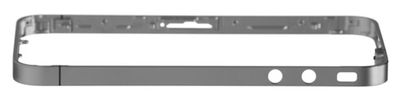
The next iPhone is expected to be released this september and there have been reports that the new device might be undergoing testing within the current iPhone 4 casing. The Wall Street Journal has claimed that the final design will be "thinner and lighter" than the iPhone 4.
Update: Based on serial number and iOS version, it seems this is most likely an earlier iPhone 4 prototype. The serial number indicates that the phone was manufactured in the 48th week of 2009.
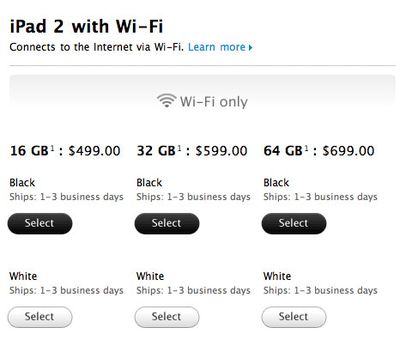
Fortune noted earlier today that Apple has finally caught up with iPad 2 demand this weekend with shipping times down to 1-3 business days. This comes over 4 months since the iPad 2 was originally launched in March.
Shortly after its launch, the iPad 2 had 4-5 week delays in availability. Lines were common at many stores for months after the launch. Just last week, Apple had already made steady improvements in availability by dropping ship times down to 3-5 days for the first time since launch.
A judge with the US International Trade Commission ruled today that HTC violated two of Apple's patents in a year-long case filed last March. Apple had accused HTC of violating 20 of its patents, and filed a second complaint this week, claiming infringement of five more patents. HTC has said it will appeal the decision.
We can sit by and watch competitors steal our patented inventions, or we can do something about it. We’ve decided to do something about it. We think competition is healthy, but competitors should create their own original technology, not steal ours.
If HTC's appeal fails, it will be required to settle with Apple over the patents. However, FOSS Patents' Florian Mueller notes the ITC decision could be very bad for Android, if Apple refuses to settle:
Depending on which two patents HTC infringes and on whether the Commission affirms the ALJ's decision, this could in a worst-case scenario result in a shutdown of many or even all Android-based HTC products in the U.S. market. In a less extreme scenario, HTC might have to remove certain functionality from its products, and that could result in a significant degradation of the user experience and quality of those devices.
Mueller notes that Apple has two ITC complaints and three federal lawsuits currently in motion against HTC, with 16 other patents in question aside from the ones in today's decision.
The United States International Trade Commission is an independent federal agency that, among other things, adjudicates cases involving imports that allegedly infringe intellectual property rights." It has the power, in rare cases, to ban infringing products from the country entirely.
- U.S. Patent No. 5,946,647 on a "system and method causes a computer to detect and perform actions on structures identified in computer data."
- U.S. Patent No. 6,343,263 on a "data transmission system having a real-time data engine for processing isochronous streams of data includes an interface device that provides a physical and logical connection of a computer to any one or more of a variety of different types of data networks."
Both of these patents are at issue in the lawsuits between Apple and Motorola as well.
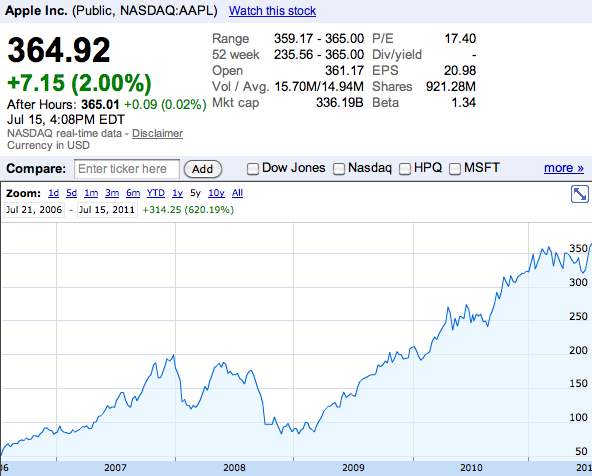
Rumors have been flying over the past few weeks about new products, including new MacBook Airs, Mac Mini's, Mac Pro's, the next iPhone, and new versions of the OS X and iOS. Investors seem to be pretty enthusiastic about the new lineup that Apple has in the pipeline.
Since its initial public offering in December 1980, AAPL is up more than 10,000%, having gone through three 2:1 splits, the most recent on February 28, 2005.
The highest close prior to today was $363.13 back on February 16, 2011.
Earlier this week, part numbers for upcoming Apple hardware updates surfaced, with claims that the parts represented new MacBook Air and Mac Pro models. While the MacBook Air part numbers are believed to be legitimate, the claim regarding the "Mac Pro" part numbers was later revised to state that they referred to new Mac mini and MacBook models.
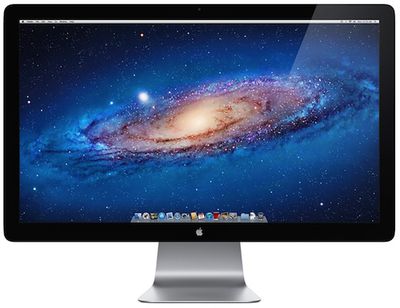
But even that revised assertion isn't entirely correct, as while the Mac mini numbers are assumed to be correct, the part number ascribed to a new MacBook is in fact for a new Thunderbolt-enabled LED Cinema Display.
Apple has even confirmed that information by prematurely posting a new image on its site depicting the display and identifying it in the URL as the "MC914" part that had been previously thought to be a new MacBook. The display appears essentially identical to the existing LED Cinema Display from the front, although Apple's new promotional image displays a Lion desktop background rather than the Snow Leopard one found on the images for the current model. The rear of the display will obviously include a Thunderbolt port in place of the current mini DisplayPort connection.
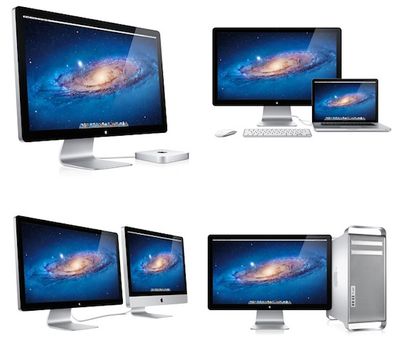
Additional gallery images also show the new display paired with a number of Apple's Mac products, all of which show the same form factor as the current models, suggesting that the Mac mini scheduled to appear alongside the new display (which appears here as the Mac Mini Server model) will retain its current form factor. Apple's Mac Pro has been rumored to see a redesign, but appears set to debut a few weeks later than the new display, meaning that Apple would need to continue showing the new display alongside the current Mac Pro until that time. Consequently, the new image showing the Mac Pro likely offers no insight into whether or not the Mac Pro will be seeing a redesign.
Thanks, Ben!
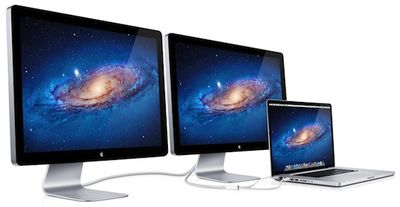
Update: We've spotted a new image depicting a MacBook Pro connected to two LED Cinema Displays daisy-chained via Thunderbolt. This feature would only be compatible with 15-inch and 17-inch MacBook Pros of the current generation supporting Thunderbolt.
Update 2: While not revealing any new products, a number of images of Apple's existing products are also starting to be updated in Apple's online stores to show the Lion desktop background instead of the Snow Leopard one. For example, Apple's iMac page has had its graphics updated to show a Lion desktop, while other machines elsewhere in the store are still showing Snow Leopard.
Thanks, Nicholas!
Update 3: The 27" LED Cinema Display seems to have been removed from the Apple Online Store. Clicking "Buy Now" from the Apple Cinema Display page results in a broken link. Additionally, all the images shown above have been removed from Apple's website as well.
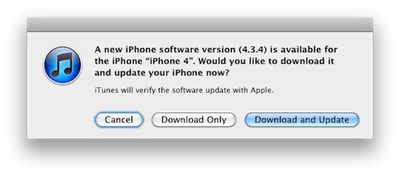
Apple has just released iOS 4.3.4, making good on a promise to patch a vulnerability that has been used for the latest JailbreakMe.com jailbreaking method but which could also allow malicious downloads to infect users' devices. The update is available for the iPhone 4/3GS, third- and fourth-generation iPod touch, and all iPads. A special iOS 4.2.9 update is also available for the CDMA iPhone 4.
The iOS 4.3.4 update comes in as Build 8K2, while the iOS 4.2.9 registers as Build 8E501.
iOS 4.3.4 Software Update
Fixes security vulnerability associated with viewing malicious PDF files.
Apple has also posted security-related documents outlining the three vulnerabilities patched in iOS 4.3.4 and iOS 4.2.9.
Earlier this week, USA Today reported on research from retail sales analyst David Berman ranking Apple as the fastest-growing major retailer in the United States during the first quarter of this year, boosting its domestic sales by 80% over last year's numbers.
Calling Apple's sales "mind-boggling", Berman notes that Apple's brick-and-mortar retail stores are even outpacing the company's overall performance, growing by 90% year-over-year.
That increase accounted for one-fifth of all sales growth by publicly traded retailers in the U.S., according to a recent analysis of sales trends by retail sales expert David Berman. In part, that's a reflection of poor sales among most retailers. But it also highlights how Steve Jobs' technology giant is grabbing a big slice of market share in everything from smartphones to PCs.
Apple's year-over-year U.S. sales growth of $4.6 billion for the first quarter was followed by Amazon and Wal-Mart, with total sales growth from public retailers coming in at $23.2 billion.
Apple is set to announce its financial results for the second calendar quarter (third fiscal quarter) of the year next Tuesday, July 19th.
Late last month, we noted that Apple had reportedly begun offering a seven-day window for "returns" on App Store purchases in Taiwan, a move made in response to a notice from government officials requiring Apple to comply with consumer protection laws requiring such return policies.
As reported by IDG News, Apple has now formalized that policy, updating its terms and conditions for the Taiwanese Mac App Store, App Store, and iBookstore earlier this week to include language outlining the policy.
You may cancel your purchase within seven (7) days from the date of delivery and iTunes will reimburse you for the amount paid, provided you inform iTunes that you have deleted all copies of the product. Upon cancellation you will no longer be licensed to use the product. This right cannot be waived.
The change appears to be unique to the Taiwanese market, with Apple's terms and conditions documents for its stores in other countries making no mention of a similar policy. Apple does, however, routinely judge refund requests on a case-by-case basis and will frequently issue refunds for purchases made in error or in other select situations. Apple has even been said to be offering refunds on its own Final Cut Pro X apps to those customers dissatisfied with their purchases.
Google, which currently offers a standard 15-minute refund policy on Android app purchases, has resisted complying with the regulations, disagreeing with the government's interpretation of the consumer protection act. The city of Taipei has already fined Google nearly $35,000 over its failure to comply, and the company has appealed that fine as the two sides continue to discuss the situation.
Apple today issued a media alert announcing details for next Tuesday's release of its financial results for the third fiscal quarter and second calendar quarter of 2011. As usual, the results will be released after the close of Tuesday's trading at approximately 4:30 PM Eastern / 1:30 PM Pacific. Apple's conference call discussing the results will follow at 2:00 PM Pacific and will be available via a live audio webcast. MacRumors will provide running coverage of the conference call highlights.
Apple's conference call webcast discussing Q3 - 2011 financial results will begin at 2:00pm PT/5:00pm ET on Tuesday, July 19, 2011.
Please note that comments made during this call may include forward-looking statements that are subject to risks and uncertainties, and that actual results may differ materially from these forward-looking statements. For more information on the factors that could influence results, please refer to Apple's SEC filings.
Apple's third fiscal quarter of 2011 saw the introduction of new Thunderbolt-equipped iMacs in early May, and also marked the first full quarter of availability for the iPad 2. Apple also quietly introduced new Time Capsule and AirPort Extreme base stations near the close of the quarter. Most of the rest of the company's Mac product lines have been awaiting the release of OS X Lion before seeing updates, while the iPhone did not see its traditional June introduction within the quarter.
For the quarter, analysts are predicting net earnings of $5.73 per share on revenue of $24.75 billion, above Apple's guidance of $5.03 profit per share on $23 billion of revenue. Apple's year-ago results for the third fiscal quarter of 2010 included net earnings of $3.51 per share on revenue of $15.7 billion.
PCMag reports that Verizon and AT&T's upcoming LTE ("4G") networks will be incompatible with each other:
Thinking of unlocking a Verizon Wireless LTE phone for use on AT&T's network, or vice versa? Think again. Verizon Wireless confirmed today that its LTE phones will not "be compatible on other LTE networks in the U.S." because "the phones will be on different frequencies," according to Verizon spokeswoman Brenda Raney.
LTE is the next generation data transfer technology beyond 3G and is frequently labeled 4G.
It turns out that AT&T and Verizon will be using different frequencies for their LTE implementations which will make it more difficult for manufacturers to support both networks. Of course, it's possible to support multiple networks in a single device, but it does require additional consideration in communication parts and antenna design.
Apple presently offers two separate iPhone models to support Verizon's CDMA and AT&T's GSM networks, but Apple is expected to consolidate support into a single device with the iPhone 5. Meanwhile, rumors point to Apple holding off on supporting LTE until at least the 2012 iPhone revision.
Reuters reports that Taiwanese manufacturer TSMC has already started a trial manufacturing of the A6 system-on-chip for Apple, Inc.
Apple has been reported to be shifting its chip manufacturing from Samsung to a "non-competititor" such as TSMC. Whether TSMC actually wins the contract from Apple will depend on their ability to produce a high enough yield of the A6 processors.
"TSMC has got all the authorization and details ready. Whether Apple puts in a formal order will depend on the yield rate," the source said.
Such a shift to TSMC would be a significant loss to Samsung. Apple has become Samsung's biggest customer with over $7.8 billion in product contracts this year. The two companies, however, have had an increasingly uneasy relationship with lawsuits and accusations that Samsung has been copying Apple's iPhone and iPad products.
The A6 will be the successor to Apple's A5 system-on-chip which presently powers the iPad 2. Like the A4 before it, the A5 contains an ARM processor, graphics processing unit and RAM for Apple's mobile devices. The A5 is also expected to power the upcoming iPhone 5.
It's not clear what additional improvements we'll see with the A6 chip, but one possibility is the incorporation of the latest PowerVR Series 6 GPU which promises a significant graphical performance boost to the current implementation. The A6 chip has been previously rumored to be shipping in 2012.
AllThingsD weighs in on the MacBook Air rumors that have been circulating the past few weeks. They claim that the long awaited MacBook Air will arrive "late next week" according to "several sources".
Several sources indicate that the company plans to uncrate the eagerly anticipated updates to its MacBook Air line late next week. “The rumor sites are off by a week,” one source said.
AllThingsD says to look for an announcement Thursday or Friday and that the new MacBook Airs will sport a Thunderbolt port, backlit keyboards, and 128GB and 256GB storage options.
As we pointed out before, Apple will have to release OS X Lion at the same time or before the new hardware releases. So, expect OS X Lion sometime next week as well.



 Lion may be the first release of the Mac OS to be delivered as a digital download, but there has been a circulating method to burn the Lion download onto a bootable DVD. The process still works for the Golden Master version of Lion and is a pretty straightforward process for Mac users who are comfortable making their way around the Finder.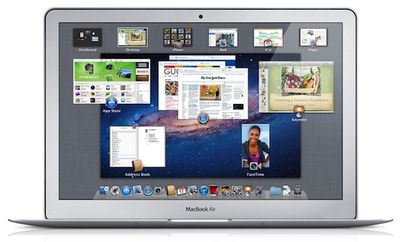
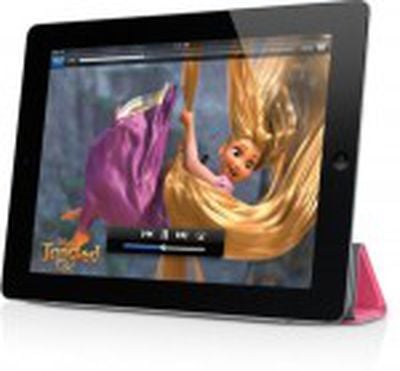 Rumors of Apple bumping the iPad up to a higher-resolution display received a new boost today with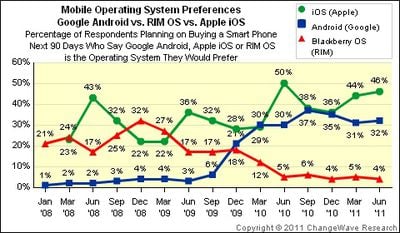
 A judge with the US International Trade Commission ruled today that