MacRumors

With the explosive growth of Facebook and Twitter, social networking has been the biggest trend in the recent years. Apple has already tried delve into this market a bit with its iTunes network Ping, though with limited success.
loc
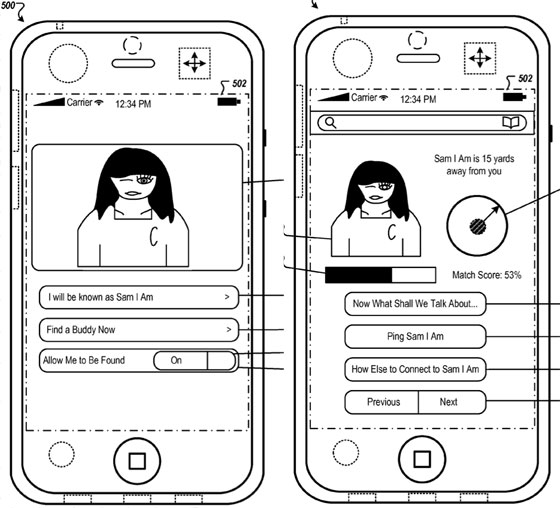
Based on a new patent application published today, it seems Apple has been exploring far more ambitious attempts using the iPhone, location-based services and interest matching. The result is the possibility that your iPhone could find you your next friend, business partner or date. Apple sets up the scenario in the patent filing:

Social networks are a well known phenomenon, and various electronic systems to support social networking are known. Growing a social network can mean that a person needs to discover like-minded or compatible people who have similar interests or experiences to him or her. Identifying like-minded people, however, often requires a substantial amount of and time and effort because identifying new persons with common interests for friendships is difficult. For example, when two strangers meet, it may take a long and awkward conversation to discover their common interests or experiences.

So, instead of "awkward conversation", Apple proposes that individuals' interests can be determined manually by questionnaires (interests, books, etc...) but also automatically by mining various data found in their iPhone device. You will be able to find others in your immediate vicinity that might match your interests and introduce yourself to them through your iPhone.

Common interests and experiences of two or more users located close to each other can be identified from content, including automatically created usage data of the mobile devices. Usage data of a mobile device can be created based on activities performed on the mobile device (e.g., songs downloaded), a trajectory of the mobile device (e.g., places traveled), or other public data available from the mobile device (e.g., pictures shared).

Of course, all this would be opt-in only to avoid any privacy concerns. For example. GPS tracking could identify people who have traveled to the same locations. Phone numbers and contacts can be compared, as well as common bookmarks or games played on device. Overall the application is a fascinating read. They even suggest that facial recognition features could be used to identify common contacts.

Now, patent applications tend to be overambitious descriptions of what could be, and Apple is known to dabble in various areas that they don't necessarily plan on pursuing. That said, location-services and social network are rapidly growing markets, so it wouldn't be surprising for Apple to make some efforts in those areas. In fact, we've already seen references to a "Find My Friends" features in developer builds of iOS.

Tag: Patent

backtoschool
Apple has finally launched the Back to School promotion for 2011.

When you buy a new qualifying Mac with Apple education pricing* from June 16, 2011, through September 20, 2011, you'll get a $100 Back to School Card to use on the Mac App Store, the App Store, the iTunes Store, and the iBookstore.

As reported, this year's back to school promotion offers a $100 iTunes/App Store Gift Card with the purchase of a qualifying Mac. The promotion starts today and ends on September 20, 2011. International Apple Stores have also launched their local equivalents (65 British Pounds in UK, 75 Euro in Europe).

You must be a college student, student accepted to college, parent of college student or faculty/staff at any grade level. Qualifying computers include the MacBook, MacBook Pro, MacBook Air, iMac, and Mac Pro. Readers should also note that any Mac purchased now will also get OS X Lion for free.

Update: Apple has posted the terms and conditions. When the new MacBook Airs are released, they will also qualify.

21rLOPhoto by @sadatkarim

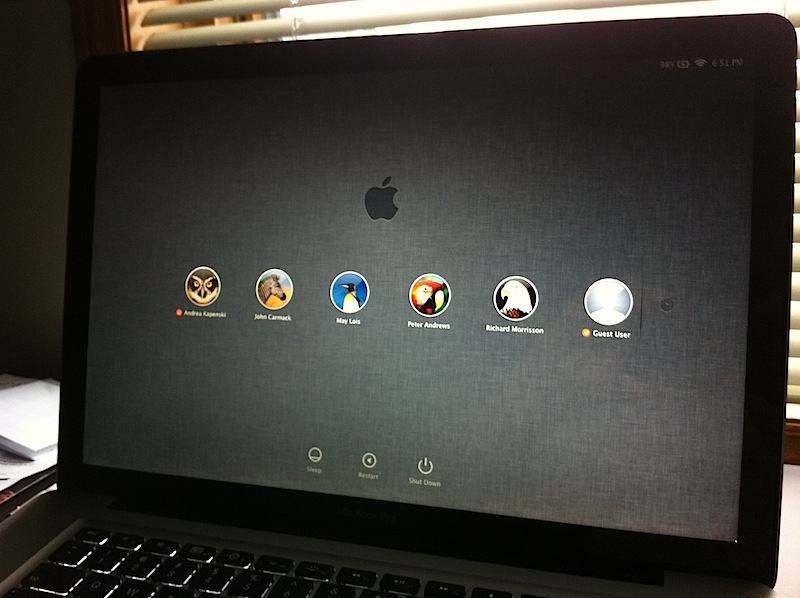
Tonight's update to OS X Lion Developer Preview 4 includes an enhanced login screen (as seen during the WWDC keynote), including a new background showcasing the dark linen background that seems to be everywhere in iOS and OS X these days.


The old login screen displayed the clock and a Wi-Fi menu. The new screen also displays the current built, current IP address, and computer name -- cycling through the information is accomplished by clicking on the clock.

google sync calendar event
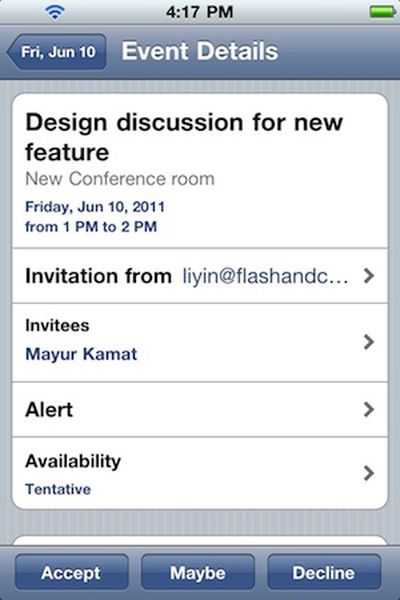
Google today announced that it has updated its Google Sync service to iOS, bringing several enhancements to the company's integrated syncing for mail, contacts and calendars when set up as a Microsoft Exchange account. The new features included searching of full email history, calendar event management, and support for "send mail as" options for users with multiple accounts.

Google Sync keeps your phone's native mail and calendar apps in sync with your Gmail, Calendar and Contacts. Today, three new updates to Google Sync for iOS will allow you to:

- Search all your emails in Gmail, not just the emails stored locally by the iOS mail app.
- Accept, decline or edit calendar events from the iOS calendar app.
- Send email from the address you want. We recognize that some of you manage multiple email addresses from a single Gmail account. Gmail’s "Send Mail as" feature lets you send messages with another email address listed as the sender instead of your Gmail address, e.g. joe@altostrat.com instead of joe@gmail.com. Now the iOS mail app will respect these settings.

The updated features should be automatically rolling out to all users utilizing the Google Sync service via a Microsoft Exchange-based account setup.

core location mapAfter hearing from Apple, Google, and others last month, Senator Al Franken (D-MN) today introduced The Location Privacy Protection Act of 2011, a new bill that would require companies to take better care of user location information on mobile devices:

The Location Privacy Protection Act of 2011 is a narrowly-tailored bill that would close current loopholes in federal law to require any company that may obtain a customer’s location information from his or her smartphone or other mobile device to (1) get that customer's express consent before collecting his or her location data; and (2) get that customer's express consent before sharing his or her location data with third parties. If any company obtains the location information for more than 5,000 mobile devices, that company will also have to (3) take reasonable steps to protect that information from reasonably foreseeable threats; (4) tell an inquiring customer whether or not they have his or her information, and (5) delete that information if that customer so requests it.

The Senator "concluded that our laws do too little to protect information on our mobile devices" and noted that "this legislation would give people the right to know what geolocation data is being collected about them and ensure they give their consent before it’s shared with others."

Just a few weeks ago, Senator Franken sent a letter to Apple and Google, requesting that both companies require app developers to have "clear and understandable privacy policies".

It would appear that Apple is already in compliance with sections 1 through 3, and presumably sections 4 and 5 are fairly easy to implement. iOS apps are already required to ask users for permission to use their location data and iOS devices display an icon in the top bar to indicate when location data is being used.

Repeated attempts by MacRumors to obtain the full text of the bill through Senator Franken's office were unsuccessful, though a one-page summary [PDF] is available.

This isn't the first time Congress has attempted to regular location information on mobile devices. A similar bill was introduced in 2001 by then-Senator John Edwards (D-NC). In fact, the bill had an identical title, The Location Privacy Protection Act of 2001.

That bill would have ordered the FCC to require providers of location-based services to:

(1) inform customers about their policies on the collection, use, disclosure of, and access to customer location information; and (2) receive a customer's express authorization before collecting, using, retaining, or disclosing such information.

The Edwards bill died in committee.

lionupdate
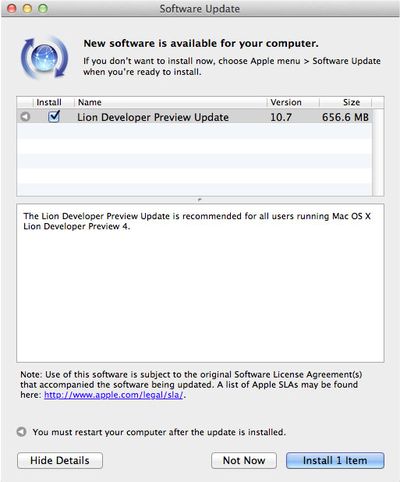
Apple seems to be putting the final touches on OS X Lion which is set to launch in July. They have pushed out a new software update for developers who are running the Developer Preview 4 that was released at WWDC.

There's no word on what has changed between versions. OS X Lion will be launching sometime in July for $29.99 via the Mac App Store.

Update: It's All Tech posts some of the changes found in the latest release. Perhaps most notable is that this build is not the final since there is still placeholders for some of the videos:

instruc

bts2
We've relayed multiple times that the Apple Back to School Promotion would be starting at any minute. The predictions starting kicking off a few weeks ago with today even being suggested a possible launch date. We're finally going to see Apple's Back to School promotion launching tomorrow (June 16th), and we actually have photographic proof of the imminent launch.

The above photos were sent to us by a tipster indicating that the promotion will offer a $100 gift card that can be used in the Mac App Store, iTunes Store, App Store or iBookstore, and that it will launch tomororow. In the fine print it specifically lists "June 16th" as the launch date with the promotion running until September 20, 2011".

The offering of an App Store gift card is a notable departure from Apple's previous Back to School promotions which offered students free iPods with the purchase of a Mac. The new push into App Store credit is a reflection of Apple's new push into the App Store for Mac that launched early this year. The Mac App Store will be the distribution point for Mac OS X Lion and Final Cut Pro X.

Update: iSpazio.net reports that European Apple Back to School will also be kicking off with a 75 Euro gift card.

Schermata 2011 06 15 a 23

Apple has been touting full-screen apps as a major feature in OS X Lion. By all accounts, it works very well to remove distractions and help users focus on the task at hand.

multiplemonitors
For multiple-monitor users, however, full-screen apps don't live up to the hype. When full-screen mode is turned on, Lion dims supplementary monitors (putting up the "linen" background) leaving extra screens as little more than expensive paperweights.

Don't worry, there's an easy solution: don't use full-screen mode.

The 2011 edition of Apple's Worldwide Developers Conference (WWDC) just wrapped up a few days ago, but some attendees may already be looking forward to next year in hopes of penciling in dates so that they are ready to go when tickets go on sale and potentially sell out within hours. So those planning on attending WWDC 2012 may want to take renewed note of a multi-year calendar from the San Francisco Convention and Visitors Bureau that was discovered last year, a document that listed June 10th through 15th as the tentative dates for WWDC 2012, with the actual conference presumably kicking off with a keynote on Monday, June 11th.

Tentative WWDC Dates:
2012: June 10th - June 15th
2013: June 9th - June 14th
2014: June 1st - June 6th
2015: June 7th - June 12th

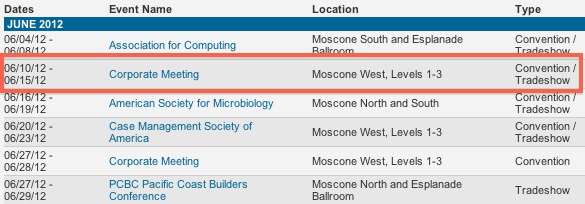
That document did accurately reflect the 2011 conference dates, but was not correct about the 2010 dates, emphasizing the tentative nature of the information. But adding some fuel to the speculation is the Moscone Center's event calendar, which currently shows a generic "Corporate Meeting" listed running from Sunday, June 10th through Friday, June 15th next year.

moscone jun12 calendar
Such generic listings "Corporate Event" and "Corporate Meeting" frequently appear as placeholders for WWDC well ahead of time, although they are of course not exclusive to Apple and are used whenever booking entities do not wish to publicly disclose their identities.

Even if the "Corporate Meeting" listing does refer to WWDC, Apple is certainly capable of adjusting its schedule, although busy conference schedules can make it difficult to do so as things begin to book up. Consequently, it seems reasonable to speculate that Apple and the Moscone Center have at least penciled in the June 11th-15th dates for next year's WWDC, but we'll certainly be keeping our eyes on the schedules to see if anything changes, as they have on occasion in the past.

ipad 2 hand
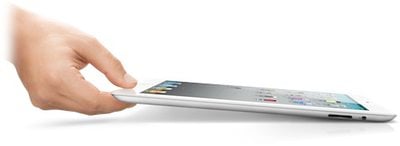
The Wall Street Journal reports that three people have been sent to prison in China over their roles in facilitating leaks of information on the iPad 2 prior to its release.

The court announced the decision Tuesday in statements on its official account at Sina Weibo, a Twitter-like microblogging service in China. It said that Xiao Chengsong, general manager of Shenzhen MacTop Electronics Co., had offered 20,000 yuan, or about $3,000, plus discounts on MacTop products to a former Hon Hai employee named Hou Pengna, for information about the iPad 2. The court said Ms. Hou then paid Lin Kecheng, a Hon Hai research-and-development employee, to get digital images of the device's back cover from last September, six months before the iPad 2 was publicly announced.

The three people were sentenced to prison terms ranging from 12 to 18 months and are subject to fines ranging from approximately $4,500 to $23,000.

Cases for the iPad 2 began appearing on Chinese supply sites four months ahead of Apple's official unveiling, and it was revealed in late April that three workers had been arrested in connection with the leak soon after those initial cases appeared. The employees cited in that report had been claimed to be Foxconn employees and are presumed to be the same ones sentenced to prison in the new report, although only two of them were actually Foxconn employees while the the third was manager of the case manufacturing company that solicited the information.

Related Roundup: iPad
Buyer's Guide: iPad (Caution)
Related Forum: iPad

Apple's latest edition of the iMac is finally shipping with the build-to-order 3.4GHz Intel Core i7 and 256GB Solid State Drive option installed. As with any new Apple product, benchmarks and speedtests are beginning to trickle out, and the conclusion from Macworld is that this is the fastest Mac they've ever tested.

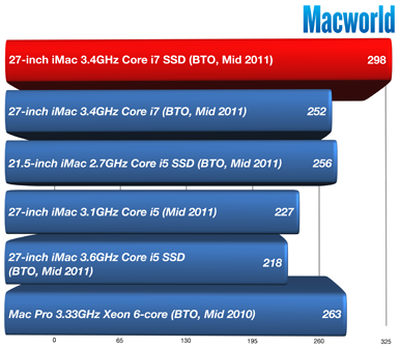
Last month, Macworld benchmarked the highest standard configuration 27" iMac Core i5 3.1GHz with standard hard drive installed. It scored 227 on Speedmark 6.5, roughly 16 percent faster than the old model -- but still quite a bit slower than a Mac Pro 3.33GHz Xeon 6-core, which scored a 263 on the same test.

Now, after a month-long delay, Apple is finally shipping BTO 3.4GHz Core i7 iMacs with a 256GB SSD option. This top-of-the-line iMac, the 27" 3.4GHz Core i7 w/SSD has been declared the fastest Mac that Macworld has ever tested.


The video above was sent in by a reader. He filmed it on his 27" 3.4GHz Core i7, 16GB of RAM and the 256GB SSD option. He opens all the standard applications that come with the iMac simultaneously (though with Front Row and Dashboard deselected, because they're both full-screen apps) as a quick demo of the speed of his new SSD iMac.

Macworld's testing puts the 3.4GHz i7 w/SSD at 298 on the Speedmark 6.5 test, well clear of the Mac Pro 3.33GHz Xeon 6-core's comparatively pokey 263. It also beat the Mac Pro in file duplication, Zip file compress and uncompress, iTunes encoding, and iMovie and iPhoto importing tests.

It's important to note, however, that for massively parallel tasks like Handbrake encoding, Cinebench, Mathematica, and GeekBench benchmarks the Mac Pro still outperforms the iMac because it has more cores, especially with Hyper-Threading. But, for individual application tests like encoding an MP3, importing a movie to iMovie, or importing photos to iPhoto, the iMac beats all.

ultimateimac2011speedmark 241608

Of course, the brand new iMac might be faster than the current generation Mac Pro, but the Mac Pro hasn't been updated since last July. New Mac Pros are expected sometime soon, presumably with Thunderbolt support and a rumored narrower, rackmountable enclosure.

Related Roundup: iMac
Buyer's Guide: iMac (Caution)
Related Forum: iMac

office 2011 icons 2Microsoft yesterday released several updates for users of its Office for Mac productivity suites, bringing security and stability improvements to Office 2011, 2008, and 2004, as well as a pair of ancillary updates.
- Microsoft Office for Mac 2011 14.1.2 Update (108.9 MB): Improvements include security fixes and several stability and reliability improvements for Outlook and Word.

- Microsoft Office 2008 for Mac 12.3.0 Update (333.0 MB) and Microsoft Office 2004 for Mac 11.6.4 Update (13.0 MB): Improvements appear to be limited to security fixes.

Additional details on the security fixes, which address as many as eight vulnerabilities in Excel depending on Office version, are available in a Microsoft security bulletin.

- Open XML File Format Converter for Mac 1.2.0 (45.0 MB) and Microsoft Entourage 2008 for Mac, Web Services Edition (64.0 MB): These updates appear to primarily provide compatibility with the updated Office for Mac versions.

facebook photo app iphone
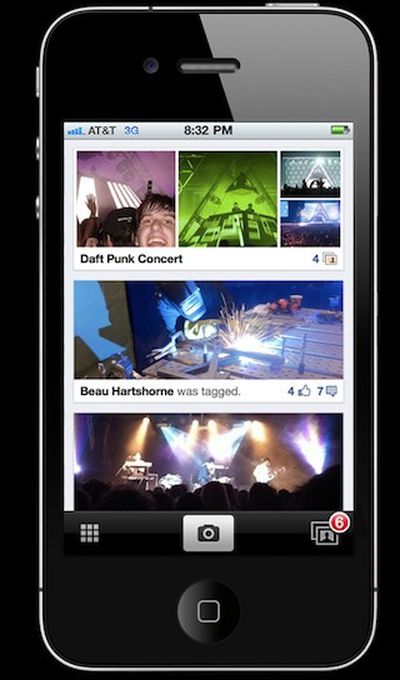
TechCrunch reports that it has receiving detailed information on a forthcoming iPhone application from Facebook that will focus on photo sharing, building on top of the company's massive existing platform to apparently pull together aspects of many other popular photo apps in what appears from the leaked documents to be an "awesome" offering.

But again, the app looks amazing. We've heard that internally it is being called either "Hovertown" or "WithPeople". And while it looks like a stand-alone app right now, there are also signs that it could be eventually integrated into Facebook's main iPhone app - as well as the main site.

Either way, based on the images in front of us, the best way to think about it appears to be Path meets Instagram meets Color meets (Path's new side project) With - with a few cool twists. And obviously, it's built entirely on top of Facebook's massive social graph.

No real details on the app other than a single image have yet been provided by TechCrunch, although the site is currently working through the significant amount of leaked material to decipher more about its features and functionality.

Update: TechCrunch has now filed a follow-up report sharing more images of the forthcoming application.

A few notes: the images we have suggest that while polished, this still may be a work in progress. It's clear that some of these mock-ups are older than other ones, given a few documents we have as well. Also, some images make it seem as if the service will eventually reside within the existing Facebook iPhone app, while others seem to showcase an entirely new app (or a completely redesigned Facebook app). It's entirely possible that both will be correct. It would make a lot of sense for Facebook, which is by far the largest photo service on the Internet with close to 100 billion photos, to make their own dedicated photo app. The space is exploding with popularity right now as Instagram and others are gaining millions of users quickly. Regardless, Facebook's focus on mobile photos going forward is very clear.

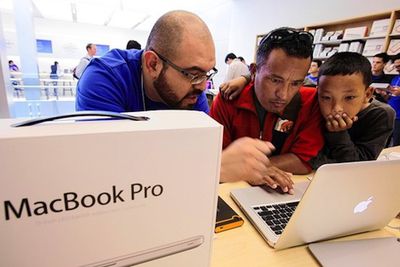
In the wake of yesterday's announcement regarding Apple retail chief Ron Johnson's pending departure to take the CEO position at department store chain J.C. Penney, The Wall Street Journal publishes an extensive look at the company's retail store operations and philosophy, relying on internal training materials and interviews with former employees to gain a sense of what Apple is doing differently from other companies that has made its retail stores such an overwhelming success.

A look at confidential training manuals, a recording of a store meeting and interviews with more than a dozen current and former employees reveal some of Apple's store secrets. They include: intensive control of how employees interact with customers, scripted training for on-site tech support and consideration of every store detail down to the pre-loaded photos and music on demo devices.

While much of the information has been published in other venues or is simply common knowledge given the company's retail store workforce of 30,000 employees, the extensive report does nicely summarize much of what has gone into developing the Apple retail store experience.

According to several employees and training manuals, sales associates are taught an unusual sales philosophy: not to sell, but rather to help customers solve problems. "Your job is to understand all of your customers' needs - some of which they may not even realize they have," one training manual says. To that end, employees receive no sales commissions and have no sales quotas.

While Apple may not have strict sales quotas in place for its employees, the company does certainly have performance goals for metrics such as "attachment rates", the frequency with which staff members are able to convince customers to add on ancillary products such as AppleCare to their purchases. Staff members who fall short of the goals receive additional sales training or are diverted to other positions within the store.

apple retail store mbp
The report also covers the history of Apple's retail store initiative, noting that it began at a time when Apple was struggling to return to prominence following the return of Steve Jobs and when the company was having a hard time achieving appropriate visibility in third-party retail stores. Even in stores such as CompUSA where Apple had dedicated display areas, the company was frustrated over its inability to control the customer experience.

Consequently, Jobs brought in Gap president Mickey Drexler, who joined Apple's board and assisted with defining the company's retail store goals. Ron Johnson was recruited from Target to lead the effort, and the retail store push began with an extensive period of planning and mockups that ultimately led to the first two stores opening in Tysons Corner, Virginia and Glendale, California in May 2001.

Apple's meticulous attention to detail extends down to its hiring process, where prospective employees generally participate in several rounds of competitive interviews assessing a variety of details including problem-solving skills, leadership qualities, and enthusiasm for Apple products.

Once hired, employees are trained extensively. Recruits are drilled in classes that apply Apple's principles of customer service. Back on the sales floor, new hires must shadow more experienced colleagues and aren't allowed to interact with customers on their own until they're deemed ready. That can be a couple of weeks or even longer.

Apple's retail store chain has already grown to over 325 stores in eleven countries, and the company has been pushing forward on larger and more iconic stores in an ever-growing number of markets, continually extending its reach with what has become one the most successful retail sales models in use today.

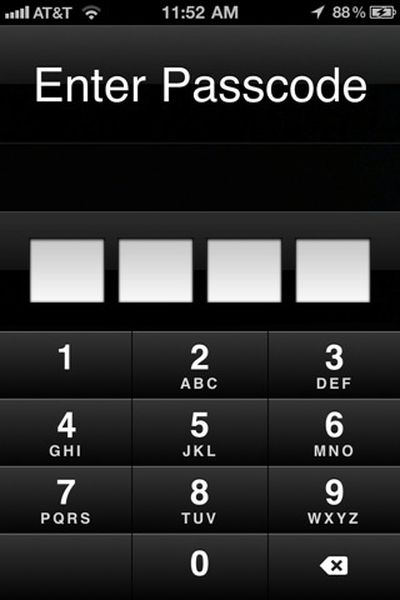
Earlier this week, iOS developer Daniel Amitay published a report examining trends in passcodes chosen by users of his Big Brother Camera Security application. Amitay had anonymously collected over 200,000 passcodes used on his app and offered the data up as a proxy for actual iPhone passcode usage data based on the similarity of the input system style and functionality.

big brother camera security enter passcode
Amitay now reports that his application has been pulled from the App Store by Apple, although he is unsure at this time whether the removal was due to publication of the data or his admission of collecting it in the first place.

As of today at 4:58pm EST, Big Brother has been removed from the App Store. I'm certainly not happy about it, but considering the concerns a few people have expressed regarding the transfer of data from app to my server, it is understandable.

I think I should clarify exactly what data I was referring to, and how I was obtaining it. First, these passcodes are those that are input into Big Brother, not the actual iPhone lockscreen passcodes. Second, when the app sends this data to my server, it is literally sending only that number (e.g. "1234") and nothing else. I have no way of identifying any user or device whatsoever.

Amitay points to Apple's iTunes licensing agreement in support of his belief that he can collect such information, noting that he had planned on using the data collected to generate a list of common passcodes that would offer a warning of the codes being too obvious if they were chosen by a user. Consequently, it is unclear whether it is the collection itself or the publication of it that raised Apple's ire.

Amitay is currently reaching out to Apple to address the issue and have Big Brother Camera Security returned to the App Store.

Update: Amitay has updated his post to note that he has received a response from Apple relaying that his application was pulled for "surreptitiously harvesting user passwords". He has submitted an updated version of the application omitting the passcode collection capabilities and has appealed Apple's decision on the basis of the data being specific to the app, anonymized, and used for the purposes of improving the application.

Imagination Technologies, the company behind the iPhone and iPad's PowerVR graphic processor unit (GPU), has announced that six "key partners" have already selected their next generation PowerVR Series 6 GPU (codename: Rogue) for licensing. The partners include ST-Ericsson, Texas Instruments, MediaTek as well as three "yet to be announced" licensees.

imagination
Apple has long used Imagination Technologies' GPUs to power their mobile devices and is likely one of the unnamed licensees. Besides being a major customer, Apple is also an investor in the company with ownership pegged at 9.5% back in 2009. The iPad 2 currently uses the PowerVR SGX543MP2 GPU. Combined with the A5 processor, Apple claimed the iPad 2 has 9x faster graphics than the original model. This upcoming GPU is said to deliver another significant performance boost for mobile graphics.

The press release is devoid of any hard details and offers just some vague promises of future performance.

The POWERVR Series6 GPU family, which delivers unrivalled GFLOPS per mm2 and per mW for all APIs, delivers not only a clear technology advantage and exceptional roadmap, driven by one of the largest teams of graphics engineers in the world, but also an extensive ecosystem of third party developers which has created hundreds of thousands of apps optimised for POWERVR enabled devices to date.

The new graphics processor will be backward compatible with the PowerVR SGX GPU which presently powers the iPad and iPhone, so will be an easy transition in future models.

A few numbers were detailed back in February during Mobile World Congress. According to a press release from ST-Ericsson, the Series 6 PowerVR chip will push over 350 million "real" polygons per second when used in their Nova A9600 SOC. That particular chip is said to be "sampling" in 2011.

Based on the usual lead time for these announcements, it seems unlikely we'll see these new GPUs in Apple's products until 2012 at the earliest. This more powerful graphics processor may help support the additional pixels of the rumored "Retina" display in the next iPad.

Earlier this evening, Apple released version 5.5.3 of AirPort Utility. This small update to the AirPort Extreme Base Station and Time Capsule administration software contained a few bug fixes, but also a bit of a surprise. Readers in the MacRumors Forums (neek and jonnyz) found references to unreleased 4th Generation Time Capsules and 5th Generation AirPort Extremes.

In the weeks leading up to the WWDC keynote, there had been reports of dwindling Time Capsule and AirPort Extreme stocks, suggesting an imminent refresh. It seems that Apple has been working on next-generation devices, but hasn't yet released them.

time capsule leap forward

Also found were references to Software Updates being stored on devices, but these references are not new as the same text has been found in older versions of the software dating back to at least 2010.

"bsUP.productName" = "Store Apple software updates on this %@";
"bsUP.description" = "Apple software updates that are copied to this %@ are available to anyone using this network.";

These findings were also reported by 9to5Mac, which had previously detailed that upcoming Time Capsules would be offering a Software Update caching system:

What we do know is that Apple has been internally testing Time Capsules to cache Software updates for both Mac and iOS devices. The way we've heard it works is that the new Time Capsule learns which devices connect to it via Wifi. It then goes out to Apple's servers and downloads Software Updates for those products.

When the user wants to install the software update, the Time Capsule, which is also the router, routes you to the locally stored update, rather than downloading the whole thing over the Internet.

Given the fact that these Software Update references were also present in the old firmware, it's not clear when Apple is planning on launching this features, especially in light of the recent iCloud announcements. Apple has also been rumored to be redesigning its Time Capsules and AirPort Extremes around the same A4/A5 processors used in the iPhone and iPad.

Related Forum: Networking

More evidence has emerged to suggest that a future version of the iPad will sport a "Retina" display with a resolution of 2048x1536, or double the horizontal and vertical pixels of the current iPad.

Back in January, a number of images were discovered within iPad apps showing icons twice the size needed for the 1024x768 screen on the iPad. This suggested a similar pixel-doubling strategy to that used in the iPhone 4's Retina Display. That particular feature wasn't included in the iPad 2, but perhaps will be in the iPad 3.

Resolution Comparison
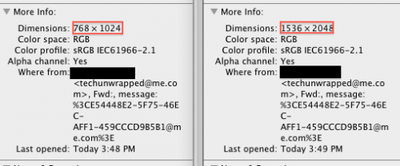
New clues regarding a possible 2048x1536 iPad display were reported today by Techunwrapped. Their tipster noticed the Twitter.framework within the iOS SDK had huge images, twice the size needed for the current iPad:

As I was going through the iOS SDK I came across some images in the new Twitter .framework. The resolution appears to be 1,536 x 2,048.

The Twitter.framework is the only framework I found to have these enormous images.

Techunwrapped goes on to suggest that because the large images were only included in the Twitter section of the iOS SDK -- a relatively new part of the iOS codebase -- it means an iPad 3 will come out in the same timeframe as iOS 5 is released.

Based on the discovery of pixel-doubled iPad images as far back as January, we are hesitant to attach any significant timeline to these discoveries, but they are simply more signs that Apple plans to release a Retina Display-equipped iPad.

Related Roundup: iPad
Buyer's Guide: iPad (Caution)
Related Forum: iPad