MacRumors

172005 mba3
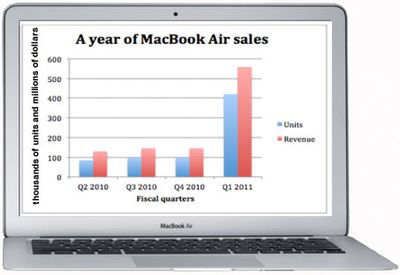
Graph from Fortune

A new research note by J.P. Morgan's Mark Moskowitz reveals that Apple's MacBook Air has seen significant sales growth since its most recent refresh in October (via AppleInsider and Fortune). MacBook Air sales in the last quarter were 333% higher year over year with projections of annual revenue of near $2.2 billion. The new MacBook Air adopted an SSD-only design, introduced an 11.6" model, and saw a considerable price drop from the previous models.

"We believe that the growth rate of the MacBook Air stands to moderate, but we expect the product to exhibit increasing contribution to the overall Mac business," Moskowitz wrote. "(The fourth quarter of calendar 2010) was the first quarter in which the MacBook Air accounted for greater than 10% of total Apple Mac units. More importantly, the MacBook Air accounted for 15% of total notebook sales during the quarter, versus 5% in the prior year."

The MacBook Air was originally released in January 2008 as a 13" model only with a starting price of $1799. While Apple has offered slight improvements and price drops in the interim, October's refresh was the most dramatic overhaul of the ultra-portable with the introduction of an 11.6" model that starts at $999.


Related Roundup: MacBook Air
Related Forum: MacBook Air

130740 ipad  2 shipping 040411

Shipping estimates for new online orders of all iPad 2 models have improved to 2-3 weeks today, down from earlier 3-4 weeks. The new shipping estimates appear to apply in all countries where the iPad 2 is currently shipping.

With Apple releasing its first television commercial for the iPad 2 over the weekend and shipping estimates now improving, it appears that the company is confident enough in its ability to meet demand that it can begin more high-profile marketing campaigns to appeal to a broad base of consumers beyond the early adopters that have so far been soaking up supplies as quickly as they can be replenished.

Related Roundup: iPad
Buyer's Guide: iPad (Neutral)
Related Forum: iPad

123733 otay ranch store
Apple's Otay Ranch retail store

San Diego 6 reports that an attempted holdup at Apple's Otay Ranch retail store in Chula Vista, California went sour this morning, with one of the robbers reportedly having been shot and killed by a mall security guard.

A security guard caught the suspects smashing the glass front doors of the Apple Store at the mall before the mall opened for the day.

The guard reportedly shot a male suspect in the head.

NBC San Diego reports that two other suspects, one of whom had also been shot, have been arrested. The incident happened shortly before 7:00 AM this morning, before the store had opened for business.

Update: 10News reports that approximately 40 shots were exchanged between the security guard and the armed robbers, according to Chula Vista police.

113316 ft logo

With Apple's new in app subscription mechanism for iOS devices now deployed and publications such as The New York Times already moving to take advantage of it, some publications are still holding back over Apple's insistence that customer information only be provided to the publications on an opt-in basis. According to Reuters, influential business newspaper Financial Times is one of those publications unwilling to part with its customer information.

"We don't want to lose our direct relationship with our subscribers. It's at the core of our business model," [FT.com managing director] Rob Grimshaw told Reuters in an interview on Monday.

He said he was hopeful of a positive outcome to negotiations with Apple, but added: "If it turns out that one or another channel doesn't mix with the way we want to do business, there's a large number of other channels available to us."

Grimshaw noted that the FT has "a great relationship with Apple", despite the fact that the two companies don't see eye to eye on subscription billing policies.

The report notes that the Financial Times has already developed a relatively successful paywall model for its online content, with the newspaper bringing in about 40% of its revenue through digital sales. Consequently, the company believes that it has more to lose by supporting Apple's in app subscriptions than publications that have yet to successfully tap into digital access payments.

Related Roundup: iPad
Buyer's Guide: iPad (Neutral)
Related Forum: iPad

104554 att early upgrade iphone apr11

Last Friday, Android Central posted a screenshot appearing to show changes to AT&T's smartphone pricing structure set to go into effect yesterday, increasing "early upgrade" pricing for all iPhone models that is applied when an on-contract customer is not yet eligible for full subsidy by $50.

According to the AT&T bulletin, early upgrade pricing for the 8 GB iPhone 3GS has moved from $249 to $299, while the 16 GB iPhone 4 has moved from $399 to $449 and the 32 GB iPhone 4 moved from $499 to $549. BGR has confirmed the price increases with AT&T.

AT&T is also boosting prices on its feature phones and non-iPhone smartphones, pushing no-commitment pricing up by $20 on feature phones and $50 on non-iPhone smartphones. AT&T's one-year commitment pricing is also going up by $150 for non-iPhone smartphones, while feature phones on similar plans are going up by $10.

Related Forum: iPhone

095432 comscore feb11 phones

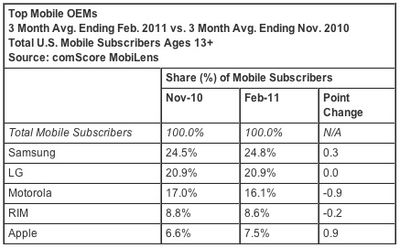
comScore late last week released the results of its latest monthly survey of U.S. mobile phone users, revealing that Apple's new CDMA iPhone released on Verizon that month ranked as the best-selling phone during the month. That performance helped boost Apple's share of the mobile phone market in the U.S. to 7.5% for the three-month period ending in February, up from 6.6% in the prior period.

095433 comscore feb11 smartphones

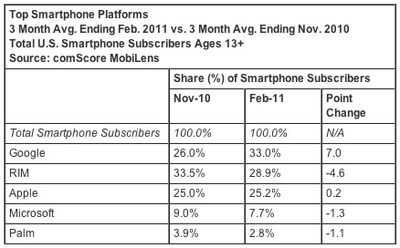
When looking only at smartphones and the operating systems running them, Android's usage continued to soar during the period, up 7 percentage points to move past Research in Motion to claim the top spot in overall usage in the U.S. (not new purchases) with 33% of the market. RIM slipped to 28.9%, while Apple nudged up slightly to 25.2% as Microsoft and Palm continued to drop.

That result seems to mirror other recent surveys that show Apple essentially maintaining its relative share in the rapidly growing smartphone market while Android surges at the expense of Research in Motion and smaller players.

Related Forum: iPhone


Apple today released its first television commercial for the iPad 2, taking a philosophical approach to focus on the experience of using the device rather highlighting its technical capabilities or specific features.

This is what we believe. Technology alone is not enough. Faster, thinner, lighter...those are all good things. But when technology gets out of the way, everything becomes more delightful...even magical. That's when you leap forward. That's when you end up with something like this.

The new ad has been posted on Apple's iPad page and on its YouTube page.

Related Roundup: iPad
Buyer's Guide: iPad (Neutral)
Related Forum: iPad

165938 cablevision ipad 1

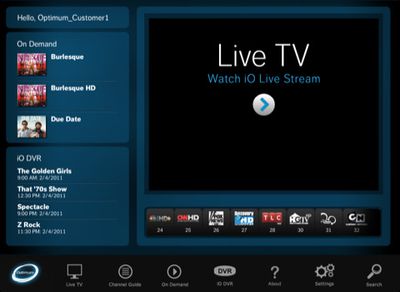
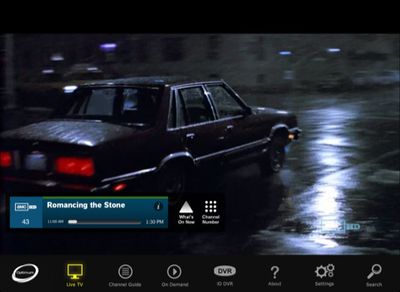
While Time Warner Cable has been working to add channels to its live TV app for the iPad in the face of opposition from several content providers including Viacom, Discovery, and Fox, Cablevision has gone all in with the release of its new Optimum for iPad application offering the cable company's subscribers full access to their television packages.

In addition to approximately 300 live channels and access to VOD [video on demand], the Optimum App for iPad integrates enhanced guide information that makes it easier than ever before for customers to find the content they already receive as part of their cable television subscription. Programming is fully searchable, including by genre, and the application includes the ability to schedule DVR recordings and manage previously-recorded content.

165938 cablevision ipad 2

In its press release, Cablevision also takes content providers head-on with its argument that the functionality is permissible under current licensing agreements. Cablevision's key argument hinges on the fact that the content is not delivered over the Internet, and instead comes directly through the its digital cable network before being transmitted to the iPad via Optimum modem.

Cablevision uses its secure and proprietary Advanced Digital Cable television network to deliver cable programming to customers for viewing on the Optimum App for iPad, and content is not delivered over the Internet. The application turns the iPad into an additional television, enabling Cablevision customers to view the same live programming and VOD content already being delivered to other TVs in the home as part of the service they have paid for. Cablevision has the right to distribute programming over its cable system to iPads configured in this way under its existing distribution agreements with programming providers.

We have yet to hear any official response from content providers, so it will be interesting to see how they react to Cablevision's offerings.

Related Roundup: iPad
Buyer's Guide: iPad (Neutral)
Related Forum: iPad

With the shift in form factor for the iPod nano at its latest update, a number of users were disappointed to see the camera that had been added in the fifth-generation model disappear. But if a new report from Taiwanese site Apple.pro [Google translation] is correct, the seventh-generation iPod nano presumably set for introduction later this year may retain its current smaller form factor but still add a rear-facing camera once again.

According to the report, a source in California sent the below photo claimed to be the rear case for the next-generation iPod nano, displaying what appears to be a camera hole in an upper corner.

162628 ipod nano 7gen case

The report raises some question as to whether the photo could be an April Fools' joke, although the photo does at least appear genuine and is consistent with the casing of the sixth-generation model with the exception of the new camera hole. Based on the position of the hole, the camera would appear to take up space currently occupied by a portion of the iPod nano's battery, so it is unclear whether the device would be able to use a smaller battery or if components could be shifted around enough to accommodate the camera while maintaining the same size for the battery.

Unaddressed is how the clip on the next-generation iPod nano would accommodate the rear-facing camera, as the clip is currently covers the entire back of the device and would of course obscure the camera. Based on the screws visible on the inside back of the case, however, it seems that Apple have simply narrowed the clip and perhaps shifted it down slightly from center in order to accommodate the camera.

Finally, the report claims that the iPhone 5 will come in both black and white versions similar to the iPad 2. The iPhone 4 of course was introduced in both black and white models, but the white model has yet to begin shipping after several delays reportedly due to issues with light bleeding through the painted glass and affecting camera performance.

Apple.pro has occasionally offered accurate information in the past, perhaps most notably with the posting of photos of a small touchscreen that appeared in the sixth-generation iPod nano a few months later.

Update: As noted by Sonny Dickson, the current 6G nano tear down photo from iFixit bears a close resemblance to the leaked photo:

220129 6gnano

Related Forum: iPod touch and iPod

004950 sony wordmark 400

According to 9 to 5 Mac, Walt Mossberg tonight conducted an interview with Sony CEO Howard Stringer at Carnegie Hall in New York City as part of the JapanNYC festival, and Stringer interestingly revealed that its shipments of camera sensors to Apple have been delayed by the effects of the earthquake in Japan last month. Sony is not currently known to be a camera supplier for Apple, as OmniVision Technologies has been reported as the sole supplier of image sensors for all of Apple's mobile products so far.

Stringer just said that their camera image sensor facility in Sendai was affected by the tsunami. Getting image sensors to Apple will be delayed.

Stringer's discussion of camera production for Apple was confirmed by The Wall Street Journal:

Early on, he raised the irony of Sony supplying camera components for Apple devices. It "always puzzles me," he said. "Why would I make Apple the best camera?"

It is unclear what devices he was talking about as Sony isn't known to supply key camera components, known as image sensors, to Apple; A Sony spokeswoman declined to comment and an Apple spokesperson couldn't be reached for comment.

Given that Sony is not believed to be a camera supplier for any of Apple's current products, the assumption is that the cameras are for an unreleased product that may be in the early stages of a production ramp-up. That assumption draws renewed attention to an April 2010 report from Rodman Renshaw analyst Ashok Kumar claiming that Sony had in fact been tabbed to provide image sensors for the 2011 version of the iPhone, with the sensors reportedly coming in at 8 megapixels.

That same report also claimed that OmniVision would continue to provide camera sensors in a 5-megapixel variety for the fourth-generation iPhone, a claim that did in fact turn out to be true with the iPhone 4.

Related Forum: iPhone

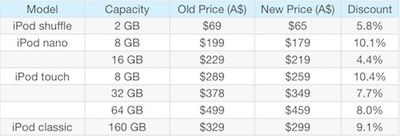
Apple yesterday lowered prices on its iPod lines in its Australian online store, dropping prices as much as 10% on some models.

153419 ipod prices au 040111

The Australian dollar gained strength on the U.S. dollar in the latter half of 2010, moving from a low of 81 cents in June to near parity by October. The exchange rate for the two currencies has remained near that level since that time, with the Australian actually drifting a bit higher than the U.S. dollar over the past few days. Even with the price drops and accounting for taxes built into the Australian pricing, iPod prices remain a bit higher than they are in the United States, although that is common practice for Apple as it deals with higher distribution in many of its international markets and hedges against future currency fluctuations.

Apple is usually very slow in reacting to fluctuations in exchange rates, preferring to maintain stable price points in each country and typically only changing price points in response to currency fluctuations at the time of new product introductions. Consequently, it is unclear why Apple has decided to drop its iPod pricing, and only its iPod pricing, in Australia at this time. Apple's "Back to School" rebate program offering a free iPod touch with the purchase of a Mac did just end in Australia, but the same program also ended in New Zealand and Apple did not opt to reduce pricing in that country. New Zealand's dollar has not, however, gained as much value against the U.S. dollar over the past year as has the Australian dollar.

Related Forum: iPod touch and iPod

The U.S. Patent and Trademark Office yesterday published a remarkable volume of new Apple patent applications, offering another look at technologies the company has at least been thinking about, even if they may never see the light of day. Here are a couple of the interesting ones that made their appearances yesterday.

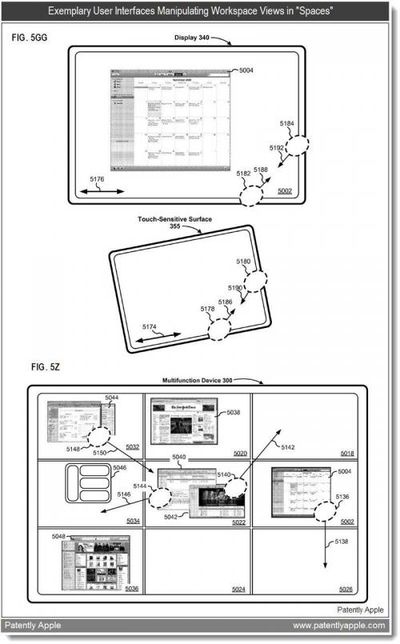
One patent application detailed by Patently Apple describes a concept for bringing a "Spaces" style workspace switcher to the iPad. While the interface is extremely similar to that found in Mac OS X and in fact uses Mac OS X running on a tablet-style device in image exhibits within the application, it does reveal that the company has considered how such a system could be implemented on a multi-touch device.

140342 spaces tablet 500

According to descriptions within the patent application, Apple envisioned invoking Spaces on an iPad-like device with either a two-finger pinching gesture in a specific location or by using a five-finger tapping or pinching gesture. Various interactions be used to either switch directly between workspaces or to display a graphical representation of all workspaces for selection or to drag windows between workspaces.

As noted by AppleInsider, a second patent application discusses the potential for including multiple cameras on the iPhone to enable users to take three-dimensional photos. In particular, Apple discusses hardware methods of employing three sensors to pick up different information about a scene, including individual sensors for luminance (brightness) and chrominance (color) with a third sensor to provide alignment information for constructing a three-dimensional image rather than relying on software extrapolation for such purposes. Apple argues that the system would produce higher-quality images and reduce processor load for creation of three-dimensional images.

Related Roundup: iPad
Tag: Patent
Buyer's Guide: iPad (Neutral)
Related Forums: iPad, iPhone

Today is April 1, 2011 and represents April Fools' Day -- so readers should be wary of hoaxes and claims at both news and rumor sites today. Today also represents Apple's 35th anniversary, having been founded on this day in 1976 by Steve Jobs and Steve Wozniak.

Among the popular April Fools' Day jokes making the rounds today:

- ThinkGeek is offering a Playmobil Apple Store Playset with an available "Line Pack" of extra figures to allow kids to accurately simulate the Apple retail store experience.


- Self-repair proponents iFixit have actually released an iPhone 4 Oppression Kit for those customers whose devices have standard Phillips screws and who find those screws too easy to remove. With the new iPhone 4 Oppression Kit, users can replace those screws with Apple's new pentalobular screws, making it nearly impossible to open their iPhone if they lose the compatible screwdriver included in the kit.

- Google is debuting Gmail Motion a new Gmail interface that takes advantage of the user's webcam to interpret gestures and other motions for controlling Gmail.


Google has of course rolled out a number of other April Fools' Day features from its different product teams, including a "1911" YouTube filter that turns any video into a sepia-toned silent film.

MacRumors does not participate in April Fools' Day prank news stories, although we have in the past occasionally supplemented our coverage with such special features as a Big Bunny Bundle and Page 3 rumors.

093047 twcable tv ipad email

As we noted yesterday, Time Warner Cable's popular live TV application for the iPad has faced opposition from a number of content providers who believe that the implementation is a violation of their agreements with the cable company. Time Warner Cable has rolled out a dedicated site to garner support from customers and keep them informed on the situation.

As noted on that site and in an email to customers, Time Warner Cable has at least temporarily pulled a number of channels from application as it seeks to focus on content providers actually interested in embracing the new technology while also pursing a resolution to the disputes using any means necessary.

And, while most TV network owners agree with us that this is a great convenience for our customers and their viewers, a few networks disagree. As a result, for the time being, we have decided to focus our iPad efforts on other enlightened programmers who understand the benefit and importance of allowing our subscribers - and their viewers - to watch their programming on any screen in their homes.

Unfortunately, that means that channels from network groups Discovery Communications, Fox Cable, and Viacom will be removed from your iPad lineup, effective immediately.

- Discovery channels: Animal Planet, Discovery, TLC
- Fox channels: FX, National Geographic
- Viacom channels: BET, CMT, Comedy, MTV, Nickelodeon, Spike, VH1

In the email sent last night, Time Warner promised that it would be adding new channels as early as that evening to compensate for the removals, and the company appears to have done so today. Unfortunately, however, the list of new channels appearing on our device is generally of lower quality than those channels that have been removed.

New channels: CNBC World, C-SPAN, C-SPAN 2, C-SPAN 3, Chiller, Disney XD, G4, Home Shopping Network, Jewelry Television, QVC, Sleuth, Soap Net, Style, Golf Channel, and WE tv.

Time Warner has promised to continue working to expand the list of channels available through its iPad application.

Update: Time Warner has now also added ESPNews and the Independent Film Channel, along with a trio of Time Warner local news channels available to subscribers in the New York City (NY1 and NY Noticias) and Austin, Texas (YNN Austin) markets.

Related Roundup: iPad
Buyer's Guide: iPad (Neutral)
Related Forum: iPad

220109 garageband mac icon

While Apple had touted the ability to move projects between its new GarageBand for iPad and the corresponding application for Mac OS X, the two versions were not initially compatible, as GarageBand for Mac has been unable to launch GarageBand projects created in the iPad application.

Apple today addressed that issue with the release of GarageBand 6.0.2 for Mac OS X, a welcome update for users of the iPad application who have been looking to do more advanced editing on their Macs.

This update improves overall stability and addresses a number of minor issues, including the following:

- Support for opening projects imported from GarageBand for iPad.

This update is recommended for all GarageBand '11 users.

The update weighs in at 47.44 MB and requires Mac OS X 10.6.3 or later.

170823 promenade at chenal
Promenade at Chenal, Little Rock, Arkansas

As noted by ifoAppleStore and several eagle-eyed observers who reported the developments to us, Apple is preparing to open a new retail store this October in Little Rock, Arkansas. The store will be the company's first in that state.

After an extended four-year courtship, Apple has finalized plans -- for a second time -- to open a store at the Promenade at Chenal mall in Little Rock (Ark.). Job listings for the future store were posted last week, indicating an October grand opening.

Apple had been preparing to open a store in Little Rock several years ago, filing building plans in November 2007 and following that up with job postings in January 2008. Those plans apparently fell through, but it now appears that Apple has revived the project and is going forward with it, having signed a lease committing itself to the new space.

Arkansas should become the 44th U.S. state with at least one Apple retail store, with its opening apparently set to come just after Apple opens its first Alaskan store in September. With those openings, just six states will be without an Apple retail store: Montana, North Dakota, South Dakota, Vermont, West Virginia, and Wyoming.

152050 android honeycomb icon

One of the major talking points long used by Google in support of its Android smartphone operating system over iOS is its "open" nature that has allowed handset manufacturers and others to tweak and customize the software for their needs. Apple CEO Steve Jobs has argued that the "open" nature would more accurately be described as "fragmented" in justifying why he believes that Apple's "closed" or "integrated" iOS is a better platform for consumers.

Google executive Andy Rubin responded to Jobs' comments last October by using his first ever Tweet to define "open" as the code needed to get the Android source code installed and ready for use by anyone interested in it.

But as Android's popularity has taken off and the number of manufacturers and devices utilizing it has exploded, Google has begun tightening its control over the operating system, perhaps recognizing that a purely open system might in fact not be best for consumers and looking to exert its influence over how Android is presented to and behaves for users.

Last week, Bloomberg Businessweek reported that Google has decided to hold back from releasing the source code for its new "Honeycomb" version of Android to the public, claiming that the code is not yet ready for public tweaking given corners that needed to be cut to bring it to market to compete with the iPad.

"To make our schedule to ship the tablet, we made some design tradeoffs," says Andy Rubin, vice-president for engineering at Google and head of its Android group. "We didn't want to think about what it would take for the same software to run on phones. It would have required a lot of additional resources and extended our schedule beyond what we thought was reasonable. So we took a shortcut."

Rubin says that if Google were to open-source the Honeycomb code now, as it has with other versions of Android at similar periods in their development, it couldn't prevent developers from putting the software on phones "and creating a really bad user experience. We have no idea if it will even work on phones."

Still, Rubin argued that Google has not changed its philosophy about Android being an open source project.

Bloomberg Businessweek continued digging into the situation, however, and yesterday published a report outlining how Google has in fact been taking new steps to crack down on how Android is being deployed, moves that have angered some hardware manufacturers.

Playtime is over in Android Land. Over the last couple of months Google (GOOG) has reached out to the major carriers and device makers backing its mobile operating system with a message: There will be no more willy-nilly tweaks to the software. No more partnerships formed outside of Google's purview. From now on, companies hoping to receive early access to Google's most up-to-date software will need approval of their plans. And they will seek that approval from Andy Rubin, the head of Google's Android group.

According to the report, Google has been increasing enforcement of "non-fragmentation clauses" in recent months, requiring partners to submit their plans to Google for final say on their implementation. The policies have ruffled some feathers in the industry, including at Facebook and Verizon, where tweaked versions of Android have been under development. Google's actions have sparked a few complaints to the U.S. Department of Justice, although it is unclear whether there is any momentum for a coordinated push back from manufacturers or regulators.

141621 twc apple amazon logos

Over the past few weeks, a pair of announcements have seen Time Warner Cable announce a live TV app for iPad and Amazon unveil cloud-based storage for music, two areas in which Apple has been rumored to be trying to roll out its own offerings but has yet to do so.

One of the primary barriers for Apple seems to have been its preference to try to work with the content providers, companies that have traditionally been slow to adopt new technologies and distribution methods. Ever since Apple's December 2009 acquisition of Lala Media, observers have speculated that the company has been looking to deploy a cloud-based iTunes service.

In fact, sources such as CNET have kept a close eye on Apple's efforts to bring music and even video to the cloud, noting a number of times that negotiations with record labels and movie and television studios have been slow to proceed and that Apple was unlikely to roll out the services without the agreement of the content providers, as the company would be likely to find itself in court without it. Apple has also been said to have pitched TV subscription plans to TV networks in a bid to circumvent traditional cable TV service, but the company saw little success with those negotiations.

Enter Time Warner Cable (itself part of a media conglomerate generating music, TV, and movie content) and Amazon, which both appear to have taken the bull by the horns and released their new services without the blessing of content providers and are now facing backlash from those companies.

Time Warner's app, which streams live TV content to the iPad, offers 32 channels and is limited to users who subscribe to both Time Warner cable and Internet services, and is only functional through each user's own home network, in effect serving simply as another television in the household. But the arrangement has been viewed as unacceptable by a number of content providers, with Viacom vehemently objecting to the inclusion of its channels in the application and Fox and Scripps sending cease-and-desist letters to Time Warner demanding that their channels be removed.

For its part, Time Warner Cable has rolled out a dedicated site appealing to consumers and asking for their support in the increasingly bitter battle between the cable operator and the networks over iPad app access.

A similar story took place at Amazon, where the company rolled out its Cloud Player for music earlier this week without the agreement of record labels, many of whom claim that the use is not permitted under current music licensing deals. Amazon has tried to sidestep legal issues by requiring users to upload their own copies of digital music files, appearing to believe that such a "passive" setup would be allowed under law. According to The Wall Street Journal, Amazon is now going back to record labels in an effort to secure licensing deals that would allow for a more efficient system in which Amazon could house centralized libraries of music tracks with users being offered access to them on a song-by-song basis as determined by a database outlining their ownership of tracks.

It remains to be seen just which approach will prove more successful, as users rush to embrace new products and services that allow them access content on the go while content providers remain slow to respond to the rapidly-changing technological advancements. Companies like Time Warner and Amazon that are plowing ahead possess significant first-move advantage in the market, but may face hurdles of lawsuits and eroding relationships with content providers that could cause difficulties for the companies. On the other hand, Apple appears to have worked to bring all stakeholders on board before launching its offerings, but has little other than rumors and speculation to show for it so far.