Bloomberg reports that Palm has placed itself up for sale, working with several partners to find a buyer for the struggling company.
The company is working with Goldman Sachs Group Inc. and Frank Quattrone's Qatalyst Partners to find a buyer, said the people, who declined to be identified because a sale hasn't been announced. Taiwan's HTC Corp. and China's Lenovo Group Ltd. have looked at the company and may make offers, said the people.
Palm's stock, which had seen its target price cut to as low as zero by some analysts in recent weeks after poor financial performance, received a boost late last week on rumors of a buyout.
Palm and Apple have been sharing frosty relations in recent years, as Palm has attempted to recruit a number of former Apple executives and employees to ride the company's new webOS back to prominence. The company's launch model, the Palm Pre, was met, however, with veiled threats from Apple Chief Operating Officer Tim Cook over its swiping and pinching multi-touch gestures. The two companies further sparred over iTunes media syncing for the Pre, with the companies engaging in a software game of cat-and-mouse and filing complaints to regulatory bodies over the issue.
Focusing on interactivity, performance and maximizing the impact of digital content and marketing campaigns across media and devices, the Creative Suite 5 product line brings exciting full version upgrades of flagship creative tools while delivering significant workflow enhancements to designers and developers.
Creative Suite 5 also introduces Adobe Flash Catalyst CS5, a new design tool that allows you to create web application interfaces without writing code.
Using Flash Catalyst CS5, designers can easily add interactive Flash content to Web sites and applications by transforming native Adobe Photoshop and Adobe Illustrator artwork, as well as files from Adobe Fireworks CS5, into functional content and user interfaces (UI).
One of the most eye catching new features of Adobe Photoshop CS5 is content-aware fill which was demoed on video late last month:
Adobe will be offering an first look streaming preview of the many new features starting at 8am Pacific, 11am Eastern time today (Monday, April 12th). Adobe's Creative Suite 5 products are expected to ship in the next 30 days.
Almost as soon as we were ushered into the age of modern driving with the invention of the automobile we entered the age of distracted driving with the inventions of shiny things to keep us distracted: let it be the car radio or more recently the cell phone. Recent research by the National Safety Council on distracted driving has shown that cell phone usage when driving can cause a driver to miss up to 50% of the information collected in their driving environment, and that hands-free cell phones do not provide any safety benefit when driving. For more, read the NSC's white paper (pdf link).
All of this research as well as public recognition of the problem (did you notice the question by a reporter during the Q&A section of last Thursday's iPhone OS Media Event?) has led a number of developers to create technological solutions to the problem. One of the solutions is "izup" by Illume Software, currently available for Blackberry, Android and Windows Mobile, with versions under development for quick messaging devices and the iPhone. In an interview with MacRumors, Mark Thirman, Vice President of Business Development for Illume Software, explained the appeal of such applications.
Put yourself in the mindset of a parent or an employer. You really want to reduce the risk for our children or your employees while they're driving.
izup works by detecting when its host device is traveling at a speed greater than 5 mph, then sending incoming calls to voicemail and making only select "white-listed" phone numbers available for out-bound calling. When an emergency number is dialed, a notification can be sent to the account holder (i.e., parent, employer) with the device's location. All SMS texts are also blocked as well as other apps, although there is an app whitelist meant for navigation apps.
With the announcement of iPhone OS 4, Thirman says that an iPhone version of the application is now possible, and that it wouldn't be "just a port". The company is even evaluating whether using iAds would be beneficial to subsidize the cost (currently $4.95 per month for other platforms with volume discounts available).
The iPhone version of izup is scheduled to be released alongside iPhone OS 4 this summer.
In a series of emails reportedly between Steve Jobs and Greg Slepak, Jobs responds to questions about Apple's recent move to ban tools that allow cross-compilation from other languages into iPhone OS native code. The change in terms effectively blocks Adobe's Flash-to-iPhone compiler and could affect other similar developer tools.
Jobs reportedly points to John Gruber's analysis of why Apple might have implemented this. Gruber argues that Apple wants control over native iPhone OS development and cross platform solutions would dilute iPhone-exclusive and iPhone native apps.
If that were to happen, there's no lock-in advantage. If, say, a mobile Flash software platform -- which encompassed multiple lower-level platforms, running on iPhone, Android, Windows Phone 7, and BlackBerry -- were established, that app market would not give people a reason to prefer the iPhone. .... And, obviously, such a meta-platform would be out of Apple's control. Consider a world where some other company's cross-platform toolkit proved wildly popular. Then Apple releases major new features to iPhone OS, and that other company's toolkit is slow to adopt them. At that point, it's the other company that controls when third-party apps can make use of these features.
Gruber also believes that these cross platform compilers rarely produce high quality native apps. Steve Jobs reiterated this point in a followup email:
We've been there before, and intermediate layers between the platform and the developer ultimately produces sub-standard apps and hinders the progress of the platform.
After months of speculation, it appears Apple is finally going to deliver new MacBook Pro systems to customers. The above screenshot shows part numbers that Microcenter has received for new Mac systems. We've since received independent confirmation from another source besides Microcenter that those part numbers are real, and that we should expect new 15" and 17" MacBook Pros very soon. The image shows 4 different systems:
Apple System Good-USA $1799.99 Mac system #1 Best-USA $2199.99 Mac system #2 Best-USA $2299.99 Mac system Better-USA $1999.99
These seem to correspond with three 15" MacBook Pros and a 17" MacBook Pro ($2299.99). The new machines are likely using Intel's Core i7 and i5 mobile processors.
While previous rumors have pinpointed April 13th as the likely day, other reports we've received are less certain of that date. Regardless, we feel reasonably confident that the new MacBook Pros will come very soon.
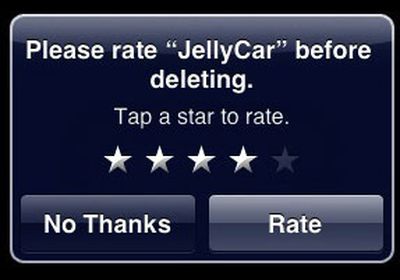
Rate on delete feature introduced in iPhone OS 2.2
Developers will be pleased to learn that Apple has removed a controversial "Rate on Delete" feature from iPhone 4. Starting in iPhone 2.2, when a user deleted an App from their iPhone, the operating system would ask the user to rate a App using the 1-5 star rating system in the App Store. The move was presumably meant to increase rating participation in the App Store.
However, many developers were unhappy with the system as they felt it skewed the ratings downwards. The system increased the number of ratings from customers who were likely unhappy with an app, while those who kept an app on their iPhone would never be prompted for a rating.
iLounge has posted an excellent summary of changes in iPhone 4 on an app-by-app basis. They do a good job covering much of what has been discussed including multitasking, wallpapers, folders, mail and more.
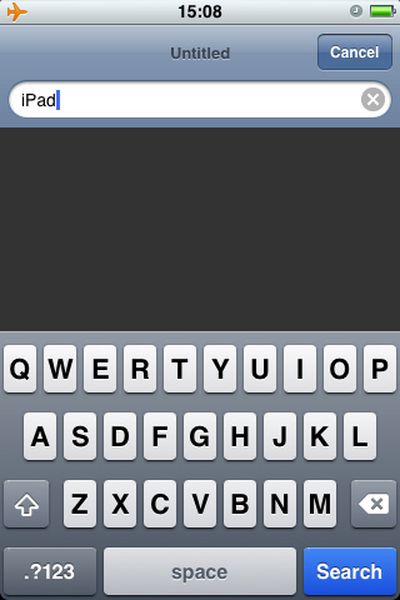
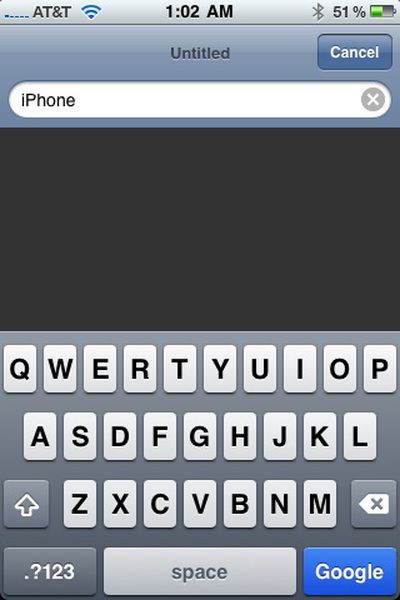
iLounge, however, also noted that in iPhone 4's Safari application, Apple has removed the "Google" branding from the search button and simply replaced it with "Search". While seemingly a minor detail, Apple has been said to be in discussions with Microsoft to replace Google as the default search engine on the iPhone. If this were to happen, Google would likely still be a user enable-able option.
Note, the iPad's Safari also uses the "Search" button on the keyboard. "Google" still appears in the search window itself in Safari.
Apple's decision to alter its iPhone developer licensing agreement yesterday to apparently exclude such offerings as Adobe's forthcoming Packager function of Flash Professional CS5 that would allow developers to export Flash content into the native iPhone format has continued to rumble throughout the industry today, with voices weighing in from all over about the impact of the decision and Apple's motivation for making the change.
Lee Brimelow, a "platform evangelist" for Adobe, shares his thoughts (via TiPb) on his semi-official TheFlashBlog, referring to Apple's decision as a slap in the face to developers.
What they are saying is that they won't allow applications onto their marketplace solely because of what language was originally used to create them. This is a frightening move that has no rational defense other than wanting tyrannical control over developers and more importantly, wanting to use developers as pawns in their crusade against Adobe.
An additional claim that "Apple has timed this purposely to hurt sales of CS5" has been redacted from Brimelow's blog entry at the request of Adobe, but not before it was captured by TiPb. Adobe's Creative Suite 5, of which Flash Professional CS5 will be a part, is scheduled for introduction next Monday.
Brimelow notes that he has decided to boycott Apple products "until there is a leadership change over there" and states in no uncertain terms how he feels about the situation.
Now let me put aside my role as an official representative of Adobe for a moment as I would look to make it clear what is going through my mind at the moment. Go screw yourself Apple.
But whether Apple's move is solely a shot directed at Adobe as Brimelow and others have contended appears to be up for debate, as AppleInsider notes that it may have more to do with the multitasking features being deployed in iPhone OS 4.
The primary reason for the change, say sources familiar with Apple's plans, is to support sophisticated new multitasking APIs in iPhone 4.0. The system will now be evaluating apps as they run in order to implement smart multitasking. It can't do this if apps are running within a runtime or are cross compiled with a foreign structure that doesn't behave identically to a native C/C++/Obj-C app.
"[The operating system] can't swap out resources, it can't pause some threads while allowing others to run, it can't selectively notify, etc. Apple needs full access to a properly-compiled app to do the pull off the tricks they are with this new OS," wrote one reader under the name Ktappe.
Whatever the reason for Apple's adjustment of its licensing terms, tempers are certainly flaring in the protracted dispute between the two companies.
Bloomberg reports that a new quarterly Securities and Exchange Commission (SEC) filing from Adobe reveals for the first time that Apple's refusal to adopt Adobe's Flash platform for the iPhone and iPad could pose a material threat to Adobe's business.
The admission comes as part of the "Risk Factors" section of the report that typically offers "doom and gloom" scenarios in which the company's business could experience difficulty, but makes specific mention of Apple's potential effect on the company.
Additionally, to the extent new releases of operating systems or other third-party products, platforms or devices, such as the Apple iPhone or iPad, make it more difficult for our products to perform, and our customers are persuaded to use alternative technologies, our business could be harmed.
Bloomberg notes that earlier SEC filings from Adobe contained language noting that it wished to work with Apple on the iPhone platform but required cooperation from Apple in order to do so.
The dispute between Adobe and Apple over the inability for the iPhone, iPod touch, and now iPad to handle media in the Flash format has been well-known ever since the iPhone's original introduction in 2007, and thus it seems to be no surprise that Adobe may consider the situation at an impasse and consequently have adopted stronger language regarding the risk it poses to the company's business.
Interestingly, the filing comes just one day after Apple's iPhone OS 4 preview event alongside which the company released a modified developer licensing agreement that appears to prohibit the use of a feature in Adobe's forthcoming Flash Professional CS5 to export Flash content into the native iPhone format. Flash Professional CS5 is set to be introduced as part of Creative Suite 5 next Monday, and Adobe is reportedly looking into the change in Apple's developer licensing terms to understand how it affects the company's plans.
Apple engineers Anders Carlsson and Sam Weinig yesterday announced the forthcoming release of a new web framework known as "WebKit2" that will build upon the existing engine that powers the company's Safari browser as well as a number of other browser applications including Google Chrome. Notably, WebKit2 will support running various browser elements in different processes, "sandboxing" them to prevent problems with a single element from crashing the entire browser.
WebKit2 is designed from the ground up to support a split process model, where the web content (JavaScript, HTML, layout, etc) lives in a separate process. This model is similar to what Google Chrome offers, with the major difference being that we have built the process split model directly into the framework, allowing other clients to use it.
The team behind WebKit2 has also posted documentation outlining some of the changes coming in WebKit2 and how its split process model differs from that used in Chromium and Google Chrome, building the functionality directly into the framework rather than putting it in the application layer where considerable work would be required for porting or reusing the functionality.
CNET notes that Apple's announcement has ruffled some feathers in the WebKit community, as it is being seen as rolling out a major revamp of the engine without the input of the rest of the community. Apple's Maciej Stachowiak responded to the criticism, noting that existing ports will continue to work and that the new tools are in a very early stage that is appropriate for review and discussion by the community.
We picked the name "WebKit2" in the hopes of picking something really bland. Apparently that backfired, because it seems to make this project seem like a bigger deal than it is. Basically, you can think of this as a new port-specific API [application programming interface]. But we're trying to put some general mechanisms in this API, so other ports can use it if they choose. We are also welcoming input from the whole WebKit community on the design, architecture and direction of this work. It is at a very early stage, barely enough that you can build a trivial demo browser on top of it. We decided that our proof of concept was far enough along at that point that we should make the code public for community review and input.
Initial versions of WebKit2 have been developed for Mac and Windows, and the developers invite others to submit patches for additional ports.
Another SDK release from Apple means more hints to uncover about their future plans. Today's iPhone OS 4 release was no exception, though the hints it reveals seem to be familiar. The iPad SDK first revealed tons of evidence that Apple had, in fact, been working on support for video conferencing iChat as well as support for a front-facing camera.
While the iPad didn't implement these features, it seems likely that the next iPhone will. A report from John Gruber last week claimed that the next generation iPhone would carry the following features:
- A4-family CPU system-on-a-chip - 960x640 double-resolution display - second front facing camera - 3rd party multitasking in iPhone 4
3rd party multitasking came true during today's keynote, and SDK 4 evidence continues to contain references to "front facing" cameras.
Meanwhile TUAW posts evidence of an "iChatAgent" process running on the new operating system (pictured above). Apple is expected to release a new iPhone sometime this summer. Rumors have also suggested that the next iPhone may make its way to the Verizon network as well.
Daring Fireball notes a very specific change in the iPhone OS 4 SDK that will directly thwart Adobe's efforts to directly compile Flash applications onto the iPhone. The new terms dictate the following:
Applications must be originally written in Objective-C, C, C++, or JavaScript as executed by the iPhone OS WebKit engine, and only code written in C, C++, and Objective-C may compile and directly link against the Documented APIs (e.g., Applications that link to Documented APIs through an intermediary translation or compatibility layer or tool are prohibited).
This seems to go directly against Adobe's plans to release Flash Professional CS5 that would have allowed developers to export native iPhone applications from Flash. Adobe had hoped to provide this compatibility layer to allow their Flash developers to write once and then deploy to multiple platforms.
Adobe has acknowledged the change to the New York Times, but doesn't have any change in plans just yet.
We are aware of Apple's new SDK language and are looking into it. We continue to develop our Packager for iPhone OS technology, which we plan to debut in Flash CS5.
With iPhone 4 seeded to developers, videos and screenshots of the new operating system are already appearing. Here's one video (in Polish) walking through multitasking and folders (via MyApple.pl):
We've discovered references to Camera Flash in the iPhone SDK (again), suggesting that Apple is working on a physical camera flash for future versions of the iPhone. Apple has also integrated Grand Central Dispatch into the iPhone OS -- a technology introduced with Snow Leopard to ease the use of multi-core processors. The current iPhone currently only has single core processors, though there have been long-standing rumors that Apple might use the multi-core Cortex A9 in the future.
Apple has posted a preview page covering the various iPhone 4 announcements today. Notably, they list device compatibility for the iPhone 4 OS:
iPhone OS 4 will work with iPhone 3G, iPhone 3GS, and the second- and third-generation iPod touch this summer, and with iPad in the fall. Not all features are compatible with all devices. For example, multitasking is available only with iPhone 3GS and the third-generation iPod touch (32GB and 64GB models from late 2009).
The original iPhone and 1st Generation iPod touch are excluded from iPhone OS 4 compatibility, while the 3G and 2nd Generation iPod Touch exclude multitasking abilities. Customers will have to have an iPhone 3GS, 3rd Generation iPod Touch, or iPad to access the full feature set including multitasking.
iPhone OS 4 is due this summer. To gauge how many of our readers will be able to take advantage of the new OS, we've created this simple poll asking the latest iPhone or iPod Touch hardware you own. Note that we've purposefully excluded the iPad in the interest of simplicity:
Detailed differences between models are listed here: iPhone, iPod Touch.
With today's introduction of iPhone OS 4, Apple revealed several new enhancements to its Mail application, as well as a number of improvements tailored to the enterprise community.
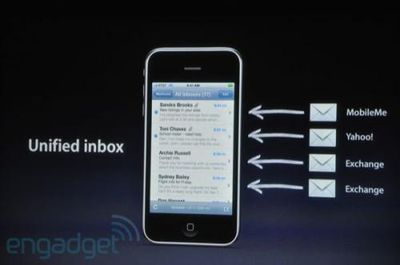
One of the most requested email features for the iPhone OS has been a unified inbox that would allow users to check for new messages across all accounts without requiring navigation to each account individually. Apple CEO Steve Jobs indicated last month in an email response to a user that such a feature was in the works, and it did in fact make an appearance at today's event. Users who prefer to view their inboxes individually will also gain access to simpler navigation between inboxes for different accounts.
iPhone OS 4 will also introduce threaded conversations to Mail, making it easier for users to follow multiple discussions. Finally, users will be able to directly open email attachments with compatible apps downloaded from the App Store.
On the enterprise front, Apple will be rolling out a new Mobile Device Management that will allow for simple wireless configuration and management of corporate iPhone OS devices. Enterprise users will also be able to wirelessly distribute apps to their client devices.
Security is another major improvement for the enterprise aspects of iPhone OS 4, with new encryption options and support for forthcoming SSL VPN applications from Juniper and Cisco. Finally, support for multiple Exchange accounts and compatibility with Exchange Server 2010 offers more flexibility for corporate users.
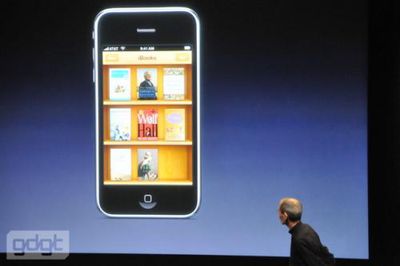
Apple today announced that iBooks, its App Store ebook reader application released for the iPad in the U.S. last week, will be coming to the iPhone and iPod touch as part of iPhone OS 4 later this year. The iPhone version of iBooks will also offer access to the company's iBookstore, a marketplace where users can purchase and download ebook content.
Currently available only in the United States, Apple has been making plans to extend access internationally, a process that is taking some time to execute due to the complexity of geographic distribution deals with publishers.
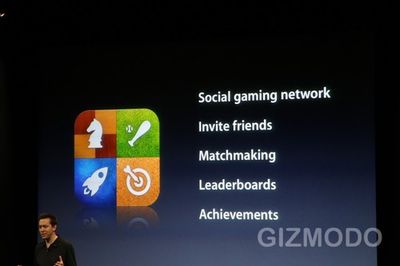
Another major announcement today was Apple's intention to provide a centralized Game Center that offers users a way to track achievements, high scores and offer matchmaking services for online multiplayer. The system sounds similar to Microsoft's Xbox Live service which has been very popular.
The move shows that Apple is very serious about iPhone gaming and sees it as a major focus for the platform. Several companies, however, will be impacted by Apple's move. A number of small companies have already established themselves as similar service providers on the iPhone. These include OpenFeint, AGON, and Ngmoco's Plus+ system. The problem with these systems has been the fragmentation requiring players to sign up for multiple services.
Game Center will be part of iPhone OS 4 which is due this summer.