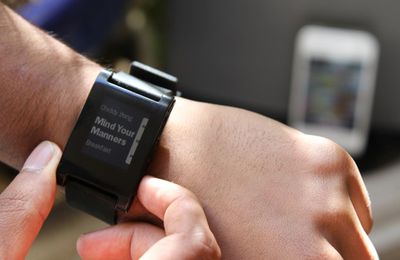
Kickstarter is a popular place for wild ideas to gain some traction, but sometimes an idea clicks with so many people it's possible to wonder why no one thought of it before. Such is the case with the Pebble digital wristwatch.
It uses an e-paper display, similar to the screen on the Amazon Kindle, and connects to the iPhone (and Android devices) via Bluetooth. Pebble uses vibrating alerts to tell the wearer of incoming calls, emails, calendar alerts, Facebook and Twitter messages, weather alerts and more. It also has an extensive SDK for developers and its own "Pebble watchapp store". It will also be waterproof enough to swim with, but it will not be a dive watch.
The company behind the watch even has experience with smart watches. Pebble has been making a BlackBerry-compatible watch called the inPulse, and is a graduate of the Y Combinator startup incubator. It has now received pledges for $3.8 million from 26,500 backers on Kickstarter for a watch that will retail somewhere around $150 when it goes on sale this fall.
An article by Bloomberg notes that Kickstarter wasn't Pebble's first choice for raising funds. He tried to raise money via traditional venture capital firms, but "few investors were interested in betting on a hardware startup, or dealing with the headaches that often come with manufacturing goods." However, Kickstarter seems to have worked out very well. The watch is the most funded Kickstarter project ever.
Pebble told MacRumors that it's treating Kickstarter as a discounted pre-order mechanism, and once the funding period closes in a month it will continue taking orders on its website. US buyers can preorder a Jet Black Pebble watch via Kickstarter for $115, while foreign buyers will pay slightly more to cover shipping.
Update: Pebble has now passed the $4 million mark.
Back in January at Macworld, we noted that Autodesk was planning to bring its Inventor Fusion mechanical design software to the Mac. At the time, the company promised the a free technology preview of Inventor Fusion for Mac would be available in the coming weeks, with an official release to follow later.
Inventor Fusion is a free technology preview that enables creation of designs through intuitive direct manipulation tools. Our aim is to set a new standard for Assembly design, giving users greater control over designs without sacrificing productivity. Hopefully this technology preview will make it easier to open and edit 3D models from virtually any source and incorporate them into new or existing designs (such as in Autodesk Inventor). Your feedback will determine if we are correct in our thinking.
The system requirements for Inventor Fusion for Mac include most relatively recent Mac Pro, iMac, and MacBook Pro models with specific graphics options from AMD, NVIDIA or Intel. Autodesk has, however, indicated that users may still have success running the software on officially unsupported systems.
The release of the Inventor Fusion preview for Mac is the second major Mac-related announcement for Autodesk this week, following the company's unveiling of Smoke 2013, an updated version of its professional-level video editing and visual effects software for Mac. Smoke 2013 will be launching "later this fall" at a price of $3,495 per license, a significant discount from the $14,995 pricing on previous versions.
FOSS Patents reports that the chief executives of Apple and Samsung, along with their respective general counsels, will meet within the next 90 days at a San Francisco courthouse for a court-moderated discussion aimed at settling the long-standing patent dispute between the two companies. As outlined in a joint statement before the court:
As directed by the Court, Apple and Samsung are both willing to participate in a Magistrate Judge Settlement Conference with Judge Spero as mediator. At Apple, the chief executive officer and general counsel are the appropriate decision-makers, and they will represent Apple during the upcoming settlement discussions. At Samsung, the chief executive officer and general counsel are also the appropriate decision-makers, and they will represent Samsung during these settlement discussions.
The report notes that the settlement talks are "semi-voluntary" in that the court can only compel the parties to meet and talk, but can not force them to reach an agreement. It also in the best interest of the two companies to make their most senior officials available for the discussions so as to demonstrate for the court a good faith effort at resolving the dispute.
Apple would obviously be represented by CEO Tim Cook and general counsel Bruce Sewell, while Samsung would appear to be sending representatives from the parent company including CEO Gee-Sung Choi.
A frequent complaint amongst some iPhone power users is the number of steps it takes to toggle Bluetooth on and off. It takes the user four steps -- Settings/General/Bluetooth/Toggle -- to turn it on or off. However, a just-launched app aims to make the task much simpler.
Bluetooth OnOfflaunched last night and enables the toggling of Bluetooth with just a tap -- or even, via a blank toggle, simply by launching the app. To do this, head to the app’s settings panel in Settings and toggle the unlabeled switch there, kill the app through the multitasking tray and relaunch it.
It's a universal app, for iPhone and iPad -- however, this sort of direct control of Bluetooth is prohibited by Apple's iOS app guidelines and it's unclear how long Apple will allow the app to remain on the App Store.
Marking yet another milestone in its rollout of 4G LTE connectivity, Verizon today announced that with another major expansion coming later this week, the carrier's LTE network will now cover two-thirds of the United States population. This week's expansion, officially going live on Thursday, will see coverage in 27 new markets and expansion of coverage in 44 existing markets.
Verizon Wireless, owner of the nation’s largest 4G Long Term Evolution (LTE) network, today announced that it will cover more than two-thirds of the U.S. population when it introduces its 4G LTE network in 27 new markets and expands in 44 markets on April 19. With the new and expanded markets, Verizon Wireless continues to lead the industry in 4G LTE deployment, offering network coverage in 230 markets across the United States.
By the end of the year, Verizon expects to have LTE coverage available in over 400 markets, making the next-generation data speeds available for 260 million people, or well over 80% of the U.S. population.
Verizon, which is leading the major U.S. carriers in LTE deployment, boasts real-world speeds of 5-12 Mbps download and 2-5 Mbps upload. AT&T is also rapidly building out its LTE network, and while it is behind Verizon in its rollout, it does offer faster fallback 3G speeds than Verizon does. Sprint, the third major U.S. carrier to offer the iPhone, has yet to officially launch its LTE services as it seeks to migrate away from WiMAX as its 4G technology, although its LTE network should debut in its first round of markets in the near future.
Apple currently offers LTE compatibility through AT&T and Verizon on the new iPad, with separate models offering the support on each carrier. The company has, however, been embroiled in some controversy in international markets, where its "4G" claims have been targeted by regulators seeking to determine whether Apple has been providing adequate disclosures that the devices will not be compatible with LTE networks in those countries due to differences in the frequencies being used by the carriers.
Activist group Greenpeace today issued a new report entitled How Clean is Your Cloud?, targeting major Internet companies including Apple, Amazon, and Microsoft over their heavy use of coal-derived power for their massive data centers.
Given the energy-intensive nature of maintaining the cloud, access to significant amounts of electricity is a key factor in decisions about where to build these data centers. Since electricity plays a critical role in the cost structure of companies that use the cloud, there have been dramatic strides made in improving the energy efficiency design of the facilities and the thousands of computers that go inside. However, despite significant improvements in efficiency, the exponential growth in cloud computing far outstrips these energy savings. Companies must look not only at how efficiently they are consuming electricity, but also the sources of electricity that they are choosing.
The study covers 14 Internet companies, but singles out Apple, Amazon, and Microsoft as the biggest offenders. According to Greenpeace's data, Apple is the only one of the 14 companies to derive more than half of its data center power (55%) from coal. Apple also ranks third in the share of its power needs coming from nuclear sources.
Greenpeace acknowledges Apple's work to build a 20-megawatt solar farm and 5-megawatt fuel cell facility at its new data center in Maiden, North Carolina, but downplays their significance by claiming that the facilities will cover only 10% of the site's power needs. Greenpeace specifically takes Apple to task for its decision to locate its data center in North Carolina, which reportedly maintains one of the dirtiest power grids in the country. In particular, Duke Energy is continuing to invest in coal and nuclear power options while investing "very little" in renewable energy. A similar situation exists in Prineville, Oregon, where Apple has announced plans for another data center.
To deliver iCloud services, Apple has dramatically expanded its data center infrastructure. It has invested at least $1bn in an “iDataCenter” in North Carolina, one of the world’s largest data centers, and just announced another facility to be built in Prineville, Oregon. Unfortunately, both of these investments are powered by utilities that rely mostly on coal power. Given the lack of transparency, siting policy or a clear commitment to power the iCloud with renewable energy, Apple is finding itself behind other companies such as Facebook and Google who are angling to control a bigger piece of the cloud.
Apple maintains a significant environmental section of its website, including disclosures on its Maiden data center, which the company believes is the only data center of its size to achieve a LEED Platinum rating from the U.S. Green Building Council. But while Greenpeace gives Apple some credit for its steps, the organization continues to give Apple poor marks for a lack of complete transparency about its data center power demands and publicly-available policies regarding the energy considerations for its projects.
While Apple, Amazon, and Microsoft take the brunt of Greenpeace's criticism, Yahoo and Google receive high marks for their policies prioritizing renewable energy in their projects and for promoting policies to increase investment in renewable energy. Facebook also receives high marks for its recent commitment to renewable energy, including its latest data center in Sweden that can be powered with 100% renewable energy.
Update: In a statement issued to The New York Times, Apple discloses for the first time that the current data center in Maiden, North Carolina consumes roughly 20 megawatts of power, meaning that the 25 megawatts of power planned for the solar farm and fuel cell facility at that location should be sufficient for at least this phase of the project. Apple's long-term plans include eventually doubling the size of the data center with a second building, and it seems unlikely that the 20-megawatt number includes those plans.
In a statement issued in response to the report, Apple disclosed for the first time that the data center would consume about 20 million watts at full capacity — much lower than Greenpeace’s estimate, which is 100 million watts. In territory served by Duke, a million watts is enough to power 750 to 1,000 homes.
Kristin Huguet, a spokeswoman for Apple, added that the company is building two large projects intended to offset energy use from the grid in North Carolina: an array of solar panels and a set of fuel cells.
Update 2: Greenpeace has responded with a blog post questioning Apple's statements about energy usage at the Maiden data center.
While it is good to see Apple acknowledge it should reveal more details of the energy consumption of its data centers, the information they released today does not add up with what they have reported to be the size of the investment and physical size of the data center. [...] While Apple is well known for making more expensive consumer products, if Apple’s plans for the $ 1Billion investment only generates 20MW in power demand, that would be taking the “Apple premium” to a whole new level.
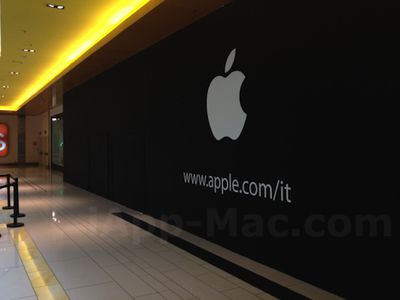
The first half of each year is a slow time for Apple retail store openings, but the company does continue to schedule sporadic additions to its network of stores as new locations come online. For its latest addition, Apple will be holding a grand opening for its second store in Rome, Italy this Saturday, April 21 at 10:00 AM. The new Porta di Roma store is located in the shopping center of the same name, a major mall with over 220 shops that opened five years ago.
Just yesterday, iApp-Macposted a few photos [Google translation] of the new store, which remains hidden behind a black construction barrier typical of Apple's projects.
The new Porta di Roma store will be Apple's tenth Italian location and will join the existing RomaEst store in serving the city's customers.
The Next Web notes that a new iPhone 4S ad aired during ESPN's SportsCenter this afternoon, featuring actor Samuel L. Jackson giving Siri orders.
Updated: The ad does appear to be an Apple creation, with the three U.S. iPhone carriers -- AT&T, Sprint, and Verizon -- being variously featured in title cards at the end of the ad. There is a similar ad featuring Zooey Deschanel being broadcast as well:
Apple rarely, if ever, uses celebrities in their advertising, particularly as themselves. The "I'm A Mac" ads featured Justin Long and John Hodgman, but they were playing characters rather than acting as a celebrity endorsement. One notable exception was actor Will Ferrell, who did a number of iPod ads a few years back.
AllThingsD reports that Zane Rowe, executive VP and Chief Financial Officer for United Continental -- the company behind the merged United and Continental airlines -- has joined Apple as one of the vice presidents of sales at Apple.
“We are thrilled that Zane Rowe will be joining us as one of our vice presidents of sales,” Apple spokesman Steve Dowling told AllThingsD. “He built a great team at United and we think he is going to do a fantastic job at Apple.”
United Continental Holdings President and CEO Jeff Smisek said the company was "sorry Zane has decided to leave." Mr. Zane had worked for Continental Airlines since 1993.
We first previewed Propellerhead Software's second iOS app, Figure, last month. It's since been released and has been featured as Apple's iPhone App of the Week in the United States.
The software, powered by Reason -- the company's flagship music production software -- aims to let amateur musicians create their own beats through powerful but easy-to-use multitouch controls.
Playing bass, drums, and lead melodies on Figure all happens through the performance pads. These have been designed for touch control from the beginning. You can tap them like traditional keyboards or pad controllers or you can simply hold your finger down and let the rhythm wheels provide a pattern for you. You can easily tap into the sound-sculpting power of Thor’s filters, envelopes, and effects by adjusting each preset’s “Tweaks”. Don’t know what a filter or envelope is? No problem! Just move your finger along the same performance pad and listen to the changes in sound.
Figure for iPhone is available for $0.99 on the App Store. [Direct Link]
As noted by MacStories, Apple has discontinued its free trials of Aperture and iWork, directing users to the Mac App Store where the apps are available for purchase.
The discontinuation of the Aperture trial is not particularly recent, as discussion forum reports indicate that it has been missing for at least a month, but the removal has gone mostly unnoticed. It is not entirely clear when the iWork trial was taken down from Apple's U.S. site, but it appears to still be available from some international sites such as the UK site. Other international sites also suggest that the iWork trial is still available, but attempts to download the app simply lead to the Mac App Store.
Since the launch of the Mac App Store in January 2011, Apple has moved all of its major software products to the marketplace, which does not support free trials. The company advises Mac App Store developers wishing to offer free trials of their software to host the downloads on their own sites, but Apple appears to have decided that this option is no longer worthwhile for most of its own apps. Apple does, however, continue to offer a free 30-day trial of Final Cut Pro X, so it has not yet abandoned trials entirely.
Aperture is priced at $79.99 in the Mac App Store, a significant cut from the $199 price of the boxed software it replaced. In a similar fashion, the three iWork applications (Pages, Numbers, and Keynote) are available through the Mac App Store at $19.99 each, less than the $79 price for the boxed version containing all three applications.
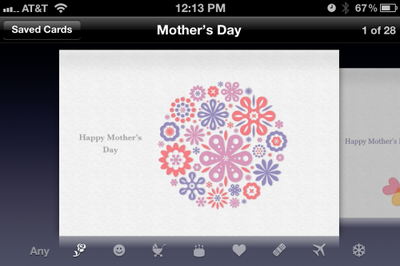
Last October, along with the iPhone 4S, Apple launched a new app called Cards that allowed iPhone owners to send real-world, customized, greeting cards to friends and relatives straight from the iPhone -- postage included.
The app was just updated with a number of new card designs, including more than two-dozen for Mother's Day, coming up on Sunday, May 13, 2012 in the U.S. There are 28 new Mother's Day cards and 28 new Get Well cards, along with a number of new cards in each of the other categories as well.
Each card is $2.99 when sent within the U.S. and $4.99 when sent to or from anywhere else, including postage. The Cards app is a free download from the App Store. [Direct Link]
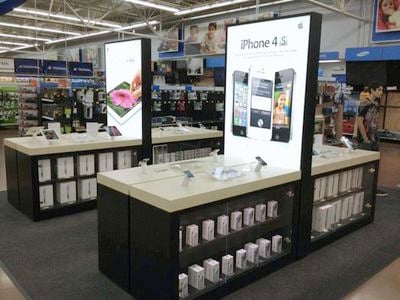
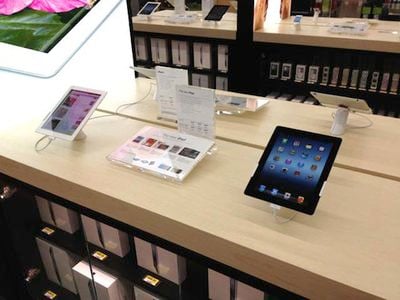
ifoAppleStore shares some photos of a newly-revamped Apple product display section in an Arkansas Walmart store near the retail chain's headquarters. Coming with dedicated wood display surfaces and lighted signage, the new displays mark a distinct improvement over the previous Apple product displays that had simply been integrated into existing display shelving.
The displays feature tall, double-sided, back-lit graphics, a clean-looking wood table, live display products and under-table accessory storage with security glass. The new look updates previous Apple product displays within Walmart stores that have been notoriously small, invisible and poorly maintained.
Walmart has long been a close retail partner with Apple, and the company has served as a launch-day source for a number of high-profile Apple products. The chain was even the first store to begin selling the new iPad in many locations in the United States, with a number of the company's stores offering select models of the device at 12:01 AM local time on launch day, eight hours ahead of Apple's own retail stores.
Apple has been rumored to be partnering with Walmart to bring store-within-a-store concepts to the retailer's Sam's Club warehouse stores, and it seems that the companies are also at least exploring expanding their partnership in the more plentiful Walmart locations. Apple has also committed to bring 25 dedicated Apple shops to Target stores, signifying the company's interested in expanding its presence at mass market retailers with a broader reach than its own retail store network.
While Apple has received much publicity for its partnership with the Fair Labor Association to audit working conditions at several of its manufacturing partners' facilities in China, Financial Times reports that the company has now also partnered with the Institute of Public and Environmental Affairs (IPE) for an environmental audit of a supplier's facilities.
Apple has agreed to a jointly monitored audit of pollution controls at a supplier's factory in China, in what activists see as a breakthrough in their efforts to persuade the world's most valuable company to address environmental concerns.
A maker of printed circuit boards for the Silicon Valley company is due to be inspected in the next few weeks by auditors, with Apple and the China-based Institute of Public and Environmental Affairs (IPE) jointly monitoring their efforts.
According to the report, Apple and the IPE have been in discussions for months about a partnership, culminating in a five-hour meeting in Cupertino last October that set the stage for a formal relationship. Following this initial audit, the IPE hopes that it will be able to partner with Apple on audits of thirteen other facilities in China that are already being monitored by Apple.
The IPE is led by Ma Jun, an environmental activist who just today was announced as one of six winners of this year's Goldman Environmental Prize.
In October, the activist and author met with senior Apple executives in San Francisco and Cupertino to discuss his report, published a month earlier, on health hazards caused by pollution in the company's Chinese supply chain.
Ma will be at the War Memorial Opera House in San Francisco on Monday to receive the Goldman Environmental Prize for "bringing unprecedented environmental transparency and empowering Chinese citizens to demand justice." His work has prompted the Chinese government and multinational corporations, including Apple, to more seriously confront the issues he has long been raising.
As part of its environmental disclosures, Apple has noted that it focused on 14 suppliers for environmental audits in 2011, and the company is expanding its efforts in 2012 to include additional facilities, work more closely with governmental and nongovernmental agencies such as the IPE, and increase training on environmental responsibility throughout its supply chain.
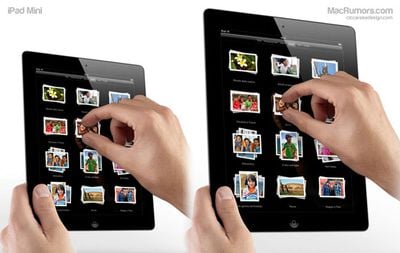
Kotaku reports on claims [Google translation] from Chinese web portal NetEase regarding Apple's plans for the launch of a smaller "iPad mini" in the third quarter of this year. According to the report, Apple is planning to launch with six million units of the device at a price of either $249 or $299 in order to combat forthcoming Windows 8 products, although smaller Android tablets such as Amazon's Kindle Fire have also been viewed as targets for Apple.
NetEase claimed that the device will be released around the third quarter of this year to "counter attack" the upcoming Windows tablets. The report further claims that the devices will cost anywhere from US$249 to $299 and that there will be an initial 6 million units ready for launch.
The well-connected John Gruber has claimed that Apple has a 7.85-inch iPad in its labs, but he does not know whether the product will ever make it to market. Various claims of Apple moving closer to production of the smaller iPad have also been surfacing as rumors continue to swirl.
Mockup of 7.85-inch "iPad mini" next to iPad 2 (courtesy of CiccareseDesign)
Last December, we posted a paper mockup showing what a 7.85-inch iPad would look and feel like, coming to the conclusion that onscreen elements would remain usable even as the standard iPad resolution of 1024x768 was squeezed into a 7.85-inch display rather than a 9.7-inch screen. A 7.85-inch "iPad mini" display with a resolution of 1024x768 would carry a pixel density of 163 pixels per inch, exactly the same density as the non-Retina iPhone and iPod touch models. Consequently, content meeting Apple's interface guidelines would display at acceptable sizes on such a display.
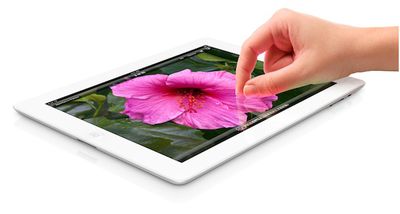
Apple today officially announced two more rounds of launches for the new iPad, with the first round coming on Friday, April 20 and including twelve markets led by South Korea. The second round comes on Friday, April 27 and includes nine more countries.
Apple today announced the new iPad, the third generation of its category defining mobile device, will arrive in South Korea and 11 additional countries on Friday, April 20. [...]
In addition to South Korea, the new iPad also will be available beginning on Friday, April 20 in Brunei, Croatia, Cyprus, Dominican Republic, El Salvador, Guatemala, Malaysia, Panama, St Maarten, Uruguay and Venezuela. Beginning on Friday, April 27, the new iPad will be available in Colombia, Estonia, India, Israel, Latvia, Lithuania, Montenegro, South Africa and Thailand.
Apple has moved quickly to launch the iPad in markets around the world, beginning with a 10-country launch on March 16 and following that with debuts in 25 more countries just a week later.
One key market that has yet to see an announcement regarding availability of the new iPad is China. Regulatory authorities have approved at least the Wi-Fi version of the device, but Apple is apparently not yet ready to launch the device in the country.
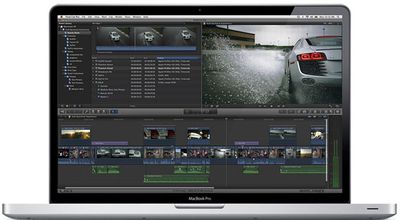
Apple met with video consultant and trainer Larry Jordan on the eve of the 2012 NAB show and shared some upcoming plans for Final Cut Pro X. The following features are expected in Final Cut Pro X in 2012:
- Multichannel Audio Editing Tools - Dual Viewers - MXF Plug-in Support - RED camera support
Jordan goes into some light details about some of the new features. FCP X will be able to read MXF files directly without the need to convert to QuickTime. The same can be said for RED camera support whose files will be able to be edited natively. Finally, Apple explains that Dual Viewers is analogous to Source and Record monitors and that they will try to do it better than has been implemented in the previously.
While those are the only features officially announced, Apple indicated that they wouldn't be the only new features coming this year. Jordan also asked for hints about upcoming hardware, but Apple didn't provide any information.
The National Association of Broadcasters (NAB) conference kicks off this week in Las Vegas. Apple has not held a major presence at the show in recent years, but did use the venue last year to introduce Final Cut Pro X. Apple again appears to have a presence at the show and is at least meeting with some prominent figures. The NAB runs through April 19th.
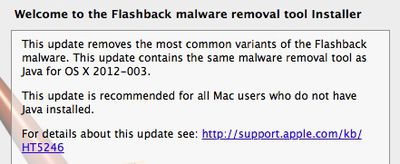
Following yesterday's release of fresh Java updates to remove the Flashback malware system from Macs running OS X Lion and Snow Leopard, Apple today released a standalone Flashback malware removal tool to clean infections from OS X Lion systems without Java installed.
About Flashback malware removal tool
This Flashback malware removal tool that will remove the most common variants of the Flashback malware.
If the Flashback malware is found, a dialog will be presented notifying the user that malware was removed.
In some cases, the Flashback malware removal tool may need to restart your computer in order to completely remove the Flashback malware.
This update is recommended for all OS X Lion users without Java installed.
While the most dangerous method of attack for Flashback exploits a security hole in Java that Apple has now patched, various versions of the malware have also used social engineering and other tricks in attempting to gain access to users' systems.
With OS X Lion not having Java included by default, users of Apple's latest operating system who have found themselves infected through other means and do not have Java installed can use the new tool to clean their systems without needing to install Java.
The update weighs in at 356 KB and requires OS X Lion without Java installed.




 A frequent complaint amongst some iPhone power users is the number of steps it takes to toggle Bluetooth on and off. It takes the user four steps -- Settings/General/Bluetooth/Toggle -- to turn it on or off. However, a just-launched app aims to make the task much simpler.


 We
We 
 While Apple has received much publicity for its partnership with the Fair Labor Association to audit working conditions at several of its manufacturing partners' facilities in China,