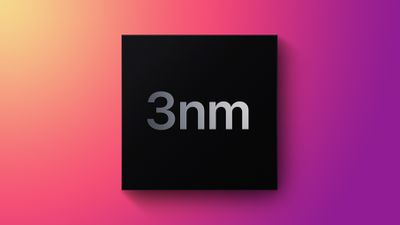
Apple's main chip supplier TSMC will kick off mass production of 3nm chips this week, with Apple being the primary customer of the new process, which could first be used in upcoming M2 Pro chips expected to power updated MacBook Pro and Mac mini models.
According to the new report by DigiTimes, TSMC will start mass production of its next-generation 3nm chip process on Thursday, December 29, in line with reports from earlier in the year that said 3nm mass production would begin later in 2022. From the report:
TSMC is scheduled to hold a ceremony at Fab 18 at the Southern Taiwan Science Park (STSP) on December 29 to mark the start of commercial production of chips using 3nm process technology. The pure-play foundry will also detail plans to expand 3nm chip production at the fab, according to sources at semiconductor equipment companies.
Apple currently uses TSMC's 4nm process in the A16 Bionic chip in the iPhone 14 Pro series but could jump to 3nm as soon as early next year. A report in August claimed the upcoming M2 Pro chips would be the first to be based on the 3nm process. The M2 Pro chip is expected to debut first in updated 14-inch and 16-inch MacBook Pros early next year and possibly updated Mac Studio and Mac mini models.
Later in 2023, according to another report, the third generation of Apple silicon, the M3 chip, and the A17 Bionic for the iPhone 15, will be based on TSMC's enhanced 3nm process, which has yet to be made available. According to the DigiTimes report today, citing industry sources, production of 3nm process chips is "unlikely to ramp up" until production of the enhanced version gets underway.
Saturday April 11, 2026 9:14 am PDT by Joe Rossignol
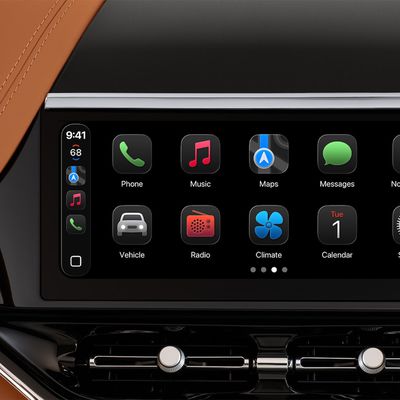
Last year, Apple launched CarPlay Ultra, the long-awaited next-generation version of its CarPlay software system for vehicles. Nearly a year later, CarPlay Ultra is still limited to Aston Martin's latest luxury vehicles, but that should change fairly soon.
In May 2025, Apple said many other vehicle brands planned to offer CarPlay Ultra, including Hyundai, Kia, and Genesis.
CarPlay Ultra...
As we wait for WWDC to kick off next Monday, Apple today announced the winners of its annual Apple Design Awards, recognizing apps and games for their innovation, ingenuity, and technical achievement.
The 2025 Apple Design Award winners are listed below, with one app and one game selected per category:
Delight and Fun - CapWords (App) and Balatro (Game)
Innovation - Play (App) and PBJ -...
Saturday April 11, 2026 9:07 am PDT by Joe Rossignol
While the AirPods Max 2 received more attention, Apple also released a second pair of headphones last month: Nike Powerbeats Pro 2.
Nike Powerbeats Pro 2 are the same as the regular Powerbeats Pro 2, except they have a two-tone design consisting of black and Nike's signature Volt neon green-yellow color. The headphones were released on March 20 in the U.S., Canada, Australia, the U.K., and a ...
Production on the iPhone Fold is behind schedule, but the device is still slated to launch in fall 2026, reports DigiTimes. The site says that production has been pushed back by "roughly one to two months," but Apple has not communicated any launch delays to suppliers. Apple is still planning for a 2026 launch, which suggests a tighter production schedule.
Apple planned to begin iPhone Fold...
Apple is moving more decisively to reduce its reliance on Chinese manufacturers ahead of the launch of a wave of new products with OLED panels, DigiTimes reports.
Apple has apparently accelerated efforts to diversify its OLED sourcing away from Chinese suppliers such as BOE, which have historically played an important role in the company's display supply chain. The impact on BOE has already...
Saturday April 11, 2026 9:14 am PDT by Joe Rossignol
Last year, Apple launched CarPlay Ultra, the long-awaited next-generation version of its CarPlay software system for vehicles. Nearly a year later, CarPlay Ultra is still limited to Aston Martin's latest luxury vehicles, but that should change fairly soon.
In May 2025, Apple said many other vehicle brands planned to offer CarPlay Ultra, including Hyundai, Kia, and Genesis.
CarPlay Ultra...
According to the new report by DigiTimes ('https://www.digitimes.com/news/a20221225PD200.html'), TSMC will start mass production of its next-generation 3nm chip process on Thursday, December 29, in line with reports from earlier in the year ('https://www.macrumors.com/2022/08/22/3nm-chip-production-for-upcoming-macs-report/') that said 3nm mass production would begin later in 2022. From the report: Apple currently uses TSMC's 4nm process in the A16 Bionic chip in the iPhone 14 Pro series but could jump to 3nm as soon as early next year.
It's well-known, from TSMC's own press releases, that the N4P process (likely used in the A16) is 5 nm, not 4 nm: https://pr.tsmc.com/english/news/2874 "As the third major enhancement of TSMC’s 5nm family, N4P will deliver an 11% performance boost over the original N5 technology and a 6% boost over N4."
So how much weight should we give to DigiTimes' TSMC reporting when they aren't even aware of something so basic?
And why doesn't MR do some basic fact-checking before posting this stuff? Given that the whole point of this article is to report on a process change, you'd think they want to get the process descriptions right.
According to the DigiTimes report today, citing industry sources, production of 3nm process chips is "unlikely to ramp up" until production of the enhanced version gets underway.
This doesn't make sense. First they say that mass production on the first gen 3 nm chip (N3) starts in a few days, but now they're saying that production on 3 nm is unlikely to ramp up until the next gen 3 nm (N3E) gets underway. This is just screaming out for clarification, yet MR gives us none. Come on guys, how putting some thought into these articles, rather than just cutting and pasting a few quotes from another source (which, incidentally is behind a paywall, preventing us from checking it ourselves)?
It's well-known, from TSMC's own press releases, that the N4P process (likely used in the A16) is 5 nm, not 4 nm: https://pr.tsmc.com/english/news/2874 "As the third major enhancement of TSMC’s 5nm family, N4P will deliver an 11% performance boost over the original N5 technology and a 6% boost over N4."
So how much weight should we give to DigiTimes' TSMC reporting when they aren't even aware of something so basic?
The Digitimes reporters are very well aware of TSMC processes. In this case, you seem to be the confused party.
The 3nm process which was in risk production and that didn’t quite perform to par, hence delayed until now, is what is going into volume production. The improved version of that, commonly referred to as N3e in the industry, is assumed to be the one that will see major adoption, and will follow rather close on the heels of this initial version.
There is nothing strange about this report. It is simultaneously disappointing that this process wasn’t ready for volume production in May, but at the same time it’s nice to see that they are ready to start producing consumer chips on it now. It offers no density improvement for either SRAM or I/O circuitry and only modest improvements for logic, so pinning large expectations on lithography driven advances would not be wise. Still, there will be some gains. Looking forward to see the end results.
So if I understand this right? It looks as though the standard 3nm chip will be M2 in nomenclature and reserved for the Macbook Pro, Mac Mini released in spring 2023.
The enhanced 3nm process will therefore be the M3 chip.
Wrong, M2 Pro/Max already out in the wild and the spotted Geekbench 5 results indicate that they are using N5P like the regular M2.