Five Years of Apple Silicon: M1 to M5 Performance Comparison - MacRumors
Skip to Content

Five Years of Apple Silicon: M1 to M5 Performance Comparison

Today marks the fifth anniversary of the Apple silicon chip that replaced Intel chips in Apple's Mac lineup. The first Apple silicon chip, the M1, was unveiled on November 10, 2020. The M1 debuted in the MacBook Air, Mac mini, and 13-inch MacBook Pro.
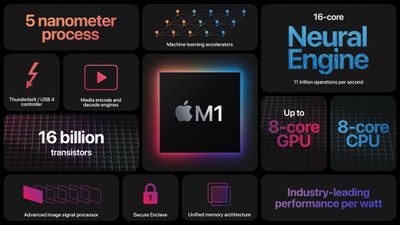
m1 chip slide
The ‌M1‌ chip was impressive when it launched, featuring the "world's fastest CPU core" and industry-leading performance per watt, and it's only improved since then. We've had five total generations of Apple silicon chips, with the M5 unveiled in the 14-inch ‌MacBook Pro‌ just last month.

Here's how the M5 measures up to the ‌M1‌, per Apple's M5 specs:

  • 6× faster CPU/GPU performance
  • 6× faster AI performance
  • 7.7× faster AI video processing
  • 6.8× faster 3D rendering
  • 2.6× faster gaming performance
  • 2.1× faster code compiling

Geekbench comparison scores:

  • ‌M1‌ single-core - 2,320
  • M5 single-core - 4,263
  • ‌M1‌ multi-core - 8,175
  • M5 multi-core - 17,862
  • ‌M1‌ Metal - 33,041
  • M5 Metal - 75,637

Both CPU and GPU performance have increased significantly over the past five years, and Apple has boosted AI and gaming performance too with add-ons like hardware-accelerated ray tracing and an ever-improving Neural Engine.

‌M1‌ Chip M5 Chip
Made with TSMC's 5nm process (N5) Made TSMC's third-generation 3nm process (N3P)
Based on A14 Bionic Pro chip from iPhone 12 Based on A19 Pro chip from iPhone 17 Pro
8-core CPU, 8-core GPU 10-core CPU, 10-core GPU
3.2 GHz CPU clock speed 4.61 GHz CPU clock speed
No integrated Neural Accelerators Integrated Neural Accelerator in every GPU core
No ray tracing engine Third-generation ray tracing engine
No dynamic caching Second-generation dynamic caching
Support for up to 16GB unified memory Support for up to 32GB unified memory
68.25 GB/s unified memory bandwidth 153 GB/s unified memory bandwidth

Apple sold Apple silicon Macs alongside Intel Macs for three years, but phased out the final Intel Mac in June 2023 when the 2019 Mac Pro was discontinued. Now all of Apple's devices have Apple chips, and we're even hitting the end of the road for Intel Mac software support. Intel Macs won't get software updates after macOS Tahoe.

Over the next five years, Apple silicon chip technology will continue to evolve. Apple supplier TSMC is already working on 2nm chips that could make an appearance as soon as 2026, offering a 10 to 15 percent speed improvement and a 25 to 30 percent power reduction. 1.4nm chips could follow as soon as 2028 for even more power and efficiency.

Popular Stories

m6 chip

Apple Reveals M6 as First-Ever 2nm Chip

Tuesday August 25, 2026 6:05 am PDT by
Apple today announced the M6 chip, its first built using a 2-nanometer process and featuring a Dual 16-core Neural Engine. Apple says the 2nm process packs greater transistor density into a smaller die, contributing to the chip's overall gains in performance and power efficiency. The M6 chip features a larger, more powerful 12-core CPU, two more cores than the M5, made up of two super...

m5 ultra chip

Apple Debuts M5 Ultra as Most Powerful Chip Ever

Tuesday August 25, 2026 6:12 am PDT by
Apple today announced the M5 Ultra, which the company says is its most powerful chip ever. The M5 Ultra is built by connecting two dual-die M5 Max chips using Apple's next-generation UltraFusion technology, which is the first time Apple has used a quad-die architecture in an M-series chip. UltraFusion increases inter-die bandwidth to over 4.4TB/s and connection density by more than 6x,...
apple silicon gray

Leaked Images Give First Look at Apple's AI Servers

Wednesday August 26, 2026 9:34 am PDT by
Images claiming to show the inside of an Apple-made AI server, believed to power Private Cloud Compute, surfaced online this week, offering a first look at how the hardware is laid out. The images were shared earlier this week by the X user @hsuchingpo, an account with a track record of Apple hardware and prototype leaks. Captioned simply "Apple M5 Server," the leaker said the hardware is "mo...

Top Rated Comments

11 months ago
The (base) M1 MBA is amazing. The M5's numbers are impressive, but aside from "using" the CPU and GPU I don't do any of the other things listed. That's why I'm typing this from my (base) M1 MBA with no plans to upgrade. (I can wait till the MBA gets an OLED display. 🤤 )

Score: 56 Votes (Like | Disagree)
Kylo83 Avatar
11 months ago
M1 Max is still over kill
Score: 32 Votes (Like | Disagree)
RumorConsumer Avatar
11 months ago

Does anybody need faster than an Intel Mac?
resounding yes are you kidding me
Score: 29 Votes (Like | Disagree)
gank41 Avatar
11 months ago
My M1 MBP is still running great. I'm really struggling to find a reason to upgrade.
Score: 23 Votes (Like | Disagree)
DaveMcM76 Avatar
11 months ago
My M1 Mac Mini (16GB, 1TB) is still going strong running macOS Tahoe and showing no obvious signs of slowing down or struggling that would push me towards considering an upgrade. It replaced a Core i5 mid 2011 Mac Mini so felt like a rocket ship by comparison when I got it.
Score: 20 Votes (Like | Disagree)
Agent007 Avatar
11 months ago
Apple Silicon has been mostly great but they've been slacking on MacOS and there's no option for alternative OS like there was in the Intel days. Even Linux support is lacking major features like TB and display output. Granted, Windows has also gotten worse during this time frame so it wouldn't be an option anyway.

For its time, OS X was a better OS than MacOS is now. I HATE the iOSification of MacOS icons, menus, etc. I HATE having to do a song-and-a-dance just to install a non-Apple-blessed app - can't even be turned off in settings. And the bloatware that can't be deleted? Are you KIDDING ME?

I haven't installed MacOS 26 and don't plan to.
Score: 16 Votes (Like | Disagree)