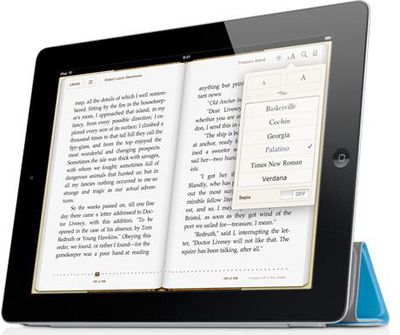
Class-action Suit Filed Against Apple and 5 Book Publishers Over E-book Pricing
The lawsuit, filed this afternoon in the Northern District of California claims Apple and Hachette, HarperCollins, MacMillan, Penguin, and Simon & Shuster illegally worked together to enable an "agency model" as the standard for e-book sales, rather than the "wholesale model" that is used in the physical publishing industry. The complaint argues that the strategy was unfair and anticompetitive because e-book prices rose after the agreements were in place.
From the lawsuit:
In November 2007, Amazon revolutionized the book publishing industry by releasing the Kindle, a handheld digital reader for electronic books or “eBooks.” Using proprietary “electronic ink” technology, the Kindle replicated the appearance of ink on paper and introduced numerous efficiency-enhancing characteristics, including portability and other advantages of a digital format.
A major economic advantage to eBook technology is its potential to massively reduce distribution costs historically associated with brick-and-mortar publishing. But publishers quickly realized that if market forces were allowed to prevail too quickly, these efficiency enhancing characteristics would rapidly lead to lower consumer prices, improved consumer welfare, and threaten the current business model and available surplus (profit margins). So, faced with disruptive eBook technology that threatened their inefficient and antiquated business model, several major book publishers, working with Apple Inc. (“Apple”), decided free market competition should not be allowed to work – together they coordinated their activities to fight back in an effort to restrain trade and retard innovation. The largest book publishers and Apple were successful.
Eventually, Amazon and the various book publishers came to agreements regarding the agency model and e-books have been priced that way ever since. Random House was the only major publisher to resist the agency model -- making it a late entry to the iBookstore. Random House books finally joined Apple's bookstore earlier this year.
Publishers were concerned that Amazon's aggressive $9.99/book pricing strategy -- where the bookseller sold books for a loss, presumably to drive adoption of its new Kindle platform -- would quickly erode the profits and reduce the perceived value of their books. Random House was concerned the agency model would lead to a price war between the publishing houses.
This lawsuit alleges that as a "direct result of this anticompetitive conduct as intended by the conspiracy, the price of eBooks has soared" and "bring claims under federal and state antitrust laws to enjoin the illegal conduct and to obtain damages."
We've uploaded the filing to Scribd.
Top Rated Comments
(View all)Until he realized that he can ride to higher profits on the burgeoning e-book sales, that is.
I hope the suit wins. It will be better for all consumers.
Yeah where are all the "green people" now? bitching about the price!
And they should be. There is no where NEAR the same overhead needed for an ebook as is needed to produce and distribute a physical book. Reminds me of Costco vs. Sams -- Costco does business on the notion that there's no reason for 'windfall' profits: if the price to produce goes down, the price of the product goes down too. Period. Sams just eats the created margin. The same is true here. Rather than attempting to push market growth and encourage adaptation, we're being hamstrung by higher prices for pure greed. Make no mistake, the production cost on e-books already were already lower and are only going down. We're being price gouged.
:apple:
Who cares! if you don't want to pay for an e-book pay full price at the bookstore!
Ok, I'll just drive down to my local borde.... oh, they closed down.
Ok, I'll just drive down to my local barns and no..., oh, they closed down as well.
Ok, I'll just drive down to my local mom & pop book sto..., oh, they were ironically closed down by Borders and B&N years ago.
Ok, e-book it is.
It's ridiculous that ebooks cost the same or MORE than physical books. Fact is this is collusion on pricing, and publishers are trying to protect the layers of middle men no longer needed. Many many authors who turned to ebooks self published report they make the same money selling ebooks at $2/book as they did using publishers of physical books.
ebooks are NOT worth $10 or higher. More like half that (at MOST). Until then, everyone should pirate the ebooks.
Maybe some lawyer could explain this to us. How can Apple be accused of price fixing if they are using the agency model? Under the agency model, the publisher rather than the seller dictates the price of the book (ie not Apple) whereas under the old wholesale model, not only did the seller (Amazon) dictate the price (price fix) but they also could change the price if it was not selling well causing the publisher to possibly incur a loss.
To qualify for the iBookStore, Apple insisted that the publishers agree to the agency model for all distributers. It wasn't enough that the publisher agree to use the agency model with Apple, they had to also agree to use the agency model with Amazon, and at the same price.Apple is dictating the price at which the publishers sell their ebooks in other stores, like Amazon. They can't do that.
If Amazon wants to sell their ebooks at no profit, it's not Apple's business to interfere unless Amazon's sole intention is to inhibit competition. That's clearly not the case, however, because it's well established that Amazon is willing to sacrifice their ebook profits to increase Kindle sales (a legitimate business strategy), and also utilized this pricing model long before Apple sold ebooks.
How are these two things contradictory?
He didn't say people don't read, he said don't read books.
No, he did not. Jobs was referring specifically to e-books.
Quote:
Amazon’s Kindle e-book reader will fail, Steve Jobs says, because Americans simply don’t read. From The New York Times:
“It doesn’t matter how good or bad the product is, the fact is that people don’t read anymore,” he said.
And all those who so predictably jump to defend Apple, should stop for a minute to actually understand the issue.
Before the launch of the iPad, Apple did effectively colude with the major publishers, positioning the iPad as an ereader and making sure that nobody can sell titles for less than Apple.
... Apple was involved in the scheme. The complaint alleges that Apple believed that it needed to neutralize the Kindle when it entered the e-book market with its own e-reader, the iPad, and feared that one day the Kindle might challenge the iPad by digitally distributing other media like music and movies.
The complaint claims that the five publishing houses forced Amazon to abandon its discount pricing and adhere to a new agency model, in which publishers set prices. This would prevent retailers such as Amazon from offering lower prices on e-books.
Apple had already established such a model on its App store, taking 30 percent revenue on sales while the publishers receive 70 percent.
...
The complaint notes that Apple CEO Steve Jobs foreshadowed the simultaneous switch to agency pricing and the demise of discount pricing in an interview with The Wall Street Journal in early 2010. In the interview, he was asked why consumers would buy books through Apple at $14.99 while Amazon was selling the same book for $9.99. “The prices will be the same,” he stated.
Put simply - Before the agency model, Amazon etc bought eBooks wholesale similar to how they would physical books. What they chose to charge for them was their own business, governed by the free market (again, the same as they do with real books). They could choose to sell them at a loss to drive their own business (as most supermarkets do with various products, eg. Tesco sell a lot of beer at cost or below-cost in order to increase footfall in their stores). Again, this is a free market economy and competitors can respond accordingly.
With the Agency model, the publisher has withdrawn the ability to buy eBooks from them wholesale, so if Amazon, Apple etc wish to sell their books they must accept the new terms and only sell the book at the agreed price in exchange for a cut of the sale. If this isn't price-fixing, I don't know what is.
The outcome is a restricted market and one in which the publishers control the price, sellers such as Amazon, Apple etc are not able to compete because they cannot sell the book below the agreed price.
You just have to look for books on Amazon which state 'This price has been set by the publisher' in order to identify which ones are sold under the Agency model.
As far as I am aware, Apple was instrumental in pushing this new model as they probably worked out they would find it hard to compete with Amazon (or didn't WANT to compete) as they were entering a new market which Amazon was already the market leader. It was a great strategy as it took away the main tool Amazon had to attract customers, lower prices. What is there to differentiate iBooks and Amazon Kindle now? Prices are the same, it's just the interface that's different.
Ultimately I think publishers will lose this battle, particularly in the UK where European law is very much in favour of free market competition. Agency pricing is anti-competitive, anti-consumer and governments will (eventually) rule against it.
But wasn't amazon doing the same with the subsidized $9.99 price point? they wanted kindle adaption, and that is how they got it. Which, in turn set a precedence for book prices that was low, and no one could be expect to compete against without taking the same losses.
I dunno, it will be interesting to see it play out.
You're right. Amazon forwent their ebook profits to encourage Kindle adoption and convince customers that ebooks are not to be feared. Likewise, Apple could compete by forgoing their iBook profits to encourage iPad adaption, couldn't they? But Apple didn't want to be competitive, so instead they used their market influence to artificially control prices.
Apple has no legal right to demand that pricing be identical across all retailers, but Apple colluded with book publishers to do exactly this.
[ Read All Comments ]

Accessory maker Moshi has released a new ultra-thin plastic shell protective case for the 11" and 13" MacBook Air models. This type of plastic case tends to be especially popular among...
Blizzard Entertainment said this week that it sold more than 3.5 million copies of Diablo III on launch day, setting the record for fastest-selling PC game. The company also sold 1.2 million copies...
Hard drive maker Seagate has announced it will purchase data storage device maker LaCie for roughly $186 million.
The company plans to buy the controlling stake owned by Philippe Spruch,...
Intuit has upgraded the iOS app for its Mint personal finance tool with two new "most-requested" features that should keep users from ever having to go to the Mint.com website. Until now,...