Got a tip for us? Share it...

Apple Patent Application Reveals Moldable Charging Dock for Media Devices


In addition to yesterday's published patent applications from Apple describing tamper-resistant labels and accelerometer-based menu navigation, Patently Apple noticed a third interesting patent, this one covering a universal charging station with a moldable elastic surface surrounding the actual connector, capable of conforming to and supporting devices with varying form factors.

The patent application, entitled "Aesthetically pleasing universal dock" and filed on June 4th, 2008, seeks to improve on Apple's existing system for universal docks, which offers individual plastic inserts for each device form factor to allow them to fit snugly into the dock.

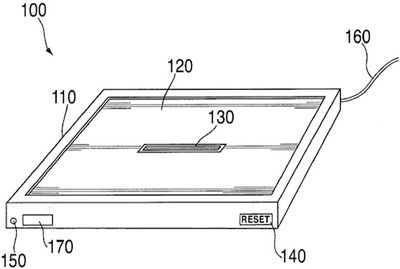
In one embodiment, a dock that supports a plurality of differently-shaped electronic devices includes a housing, a connector coupled to the housing, and a compressible support layer positioned at least partially about the connector. At least a portion of the compressible support layer compresses to the shape of at least a portion of an electronic device that is attached to the connector.

Apple suggests a number of possible options that could be offered on such a dock, including the ability to offer "lasting compression" that would retain the shape of the device mounted in it after removal, allowing for easy remounting of the device at a later time.
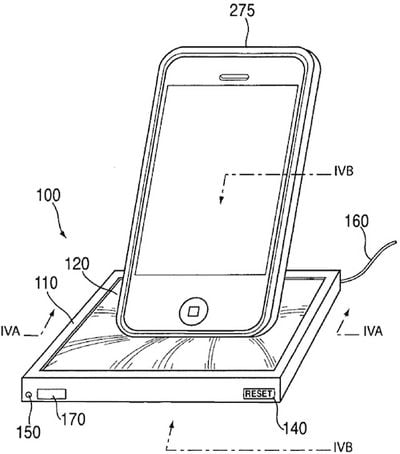

Apple also proposes a related support mechanism in which, rather than a support material compressing to fit a device, a thinner support material could rise in response to the mounting of a device, creating a support around the device. Apple also proposes the possibility of using mechanical or electrical signals and buttons to mold the support surface, allowing a user to create an appropriate surface for their device or reset an already-molded surface at the touch of a button.

Taking things even a step further, the application proposes that a method could be employed for the dock to automatically detect what kind of device is being mounted and conform its support surface accordingly. And finally, Apple proposes including an infrared remote sensor as in existing universal docks, allowing for control of devices mounted in the dock.


Top Rated Comments

(View all)

28 months ago

Taking things even a step further, the application proposes that a method could be employed for the dock to automatically detect what kind of device is being mounted and conform its support surface accordingly.


This would be cool. I'd worry about the user putting the device in at the wrong angle, potentially loosening the connector. Detect and conform. That's the way to go.
Rating: 0 Positives / 0 Negatives
28 months ago
Jello power! Moulds to any shape you choose :D
Rating: 0 Positives / 0 Negatives
28 months ago
Way cool!
Rating: 0 Positives / 0 Negatives
28 months ago
Hey, the iPhone in that picture leaves a rather large gap between the bottom of the screen and the Home button... must be the next generation of iPhone! :rolleyes::D
Rating: 0 Positives / 0 Negatives
28 months ago
less cables = less clutter = good !
My little pet peeve... keeping all the cables around and behind my work console clean and neat... I guess I could have more important things to worry about.... but this is a good start !
Rating: 0 Positives / 0 Negatives
28 months ago
Hmm play dough? :)
Rating: 0 Positives / 0 Negatives
28 months ago

less cables = less clutter = good !


It looks like this still has a connector.

Seems pretty old tech compared to using Bluetooth plus connectionless inductive charging pads.
Rating: 0 Positives / 0 Negatives
28 months ago
It seriously boggles the mind the thing companies try to get patents for... The addition of memory foam to a iPod dock is patentable? I guess... It's novel... But nothing new was invented here it like patenting the use of legos to make a chair...
Rating: 0 Positives / 0 Negatives
28 months ago

It looks like this still has a connector.

Seems pretty old tech compared to using Bluetooth plus connectionless inductive charging pads.


I might agree with you except for one thing, the inductive charging pads are wasting electricity. True, they may be turned off when the device isn't on the charging pad, but inductive power transmission is inherently lossy without a ferrous carrier. You're looking at a potential of between 50% and 75% of the charging power wasted. At least with a physical connection, there's much less waste. You might also consider that any device that uses a transformer to reduce wall voltage to device voltage is almost always 'on' even when nothing is connected. To prevent this issue, you either need a physical on/off switch on the primary side or you charge the item through a master device like your computer, which usually includes such a switch. Of course, if you're using DC only, then the master device doesn't need to worry about individual on/off switches when the charged item is removed from the dock.

Really, technology needs to come off of AC-only devices. AC is necessary for the transmission of electricity to the point of use, but from the wall socket on, DC would really be more efficient and potentially save as much as 75% of the electricity we now waste.
Rating: 0 Positives / 0 Negatives
28 months ago

It seriously boggles the mind the thing companies try to get patents for... The addition of memory foam to a iPod dock is patentable? I guess... It's novel... But nothing new was invented here it like patenting the use of legos to make a chair...


I think you're misreading the patent. This isn't necessarily 'memory foam', since that would reset itself as soon as you remove the device, but rather something more on the line of 'memory metal' which would maintain the shape when the device is removed while providing reasonable support for the device while docked. It may include a foam padding, but foam wouldn't be the sole support.
Rating: 0 Positives / 0 Negatives

[ Read All Comments ]