RIM's BlackBerry vs iPhone's ActiveSync
"Every e-mail message sent to or from a RIM device, goes through a NOC up in Canada. Now, that provides a single point of failure, but it also provides a very interesting security situation. Where someone working up at that NOC could potentially be having a look at your e-mail. Nobody seems to be focused on that. We certainly are."
These concerns, however, may have been overstated. American Technology Research issued a report (via Appleinsider) comparing the two approaches to providing Exchange support for the Apple's iPhone vs the RIM's BlackBerry.
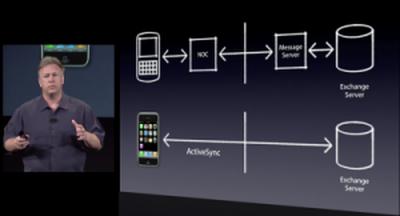
RIM's setup for Exchange support requires the use of BlackBerry Enterprise Server which connects to RIM's network operations center (NOC) in Canada. Even though messages travel through a number of servers, the contents are encrypted at the origin before being passed through RIM's NOC and finally to the BlackBerry device which alone can decrypt it. According to the research company, this gives BlackBerry the "highest level of security in the industry".
In contrast, the iPhone will interface directly with the Exchange server. The analysts, however, go on to speculate that Apple's ActiveSync implementation could have its own issues with security, and have an impact on battery life and scalability. Regardless, they feel that the iPhone's unique advantages could provide a better ActiveSync experience over existing implementations.
Apple is set to release their new enterprise features for the iPhone in June 2008.
Top Rated Comments
(View all)While I do think the Iphone leapfrogged RIM with ActiveSync, maybe Steve should keep the hyperbole down a bit just until the update is, I don't know, actually released and proven.
Let's all calm down, shall we? All we do here is talk about things up to and after the point where they are either proven or disproven... Steve can do it once in a while, too.sheesh.
I hate that he portrays us Canadians as a huge security risk to you Americans. Yeah, play on the fears of the ignorant American who thinks anyone on foreign soil must be the bad guy.
While I do think the Iphone leapfrogged RIM with ActiveSync, maybe Steve should keep the hyperbole down a bit just until the update is, I don't know, actually released and proven.
Security aside, adopting Activesync is a HUGE win for Apple. This allows them instant corporate device credibility without the need to develop a humongous solution in the server space.
Shoot, let Microsoft do all the heavy lifting in the server world (where they should stay put IMO) and our iphones can just ride the wave.
If you were to add up the cost of developing the back-end infrastructure costs of the RIM solution and compare them to the iphone's cost for adopting the Activesync protocol, you would be talking pennies vs. millions.
Also, this frees up apple to continue to spend money on the user experience instead of needing to worry about the entire round trip of device > carrier > messaging infrastructure
the floodgates are about to be opened WIDE
However, even encryption doesn't change the fact that there's a single distribution node and that attacks on or failures of that distribution node could potentially affect all of RIMS clients (and have, on several occasions). An approach where companies can control their own servers, or delegate control to a third party, is always preferable in the enterprise.
I doubt think Steve meant to attack Canada with his comments -- that's just where the servers are.
There's still a lot of questions here, though. Apple's current iPhone mail implementation offers no spam protection -- I had switch email addresses and route the new address through Gmail to avoid the 3500+ pieces of spam email my ten-years-old email address gets every week. The current mail interface is pull-based, with a minimum lag time of 15 minutes -- a far cry from the instant-read nature of the Blackberry. Personally, I prefer to wait...but for most Blackberry users, the near instant nature is the appeal. Our production systems people LOVE the thing.
The government and the majority of Fortune 500 corps have been utilizing BB without much security issues, yet Steve is going to shed some light on security that all these CIOs overlooked:rolleyes:
There's still a lot of questions here, though. Apple's current iPhone mail implementation offers no spam protection -- I had switch email addresses and route the new address through Gmail. The current mail interface is pull-based, with a minimum lag time of 15 minutes -- a far cry from the instant-on nature of the Blackberry. Personally, I prefer to wait...but for most Blackberry users, the near instant nature is the appeal. Our production systems people LOVE the thing.
maybe its because the Spam control should be done on the server, not in the device itself?
[ Read All Comments ]

Analytics firm Chitika today released a report showing that by its metrics iOS has now surpassed OS X in overall web traffic share in the United States. Chitika's methodology involves an analysis...
One of the most frequent reasons for an iPhone to go on a trip to the Apple Store's Genius Bar is because of water damage. Typically, a water damaged iPhone can be replaced for a flat $199...
TheVerge's Joshua Topolsky summarizes the iPad 3 casing findings reported earlier today, but also adds his own sources regarding some details of the iPad 3.
Image from RepairLabs
As...
Last July, Apple discontinued the white MacBook from its consumer lineup, pushing consumers toward the company's popular MacBook Air line or the 13-inch MacBook Pro. The company didn't kill...
Popular iPhone Twitter client Tweetbot has finally arrived on the iPad, with a user interface instantly familiar to any current Tweetbot user. Designed for the Twitter power-user, Tweetbot packs a...