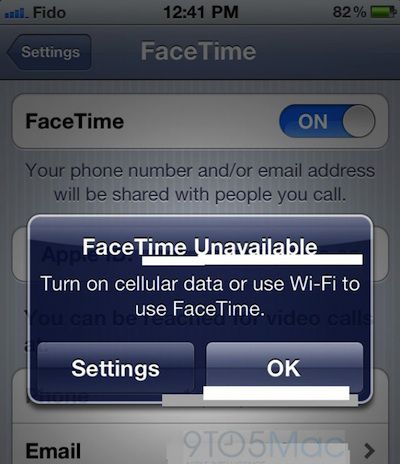
9 to 5 Mac reports that one of its readers has passed along a screenshot of an iOS 5 dialog box suggesting that Apple is preparing to support FaceTime video calling over cellular networks with the new operating system set for release this fall.
FaceTime Unavailable
Turn on cellular data or use Wi-Fi to use FaceTime.
FaceTime has officially been limited to Wi-Fi on iOS devices since its debut last year, although users have been able to work around that limitation using either jailbreaking solutions or MiFi connectivity.
Official FaceTime support over cellular networks will almost certainly require individual carriers to also be on board in much the same way that carriers have needed to support Internet tethering and other features that have the potential to significantly increase demand on their networks.
The folks behind Evernote, the notetaking and organizational app, have come up with an interesting new iPad app called Evernote Peek. The app offers a unique use of Apple's Smart Cover to help users study, learn, and improve their memory.
Evernote Peek works by connecting to an existing Evernote account where your study materials are stored. When you're ready, close the Smart Cover, then fold the first panel back to reveal the question. When you think you have the answer, fold the second panel back and check. Peek will even keep track of which answers you get incorrect so you can go back later (it's on the honor system).
Evernote Peek is a very clever use of the Smart Cover technology. It's free on the App Store.
Twitter user @BWilks2001 today posted a series of screenshots (via AppleInsider) claimed to be from Apple's forthcoming Final Cut Pro X and associated Motion 5 release, potentially offering a further glimpse at what users can expect in the next-generation professional video production suite.
The screenshots are primarily from Motion 5 and reveal such aspects as the Project Browser, rigging functions, and color adjustment functionalities. According to the poster, a revamped version of Color is also said to be on the way, although no screenshots were provided.
The screenshots have since been pulled from TwitPic, with the poster claiming or at least assuming that Apple is responsible for the removal, although there appears to be no confirmation of that. The authenticity of the images has also not been verified.
Apple demoed Final Cut Pro X back in April at the Final Cut Pro User Group Network SuperMeet held in conjunction with the National Association of Broadcasters' NAB Show 2011 in Las Vegas. At the time, the company announced that Final Cut Pro X would launch via the Mac App Store in June priced at $299, but did not provide any details on other Final Cut Studio apps such as Motion and Color. Subsequent reports had indicated that the version of Final Cut Pro X demoed at the event was "nowhere near" the final version and that more info on other Final Cut Studio applications would be forthcoming in due time.
Update: The entire @BWilks2001 Twitter account has now been removed.
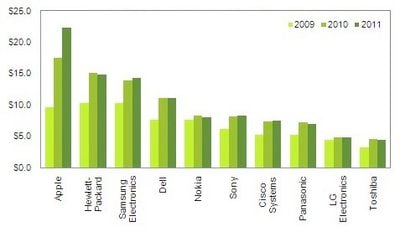
Top 10 OEM Semiconductor Buyers (Ranking by Revenue in Billions of U.S. Dollars)
According to a new research report from IHS iSuppli, Apple became the world's largest semiconductor buyer among original equipment manufacturers (OEMs) in 2010, leaping past HP and Samsung to comfortably grab the top spot with $17.5 billion in spending. Apple's surge has seen it rise from third place in 2009 and sixth place in 2008.
"Apple's surge to leadership in semiconductor spending in 2010 was driven by the overwhelming success of its wireless products, namely the iPhone and the iPad," said Wenlie Ye, Analyst for IHS. "These products consume enormous quantities of NAND flash memory, which is also found in the Apple iPod. Because of this, Apple in 2010 was the world's No. 1 purchaser of NAND flash."
Apple's lead over second-place HP, which stood at $2.3 billion in 2010, is expected to balloon to over $7.5 billion in 2011 as Apple expands its purchases to over $22 billion while other vendors remain relatively stagnant.
The report points out the marked differences between Apple's and HP's businesses, citing data showing that 61% of Apple's semiconductor spending in 2010 was on wireless products while 82% of HPs spending was on traditional computer products. That difference in focus, combined with the exploding smartphone and tablet market, has been driving Apple's run up the charts.
Apple is also cited for its ability to create an "ecosystem" of its products, with the company's tie-ins across devices leading consumers to stick with Apple for each new computer and mobile device purchase. This contrasts with the traditional PC business that offers no such ecosystem, thus leading to considerably lower brand loyalty across the range of devices and more fragmentation in purchasing patterns.
Apple last night held its annual Apple Design Awards ceremony at WWDC, recognizing twelve applications for excellence in design and innovation across four categories: Student, iPhone, iPad, and Mac. All eligible applications were required to be available via either the iOS or Mac App Store.
This year's winners come from a range of genres, from games to news to books to music and beyond. In terms of price, the winners range from the free Pulse News Reader for iOS to the $49.99 Capo for OS X.
As part of a focus on iOS at last year's conference, Apple did not include Mac applications in the Apple Design Awards competition. But with OS X Lion playing a prominent role in this year's event and the Mac App Store gaining momentum, Mac applications returned to the ballot this year.
FOSS Patents reports that Lodsys, the company that has begun filing lawsuits against App Store developers for implementing in app purchases and upgrade links, now finds itself on the receiving end of legal action. According to the report, a Michigan firm has filed a request for declaratory judgment regarding the validity of the four patents Lodsys is using in its own lawsuits. While a declaratory judgment against Lodsys would not automatically invalidate the firm's patent claims, it would set the legal framework for further challenges and negotiations both in and out of court.
Yesterday, the aforementioned Michigan company -- ForeSee Results, Inc. -- filed a proactive declaratory judgment action against all four Lodsys patents. In that complaint, ForeSee Results Inc. said that Lodsys had "threatened assertion" of one or more of its four patents against ForeSee's customers. Foresee names three examples of customers that received letters from Lodsys:
- Adidas (I have published that assertion letter on Scribd so you can take a look at it; it includes a claim chart that looks similar as the ones that many app developers received, though it relates to a different patent)
- Best Buy
- WE Energies
The report notes that the move is a preemptive strike by ForeSee Results, as its initial filing in Illinois could allow it to have any future lawsuits filed against the named companies transferred there instead of being adjudicated in the patent holder-friendly courts of the Eastern District of Texas where Lodsys has been filing its suits so far. And while the legal challenge to Lodsys' patents does not directly include the App Store developers targeted by the firm, a win for ForeSee Results could help bolster the developers' cases should a verdict come soon enough.
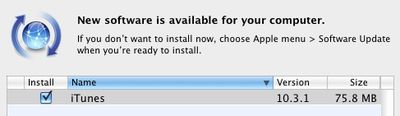
Just a day after releasing iTunes 10.3 to support some early iCloud features such as automatic downloads and access to previously purchased content, Apple has already pushed out iTunes 10.3.1 via Software Update and the company's software downloads page.
The documentation accompanying the release merely offers the same information as found with the original iTunes 10.3 release, providing no word on exactly what is addressed in what is presumably a minor bug fix update.
A number of users in Apple's support forums and elsewhere have reported issues with syncing iOS devices under iTunes 10.3, with iTunes reporting an "unknown error (-50)" when attempting to sync. Consequently, it seems reasonable to speculate that the iTunes 10.3.1 update addresses this issue, although we have yet to receive confirmation from users.
Update: In a new support document, Apple confirms that iTunes 10.3.1 addresses the "unknown error (-50)" syncing issue experienced by some users under iTunes 10.3.
Late last year it was revealed that Apple purchased a 98-acre campus from Hewlett Packard, just up I-280 in Cupertino. Last night, Apple CEO Steve Jobs, in trademark black turtleneck and jeans, explained Apple's plans for the space to the Cupertino City Council. Here's what the new 4-story building holding 12,000 employees will look like when it's completed in 2015:
As Steve describes it:
It's a pretty amazing building. It's a little like a spaceship landed. It's got this gorgeous courtyard in the middle... It's a circle. It's curved all the way around. If you build things, this is not the cheapest way to build something. There is not a straight piece of glass in this building. It's all curved. We've used our experience making retail buildings all over the world now, and we know how to make the biggest pieces of glass in the world for architectural use. And, we want to make the glass specifically for this building here. We can make it curve all the way around the building... It's pretty cool.
The facility will be 80% landscaping, with most of the parking underground, compared to 20% landscaping with all above ground parking currently. The current campus has 3,700 trees and Apple plans to increase that to more than 6,000 trees, including "some apricot orchards."
Apple also plans to build its own energy generation facility using natural gas, with the electricity grid as a backup.
One of the city councilors asked what the citizens of Cupertino would get from the new campus, and in particular brought up a free Wi-Fi network, like Google offers in Mountain View. Steve responded that Apple was the largest taxpayer in Cupertino and he felt that the tax benefits to having a company like Apple in Cupertino was benefit enough and the city should be providing a service like that.
"If we can get out of paying taxes, we would be glad to provide free Wi-Fi."
After the keynote yesterday, there was a great deal of confusion around what happens to current MobileMe subscribers with the introduction of iCloud. Apple posted a Knowledge Base article full of information about the MobileMe transition, but for some it caused more questions than it answered -- especially for those who have renewed their MobileMe accounts recently.
Here's some more detailed information.
If you wish, you can cancel your service immediately and get a refund, the amount of which depends on how long ago you renewed.
If you want to keep MobileMe until iCloud comes out, you can do that and still get some of your money back. Just cancel your MobileMe service in the fall, once iCloud arrives, and you'll get a pro-rated refund depending on how long ago you renewed.
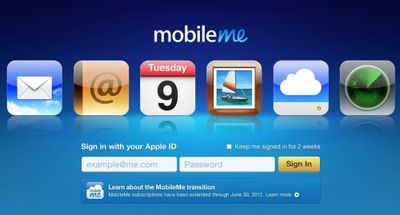
All users who had active MobileMe accounts as of June 6, 2011 have had their accounts extended through June 30, 2012 -- that's next year, 12 months away -- for free. MobileMe will continue in its current form for that time. Nothing changes, if you don't want it to, for a year.
However, you cannot make any changes either. Users cannot get a new MobileMe account either through the 60-day free trial, or by buying a new subscription. Individual accounts cannot be upgraded to family packs and additional storage can't be purchased either.
Refunds
Now, we've heard from lots of readers who are concerned that they're getting a raw deal, mostly because they renewed their memberships recently (some as recently as Saturday or Sunday) and they are upset that people are getting for free what they paid for. Apple has laid out another knowledge base article that covers cancellation, refunds and the like.
Apple will cancel and refund your full $99 subscription payment if you renewed in the past 45 days. However, you will lose all your MobileMe services immediately, and have to sign up again with everyone else when iCloud comes out in the fall.
If your account was renewed 46 days or more in the past, you will receive a pro-rated refund, based on the date you submit your request. Again, you will lose access to all your MobileMe services.
Here's the best part, though:
If you have an active MobileMe subscription and would like to cancel it for a refund, you may do so at any time.
This means you can cancel your MobileMe subscription in the fall when iCloud is released and get some of your money back. This seems pretty fair -- you'll get the full service that you paid for, and will get a little money back.
With most major consumer product releases -- think Mac OS and iLife -- Apple has an Up-To-Date program so folks who recently purchased a Mac can get the latest software without having to spend the full price.
In the past, Up-To-Date programs have generally cost $9.95 for an installation DVD. However, with the advent of the Mac App Store, that fee seems to be going away. Buried in the bottom of the OS X Lion press release yesterday was this note about Up-To-Date:
The Mac OS X Lion Up-To-Date upgrade is available at no additional charge via the Mac App Store to all customers who purchased a qualifying new Mac system from Apple or an Apple Authorized Reseller on or after June 6, 2011. Users must request their Up-To-Date upgrade within 30 days of purchase of their Mac computer. Customers who purchase a qualifying Mac between June 6, 2011 and the date when Lion is available in the Mac App Store will have 30 days from Lion’s official release date to make a request.
There you go. Anyone buying a Mac from yesterday through the launch of Lion, gets it free.
Reports are coming out that the iOS 5 beta works just fine on the 3GS, which is a relief since just a couple of weeks ago it was rumored that the 3GS wouldn't work at all. According to Apple (emphasis added):
iOS 5 will be available as a free software update for iPhone 4, iPhone 3GS, iPad 2, iPad, iPod touch (fourth generation) and iPod touch (third generation) this fall. Some features may not be available on all products.
Unfortunately, Apple doesn't spell out what, exactly, won't work on the slower iPhone 3GS and third generation iPod touch. But some research from 9to5Mac and Banolka on YouTube gives us some ideas, at least in the beta.
What we know works:
- Notification Center - Twitter Integration - Newsstand and Periodical Store - Grid Lines and Exposure/Brightness Settings in Camera app - Reading List in Safari - Volume Up Button to Take Pictures
And what doesn't (but it's a short list, so far):
- Image editing (red eye, cropping, magic wand) - Reader is missing (we've heard mixed reports on this)
So, it looks like 3GS users are in good shape going forward, but, of course, all of this may change as the beta period goes on and we get closer to release this fall. What might be most difficult to implement for the 3GS is a feature that doesn't even exist yet. We reported earlier today that Nuance/Siri Voice Features might still be included in iOS 5 and I wouldn't be surprised if that particular feature was not enabled on the relatively underpowered 3GS.
One of the surprising new iOS 5 features announced during the WWDC 2011 keynote was the introduction of Apple's own messaging service called iMessage. The new service offers a number of advantages over current SMS/text messaging. Features include delivery receipts, see when someone's typing, secure encryption and support for iPad and iPod Touch devices. iMessage also circumvents the costly text messaging plans required by carriers. According to DaringFireball, Apple's mobile carrier partners only learned about the new feature at the same time as the rest of us: during the keynote.
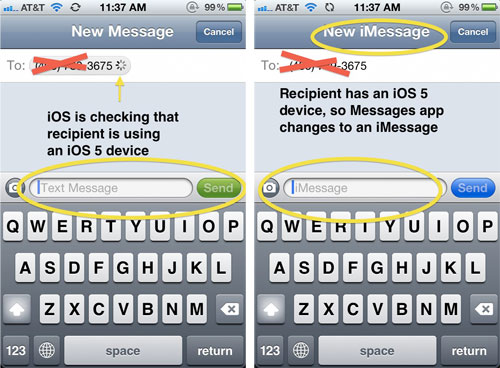
Cult of Mac has posted a nice walkthrough explaining how iMessages work alongside standard SMS messages.
Fortunately, for the end user, the transition will be relatively transparent. iMessage has been integrated into the existing "Messages" app. If you would like to text someone, iOS 5 automatically checks to see if they are eligible to receive iMessages rather than the more costly standard text message:
Once a contact is known to support iMessage, a special blue chat bubble appears by that contact's name to indicate they support iMessage. If you don't want to ever send any standard text messages, there is a preference for Messages to only try to send iMessages instead of SMSs. In summary:
Overall, iMessages are great. Being able to see when a message has been delivered and whether it's been read or not really enhance the communication experience. The best part is that you don't have to even think about them because if Apple is doing all of the work completely behind the scenes so that you won't even notice. Using iMessages on multiple devices with the new support of iCloud ensures that you'll never miss a beat when you're working on both your iPad and iPhone.
Apple previewed iOS 5 during the WWDC 2011 keynote on Monday. iOS 5 is presently available as a beta to registered developers but won't be released to the public until this fall.
TUAW reports that references to two new iPad models have been discovered in the just-released iOS 5 beta: "iPad3,1" and "iPad3,2". Given that there are currently three iPad 2 models internally identified as "iPad2,1" (Wi-Fi), "iPad2,2" (GSM), and "iPad2,3" (CDMA), the appearance of only two models in iOS 5 lends credence to rumors that the next-generation cellular-capable iPad may come as a world-mode device able to run on either CDMA or GSM networks.
The report does note, however, that these indications of new models do not always lead to new product releases, as a previously-discovered "iPhone3,2" has yet to see the light of day following the release of the GSM (iPhone3,1) and CDMA (iPhone3,3) iPhone 4 models. The missing model may have been destined for a carrier running on a different standard such as T-Mobile's slightly-different GSM 3G network, but a deal with such a carrier may simply have fallen through.
Today's report also cites the presence of "iPhone4,1" and "iPhone4,2" references pointing to the next-generation iPhone. These references are not new, however, as they appeared in iOS 4.3 betas as far back as early January.
Interestingly, iOS 5 currently makes no reference to any unreleased iPod touch models, maxing out at the current "iPod4,1" fourth-generation iPod touch. This of course does not mean that no new iPod touch is in the works, but it is curious that device identifiers for models presumably set for introduction in just a few months are not included.
The Financial Times, a major business newspaper, has decided to drop its iOS app in favor of an HTML5 based web app specifically designed for the iPhone and iPad. The move is in response to Apple's new App Store Subscription requirements that state Apple must get a 30% cut of any subscription sold on iTunes and that publications must offer subscriptions through the App Store.
In a email to subscribers today, the FT didn't mention the App Store at all, instead touting "valuable improvements" including claims that the web app will be faster and more up-to-date. The interesting part came when the email mentioned the existing app (emphasis added):
Although the old app may still be available for an interim period, we encourage you to switch to the new app as soon as possible. The new app is now the focus of our development efforts and we'll be adding a series of new features, including special reports, over the coming months.
Actually, neither the Financial Times nor anyone else knows what is going to happen at the end of the month to subscription-based apps that don't align with Apple's App Store guidelines. The deadline for subscription based apps to roll out their offerings is June 30. Quoted in the New York Times, Rob Grimshaw, managing director of FT.com said:
We don't quite know what will happen ... we'd love to keep our app in iTunes, but it may be that they will block our app at the end of the month.
They might not know what's going to happen if they don't play ball, but it's Apple's sandbox and the FT isn't sitting around idly. The new web app seems to be very similar to the current iOS App and thus may be able to provide a very similar experience without having to share revenue with Apple. The Financial Times' loyal readership is likely to follow the publication to its web app in significant numbers, meaning that the FT may not be missing out on much by bypassing iTunes.
As the first major publication to drop its iOS app over Apple's subscription guidelines, the FT might just encourage other publications to make the same move. Ben Evans notes, however, that the grass isn't always greener on the other side:
The challenge for other publishers in following the FT is that by doing so, they gain 30% but lose frictionless installs from the app store and frictionless payment from iTunes. For the FT, with a dedicated readership willing to pay, it may be worth giving those things up in exchange for the ability to offer a true cross-platform experience. But if you're depending on impulse download, the tablet experience and the ease of payment to get people to pay for your product where they never paid before, paying Apple 30% of something may be better than keeping 100% of nothing.
Apple today pushed out an update to its iBooks application for iOS devices [App Store], bringing several improvements including a new "read-aloud" narrator to select children's books.
iBooks 1.3 adds several new features and improvements:
- Help your children learn to read with the new read-aloud feature included in select children's books from the iBookstore. The read-aloud feature uses a real narrator to read the book to you, and in some books, it will even highlight the words as you read along. - Enhanced books can now automatically play audio or video included with the book. - Makes iBooks more responsive when opening very long books. - Addresses an issue where some books may display the same page twice.
It is possible that the text-to-speech aspect of the new read-aloud functionality is based on technology from Nuance that has been rumored to be making its way into iOS 5, but Apple has not specifically disclosed the basis for the new feature.
We have not been able to track down any books compatible with the new read-aloud feature yet, so it will be interesting to see how quickly and how widely it is adopted by authors and publishers.
Apple's new iTunes 10.3 offers access to the iBookstore from the desktop for the first time, although an iOS device is still required to read the books.
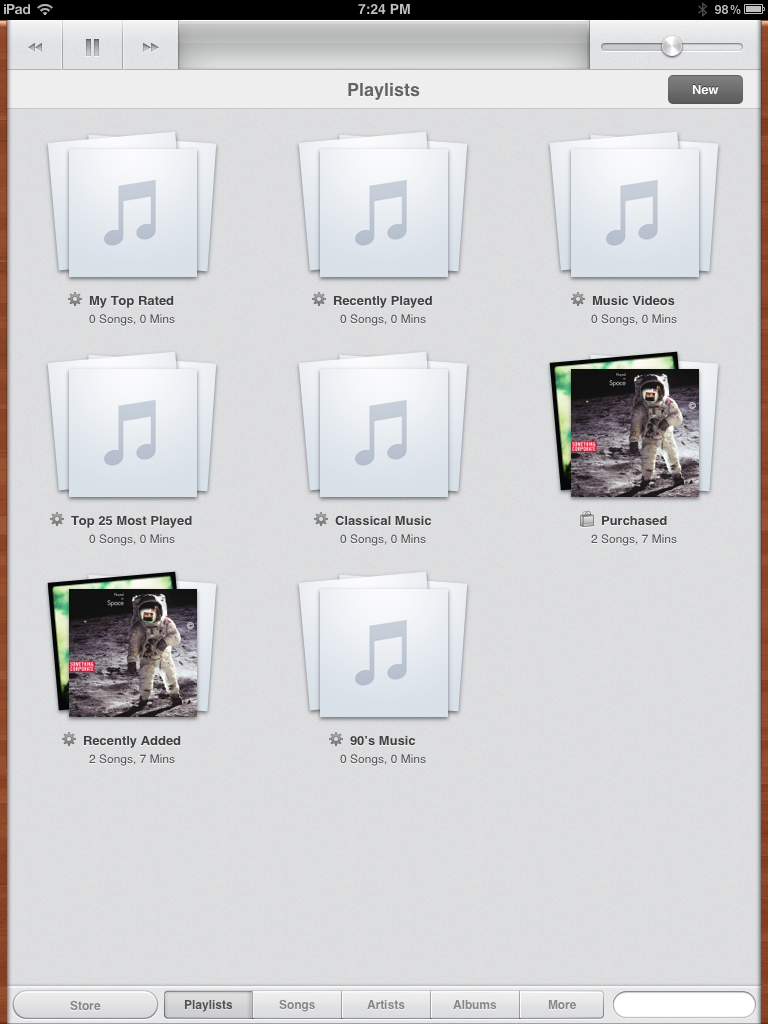
Apple claims over 200 new features coming in iOS 5. One that was listed amongst the slides was a new iPad Music app, and while it was visible and briefly mentioned in during the keynote, some readers may have missed it, so here is a screenshot passed along to us by a reader.
Alongside yesterday's announcements related to OS X Lion, Apple pushed out a fourth developer preview version of the next-generation operation system set to make its public launch next month. Among the new features in this build of Lion is "Find My Mac", a feature similar to the one already in use for iOS devices.
Evidence for Find My Mac functionality in Lion had been building, but the actual service is now finally showing its face. One user has provided screenshots of the system in action, showing first of all how Find My Mac can be enabled in System Preferences, revealing that feature allows users to lock the screen of a lost machine while allowing guest access only to Safari in order to help facilitate recovery of the machine.
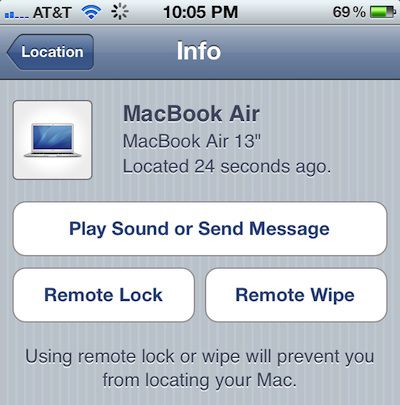
The user also reveals how his MacBook Air could be located using the Find My iPhone app on his iPhone, offering the option to simply to play a sound or send a message to whoever may have found the machine or remotely lock or even wipe the machine.
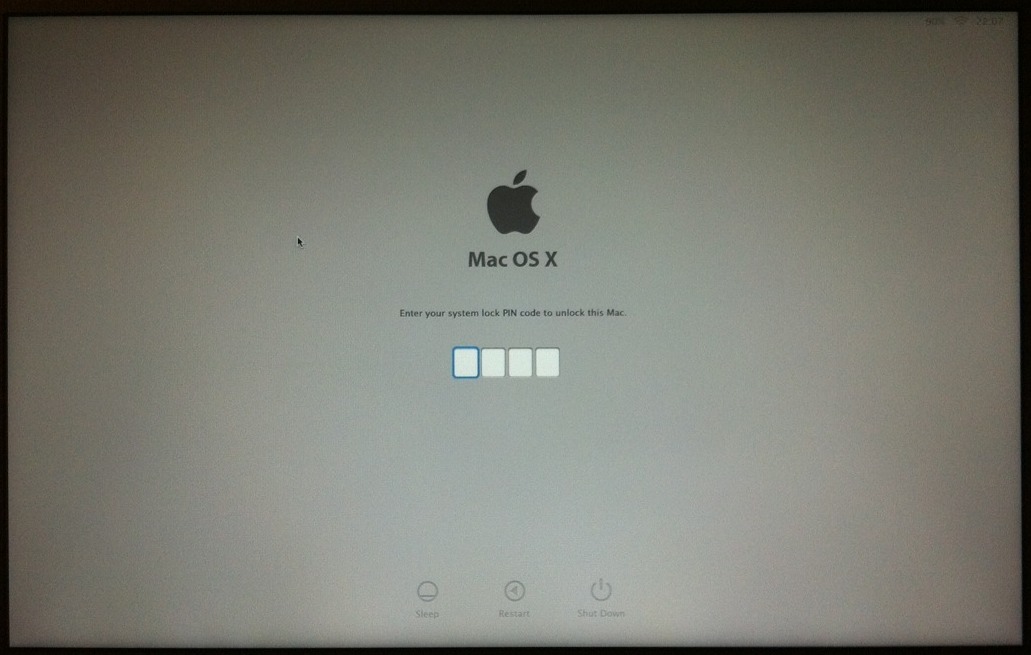
And finally, the user shows what happens to a machine once remote lock has been initiated, displaying a gray screen with boxes to input the security code to unlock the machine.
OS X Lion is set to debut sometime next month as a Mac App Store exclusive priced at $29.99. The full suite of iCloud features is not set to debut until this fall alongside iOS 5, but some features such as purchased music/app/book histories are already rolling out and Find My Mac will presumably follow suit next month.
Some iOS developers are making bank. One of the more visible iOS games over the past year has been Epic Games' Infinity Blade. In a press release today, Epic announced that its revenue from the game had exceeded $10 million in just six months of release.
Mark Rein, co-founder of Epic Games:
Infinity Blade’s success proves that triple-A gaming experiences can be hugely successful on iOS and that there is a valuable, pent up demand for premium content like this.
Donald Mustard, creative director of ChAIR Entertainment, the development studio behind Blade noted that "Apple has created an exciting, developer-friendly environment for iOS that has opened up many new doors for us."
I'm sure it helped that Apple gave Epic prime seating at iOS presentations and millions in television ad exposure. Can't get much more "developer friendly" than that! Still, with all the talk yesterday about how Apple was incorporating features that originally came from third-party apps, developing for iOS and the Mac is a win-win proposition for just about everyone -- and, if your app is good enough, Apple might just give it some sweet, sweet lovin'.
Incidentally, if Epic has made more than $10 million, that means Apple has cleared a sweet $4 million off its 30% cut.








 Student


 With most major consumer product releases -- think Mac OS and iLife -- Apple has an Up-To-Date program so folks who recently purchased a Mac can get the latest software without having to spend the full price.
 Reports are coming out that the iOS 5 beta