Apple Tops List of Largest Semiconductor Buyers in 2010

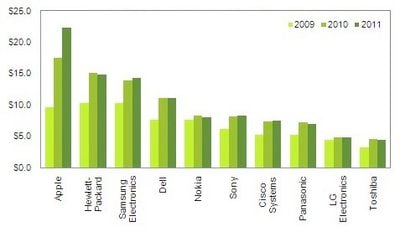
Top 10 OEM Semiconductor Buyers
(Ranking by Revenue in Billions of U.S. Dollars)
According to a
new research report from IHS iSuppli, Apple became the world's largest semiconductor buyer among original equipment manufacturers (OEMs) in 2010, leaping past HP and Samsung to comfortably grab the top spot with $17.5 billion in spending. Apple's surge has seen it rise from third place in 2009 and sixth place in 2008.
"Apple's surge to leadership in semiconductor spending in 2010 was driven by the overwhelming success of its wireless products, namely the iPhone and the iPad," said Wenlie Ye, Analyst for IHS. "These products consume enormous quantities of NAND flash memory, which is also found in the Apple iPod. Because of this, Apple in 2010 was the world's No. 1 purchaser of NAND flash."
Apple's lead over second-place HP, which stood at $2.3 billion in 2010, is expected to balloon to over $7.5 billion in 2011 as Apple expands its purchases to over $22 billion while other vendors remain relatively stagnant.
The report points out the marked differences between Apple's and HP's businesses, citing data showing that 61% of Apple's semiconductor spending in 2010 was on wireless products while 82% of HPs spending was on traditional computer products. That difference in focus, combined with the exploding smartphone and tablet market, has been driving Apple's run up the charts.
Apple is also cited for its ability to create an "ecosystem" of its products, with the company's tie-ins across devices leading consumers to stick with Apple for each new computer and mobile device purchase. This contrasts with the traditional PC business that offers no such ecosystem, thus leading to considerably lower brand loyalty across the range of devices and more fragmentation in purchasing patterns.
Popular Stories
2026 could be a bumper year for Apple's Mac lineup, with the company expected to announce as many as four separate MacBook launches. Rumors suggest Apple will court both ends of the consumer spectrum, with more affordable options for students and feature-rich premium lines for users that seek the highest specifications from a laptop.
Below is a breakdown of what we're expecting over the next ...
Apple's iPhone development roadmap runs several years into the future and the company is continually working with suppliers on several successive iPhone models at the same time, which is why we often get rumored features months ahead of launch. The iPhone 18 series is no different, and we already have a good idea of what to expect for the iPhone 18 Pro and iPhone 18 Pro Max.
One thing worth...
The Unicode Consortium has published a draft list of emoji that could come to smartphones and other devices in the future. The list shared by Emojipedia outlines 19 emoji candidates under consideration for Emoji 18.0, which is expected to be finalized in September 2026.
Among the proposed additions are a squinting face emoji, left- and right-pointing thumb gestures, a pickle, a lighthouse, a ...
Back in late 2022 and early 2023, Apple rolled out a new architecture for its Apple Home platform to deliver improved performance and compatibility, although the rollout came with some hiccups that forced Apple to pull and later re-release the upgrade.
Three years later, Apple is now on the verge of ending support for the old version of the Home architecture, which may result in access to...
In a letter to Apple CEO Tim Cook and Google CEO Sundar Pichai, U.S. Senators Ron Wyden, Ben Ray Lujan, and Edward Markey have requested that Apple and Google remove X Corp's X and Grok apps from their app stores over recent incidents of "mass generation of nonconsensual sexualized images of women and children."
X has come under fire over the past week amid reports of Grok's AI image...
iOS 26 is showing unusually slow adoption among iPhone users months after release, according to third-party analytics.
Usage data published by StatCounter (via Cult of Mac) for January 2026 indicates that only around 15 to 16% of active iPhones worldwide are running any version of iOS 26. The breakdown shows iOS 26.1 accounting for approximately 10.6% of devices, iOS 26.2 for about 4.6%, and ...
The iPhone Fold will be the first Apple device to adopt a Samsung-made OLED technology called CoE (Color Filter on Encapsulation), which could make the display brighter and thinner than previous panels, reports The Elec.
In a traditional OLED panel, a polarizing film sits above the display to cut reflections and improve contrast. The drawback is that this film also absorbs some of the OLED's ...