Intel's Broadwell Chips for Most Macs Not Shipping Until Early to Mid 2015 - MacRumors
Skip to Content

Intel's Broadwell Chips for Most Macs Not Shipping Until Early to Mid 2015

Intel's line of 14-nanometer Broadwell chips, which are expected to be included in future versions of the MacBook Air, Retina MacBook Pro, and iMac, have been further delayed, reports Chinese site VR Zone [Google Translate] (via CPU World).

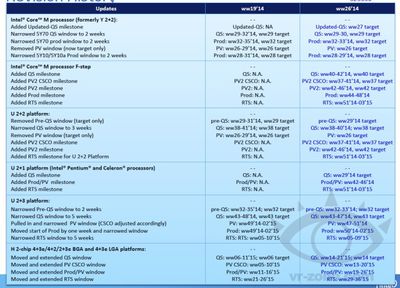
According to the site, while Intel will begin production on its extremely low power Core M processors in July and August for a 2014 launch, production on the U and H Broadwell chip series will not begin until much later in the year.

As a result, the Broadwell U 2+3 dual-core chips with GT3 (HD 5000 or Iris) graphics, likely slated for use in the MacBook Air and the 13-inch Retina MacBook Pro, won't be ready to ship until February of 2015. The Broadwell H 4+3e quad-core chips with Iris Pro graphics designed for the larger Retina MacBook Pro and iMac won't be shipping until July 2015 at the earliest.
broadwell-delay
Back in May, Intel CEO Brian Krzanich promised Broadwell processors for the 2014 holiday season, but it appears that the promised chips will be limited to the company's Core M processor series, used in ultra low power products like two-in-one computers. Broadwell chips suitable for Apple products will not make their first appearance until 2015, which Intel essentially confirmed to CNET in June.

"We expect the initial Broadwell-based devices, including fanless 2-in-1s built on the Core M processor, will be on shelves by the end of this year with more products and broader OEM availability in 2015," Intel told CNET on Wednesday.

Intel's Broadwell chips have seen several delays over the course of 2013 and 2014, and were originally slated to enter production in late 2013 before production was delayed until Q1 2014 and then Q3 2014. The delays are reportedly due to problems with the 14-nanometer process used to manufacture the chips.

Intel's continual Broadwell delays are likely impacting Apple's own release plans. Rumors have suggested Apple is planning a fall launch of a refreshed Retina MacBook Pro and a new 12-inch MacBook Air, but it is unclear which chips the company will use. Apple may only be able to offer a minor Haswell processor boost for the Retina MacBook Pro, which will be the only update the line sees until Broadwell is ready. Apple has already given the MacBook Air a Haswell refresh bump alongside a price drop with an update in late April.

On the desktop side, Apple introduced a new low-end iMac last month, but otherwise the lineup has not been updated since last September. The Mac mini has not even been updated to Haswell yet, with its last revision coming in October 2012. It is unknown why Apple has not released updated Mac mini models, as appropriate Haswell chips are readily available.

Intel's Broadwell chips are said to be 30 percent faster and more power efficient than Haswell, offering even greater increases in battery life and performance. According to Intel, the Broadwell delays will not affect the company's next line of processors, Skylake, as the chips are based on new architecture. Broadwell, however, will have a very short lifespan as Skylake has a prospective late 2015 release date.

Related Roundups: iMac, MacBook Pro, MacBook Air

Popular Stories

iPhone 18 Pro Deep Red Feature

iPhone 18 Pro Launching Later This Year With These 12 New Features

Wednesday March 18, 2026 7:39 am PDT by
While the iPhone 18 Pro and iPhone 18 Pro Max are not expected to launch for another six months or so, there are already plenty of rumors about the devices. It was initially reported that the iPhone 18 Pro models would have fully under-screen Face ID, with only a front camera visible in the top-left corner of the screen. However, the latest rumors indicate that only one Face ID component...
ios 26 4 yellow

Here Are Apple's Release Notes for iOS 26.4

Wednesday March 18, 2026 11:56 am PDT by
Apple provided developers and public beta testers with the release candidate versions of iOS 26.4 and iPadOS 26.4, which means we're going to see a public launch as soon as next week. The RC versions of the software include Apple's official release notes, giving us final details on what's included in the update. Apple Music - Playlist Playground (beta) generates a playlist from your...
Apple Logo Sketch Feature

Apple Has Now Unveiled Eight New Products This Month

Tuesday March 17, 2026 9:25 am PDT by
Apple has unveiled a whopping eight new products so far this March, including an iPhone 17e, iPad Air models with the M4 chip, MacBook Air models with the M5 chip, MacBook Pro models with M5 Pro and M5 Max chips, an updated Studio Display, a higher-end Studio Display XDR, and now the AirPods Max 2 this week. iPhone 17e features the same overall design as the iPhone 16e, but it gains Apple's...

Top Rated Comments

153 months ago
Eventually Moore's law runs into the laws of physics.
Score: 22 Votes (Like | Disagree)
153 months ago
That would mean porting OS X to work on AMD. Just like how Apple did the transition from PowerPC to Intel.

It's nothing like the transition from PowerPC to Intel.

AMD processors are x86-64 just like Intel processors are. When it comes to optimization there would be some work to do, but nothing in the ballpark of the PPC-Intel transition.
Score: 14 Votes (Like | Disagree)
maflynn Avatar
153 months ago
That bites - so much for seeing new rMBPs this year :(
Score: 13 Votes (Like | Disagree)
153 months ago
How about shipping with AMD chips?

Soooo, you want the new systems to perform worse than the current generation? Because that's what you'll get with AMD.
Score: 11 Votes (Like | Disagree)
Santabean2000 Avatar
153 months ago
How about shipping with AMD chips?

This is why Intel needs some real competition. AMD is not on par. Not even close.
Score: 11 Votes (Like | Disagree)
153 months ago
Are Intel's days in Apple's Macs numbered?

When you consider the pace at which Intel releases new CPUs these days, I'm wondering more and more whether Apple will migrate away from Intel and move to in-house A-series CPUs some day in the future.

Apple's custom silicon isn't at a point where it can power a Mac, but based on the pace at which Apple is developing its own CPUs, you have to wonder how far off that day really is.

Apple's closed ecosystem has become so large that its taking on the characteristics of a traditionally open one:

http://halifaxbloggers.ca/straighttech/2014/06/a-rainforest-posing-as-a-walled-garden/
Score: 10 Votes (Like | Disagree)