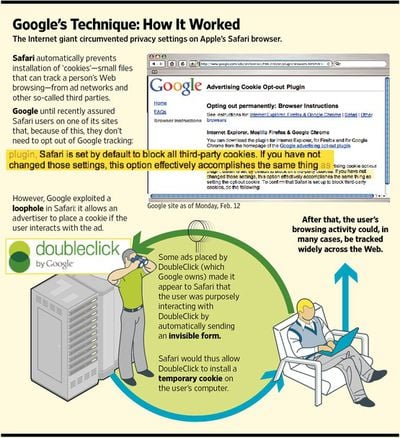
The Wall Street Journal reports that Google and several other advertising agencies have been discovered to be circumventing privacy protections in Apple's Safari browser for iOS devices in order to track users through ads on numerous popular websites. Google implemented the technique in order to embed +1 buttons on its ads, tricking users' systems into allowing cookies by using an invisible form submission to make Google's third-party cookies, which are blocked by Safari, appear as first-party cookies that are allowed.
To get around Safari's default blocking, Google exploited a loophole in the browser's privacy settings. While Safari does block most tracking, it makes an exception for websites with which a person interacts in some way—for instance, by filling out a form. So Google added coding to some of its ads that made Safari think that a person was submitting an invisible form to Google. Safari would then let Google install a cookie on the phone or computer.
The cookie that Google installed on the computer was temporary; it expired in 12 to 24 hours. But it could sometimes result in extensive tracking of Safari users. This is because of a technical quirk in Safari that allows companies to easily add more cookies to a user's computer once the company has installed at least one cookie.
Google halted the practice once it was contacted by The Wall Street Journal about it, but has tried to downplay the impact of the issue.
In a statement, Google said: "The Journal mischaracterizes what happened and why. We used known Safari functionality to provide features that signed-in Google users had enabled. It's important to stress that these advertising cookies do not collect personal information."
In a companion blog post, The Wall Street Journal notes that the loophole that had permitted Google to bypass Safari's privacy protections has been closed in WebKit, the open source engine behind Safari, with the change having been made by two Google engineers. Consequently, Apple could and appears to be preparing to bring that fix to the public version of Safari.
An Apple spokesman said: “We are aware that some third parties are circumventing Safari’s privacy features and we are working to put a stop to it.”
An update to the software that underlies Safari has closed the loophole that allows cookies to be set after the automatic submission of invisible forms. Future public versions of Safari could incorporate that update. The people who handled the proposed change, according to software documents: two engineers at Google.
The issue was discovered by Stanford graduate student Jonathan Mayer, who has also published an extensive blog post offering additional technical details on how Google and other advertising companies circumvented Safari's default cookie settings.