Apple has released the second beta for iPhone OS 4.1 to developers. The first beta was released two weeks ago and introduced some minor new features. Today's beta seems to only add minor bug fixes into the mix without any notable other features.
The iPhone 4 proximity sensor issue does not appear to be fixed in this latest beta. Apple has said the proximity sensor will be addressed in a future software update.
Apple today released a pair of Mac OS X updates for the company's new iMac models refreshed this morning, bringing upgraded functionality in the form of new Mac OS X 10.6.4 and Mac OS X Server 10.6.4 versions.
It includes Wiki Server Update 1.0, Safari 5 and general operating system fixes that enhance the stability, compatibility and security of your server, as well as specific fixes for:
- CalDAV querying of email addresses with Active Directory and Open Directory servers. - Stability and reliability accessing Wiki Server pages. - View movies on Wiki Server with Safari on iPad. - Accessing publicly accessible Wikis when logged in to the Wiki Server. - Listing blogs on Wiki Server. - Vacation mail notices that span across multiple days. - Updates from Software Update Server viewable by clients. - Stability and reliability to Software Update Server synchronization. - Downloading of software updates by Software Update Server. - Creating NetInstall images which include iLife updater packages. - Address issues copying, renaming, or deleting files on SMB file servers. - Improve reliability of VPN connections. - Resolves compatibility and performance-related graphics issues. - Improves compatibility with large-format SDXC memory cards.
As we've just noted, Apple has delivered a software update required for full functionality of its new Magic Trackpad device. In addition to Magic Trackpad support, the Mac OS X version of the update also extends several new functions to recent Apple notebook devices.
In particular, recent MacBook and MacBook Pro models receive support for the inertial scrolling that debuted on Apple's current MacBook Pro models, in addition to the new three-finger window dragging gesture that it included on the Magic Trackpad. The MacBook Air, as well as "Early 2008" MacBook Pro models gain only inertial scrolling. Inertial scrolling, already present in similar forms on Apple's iOS devices and the Magic Mouse, allows users to "flick" while scrolling as the trackpad senses the momentum of the gesture and smoothly scrolls through long documents and libraries.
Inertial Scrolling and Three-Finger Drag Gesture Support
These Mac portables support inertial scrolling and the three-finger drag gesture after you install Magic Trackpad and Multi-Touch Trackpad Update 1.0:
MacBook MacBook (13-inch, Early 2009) MacBook (13-inch, Mid 2009) MacBook (13-inch, Late 2009) MacBook (13-inch, Aluminum, Late 2008)
MacBook Pro MacBook Pro (17-inch, Mid 2010) MacBook Pro (15-inch, Mid 2010) MacBook Pro (17-inch, Mid 2009) MacBook Pro (15-inch, 2.53 GHz, Mid 2009) MacBook Pro (15-inch, Mid 2009) MacBook Pro (13-inch, Mid 2009) MacBook Pro (17-inch, Early 2009) MacBook Pro (17-inch, Late 2008)
The following Mac portables support inertial scrolling after installing Magic Trackpad and Multi-Touch Trackpad Update 1.0:
MacBook Air MacBook Air MacBook Air (Mid 2009)
MacBook Pro MacBook Pro (15-inch, Early 2008) MacBook Pro (17-inch, Early 2008)
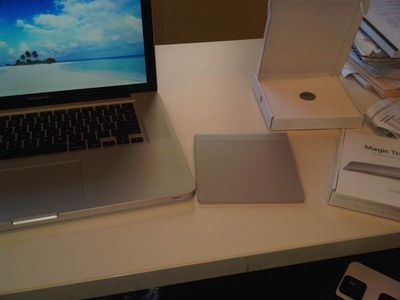
Apple's Magic Trackpad next to MacBook Pro (Source: MacRumors Forums)
Announced earlier today, Apple's Magic TrackPad is already making its way into the hands of reviewers and customers, and a few tidbits of interest have been coming out about the Bluetooth device.
To use the Trackpad, you need to install a software update that Apple will release later Tuesday. The software update enables full multitouch and gesture customization, including tap-to-touch and program-launching clickzones. Even without the software update, the Trackpad works like a regular non-multitouch trackpad. While Apple geared its full suite of multitouch gestures toward Macs, the Magic Trackpad will perform in its basic functions when paired via Bluetooth to a Windows PC--we tried it.
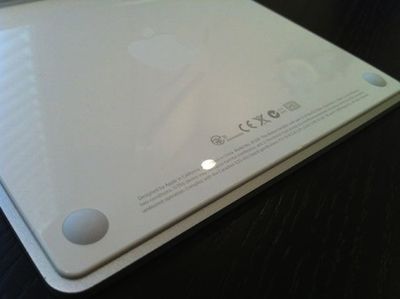
Underside of Magic Trackpad showing clickable feet (Source: Macworld)
Macworld notes that the trackpad does support a physical click but that it is generated by two feet near the front edge of the bottom of the device rather than with a movable surface on the body of the device.
Despite the Magic Trackpad's thinness and its support for the same tap-to-click feature as MacBook trackpads, you can also click by pressing down. The trackpad surface itself doesn't depress, though--instead, when you press on the trackpad, the force from the surface it's sitting on will depress the two round feet at the trackpad's base. That's what registers a click.
Finally, Engadget reports that the Magic Trackpad comes with an optional new three-finger gesture that allows users to easily drag windows around the screen, a feature not present on trackpads integrated into Apple's current notebook computers.
There's also a new gesture, if you're keeping track -- a three-finger move that lets you drag windows around (very helpful), though you give up the functionality of being to navigate stuff like iPhoto galleries with a swipe (it's an option you can toggle in preferences -- you have a choice).
Apple's Magic Trackpad is priced at $69 and requires two AA batteries, available as part of Apple's new battery charger set also released today.
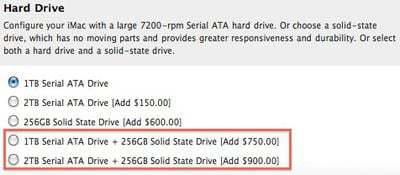
Several MacRumors readers have pointed out that Apple's new 27-inch iMac released today offers support for dual hard drives: one traditional Serial ATA in 1 TB or 2 TB capacity and one 256 GB solid state drive (SSD). Alternatively, customers can opt for a single 256 GB SSD, as described on the iMac features page.
To give your iMac a real performance boost, configure your 27-inch iMac on the Apple Online Store with an optional 256GB solid-state drive. You can choose it as your only drive or have it installed in addition to the built-in hard drive, allowing you to store the operating system, critical applications, and important files on the solid-state drive and your other files on the hard drive. Because solid-state drives have no moving parts, the computer can access data at over twice the speed of hard drives. Which makes starting up your iMac and launching applications faster than you ever thought possible.
The new offering marks the first time Apple has offered dual hard drives as build-to-order options for its iMac line, taking advantage of the space available in the 27-inch iMac's chassis to squeeze in another drive bay. The SSD options do not come cheaply, however, with a simple swap of the standard 1 TB traditional drive for a 256 GB SSD coming in at a $600 price premium. Customers looking to add the SSD as a second drive on top of the 1 TB traditional drive will find themselves looking at a $750 price boost.
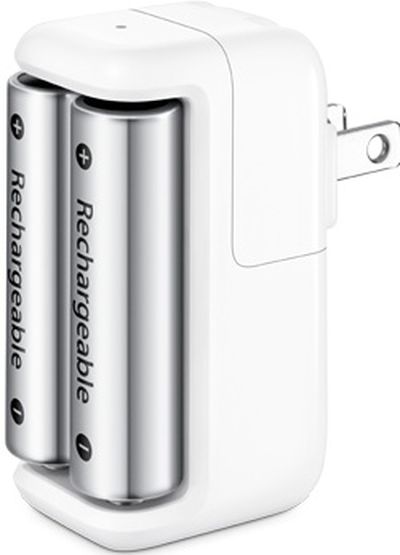
One of Apple's more interesting product announcements today was its Apple Battery Charger, designed to keep the company's increasing array of wireless peripheral devices powered up. While we briefly mentioned the release in our coverage of Apple's new Magic Trackpad that utilizes the rechargeable AA batteries Apple is now offering along with the charger, the batteries and charger themselves bear some closer examination.
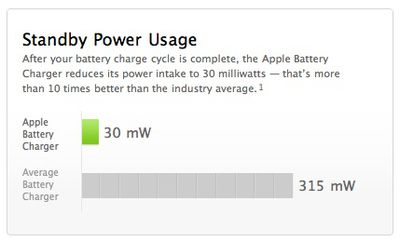
Apple touts that its new battery charger carries the industry's lowest "vampire draw", a measure of power consumed while not actively in use for its intended purpose.
The Apple Battery Charger sets a new industry standard: It has the lowest standby power usage value - or "vampire draw" - of any similar charger on the market. That's the energy most chargers continue to draw after their batteries are fully charged. But the Apple Battery Charger senses when its batteries are done charging and automatically reduces the amount of power it needs.
The company also points to the AA batteries themselves, which are designed to maintain a full charge through hundreds of charge cycles and last up to ten years. The batteries also maintain their charge while simply sitting in a drawer, retaining up to 80% of their charge after a year on the shelf. Six of the NiMH AA batteries are included with the charger.
As is to be expected, the Apple Battery Charger offers traditional Apple styling, offering the same rounded white plastic design as other power devices from the company, while also utilizing the same removable plug with fold-up prongs to allow for interchanging adapter fittings.
Bloomberg reports that Apple is facing a new lawsuit over complaints that the company's iPad tablet device overheats too quickly in direct sunlight.
The complaint, filed July 23 in federal court in Oakland, California, seeks unspecified damages and class action, or group, status. It claims the iPad "does not live up to the reasonable consumer's expectations created by Apple" because it "overheats so quickly under common weather conditions."
The iPad has a 9.7-inch touch-screen display that lets users read books and magazines, view videos, play games and surf the Internet. In direct sunlight, the tablet "turns off, sometimes after just a few minutes of use," according to the complaint.
Apple's iOS devices offer an emergency overheating mode that shuts down the device and displays a warning screen until the device has sufficiently cooled down to permit normal operation, allowing only emergency calls on the iPhone. Apple has maintained a support document on the topic of overheating dating back to at least the iPhone 3G, updating it periodically to now include the iPhone 3GS, iPhone 4, and iPad in its coverage.
Walnut Street store under construction (Source: ifoAppleStore)
Apple today announced the grand opening of its new Walnut Street retail store in Philadelphia, Pennsylvania. The events will begin with a press preview at 4:00 PM on this Friday, July 30th, with the store set to open to the general public at 5:00 PM that day.
While Apple has four existing stores in the Philadelphia area in its Suburban Square and King of Prussia locations in Pennsylvania and Cherry Hill and Sagemore stores in southern New Jersey, the new store will be the first within the city limits of Philadelphia.
Just last weekend, Apple opened new stores in Columbus, Ohio and Lexington, Kentucky.
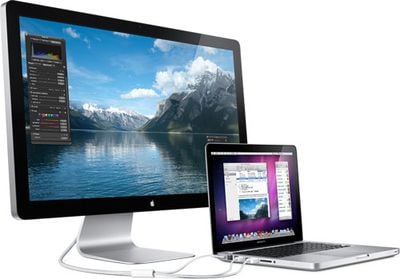
Apple also announced the release of a new 27" LED Cinema Display featuring a resolution of 2560x1440. The latest Apple screen features an iSight video camera, microphone and speakers:
"With built-in MagSafe charging, iSight camera, speakers, and USB ports, the LED Cinema Display is ideal for MacBook and MacBook Pro users," said Philip Schiller, Apple's senior vice president of Worldwide Product Marketing. "With its massive 2560 x 1440 resolution, the new 27-inch LED Cinema Display is a perfect fit with our powerful new Mac Pro, and it gives iMac users an easy way to double their screen real estate."
The 27" display also features a 16:9 aspect ratio, a MagSafe charger as well as a 3-port USB 2.0 hub. An ambient light sensor automatically adjusts the screen's brightness based on the lighting conditions.
The new LED Cinema Display will be available in September for a price of $999. It requires a Mac with Mini DisplayPort connectivity.
Apple has also dropped the price on its existing 24" LED Cinema Display to $799 from its previous $899 price point, although it appears that Apple may be phasing out that model as stock clears. Finally, Apple's aging 30" Cinema HD Display continues to be available priced at $1799, but that model is also available only while supplies last.
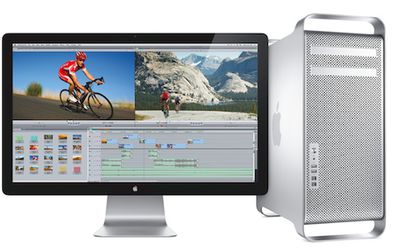
Apple today announced an update to its Mac Pro line, offering up to 12 cores of processing power for up to 50% greater performance than the previous generation. The new Mac Pro also ships with new ATI Radeon HD 5770 graphics hardware, with the Radeon HD 5870 available as a build-to-order-option.
"The new Mac Pro is the most powerful and configurable Mac we've ever made," said Philip Schiller, Apple's senior vice president of Worldwide Product Marketing. "With up to 12 cores, the new Mac Pro outperforms our previous top-of-the-line system by up to 50 percent, and with over a billion possible configurations, our customers can create exactly the system they want."
Also available for the first time are standard display connectivity of two Mini DisplayPorts and one dual-link DVI port, as well as build-to-order options for 512 GB solid state drives (SSD).
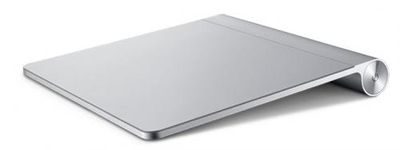
The new Magic Trackpad is the first Multi-Touch trackpad designed to work with your Mac desktop computer. It uses the same Multi-Touch technology you love on the MacBook Pro.
The new accessory supports a full set of gestures, including two-finger scrolling, pinching to zoom, rotating with your fingertips, three-finger swiping and four finger recognition. Meanwhile, tapping or double tapping on the surface initiates clicking.
The Magic Trackpad connects via wireless Bluetooth and is powered by two AA batteries. Apple has also launched a $29 Battery Charger to keep charged AAs ready for use. The Magic Trackpad sells for $69.00 and is shipping immediately.
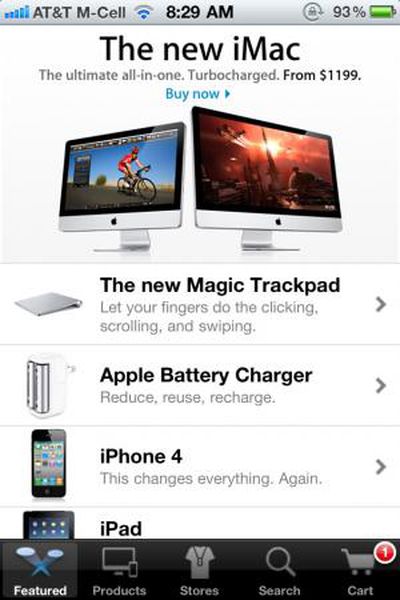
Apple Stores have been down the past couple of hours. The stores will be up soon, but Apple's own Apple Store app shows what's coming in the next few minutes. New iMacs and a Magic Trackpad.
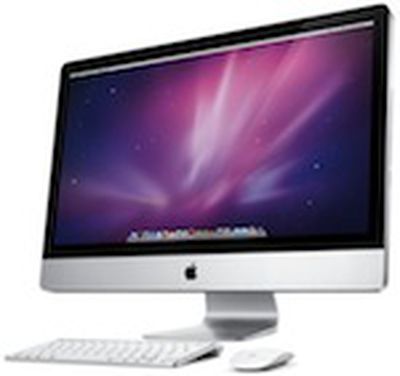
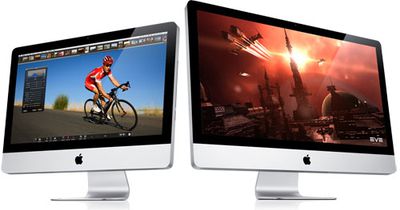
As predicted, Apple launched new iMacs today featuring the latest Intel Core i3, Core i5 and Core i7 processors and new graphics cards.
"We took the world's best all-in-one and made it even better," said Philip Schiller, Apple's senior vice president of Worldwide Product Marketing. "With the latest processors, high-performance graphics and signature aluminum and glass design, customers are going to love the latest iMac."
The new iMacs all feature dedicated graphics cards rather than relying on slower integrated graphics chips. A breakdown of the new models is provided here:
$1199 / 21.5" / 3.06GHz Core i3 / 4GB / 500GB / ATI Radeon HD 4670 $1499 / 21.5" / 3.20GHz Core i3 / 4GB / 1TB / ATI Radeon HD 5670 $1699 27" / 3.20GHz Core i3 / 4GB / 1TB / ATI Radeon HD 5670 $1999 27" / 2.8GHz Quad-Core Core i5 / 4GB / 1TB / ATI Radeon HD 5750 +$200 27" / 2.93 GHz Quad-Core Core i7 BTO option
Cult of Mac reports that Apple has issued an official response to today's ruling by the Copyright Office of the U.S. Library of Congress to create an exception to the Digital Millennium Copyright Act (DMCA) permitting users to jailbreak their iPhones or other smartphone devices in order to install unauthorized applications. Little has changed with the new decision, according to Apple, as jailbroken iOS devices are still subject to having their warranties voided.
Apple's goal has always been to insure that our customers have a great experience with their iPhone and we know that jailbreaking can severely degrade the experience. As we've said before, the vast majority of customers do not jailbreak their iPhones as this can violate the warranty and can cause the iPhone to become unstable and not work reliably.
The apparent discrepancy comes from the fact that the Library of Congress decision today simply means that users can not be charged with violations of the DMCA for jailbreaking their iOS devices, a tactic Apple had never bothered to employ in attempting to squash the practice. Apple remains free, however, to discourage users by other means, including voiding product warranties due to violations of the terms and conditions all users must agree to before using their devices and software.
The Khronos Group today announced the release of the OpenGL 4.1 specification, delivering enhancements to the standards that drive high-performance graphics on Mac OS X.
Among the features included in the new release are enhanced compatibility with OpenGL ES 2.0 APIs that drive Apple's iOS devices and extensions that drive interoperability with the OpenCL standard promoted by Apple in Mac OS X Snow Leopard for more efficiently harnessing the power of multiple cores and processors for both CPUs and graphics processors. Among the key features in OpenGL 4.1:
- Full compatibility with OpenGL ES 2.0 APIs for easier porting between mobile and desktop platforms; - The ability to query and load a binary for shader program objects to save re-compilation time; - The capability to bind programs individually to programmable stages for programming flexibility; - 64-bit floating-point component vertex shader inputs for higher geometric precision; - Multiple viewports for a rendering surface for increased rendering flexibility.
In addition, a set of extensions has been released to ensure as much backwards compatibility as possible with OpenGL 4.1, allowing significant portions of the core feature enhancements to be applied to previous-generation graphics hardware. The full OpenGL 4.1 specification is now available for download.
MacRumors has received word that Apple is gearing up to begin seeding certain developers with builds of Mac OS X 10.6.5, the fifth maintenance release for Mac OS X Snow Leopard. While the release has undoubtedly been under development for some time, only now is it approaching a state where it is ready for testing by third-party developers. Through the testing program, Apple will gain feedback on areas where it has made changes as well as other areas requiring its attention, allowing the company to tweak things until it is satisfied enough to make a public release of the update.
The length of time any one update spends in developer testing is highly variable, and thus we do not yet have an estimation of when Mac OS X 10.6.5 might become available to the general public. We do believe, however, that the first developers to get their hands on the testing builds may see something later this week.
Mac OS X 10.6.4 was released in mid-June and brought fixes for a number of issues.
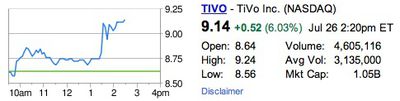
Barron's briefly notes that TiVo's shares have jumped today (currently up over 6%) on rumors that the company's technology could make an appearance in revamped Apple TV hardware.
It is unclear, however, what aspect of TiVo technology would be brought to the Apple TV. Rumors have pointed to a dramatic overhaul of Apple's set-top box, bringing a new design based on that of the iPhone 4 with an iOS-based user interface and limited physical storage. While the device could pair with a Time Capsule device for expanded local storage, the focus of the new Apple TV, said to be priced at $99, would be on streaming.
It seems difficult to believe that something like the TiVo interface would come to the Apple TV given Apple's insistence not only controlling as much of its products as it can but also simply in delivering a consistent "Apple" look and feel for its software. It is possible that the Apple TV could use some of TiVo's underlying technology for some aspects of the its functionality, although rumors of limited onboard storage would seem to complicate its use as a DVR, TiVo's primary area of expertise.
For the time being, we are placing little credence in this rumor, as stock prices frequently respond to poorly-sourced or even baseless speculation. Consequently, we are publishing this on Page 2.
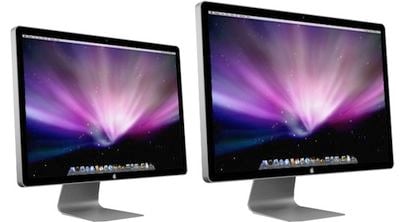
Mockup of existing 24" LED display (left) next to 27" model (right)
In announcing the return of his podcast talk show, the plugged-in John Gruber slyly hints, as he is wont to do, that Apple may be set to release a new 27-inch 16:9 widescreen display alongside updated Mac Pros and iMacs tomorrow.
We'll have much to talk about, what with the new Mac Pros (finally, right?), speed-bump iMacs, and the gorgeous new 16:9 27-inch Cinema Display that Apple might hypothetically release tomorrow.
The Mac Pro and iMac have been subjects of considerable discussion over the past few days as their availability has begun slipping in several of the company's distribution channels. A 27-inch LED Cinema Display is not a new rumor, however, as a report from March of this year pinpointed a release of just such a display along with revised Mac Pros "by June" of this year. While Apple did not meet the rumored release timeline, it appears that both products may be set to finally make their appearance along with minor bumps to the company's iMac line.
Update: In an update to his post, Gruber suggests in a "doubly-hypothetical" manner that Apple's "Magic Trackpad" that was approved by the U.S. Federal Communications Commission last week could also make an appearance tomorrow.