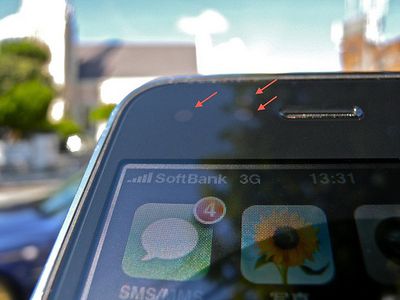
Arrow on left points to iPhone ambient light sensor (Source: ReadWriteWeb)
DigiTimes reports that Apple is in discussions with two Taiwan-based integrated circuit design firms, Integrated Memory Logic (iML) and Capella Microsystems, for sourcing of components for the company's iOS devices.
The more interesting of the two claims appears to be related Capella, which is said to have delivered new ambient light sensors to Apple for testing and verification. According to the report, Capella could be in a position to begin supplying Apple with such sensors for the iPhone by the end of the year and that the components would likely represent an improvement over existing sensors.
Capella, which ships over one million ambient-light sensors to HTC a month currently, has reportedly delivered its products to Apple for verification as the ambient-light sensors currently used by iPhone 4 have been criticized for some problems, said the sources, noting that Capella may received Apple's orders before the end of the year at the earliest.
iML is said to be in discussions to provide Apple with programmable gamma buffers for the iPad, components which help regulate the luminance of the LCD displays.
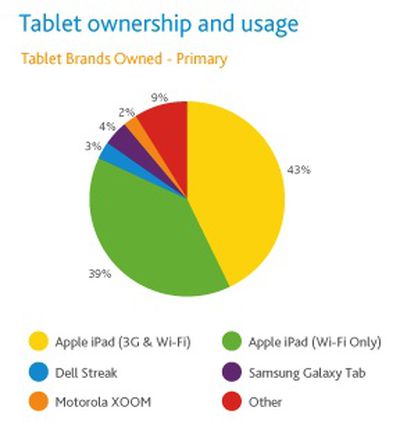
Media research firm Nielsen today announced the results of its Mobile Connected Device Report survey for the first quarter of 2011, determining that Apple held a dominating 82% of the installed base for tablets in the United States during the quarter. The survey found 3G-capable iPads slightly more popular than non-3G models, 43% to 39%, with the Samsung Galaxy Tab proving the most popular competitor with only 4% of the market.
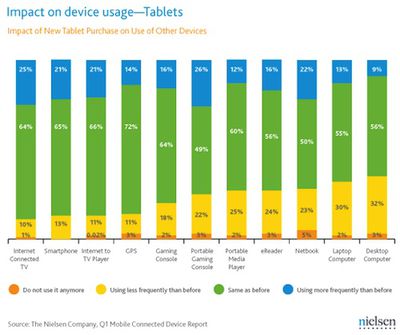
The study also examined the effect of tablet ownership on usage of other devices, with 35% of tablet owners reporting that they had decreased usage of desktop computers and 32% reporting decreased usage of notebook computers. Interestingly, 9% of owners actually increased their desktop machine usage while 13% increased their notebook usage, calling into question just how much of the usage variation is due to effects from tablets.
Twenty-seven percent of those who also own eReaders said they use their eReader less often or not at all - the same percentage as those who also own portable media players. One-in-four tablet owners who own portable games consoles are using those devices less often, if at all, since purchasing a tablet.
About half of tablet owners report that they are the exclusive user of the device in their household, while 43% report sharing the device with others. 8% of tablet owners do not use the device at all, with usage instead tied to another member of the household.
Other World Computing reports that the iMac EFI Update 1.6 released yesterday for Apple's new iMacs brings an unadvertised improvement in SATA performance for the internal hard drive bays.
While iMac EFI Update 1.6 is described as including "fixes that improve performance and stability for Thunderbolt," it would also seem that an unadvertised benefit is that it also unlocks the full 6Gb/s, SATA 3.0 capabilities of two of the internal drive bays.
Unfortunately, the optical bay remains at 3Gb/s.
The report notes that Apple also released an EFI update for the current MacBook Pros yesterday, but it is unclear whether that update attempts to address SATA performance issues found in the 17-inch models.
As noted by tonymacx86 (via 9 to 5 Mac), iFixit's teardown of the new iMac released earlier this week reveals that the machine utilizes Intel's BD82Z68 platform controller. The inclusion is notable in part because the Z68 chipset is reportedly not set for public introduction until next week.
Apple use of the Z68 chipset marks yet another exclusive for the company, which has occasionally been granted early access to forthcoming chip components ahead of public unveilings and competitors' offerings.
The Z68 chipset is also notable because it supports SSD caching, a system that marries conventional hard drives to small solid-state drives (SSDs) to provide a seamless user experience with increased performance as the most frequently-accessed files are placed on the speedy SSD.
Apple of course offers SSD options in its iMacs, either as a replacement for or in addition to the traditional hard drive included as standard. The iMac's SSD, however, is a full 256 GB drive rather than the much smaller-capacity drives envisioned for SSD caching. And while Apple doesn't seem to be supporting true SSD caching in the new iMacs, the company achieves a similar but less seamless effect by installing the operating system and applications on the SSD while leaving the traditional hard drive for media on systems configured with both types of drives.
Intel is reportedly preparing to launch its own "Larsen Creek" line of SSDs with capacities around 20 GB and specifically designed to support seamless SSD caching when paired with a traditional hard drive and a compatible chipset such as the Z68. It is unclear if Apple will be looking to incorporate such systems in future hardware, but the company is clearly interested in pursing SSD technology for its performance benefits.
The Wall Street Journal reports that Hearst Corporation has agreed to Apple's terms for in app subscriptions, making plans to begin selling subscriptions to several of its magazine titles beginning with their July issues.
Starting with their July issues, iPad apps for Esquire, Popular Mechanics and O, The Oprah Magazine, will be available through a service from Apple that allows customers to sign up for subscriptions inside the apps and get billed automatically. Subscriptions to all three publications will be sold for $1.99 a month or $19.99 a year.
Only a few publications have begun using Apple's iTunes subscription service, launched in February. Hearst is the first major magazine publisher to commit to selling subscriptions to multiple titles through it.
Hearst noted that it will also offer subscription access to its newspaper titles and other content in the future.
The development marks another significant victory for Apple in its push to bring magazine content to the iPad. Just days ago, it was revealed that Apple and Time Inc. have struck a deal to allow subscribers to the print editions of Sports Illustrated, Time, and Fortune to access the digital editions of those titles on the iPad free of charge. Time has yet to commit, however, to offering standalone iPad subscriptions for those titles.
According to 9to5Mac, Apple is negotiating with Verizon about delivering over-the-air iOS updates starting with iOS 5.
Multiple sources say the new feature will debut in iOS 5, meaning iOS 5 will not come over-the-air but following point updates to it will. Just like tethering in iOS 3, Apple has the technology but cannot just unleash it everywhere. Apple and Verizon Wireless are said to have been in talks over these wireless software updates since early this year.
An over-the-air update system would allow users to download the iOS update directly to their phone over 3G or Wi-Fi and update their phone to the latest version without connecting to iTunes. Android devices already offer this feature.
Due to the high bandwidth requirement, it seems Apple needs to negotiate deals with individual carriers to allow such a system to take place. We should note that Apple's iOS is partially capable of this functionality already. The Apple TV which is based on iOS 4 offers "over the air" updates with no iTunes syncing required. The Apple TV, however, stores little customer data so backups are not as critical as with iPhone and iPad devices.
Apple has released a couple of updates for the new iMac and recent MacBook Pros that offer various fixes, but seem to be particularly focused on Thunderbolt fixes and enhancements.
The 10.6.7 iMac update for the just-released 2011 iMacs offer additional fixes to Back to My Mac, SMB Servers, Mac App Store fixes, FaceTime performance improvements and external display compatibility. All updates should be available in your Software Update or via the direct links above.
RCR Wireless claims to have multiple sources telling it that Apple is planning on incorporating 3D technology into the next-generation iPad.
The fact that the iPad 3 is 3D is a dead cert, one Hollywood insider close to the big movie studios told RCR, adding that the screen would be the real magic. She went on to say that the big film studios were currently running around like blue arsed flies trying to gear up to release plenty of 3D content in time for Apples next launch.
Besides this "Hollywood insider", they also cite sources from iPad manufacturer Foxconn about the 3D plans.
We're not sure about the reliability of these sources, but Apple has clearly been exploring 3D technology over the years as evidenced by numerouspatentapplications. Not all of this research has been in the typical 3D technology found in recent movies and television sets. Some of the research has been in pseudo-3D technologies that involve head tracking that was effectively demoed in a recent iPad app. 3D, of course, has also been a big recent trend with the release of many 3D TVs, 3D movies, and Nintendo's 3DS handheld gaming console.
Also interesting is that this isn't the first time this has been suggested. Earlier this year, Japanese blog Mac Otakara cited their own sources who said that Apple's LCD supplier was beginning to manufacture small glasses-free 3D LCD panels for the iPod touch, though they suggested it might involve user head-tracking to accomplish the effect.
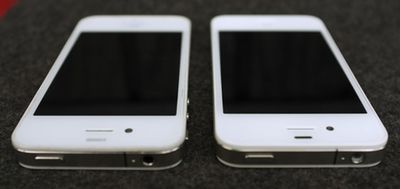
NYTimes' Nick Bilton compares one of the original white iPhones that never made it to mass production to the official production run, and detailed the slight differences.
- Yellowing discoleration on the original - Deeper proximity sensor in new model - Camera sticks out slightly in new model
The original comparison model came from an individual who reportedly purchased the first run white iPhone for $1,000 from a "guy who had connections to the factory that made the phone in China."
Several MacRumors have informed us in recent days that they have received email invitations to join "Apple Customer Pulse", a program designed to allow customers to provide survey feedback about their product purchases to Apple.
Apple values your opinion and invites you to participate in a survey about your Apple products. Your responses will remain completely confidential, and results will be viewed only in aggregate. The survey should take five minutes or less to complete.
According to one of the readers who received an invitation, the program allows users to receive up to two surveys per month to assess their usage of and thoughts on Apple products on an ongoing basis.
Apple has occasionally reached out to customers for survey feedback on their purchases, but this new program appears to be a more extensive, ongoing market research project for the company. The Apple Customer Pulse site is being administered by Socratic Technolgies, a San Francisco-based market research firm that has worked with other tech companies such as Adobe to gather customer input.
According to Whois database information, the applecustomerpulse.com domain was registered in late January, although the site did not appear on reporting services such as Netcraft until last month. The domain is registered to MarkMonitor, the branding company that Apple routinely uses for such purposes, and the administrative contact is Apple's Ken Eddings, who has appeared on many such listings including the one for me.com that revealed Apple's plans for a transition from the company's .Mac service to the current MobileMe. The new survey site is, however, hosted on Socratic's servers and not Apple's.
AppleInsider reports that it has learned that Apple is planning to utilize the Mac App Store as the "preferred" mechanism for distribution of Mac OS X Lion when it is released to the public later this year.
The Mac App Store, available to all users running the most recent version of Mac OS X 10.6 Snow Leopard, will become the de facto method for obtaining the Lion upgrade, people familiar with the matter have revealed. Users will be able to upgrade instantly without the need for physical media by purchasing Lion through the Mac App Store.
Apple is said to presumably be planning to also release Mac OS X Lion on physical media to support users who are running older Mac OS X versions incompatible with the Mac App Store or who have slow Internet connections that would make downloading the large update unwieldy.
Distribution of Mac OS X Lion through the Mac App Store would of course not be a surprise, as Apple has been working to position the marketplace as the future of app distribution on the Mac platform and has even been distributing developer builds of Lion through the store.
Options for physical media distribution could include the traditional optical disc or even USB keys such as those that ship with the MacBook Air for providing system software. The lack of an optical drive on the popular new MacBook Air provides an opportunity for Apple to push alternative distribution methods such as direct download or USB keys, although the MacBook Air is also capable of wirelessly using optical drives on nearby Macs and PCs for software installation.
Law firm Lieff, Cabraser, Heimann & Bernstein today announced the filing of a class-action lawsuit against Apple and other tech companies over "no solicitation" agreements that prevented the companies from attempting to hire away each others' employees. The lawsuit, filed by former Lucasfilm engineer Siddharth Hariharan, contends that the anti-poaching agreements limited career opportunities for and instituted artificial salary caps on employees at the companies involved.
"My colleagues at Lucasfilm and I applied our skills, knowledge, and creativity to make the company an industry leader," stated Mr. Hariharan. "It's disappointing that, while we were working hard to make terrific products that resulted in enormous profits for Lucasfilm, senior executives of the company cut deals with other premiere high tech companies to eliminate competition and cap pay for skilled employees."
"Competition in the labor market results in better salaries, enhanced career opportunities for employees, and better products for consumers," stated [attorney Joseph] Saveri. "We estimate that because of reduced competition for their services, compensation for skilled employees at Adobe, Apple, Google, Intel, Intuit, Lucasfilm, and Pixar was reduced by 10 to 15 percent. These companies owe their tremendous successes to the sacrifices and hard work of their employees, and must take responsibility for their misconduct."
The lawsuit alleges that the "no solicitation" agreements first surfaced in 2005 between Lucasfilm and Pixar, with Adobe, Apple, Google, Intel, and Intuit all joining the coalition that remained in place until at least 2009. The complaint seeks restitution for lost compensation and treble damages as punishment for the anti-competitive actions.
Specific claims of Apple's involvement in such anti-poaching agreements surfaced in August 2009 when a deal with Google was revealed. The U.S. Department of Justice finalized a settlement in September 2010 that barred Adobe, Apple, Google, Intel, Intuit, and Pixar from participating in such arrangements.
Apple today released iOS 4.3.3, bringing several fixes and improvements to Apple's operating system for mobile devices, including addressing bugs cited in the recent location-tracking controversy. The build number is 8J2 for the majority of devices, with the CDMA iPad 2 receiving Build 8J3. A separate iOS 4.2.8 build 8E401 is also available for the CDMA iPhone 4.
This update contains changes to the iOS crowd-sourced location database cache including:
- Reduces the size of the cache - No longer backs the cache up to iTunes - Deletes the cache entirely when Location Services is turned off
BGRreported just two days ago that it had gotten its hands on iOS 4.3.3, claiming that the update also brings battery life improvements and iPod bug fixes.
Intel today announced that its next-generation "Ivy Bridge" platform will incorporate new technology allowing a 3-D transistor structure known as "Tri-Gate", significantly boosting performance and efficiency. While Intel disclosed its work on 3-D transistors nearly a decade ago, the technology has finally reached the point where it can be deployed into mass production.
Intel's 3-D Tri-Gate transistors enable chips to operate at lower voltage with lower leakage, providing an unprecedented combination of improved performance and energy efficiency compared to previous state-of-the-art transistors. The capabilities give chip designers the flexibility to choose transistors targeted for low power or high performance, depending on the application.
The 22nm 3-D Tri-Gate transistors provide up to 37 percent performance increase at low voltage versus Intel's 32nm planar transistors. This incredible gain means that they are ideal for use in small handheld devices, which operate using less energy to "switch" back and forth. Alternatively, the new transistors consume less than half the power when at the same performance as 2-D planar transistors on 32nm chips.
At a special media event today, Intel demonstrated the first 22-nm Ivy Bridge processor utilizing the technology, with high-volume production of the platform set for the end of the year. Intel is also aggressively moving the Tri-Gate technology into its Atom platform for mobile devices to deliver significant performance and efficiency improvements.
Tomlinson Holman working at a Mac in 2007 (Source: Flickr)
As noted by GigaOM, tech pundit Leo Laporte today tweeted that he has heard "on good authority" that Apple has hired audio pioneer Tomlinson Holman to head up the company's audio projects.
Apple has reportedly hired Tomlinson Holman as its new audio chief, according to a tweet by Leo Laporte Wednesday morning. Laporte said he had it "on good authority" that Holman "is joining Apple to run audio." Holman is the brain behind Lucasfilm's THX sound, and the world's first 10.2 surround sound system. Apple had yet to respond to a request for confirmation as of this writing.
Holman spent fifteen years at Lucasfilm, working to develop the THX sound system and related technologies. He has been serving as professor in the School of Cinematic Arts at the University of Southern California while also pursuing development of advanced surround-sound technologies such as "10.2" for increased spatial sound perception through his own company. The technology focuses on creating a heightened level of immersion by utilizing an array of seven front speaker channels, including a pair of "height" channels installed at a 45-degree angle above the listening area.
Holman received an Academy Award for Technical Achievement in 2001 for his contributions to the development of cinema sound systems.
Popular European music streaming service Spotify today announced a major new initiative to take on Apple's iTunes, launching a new download service and software support for syncing music to non-iOS iPods.
You've been telling us how much you love discovering, sharing and talking about music in Spotify - and you've created well over 200 million playlists to prove it. But you've also said you're listening to a huge amount of music on your iPods, and that getting your Spotify playlists onto them as MP3s has been a serious hassle, forcing you to juggle multiple music players. That's until now...
As of today, Spotify is making it possible for everyone to take their playlists with them in one lean, green music machine.
The new download service allows users to purchase entire playlists with a single click, bundling tracks to lower costs to as little as 50p per song. The Spotify software also now directly syncs with all iPod classic, iPod nano, and iPod shuffle models, with the device simply showing up in the Spotify sidebar when connected via USB.
Finally, Spotify has opened up its iPhone and Android apps to all Spotify users, expanding on the original Premium access to offer to all users support for wireless syncing of playlists.
Spotify has missed a number goal dates for launching its service in the United States as it has struggled to reach agreements with major music labels. The company has, however, finally struck deals with EMI and Sony, moving it closer to securing the consent of the four major labels essentially required to debut in the U.S. Universal and Warner Music represent the two major labels not yet on board with Spotify's plans.
While Apple's new iMac models released yesterday appear nearly identical to their predecessors at first glance, the company has of course made a number of changes to beef up performance of its flagship desktop line.
The folks over at iFixit quickly got their hands on one of the new 21.5-inch models and subjected it to one of their thorough teardown routines. Among the interesting findings:
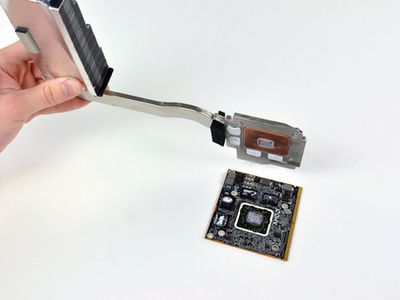
Graphics board and heat sink from new 21.5-inch iMac
- The AMD graphics chip is located on a separate board from the main logic board, allowing for replacement of the GPU without the need for an entirely new logic board. Apple of course doesn't make the GPU board particularly easy to access, as it is not considered a user-replaceable part, but it can be done.
With a bit of magic, the GPU heat sink detaches from the logic board, exposing the AMD GPU board. You heard that right, folks - you don't have to replace the entire logic board if your GPU explodes from too much l33t gaming. You can just swap out the GPU board for another one.
-The new iMac features the same LG display found in the previous generation.
-The optional secondary solid state drive appears to reside directly underneath the optical drive.
The optional SSD appears to reside beneath the optical drive - that's the only space we could find where something was clearly missing. There's three mounting points under the optical drive that have nothing attached to them in our machine, since this option is only available on 2.7 GHz 21.5" iMacs.
The previous-generation iMacs only supported secondary SSD drives on 27-inch models, with the bay positioned next to the optical drive. The bay may still be in that location on the new 27-inch models, but Apple clearly had to find a different layout for the internal components in the smaller body of the 21.5-inch model in order to fit the drive in.
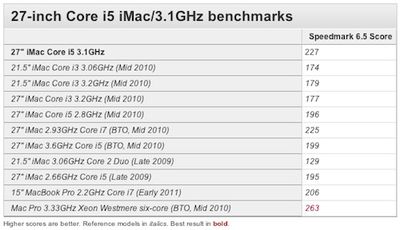
Separate from iFixit's teardown, reviewers have also begun benchmarking the new iMac models with Macworld having already put the new 3.1 GHz 27-inch model through its Speedmark 6.5 testing suite. Unsurprisingly, the machine was found to be significantly faster than the previous generation.
Our overall system performance test suite, Speedmark 6.5, shows the new system to be 16 percent faster than the previous high-end standard configuration iMac, a 27-inch 2.8GHz Core i5 quad-core model with a 1TB 7,200-rpm hard drive, and ATI Radeon HD 5750 graphics with 1GB of dedicated RAM.
Comparing to other machines, the new iMac clocked at about 10% faster than the standard high-end 15-inch MacBook Pro and about 15% slower than a build-to-order six-core Mac Pro.
Macworld will be subjecting the other three standard-configuration iMac models to the same battery of tests to provide comparison data.
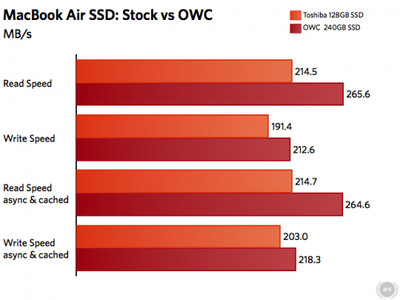
ArsTechnica provides an extensive walkthrough and installation of the OWC MacBook Air SSD replacement kits. The OWC Mercury Aura Pro Express is the only presently available SSD replacement for the MacBook Air's new compact SSD drive.
Installation requires some disassembly of your MacBook Air as well as the lengthy backup/restore process to migrate your data. The new drive offers some performance benefit over the original Toshiba SSDs, and is about on-par with the recently shipping Samsung SSD drives.
The main benefit for the replacements are increased storage capacity, but it comes at a price with 180GB/240GB/360GB drives costing $499.99/$579.99/$1179.99 respectively.