MacRumors

tapjoy offerwall
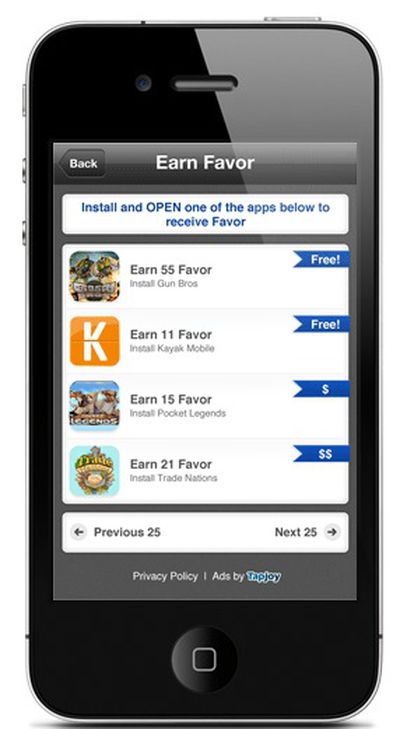
Back in April, Apple began cracking down on so-called "offer wall" services for iOS applications that incentivize users with virtual currency or other compensation for downloading and installing other applications. The services have been cited as a mechanism for unfairly boosting app download numbers and thus chart performance.

GigaOM follows up with Mihir Shah of Tapjoy, one of the major players in the incentivized install market, and learns that Apple has yet to yield on the issue, despite several proposals by Tapjoy that the company believes would address Apple's concerns over tainted chart performance.

Tapjoy CEO Mihir Shah said he reached out to Apple three weeks ago and offered to include a referral URL for the App Store when a user chooses to download an app in exchange for virtual goods. That would allow Apple to identify that the download came from Tapjoy and not count it in the App Store ranking algorithm. Shah said Apple wrote back a couple days later saying it had no time to discuss the issue.

Shah had previously proposed limiting his company's offer wall campaigns to prevent any of the participating apps from entering the Top 25 rankings via the program, but that proposal was also rejected by Apple.

Tapjoy remains confused over Apple's stance on the issue, wondering if there is more to the story than Apple has so far admitted, given that the Tapjoy has made several attempts to address Apple's concerns and has yet to receive any sort of positive response or even discussion.
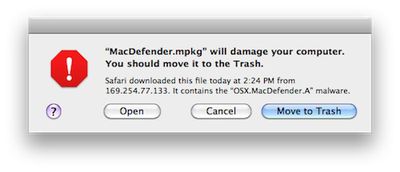
macdefender dialog box
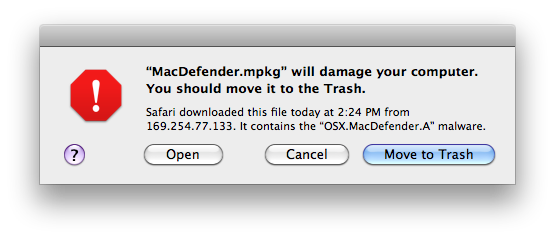
As we noted yesterday, Apple released Security Update 2011-003 for Mac OS X Snow Leopard, a system update addressing the "Mac Defender" malware threat that has been running in the wild under several different variants for the past month. The update provides tools for automatically removing the malware, as well as protection against future infections. But as reported by ZDNet, a new variant of the malware capable of circumventing Apple's update has already appeared. popping up within hours of Apple's software release.

Hours after Apple released this update and the initial set of definitions, a new variation of Mac Defender is in the wild. This one has a new name, Mdinstall.pkg, and it has been specifically formulated to skate past Apple's malware-blocking code.

The file has a date and time stamp from last night at 9:24PM Pacific time. That's less than 8 hours after Apple’s security update was released.

Apple has prepared for this eventuality by including automatic daily updates of malware definitions with the software update, enabling it to quickly deploy protection as new variants and entirely different pieces of malware surface. Consequently, Apple should be able to respond to the new threat relatively quickly, although the speed with which the new variant appeared suggests that those responsible for the malware will not be going away easily.

apple icloud trademark
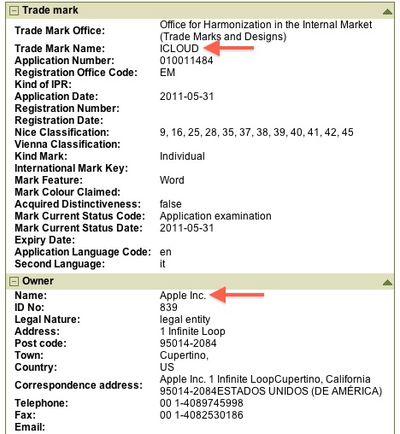
Unsurprisingly, Patently Apple notes that Apple has filed for a trademark on the term "iCloud" in Europe, staking out its territory as it prepares to introduce its new cloud-based service next Monday at its Worldwide Developers Conference (WWDC).

Apple has filed their trademark under 12 distinct International Classes covering such matters as delivering digital music by telecommunications, electronic storage, online social networking services, multimedia content for a fee or pre-paid subscription, computer software, electronic books and magazines, entertainment, photographic services, business management and advertising services, games, headgear and digital devices/computers.

In its application, Apple cites an application filed in Jamaica on December 7, 2010 for its priority date of registration.

iCloud trademarks are currently registered in the United States and Europe to Xcerion, the company behind the earlier iCloud service that recently rebranded itself as CloudMe after Apple reportedly purchased the domain and perhaps other rights to the iCloud name.

A new trademark application for iCloud also appeared in the United States last month, but the application appears to be unconnected to Apple itself and instead having been registered by Dane Baker of iOS development firm Villain, perhaps either as an attempt at squatting on the term given rumors of Apple's plans for a service by that name or simply to try to elicit a response from Apple confirming its interest in the name.

apple ipods com
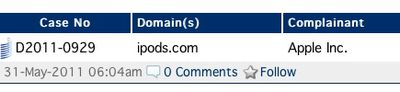
TechCrunch notes that Apple has finally gotten around to trying to acquire the ipods.com domain name, fully nine years after the domain was registered by another entity. The move comes in the form of a complaint filed under the Uniform Domain-Name Dispute-Resolution Policy yesterday.

It apparently took the Cupertino company a little over 9 full years to decide that, instead, it should be the rightful owner of the domain name, which until earlier this morning took people to some shady mp3 download site (though it no longer resolves, it seems).

Yesterday, Apple lodged a complaint, positing that the domain name should be transfered over to them. Apple of course owns the ‘iPod’ trademark, so my guess it the dispute will be resolved rather rapidly. The company currently owns iPod.com, iPhone.com, iTunes.com, iMac.com, iWork.com and many other related domain names.

It is not unusual for Apple to file complaints seeking to have domain names closely related to its products transferred to its possession, and the company has in fact had a number of domains including macosxserver.com and macosxlion.com transferred to its possession over the last few months, either by settlement with the prior owner or by decree of the Arbitration and Mediation Center of the World Intellectual Property Organization.

What is unusual, however, is the amount of time Apple waited before attempting to gain control of ipods.com. And not all domain transfers require such complaints to be filed, indicating that the company has been unable to reach an agreement with the domain's owner and is thus seeking help from regulatory and standards bodies at this time.

Related Forum: iPod touch and iPod

the heist one week sales
tap tap tap and MacHeist report that they have reached over 500,000 paid downloads of their new iOS game, The Heist, released just one week ago.

In just a little over 6.5 days, The Heist has racked up a staggering 501,813 sales at 99¢, totaling well over $300,000 in revenue. To put that in perspective, our last chart-topping app, Voices, managed to clear 300,000 sales... in its first month, meaning The Heist has been outselling it at a rate of nearly 8 fold!

In the blog post, Phill Ryu takes a look at how the developers were able to take the established MacHeist brand and build enthusiasm for the new iOS game to allow it burst strongly right out of the gate. Combining a slickly-produced game based on simple principles with a 99-cent price point and prizes and discounts for completing the challenges, The Heist was able to generate strong word of mouth that quickly pushed sales through the roof.

The Heist currently remains the top-selling paid app in a number of countries, having toppled Angry Birds from its usual perch at the top of the list.

icloud mobileme idisk
AppleInsider reports that it has received information from a source claiming that Apple will offer at least a basic tier of iCloud services free of charge to Mac OS X Lion users, although it remains unclear exactly what would be included in that package.

People familiar with Apple's plans indicated to AppleInsider that at least one of those secrets is expected to be that at least some of the services included in iCloud will be offered for free to Mac users who make the upgrade to Lion. iCloud is expected to replace the company's existing MobileMe service, which offers e-mail and remote file storage, along with syncing of bookmarks, contacts and calendar events, at a price tag of $99 per year.

That price tag may remain for users who do not make the upgrade to Lion, or for Windows users. But it is expected that the cloud services will become free to Mac users who run the latest version of Mac OS X.

One thing the free tier is not expected to offer, however, is music streaming. Apple has been negotiating licensing deals with major music labels and publishers to support that functionality, and those deals come at significant cost that Apple will almost certainly be passing along to users, although the company may offer a free introductory trial period in order to help bring users on board.

A separate, "unproven" source has also indicated that Apple may be planning to offer a relatively low price point for Mac OS X Lion, enticing users to upgrade to the new operating system. That low price could be specifically tied to Mac App Store distribution, offering users an incentive to embrace the company's new iOS-like distribution platform for Mac OS X.

Apple has historically offered new Mac OS X versions priced at $129 for single installations, although Mac OS X Snow Leopard has been priced at only $29 since its 2009 debut due to its relative focus on under-the-hood changes that may have led some users looking for more substantial visual changes to refrain from upgrading at a higher price point. It is unclear whether an "aggressive" price point for Mac OS X Lion as claimed by the source would match the $29 price point of Mac OS X Snow Leopard or if it would simply be below the usual $129 price point for major operating system releases.

Update: 9 to 5 Mac also reports that Apple may be planning to offer special educational pricing for iCloud services.

A source with some success in the past has passed along that iCloud will have educational-tiered pricing, perhaps being free for students and teachers to a certain level or with the purchase of Apple products.

Apple has been said to be announcing its annual back-to-school promotion offering free and discounted iPods (and perhaps discounted iPads) to educational customers purchasing new Macs at its Worldwide Developers Conference (WWDC) next week. The association of WWDC with the back-to-school promotion would be unusual, but would make more sense if it was somehow tied into educational customer pricing for iCloud.

maiden data center
As noted by Fortune, Apple's new data center outside of Maiden, North Carolina is now visible on satellite imagery in Google Maps and Google Earth, lifting some of the veil of secrecy that has surrounded the project.

We knew what it looked like, thanks to the local Fox TV affiliate, a trespassing photographer and a local real estate agent who conducted a couple of video flybys that ended up on YouTube.

But if you asked Google Earth or Google Maps to show you the intersection of U.S. Route 321 and Startown Road -- where the data center is located -- the current satellite imagery stopped a few yards short of the construction site. West of Startown Road, there was, as recently as two weeks ago, nothing but woods and farmland and a bit of driveway that ended abruptly in the middle of a field.

We do know that the new imagery showing the data center was live at least a few days before Apple's announcement regarding an iCloud introduction, however, as we saw it over the weekend but did not make note of it as we had not determined if it was a recent development.

Speculation has suggested that Apple may have specifically been working with Google to keep imagery of the new facility off of Google Maps, but that is far from certain as Google's satellite images are updated only periodically, especially in rural areas such as this. Fueling the speculation was the fact the the facility had been located right on the boundary between satellite image data sets that showed a brief hint of the area under construction along its western edge while the remainder of site was covered by older imagery showing only fields and trees.

The new imagery shows cleared land directly to the southeast of the facility where Apple has proposed long-term plans to double the size of the center. Also shown at the upper right at the corner of Startown Road and Elbow Road is a new Town of Maiden fire station under construction, a facility that Apple required as part of its decision to locate the data center there as the town's main fire station in the center of town a few miles away was deemed too far away for Apple's liking. The fire station is being built on a small plot of land that formerly contained a modest home that Apple purchased for $1.7 million last year.

This evening, Apple had started putting up Apple logos on Moscone West in preparation for WWDC 2011. WWDC kicks of next week on June 6th.  We've been told they've given up for the night, leaving the logo half complete.

This first photo by MacRumors reader Tyler shows the half finished logos:

IMG958368

Some earlier photos have already been posted by other sites and twitter users:

DSC00301

From MacPlus

4c57342c81ff4b6fa5f5fd0a88ae5a4d 7

From @chadjw

c967214fd5bc4b819c415c8de33fe4fc 7

838efc9abcfe402a8635eaaaf07d4cc5 7

ipad 2 oblique

Digitimes reports that Apple has begun certifying components for the iPad 3 with many Taiwan-based manufacturers actively participating.

Taiwan-based component makers for backlight modules and light bars have received certification from Apple, however, the certification of panels is still in progress, added industry sources.

While there has been talk about Apple considering the use of OLED panels for the next iPad, Digitimes' sources believe that this is unlikely with the iPad 3 and that the next generation iPad will use 9.7" LCD panels.

The timing of the launch for the iPad 3 is in 2012 according to the component makers.

Related Roundup: iPad
Buyer's Guide: iPad (Neutral)
Related Forum: iPad

infiniteloop
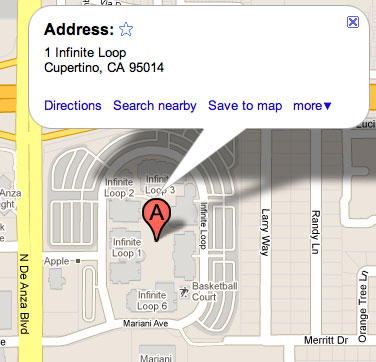
During Eric Schmidt's interview at AllThingsD 9, he revealed that Google had just renewed their Map and Search agreements with Apple. Quote per Engadget:

"We just renewed our Map and Search agreements with Apple, and we hope those continue for a long time."

This confirms rumors that Apple would be continuing to use Google Map data in iOS 5. There had been a number of Apple acquisitions and hirings that have suggested that Apple is actively working in this area. The news also suggests that Google's search remains the default choice rather than Microsoft's Bing which was said to be under consideration at one point.

HT4651 new3d enApple has detailed what changes have been made in the latest Mac OS X Snow Leopard Security update that was released earlier today. Besides adding specific detection for the "Mac Defender" malware, Apple has added a daily update to this database.

Apple maintains a list of known malicious software that is used during the safe download check to determine if a file contains malicious software. The list is stored locally, and with Security Update 2011-003 is updated daily by a background process.

This means that Apple will be able to push out profiles for newly found malware without requiring a new software update.

Users can opt-out of this daily download if they choose.

b4
TechCrunch reports that Apple will be integrating Twitter photo sharing directly into iOS 5:

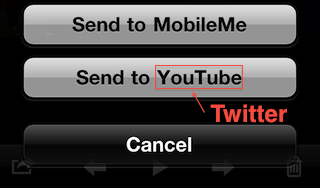
We've heard from multiple sources that Twitter is likely to have a big-time partner for such a service: Apple. Specifically, we're hearing that Apple's new iOS 5 will come with an option to share images to Twitter baked into the OS. This would be similar to the way you can currently share videos on YouTube with one click in iOS. Obviously, a user would have to enable this feature by logging in with their Twitter credentials in iOS. There would then be a "Send to Twitter" option for pictures stored on your device.

Twitter is said to be offering their own photo-sharing service in the near future. Apple will be detailing iOS 5 during WWDC next week.

DaringFireball's John Gruber adds some comments suggesting that Twitter integration is indeed in iOS 5 and that there is more to it than just photo integration:

So close to the bigger story, but yet so far. Imagine what else the system could provide if your Twitter account was a system-level service.

lodsys lawsuits png
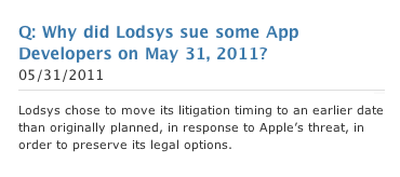
Patent holding firm Lodsys today published a series of blog posts revealing that the company has filed suit against some App Store developers, accelerating its efforts to extract licensing fees from developers for using in app purchases and upgrade links in their App Store applications. Lodsys had given developers 21 days to negotiate a license before filing suit, but the firm appears to have initiated lawsuits early in order to thwart Apple's efforts to back the developers.

Q: Why did Lodsys sue some App Developers on May 31, 2011?

Lodsys chose to move its litigation timing to an earlier date than originally planned, in response to Apple's threat, in order to preserve its legal options.

Lodsys has also disputed Apple's assertion that developers are "undeniably licensed" for the technology by virtue of an existing licensing arrangement between Apple and Lodsys.

[Apple's] letter was very surprising as Apple and Lodsys were in confidential discussions and there was clearly disagreement on the interpretation of the license terms of Apple's agreement. Before, during and after these interactions, Lodsys has carefully considered this issue and consulted several legal experts to consider Apple's claims. We stand firm and restate our previous position that it is the 3rd party Developers that are responsible for the infringement of Lodsys' patents and they are responsible for securing the rights for their applications. Developers relying on Apple's letter do so to their own detriment and are strongly urged to review Apple's own developer agreements to determine the true extent of Apple's responsibilities to them.

Simultaneous to the blog posting, Lodsys says that is has sent a detailed legal response to Apple, which it has invited the company to publish in its entirety.

Finally, Lodsys has announced that it will reimburse any developer improperly targeted by an infringement notice $1,000 for their troubles, suggesting that the firm is confident in its standing and convinced that it will prevail.

While it is true that Apple and Lodsys have an obvious dispute about the scope of Apple's license to the Lodsys Patents, we are willing to put our money where our mouth is and pay you something if we are wrong. Therefore, Lodsys offers to pay $1,000 to each entity to whom we have sent an infringement notice for infringement on the iOS platform, or that we send a notice to in the future, if it turns out that the scope of Apple's existing license rights apply to fully license you with respect to our claim relating to your App on Apple iOS.

Update: FOSS Patents reveals that Lodsys filed suit against 7 developers.: Combay, Iconfactory, Illusion Labs, Machael G. Karr, Quickoffice, Richard Shinderman, and Wulven Games.

macdefender
Apple today released Security Update 2011-003 (Snow Leopard), a new software update that addresses the "Mac Defender" malware that has been afflicting Mac users over the past month.

- Malware removal

Available for: Mac OS X v10.6.7, Mac OS X Server v10.6.7

Impact: Remove the MacDefender malware if detected

Description: The installation process for this update will search for and remove known variants of the MacDefender malware. If a known variant was detected and removed, the user will be notified via an alert after the update is installed.

The update weighs in at 2.36 MB and requires Mac OS X 10.6.7.

Seed notes for the most recent developer build of Mac OS X 10.6.8 had indicated that the update will identify and remove known variants of Mac Defender, but Apple apparently wanted to push the anti-malware portions of the update as quickly as possible before incorporating it directly into Mac OS X 10.6.8 for future updaters.

ipad 2 display
Earlier today, Apple announced that Steve Jobs will anchor the keynote at next week's Worldwide Developers Conference, also taking the unusual step of pre-announcing that Jobs will introduce the company's "iCloud" streaming service at the event.

While virtually all of the recent discussion about iCloud has been about Apple securing agreements with music labels and publishers to allow users to store their purchased songs on Apple's servers for streaming to a variety of devices, CNET reports that Apple may also be racing to secure agreements for movies and TV shows in time for the service's debut. The most specific information seems to be regarding movies:

In the past several weeks, Apple executives have stepped up their attempts to convince some of the major Hollywood film studios to issue licenses that would enable Apple to store its customers' movies on the company's servers, two sources close to the negotiations told CNET. Apple began discussing a cloud service with the studios over a year ago.

The report notes that talks with film studios are ongoing, but one stumbling block appears to be the "HBO window", an agreement between the cable channel and studios Warner Brothers, 20th Century Fox, and NBC Universal that requires those studios to temporarily stop sales and distribution of their content while it is being aired on HBO. Enforcement of such an agreement on cloud services may not be acceptable to Apple and its users who expect to be able to watch their content at any time.

The studios, led by Time Warner, do however seem to believe that cloud distribution is fundamentally different from other mechanisms and thus exempt from the HBO window, although it is unclear if the issue can be cleared up in time for next week's iCloud introduction. But even without such an agreement, Apple could launch the movie portion of the service with other major studios such as Disney, Paramount, and Sony that do not have blackout arrangements with HBO.

Information on potential TV content for iCloud seems to be based on speculation at this point, with the report pointing to Apple's existing "Multi-Pass" and "Season Pass" features that have allowed users to purchase bundles of content as foundation upon which a cloud-based service could be easily built, but it is unclear what the status of any discussions to that end might be.

Rumors of Apple looking to include movies and TV in a cloud-based service are not new, but sources have generally been silent about the negotiations as attention has focused on getting music deals done.

Tag: CNET

atf ipad
The Washington Post reports on the ongoing diversification of information technology platforms within the United States government, a trend that has seen a shift away from traditional large-scale technology contracts unable to respond to rapidly-changing markets to a more flexible approach that has seen many agencies and employees embracing Apple's iOS platform.

This is not a movie. This is not a Steve Jobs dream. This is the federal government 2.0, where technology upgrades no longer come at a "Little House on the Prairie" pace. Even President Obama, a BlackBerry devotee, has upgraded. He now owns an iPad, and it has been seen on his desk and under his arm.

The flashy consumer products that have been adopted in the corporate workforce - upending BlackBerrys for iPhones, Microsoft Outlook for Gmail, and lately laptops for iPads - are now invading the federal government. The State Department. The Army. The Department of Veterans Affairs. NASA.

The report notes that the push for increased flexibility comes from both the top management and rank-and-file workers, many of whom are using technology products such as iOS devices in their personal lives and see how they can be of use in the workplace.

Recent studies have shown that workers are increasingly purchasing their own smartphones and other technology for use in the workplace, preferring the added cost to the inconvenience of working with outdated or inadequate technology provided by their employers. Consequently, the trend is shifting to a flexible approach where workers are being allowed to select their own tools and receive stipends to cover what would otherwise have been provided on an enterprise basis. And this shift to "consumer" technology is projected to save billions of dollars in information technology costs for government units.

The adoption of these consumer devices, though still modest in size, has been widespread across a variety of agencies.

At ATF, there are about 50 iPads or iPhones in use, and the number could increase to 100 soon. At the Pacific Northwest National Laboratory, the 1,000 BlackBerrys used last year have dropped to about 700 as workers picked other smartphones. The State Department is testing iPads. Congress now allows iPads and iPhones on the House floor.

The report pitches the trend as a challenge for Research in Motion which has seen its BlackBerry platform for smartphones lose ground to iOS and Android. BlackBerry's strongest base has been in the enterprise market, and with alternatives now quickly chipping away at its dominance there, the developments could spell trouble for the company.

Related Roundup: iPad
Buyer's Guide: iPad (Neutral)
Related Forums: iPad, iPhone

findmymac
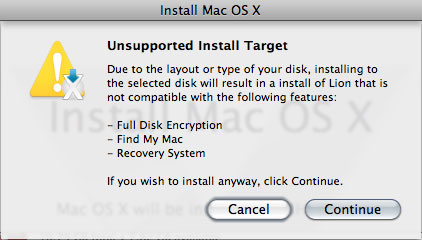
Find My Mac is likely one of the new Mac OS X Lion features that Steve Jobs will reveal at next week's WWDC keynote. One reader has noted that Find My Mac is mentioned when reinstalling the latest version of Mac OS X Lion.

DP3 through software update failed for me so I decided to format the lion partition and install it again. This is the warning I got when I tried to install lion on a HFS+ journaled formatted partition:

There is speculation that the Find My Mac feature is dependent on the creation of the recovery volume in Mac OS X Lion.

"Find My Mac" is expected to offer similar functionality as the "Find My iPhone" feature that Apple offers on iPhones. While most Macs don't have GPS built in, the same geographical Wi-Fi data used in the iPod Touch can be used to provide location data.

iwork
Apple today announced that its iWork suite of applications for the iPad has been updated to include universal binaries now capable of running on the smaller screen of the iPhone and iPod touch.

"Now you can use Keynote, Pages and Numbers on iPhone and iPod touch to create amazing presentations, documents and spreadsheets right in the palm of your hand," said Philip Schiller, Apple's senior vice president of Worldwide Product Marketing. "The incredible Retina display, revolutionary Multi-Touch interface and our powerful software make it easy to create, edit, organize and share all of your documents from iPhone 4 or iPod touch."

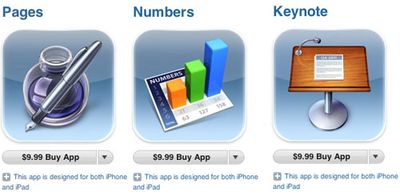
The three iWork applications for iOS (Keynote, Pages, and Numbers) are available individually via the App Store and are priced at $9.99 apiece. Besides the Universal upgrade, Apple has also added a few new features to the apps:

Keynote
• Keynote Remote app (sold separately on the App Store) to control your presentation from another iPhone or iPod touch.
• New document manager to easily sort your documents and organize them into folders.

Numbers
• New document manager to easily sort your documents and organize them into folders.
• Improved usability including Smart Zoom for viewing and editing data.

Pages
• New document manager to easily sort your documents and organize them into folders.
• Ability to change font style and size directly from the ruler when editing text.
• Smart Zoom for viewing and editing data.

Several hints nearly a year ago had indicated that Apple was working on a version of iWork for the smaller screen, but any rumors of a launch have been scant since that time.

Related Forums: iPhone, iPod touch and iPod