Medical Doctors Underline Potential Risk of iPhone 12 Interference With Pacemakers

Apple's warning to keep the iPhone 12 away from cardiac devices due to electromagnetic interference was further underlined by U.S. cardiologists this week in a new report (via NBC25 News).
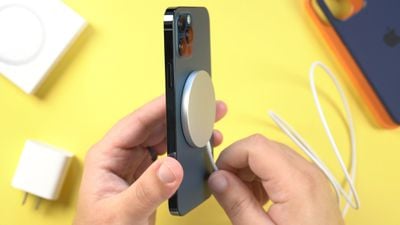
iphone12magsafe
Apple's ‌iPhone‌ 12 series includes an array of magnets that help align the phone on Apple's MagSafe charging accessory to maximize charging, and Apple already advises users with implanted pacemakers and defibrillators to keep ‌iPhone‌ and ‌MagSafe‌‌ accessories a safe distance away from such devices.

To test the extent of the risk, Henry Ford Heart and Vascular Institute cardiologist Gurjit Singh and his colleagues recently carried out further testing to see just how much of an influence the Apple products have.

According to Dr. Singh, more than 300,000 people in the U.S. undergo surgery to implant one of these devices each year, and around one in four smartphones sold last year was an ‌iPhone‌ 12. The cardiac devices have switches that respond to an external magnet to change how the device functions, which allows them to be controlled without the requirement of surgery.

Curious about potential interference with electrical devices, Dr. Singh and his colleagues took an ‌iPhone‌ 12 Pro and passed it over the chest of a patient with an implantable defibrillator.

"When we brought the iPhone close to the patient's chest the defibrillator was deactivated," said Dr. Singh. "We saw on the external defibrillator programmer that the functions of the device were suspended and remained suspended. When we took the phone away from the patient's chest, the defibrillator immediately returned to its normal function."

"We were all stunned," he said. "We had assumed that the magnet would be too weak in a phone to trip the defibrillator’s magnetic switch."

The findings are significant, since Dr. Singh is an expert in the use of devices such as implantable defibrillators that detect an irregular heartbeat and shock the heart back into a normal rhythm, and pacemakers that use electricity to keep the heart beating. Following the discovery, Dr. Singh and his colleagues immediately submitted a report of their findings to the HeartRhythm medical journal that was published on January 4, 2021.

"We believe our findings have profound implications on a large scale for the people who live daily with these devices, who without thinking, will place their phone in their shirt pocket or upper pocket or their coat – not knowing that it can cause their defibrillator or pacemaker to function in a way that could potentially be lethal."

The comments underline medical evidence published in January which cautioned that ‌‌iPhone‌ 12‌ models and related ‌MagSafe‌ devices can "potentially inhibit lifesaving therapy in a patient" due to magnetic interference with implanted medical devices. Apple provides more information about this issue in the "Important safety information for iPhone" section of the ‌‌iPhone‌‌ User Guide.

Related Forum: iPhone

Popular Stories

maxresdefault

Apple Shows Off a Key Reason to Upgrade to the iPhone 17

Saturday February 7, 2026 9:26 am PST by
Apple today shared an ad that shows how the upgraded Center Stage front camera on the latest iPhones improves the process of taking a group selfie. "Watch how the new front facing camera on iPhone 17 Pro takes group selfies that automatically expand and rotate as more people come into frame," says Apple. While the ad is focused on the iPhone 17 Pro and iPhone 17 Pro Max, the regular iPhone...
apple wallet drivers license feature iPhone 15 pro

Apple Says These 7 U.S. States Plan to Offer iPhone Driver's Licenses

Monday February 9, 2026 6:24 am PST by
In select U.S. states, residents can add their driver's license or state ID to the Apple Wallet app on the iPhone and Apple Watch, and then use it to display proof of identity or age at select airports and businesses, and in select apps. The feature is currently available in 13 U.S. states and Puerto Rico, and it is expected to launch in at least seven more in the future. To set up the...
14 inch MacBook Pro Keyboard

New MacBook Pros Could Now Arrive in March

Sunday February 8, 2026 6:02 am PST by
New MacBook Pro models with the M5 Pro and M5 Max chips could arrive as soon as Monday, March 2, according to Bloomberg's Mark Gurman. In today's "Power On" newsletter, Gurman said that the release of new MacBook Pro models is tied to the release of macOS Tahoe 26.3. The launch is said to be slated for as early as the week of March 2. He added that the M4 Pro and M4 Max models on sale today...
Apple Logo Zoomed

Apple Expected to Launch These 10+ Products Over the Coming Months

Tuesday February 10, 2026 6:33 am PST by
It has been a slow start to 2026 for Apple product launches, with only a new AirTag and a special Apple Watch band released so far. We are still waiting for MacBook Pro models with M5 Pro and M5 Max chips, the iPhone 17e, a lower-cost MacBook with an iPhone chip, long-rumored updates to the Apple TV and HomePod mini, and much more. Apple is expected to release/update the following products...
wwdc sans text feature

Apple Rumored to Announce New Product on February 19

Thursday February 5, 2026 12:22 pm PST by
Apple plans to announce the iPhone 17e on Thursday, February 19, according to Macwelt, the German equivalent of Macworld. The report, citing industry sources, is available in English on Macworld. Apple announced the iPhone 16e on Wednesday, February 19 last year, so the iPhone 17e would be unveiled exactly one year later if this rumor is accurate. It is quite uncommon for Apple to unveil...

Top Rated Comments

adamlbiscuit Avatar
65 months ago
My mum had a pacemaker fitted in 2019. Around that time she owned an original iPhone SE (2016), and even then she was told to keep it well away from her chest. This advice isn't new to the iPhone 12 at all, or at least in my mums case it wasn't.

She took the advice to heart (no pun intended) and since always kept her phone in a bag rather than a pocket, and even used the phone on loud speaker during phone calls (which you could argue is overkill but she likes to play it safe & who could blame her).

She now has an iPhone 12 mini & hasn't changed her handling of the device when compared to the SE. Point is, if you have a pacemaker fitted you're usually advised to keep any mobile device a safe distance from it and this was the case well before the iPhone 12.

That said, as someone whose mother has a pacemaker fitted I'm always grateful to see this issue highlighted. I just think it's worth pointing this out as a lot of people may mistakenly think this is unique to iPhone 12 models & it isn't. It's simply the case that the magnets are an additional thing to bear in mind, in a long list of reasons why you should keep any phone a safe distance from such devices.
Score: 25 Votes (Like | Disagree)
henryhbk Avatar
65 months ago
So it is important to differentiate between danger to a patient that is pacer dependent versus a patient who has a pacemaker as backup for an intermittent condition (note: I am a doctor). For instance if you are constantly pacer dependent (i.e. for whatever reason your sinus node isn't doing a proper job establishing your heart rate/rhythm) then this could be deadly (depending on what your non-paced escape rhythm is). Versus for instance if once in a blue moon your heart rate becomes dangerously slow and you faint, then it's not going to cause a problem (given the probability of you needing the pacer backup at the exact moment you place your iPhone 12 on your chest).

Modern pacemakers (or electronics in general) are remarkably resistant to EMI (particularly since most pacemakers now are internet connected, they certainly can handle cellular/wifi signals nearby since they themselves generate wifi or BT). The magnet is a specific off-switch (that's a feature, like when I want to take an EKG of a patient with a pacemaker and want to see the underlying heart itself, I put a ring shaped magnet (we leave them stuck on the side of the EKG cart) so the pacemaker shuts off, so we can see, then after the procedure I remove the magnet. i make the same calculation of risk when I place the order for the EKG as to whether you can safely deactivate the pacer for a little while to do the EKG (some patients yes, some no)
Score: 25 Votes (Like | Disagree)
Piggie Avatar
65 months ago
I could see a potential bedtime scenario that you'd need to be sure never happened.
And I'm 100% sure the following scenario has happened to hundreds if not thousands of people many times.

Laying in bed, tired, messing with your phone, and you drift off to sleep, your hands flop down and your phone lands on your chest.

Have to be sure you never ever put yourself in such a situation with one of these phones.
Must be 1000's of people every single night in bed, laying down doing this exact thing.
Score: 22 Votes (Like | Disagree)
verpeiler Avatar
65 months ago
If you have a pacemaker, don't put your iPhone near your heart. Got it.
I guess smartphones in general shouldn't be near a pacemaker anyway.
Score: 18 Votes (Like | Disagree)
Whathappened Avatar
65 months ago
please Apple get rid of that magnet. It is not important how fast we charge wirelessly as long as you provide one day battery life. Most of us charge overnight. My car has a (slow) charging mat, my office has one, the phone is being charged all the time.
Score: 10 Votes (Like | Disagree)
Apple_Robert Avatar
65 months ago

So it is important to differentiate between danger to a patient that is pacer dependent versus a patient who has a pacemaker as backup for an intermittent condition (note: I am a doctor). For instance if you are constantly pacer dependent (i.e. for whatever reason your sinus node isn't doing a proper job establishing your heart rate/rhythm) then this could be deadly (depending on what your non-paced escape rhythm is). Versus for instance if once in a blue moon your heart rate becomes dangerously slow and you faint, then it's not going to cause a problem (given the probability of you needing the pacer backup at the exact moment you place your iPhone 12 on your chest).

Modern pacemakers (or electronics in general) are remarkably resistant to EMI (particularly since most pacemakers now are internet connected, they certainly can handle cellular/wifi signals nearby since they themselves generate wifi or BT). The magnet is a specific off-switch (that's a feature, like when I want to take an EKG of a patient with a pacemaker and want to see the underlying heart itself, I put a ring shaped magnet (we leave them stuck on the side of the EKG cart) so the pacemaker shuts off, so we can see, then after the procedure I remove the magnet. i make the same calculation of risk when I place the order for the EKG as to whether you can safely deactivate the pacer for a little while to do the EKG (some patients yes, some no)
This is the kind of information people on the forum needed to be educated about. Thank you, Doctor.
Score: 9 Votes (Like | Disagree)