In an interesting twist as fourth-generation iPhone rumors begin to gather steam in the new year, Bloomberg cites Goldman Sachs analyst Robert Chen, who predicts that Apple's next iPhone may take some cues from the company's new multi-touch Magic Mouse and incorporate a touch-sensitive casing in addition to the traditional touchscreen.
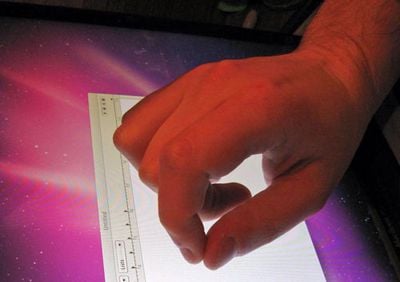
Magic Mouse, a computer mouse released in October, has a touch-sensitive solid plastic shell that replaces mechanical buttons. The technology may be replicated in the new iPhone to offer touch-sensitive features on the rear of the handset, Chen said.
No evidence for Chen's claim is given beyond the citing of an unidentified source, however, and no specific suggestions of how the touch sensitivity might be utilized are offered.
Chen also claims that the new iPhone will make an appearance "as early as June" and will offer a 5-megapixel camera, up from the 3.2-megapixel camera found in the iPhone 3GS. A report late last month indicated that Apple had in fact placed orders for 5-megapixel camera sensors for the new iPhone, with another claim last week suggesting that Apple is looking to add an LED flash to the iPhone's camera capabilities.
Valleywag today announced that it is offering a bounty of up to $100,000 for information on Apple's much-anticipated tablet device. The reward ladder begins at $10,000 for "bona fide pictures" of the device, increasing to $20,000 for video. Potential rewards for more ambitious tipsters include $50,000 for pictures of Apple CEO Steve Jobs holding the device, and $100,000 for anyone willing to let Valleywag play with it for an hour.
We've had enough of trying to follow all the speculation around Apple's impending tablet -- how it'll work, its size, the name, the software and whether it will save magazines. We want answers, dammit! And we're willing to pay.
As a disclaimer, Valleywag "encourages" tipsters to stay within the law and notes that it will not pay out any prizes until the Apple tablet debuts in order to ensure authenticity. Despite the disclaimer, however, Valleywag's offer could easily face legal challenges as pointed out by TechCrunch.
We spoke to a lawyer about the legality of the bounty, who says that Apple could have a claim against Gawker/Valleywag for inducing breach of contract, since anyone who has their hands on the tablet is certainly under a nondisclosure agreement. This could result in tort damages, with potential for punitive damages.
Apple has reportedly scheduled a media event for later this month, where it is widely expected to introduce the new tablet device, likely giving potential entrants for Valleywag's contest just two weeks to produce their information.
24/7 Wall St. reports that Apple and App Store developers appear to have lost approximately $450 million to piracy since the marketplace for iPhone and iPod touch application opened in July 2008. The rough number is based on several estimates regarding the proportion of downloads that are paid applications, the piracy rate for paid applications, and the proportion of pirated app users who would have paid for the applications had pirated versions not been available.
There have been over 3 billion downloads since the inception of the App Store. Assuming the proportion of those that are paid apps falls in the middle of the Bernstein estimate, 17% or 510 million of these were paid applications. Based on our review of current information, paid applications have a piracy rate of around 75%. That supports the figure that for every paid download, there have been 3 pirated downloads. That puts the number of pirate downloads at 1.53 billion. If the average price of a paid application is $3, that is $4.59 billion dollars in losses split between Apple and the application developers. That is, of course, assuming that all of those pirates would have made purchases had the application not been available to them for free. This is almost certainly not the case. A fair estimate of the proportion of people who would have used the App Store if they did not use pirated applications is about 10%. This estimate yields about $459 million in lost revenue for Apple and application developers.
Based on Apple's take of App Store sales of 30%, the report concludes that piracy has cost Apple itself in the neighborhood of $140 million over the past year and a half, a significant loss for the company, especially considering Apple's estimated total App Store revenue of $500-$700 million.
The report also notes that Apple has remained silent about the issue and taken no significant steps to address the issue beyond the initial security measures deployed in the App Store. Assuming Apple's true goal is to sell iPhones and iPods, then like the original iTunes Music Store, the App Store may very well be viewed as a means to that end. Consequently, the hit to Apple's bottom line may be considered somewhat acceptable to the company if it continues to drive device sales, leaving developers to bear the brunt of the revenue loss.
Boy Genius Report reveals that it has received information from a source regarding Apple's much-rumored tablet, noting that it is basically an "iPhone on steroids" and offering a few details about the device.
- The tablet's multi-touch gestures are "out of control." - It's powered by an incredibly fast ARM CPU - It runs on the iPhone kernel. - The internal model number is K48AP. - There hasn't been an updated iPhone OS build because there's too much tablet-related code/references in the OS and Apple obviously didn't want that to leak. Oops. - The tablet is basically an "iPhone on steroids."
The report is not the first to refer to Apple's tablet as carrying an internal model number of K48AP, as a Reddit user previously made the same claim, along with an assertion that the next-generation iPhone will carry internal model number N90AP. (The iPhone 3GS carries an internal model number of N88AP.) It is unknown whether the two sources are independent.
Spanish site faq-mac.comreports [Google translation] that chipmaker Intel has sent an e-mail to members of its Intel Retail Edge program touting a chance for participants to win one of two MacBook Pro notebooks based on Intel's new Core i5 processors during the month of January. Apple's MacBook Pro line currently utilizes Intel Core 2 Duo processors.
Other sources have confirmed that similar promotional e-mails have gone out to program participants in the United States and United Kingdom. Intel's Retail Edge Program is targeted at employees of retail stores that offer Intel-based products for sale, and offers them training opportunities to increase their knowledge of Intel products as well as contests and special discounts.
Early benchmarks have shown the Core i5 processors to hold significant performance advantages over the Core 2 Duo line, with similar battery life for systems based on the two lines. As noted by our Buyer's Guide, the MacBook Pro is nearing the end of its typical lifecycle, having last been updated in June 2009.
Apple is reportedly scheduled to be holding a media event in San Francisco at the end of this month, where it is widely expected that the company will introduce its long-anticipated tablet device. It is unknown whether Apple would also take that opportunity to introduce revised notebook offerings or if it would do so at a separate time.
As rumors of an Apple tablet reach a frenzy, there's no shortage of opinions of what Apple could or should do in an upcoming tablet device. One major question that has remained is the input method that Apple will choose to adopt for the tablet. This became the most obvious issue when you start holding 10-inch tablets as we did at CES. Traditional soft keyboards simply don't scale well in size. Gizmodosummarizes and explores the problem well:
I had a chance to play with a few different sizes of tablets at CES, nearly all of which had traditional onscreen keyboards -- in particular, the Android 2.0 keyboard, which is aesthetically different but functionally almost identical to iPhone OSes. None of them worked, at least in the way that I wanted them to, for one reason: they were too big. Seven-inch tablets were too large to comfortably thumb-type on, while 10-inch tablets made text input all but impossible.
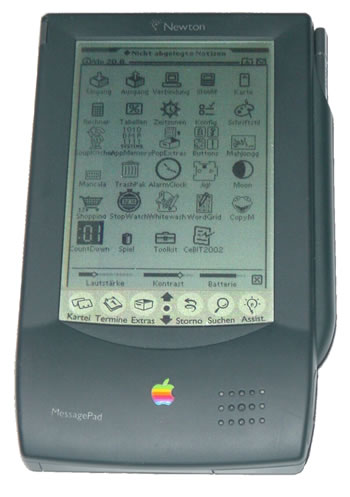
This exact issue dates back to when Apple first introduced the Newton MessagePad, which offered handwriting recognition as its primary input. One of the main benefits of handwriting recognition was the fact that it could be used while standing and holding a slate-type device. As device sizes shrank over the years and chiclet keyboards, and subsequently touch-screen keyboards, took over, the issue has been mostly forgotten.
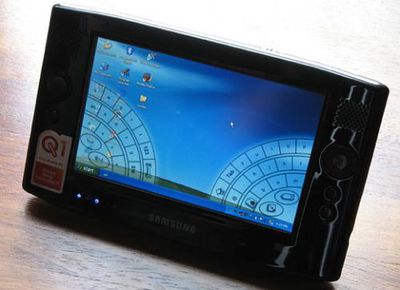
2006 Samsung UMPC with Dialkeys
The simplest (and arguably the most likely) solution will be for Apple to split the touch keyboard in some way. This is the same solution (DialKeys) that Microsoft adopted when they introduced their UMPC devices in 2006. Halves of the touch keyboard would sit along the left and right edges of the screen to be more accessible to your thumbs while holding the device with both hands.
A more intriguing solution, however, would be the reintroduction of handwriting recognition in at least a limited form alongside a more robust multi-touch keyboard. While much has been said of an old handwriting patent application that reemerged in November, the claims in that patent date back from Newton days and the provided image is clearly a depiction of the Newton MessagePad (image), complete with up/down arrows in the toolbar.
Instead, the most interesting multi-touch patent that has emerged from Apple in recent years is one that dates from February 2008, and describes a comprehensive multi-touch system which incorporates touch controls and proximity sensors to allow the device to handle a multitude of different input types, including stylus-less handwriting recognition:
Apparatus and methods are disclosed for simultaneously tracking multiple finger and palm contacts as hands approach, touch, and slide across a proximity-sensing, multi-touch surface. Identification and classification of intuitive hand configurations and motions enables unprecedented integration of typing, resting, pointing, scrolling, 3D manipulation, and handwriting into a versatile, ergonomic computer input device.
FingerWorks founder Wayne Westerman describes a system where the "pen grip detection module" checks to see if the hand imprint on the multi-touch screen matches up with that of holding an imaginary pen. If so, the movements are interpreted as digital ink and can be used for drawing, signatures or even handwriting recognition. This would go along nicely with Steve Jobs' dislike of styluses.
To be honest, we're not sure how such a system would work in practice, and the remainder of the patent application is likely to be more relevant to Apple's actual plans. The advanced recognition and processing involved paints a picture of an intuitive multi-touch input device that adapts to the user's intent.
The Loop notes that Apple has released Logic Pro 9.1 and MainStage 2.1, bringing several bug fixes to the company's professional audio applications, as well as 64-bit compatibility for users running Mac OS X 10.6.2 or later.
Adding 64-bit support to Logic 9.1 and MainStage 2.1 effectively removes the memory limit imposed on 32-bit applications running under Mac OS X. When running the apps in 64-bit mode, users can take advantage of any memory left after allocating the system, plug-ins and other apps.
As addressed in an Apple FAQ support document, users of 32-bit plug-ins will be able to use Logic Pro and MainStage in 64-bit mode, with Apple's new 32-bit Audio Unit Bridge serving to provide compatibility with those plug-ins.
The report also notes that there are several features in Logic Pro and MainStage that are not yet functional in 64-bit mode, so users should make note of those limitations before deciding which mode to use. Full details of the changes in Logic Pro 9.1 and MainStage 2.1 are available in release notes posted on Apple's site.
Apple released its updated Logic Studio suite in July and had issued a couple of minorupdates before today's major point release.
In a brief comment regarding the Apple tablet, Daring Fireball's John Gruber, notes that his sources have indicated that the device will not include a camera.
And, for what it's worth, I'm hearing there is no camera, webcam or otherwise, on The Tablet.
The much-followed Gruber has several times in the past offered accurate information on forthcoming Apple products, most recently correctly revealing Apple's October product unveilings (with the exception of his "wildcard" multi-touch trackpad gadget claim) the evening before their release.
Little more than speculation has suggested that Apple's tablet will include a digital camera, with such rumors sparked in early April with a report that Apple had ordered both 3.2- and 5-megapixel camera sensors, with the former slated for what became the iPhone 3GS and the latter for a product scheduled for introduction later in 2009.
Sources were also fairly quiet about whether the tablet would offer a webcam until relatively recently, when claims began to increase. The earliest widespread claim of a webcam appears to have been in mid-August with reports that Apple would offer two models, with and without webcam. Webcam speculation increased significantly yesterday after France Telecom executive Stphane Richard appeared to offer some confirmation of a forthcoming tablet release including a webcam option for videoconferencing, although company representatives quickly clarified that Richard's comments had been misconstrued.
Private equity firm Elevation Partners today announced that former Apple executive Avie Tevanian has joined the company as a Managing Director, joining former Apple Chief Financial Officer Fred Anderson on the team behind Palm's attempt at reinventing itself.
Tevanian was a major figure at NeXT Computer, founded by Steve Jobs and later acquired by Apple for its NeXTSTEP operating system that eventually evolved into Mac OS X. He joined Apple as part of the 1996 acquisition of NeXT, and was named Chief Software Technology Officer in 2003. He left the company in 2006.
Fred Anderson, Managing Director and co-founder of Elevation said, "Avie and I worked closely together at Apple for many years and I have always admired his engineering talent and leadership, his strategic vision for how software can transform businesses and his ability to execute on that vision. We are proud that he has decided to join Elevation and believe he will be a huge asset as we explore new investment opportunities".
Elevation Partners holds a close relationship with Apple competitor Palm, having purchased a 25% stake in the company in mid-2007 as Palm prepared to refocus on its new webOS operating system that officially kicked off in early 2009 with the introduction of the Palm Pre.
As part of the restructuring of Palm, longtime NeXT and Apple executive Jon Rubinstein joined the company, where he now serves as CEO. Combined with the association with Anderson, who holds a position on Palm's board alongside two other directors of Elevation Partners, and now Tevanian, as well as several other hires from Apple's ranks, Palm has been seen as one the primary challengers to Apple's iPhone. But while Palm has released several webOS smartphones over the past year, it has yet to gain significant market share and is instead being overshadowed in recent months by the increasing success of Android-based smartphones.
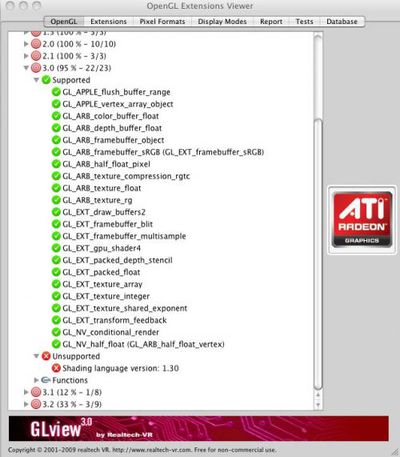
Hardmac today points to a netkas.org posting revealing that Apple has built nearly all of the required support for OpenGL 3.0 into Mac OS X 10.6.3, with 22 out of 23 extensions now supported. Most of the associated OpenGL 3.0-specific functions, however, are reportedly not yet supported.
The public release of Mac OS X 10.6.2 supports only 15 of the 23 OpenGL 3.0 extensions, suggesting that Apple is moving rapidly toward full support for OpenGL 3.0, which would offer increased graphics performance for the company's Mac computers. The graphics cards used in current Mac models already support OpenGL 3.0, which was released in July 2008, but the required software support in Snow Leopard to take advantage of the specification has not yet appeared.
A new report today from The Korea Times claims that Apple is preparing to launch the fourth-generation iPhone, with sources claiming that it could debut as early as April. The assertions apparently come from an executive of KT, the exclusive iPhone carrier in South Korea, who claims that the new iPhone will launch to large Korean corporate clients in April, with release to the general public occurring in June. Such a move would be odd for Apple, which has relied on the publicity and excitement of its iPhone launch events, a tactic that would be undermined by early availability of the handset to a limited customer base.
The executive also offered claims of an OLED screen and video chat capability for the next-generation iPhone, as well as a claim of a "highly likely" removable battery that would also be a surprising move from the company that has utilized a non-removable battery since the original iPhone and has transitioned to similar setups for its notebook computers.
They said the coming 4G iPhones will be equipped with organic light emitting diode (OLED) screens on surface and live video chat functionalities, while removable battery is highly likely.
The new 4G iPhone is also going to be loaded with dual core processors and higher and powerful graphic chips that can deliver higher video resolutions and better "still" images when taking pictures.
The report claims that Apple is planning for a relatively early introduction of the new iPhone compared to previous June or July launches in order to counter the stream of Android-based smartphones expected from Google in the wake of its launch of the Nexus One.
Reached for comment, a spokesperson in Apple's South Korean unit did offer confirmation that the company is in discussions regarding launch timing for the new iPhone.
"With KT, we've been in talks with other telecom carriers to gauge the launching timing of 4G iPhones in South Korea. More tech-oriented features will be added to the models," a representative of Apple's South Korean office said.
Meanwhile, French magazine Challengesbriefly reports [Google translation] that Apple is planning to launch the next-generation iPhone in May.
Apple will launch in early May 2010 a new version of its iPhone, it was learned from several mobile operators. . . . No information was leaked, however the characteristics of the new device.
An iPhone launch ahead of Apple's Worldwide Developers Conference (WWDC) would be something of a surprise, as Apple has consistently taken advantage of the conference to show off the forthcoming iPhone models and set the stage for their launches shortly after the conference. WWDC has been rumored to be set for June 28th through July 2nd based on the appearance of a generic "Corporate Event" listing on the Moscone Conference Center's event calendar, a placeholder tactic used in the past for Apple's conferences there. That listing has, however, now been removed from the Moscone Center's calendar.
Due to the rather surprising and questionable nature of these reports, we have collected them on Page 2 for discussion.
TG Daily reports on a rumor it heard during CES claiming that Asian suppliers of 10.1-inch LCD and OLED screens are experiencing shortages of their products as Apple snaps up available stocks for its tablet device.
"We were designing a product for a customer and we needed 10 inch screens, but we've been trying for months and can't get one from any of the Asian suppliers," an anonymous designer for a firm wishing to remain nameless told TG Daily.
"We were told that Apple pre-ordered them all. All 10 inch LCDs, and all 10 inch OLEDs too," our source continued, redundantly adding "it's for the Apple tablet."
Reports of Apple planning to use an OLED screen for its tablet have been few, with one November report curiously suggesting that the company would delay the launch of its tablet until late 2010 in order to launch two models, one carrying a 10.6-inch LCD screen and one with a 9.7-inch OLED display. Apple's potential use of OLED technology in a number of its products has, however, been a popular topic for many years now.
Today's report of Apple causing display shortages is rather similar to a claim made last month by T3, although in that case it was claimed that the industry was experiencing shortages of 7-inch screens, with Apple speculated to be about the only company capable of demanding such quantities.
Apple today released a pair of updates for its Apple Remote Desktop software package, updating both its admin and client applications to version 3.3.2.
This update improves the overall stability and performance of Apple Remote Desktop in addition to delivering the specific improvements listed below.
Setup * Improved handling of IP address and port changes for clients accessed behind a Network Address Translation (NAT) system * Upgrading to Apple Remote Desktop 3.3 will no longer reset non-administrator access privileges * Improved reliability when authenticating new client computers
Software Distribution * Improved reporting of results of failed package installations
Asset Management * MacBook Air MAC address is now correctly reported * Improved reliability of reporting systems configured with AirPort * Correctly reports system version for systems that have been promoted from Mac OS X to Mac OS X Server
Remote Assistance * Improved mouse cursor tracking when controlling remote systems * Improved reliability when controlling remote clients that have a 1366-by-768 resolution * Improved performance when clients are being controlled by RealVNC viewers * Improved reliability when controlling systems that have dual graphics processors * Improved support when controlling systems running third-party VNC servers * Improved reliability for drag-and-drop file copy * Improved reliability when controlling client computers that have two displays * Improved reliability when controlling remote systems in scale mode with certain resolutions * Menu Extra now correctly shows status when being observed by a VNC viewer
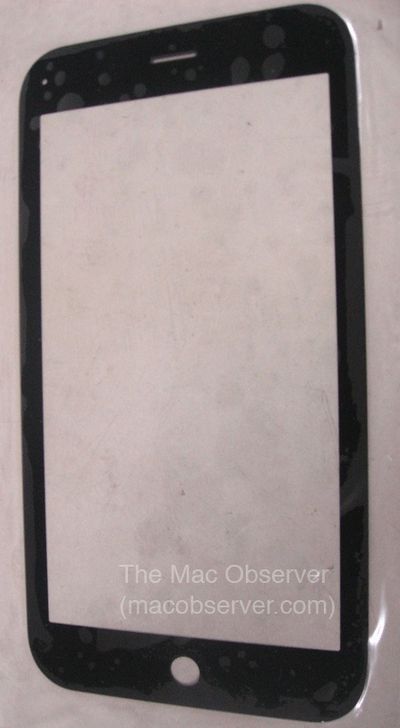
The Mac Observer reports that it has received an image from a source showing what is claimed to be the "glass" for Apple's much-rumored tablet device, although the image actually depicts a front bezel.
With no sense of scale for the image, the report relies on the source's claim that the "glass" (presumably the bezel opening for the screen) measures in at 10 inches. The bezel has a nearly-identical appearance to that of the iPhone aside from the claimed size, with a home button at one end of the screen and a slot similar to that of an iPhone's speaker at the other end. The image also depicts a small hole at the top left corner of the bezel, with speculation centering on it possibly being for a camera lens.
We aren't positive about how this device would be presented, but we thought it made the most sense in a vertical alignment. If it is legit, one wold think that the slot at the top is for a speaker, while the hole in the upper left could be for a camera lens. The button on the bottom, of course, would likely be a Home button, the same with the iPhone.
As for the reliability of the source, The Mac Observer notes only that it is trusted. We, however, are extremely skeptical of the claims, and barring additional evidence, we are posting this item on Page 2 merely for interest and discussion.
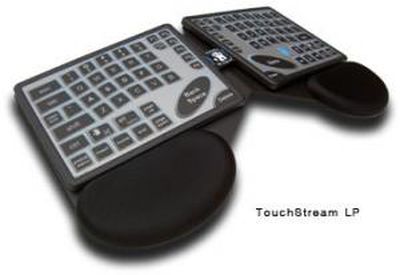
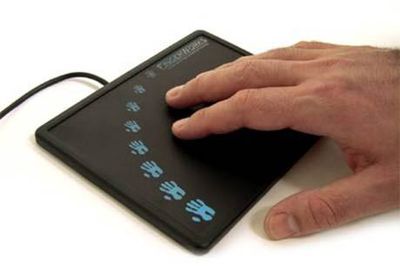
The content of Fingerworks.com has been removed this week after remaining online for nearly 5 years after the acquisition of the company by Apple. The removal seems to correspond with the impending announcement of an Apple tablet later this month. One possible explanation is that Apple will finally be implementing many of the same advanced multi-touch keyboard gestures that were originally pioneered by Fingerworks.
Up until last week, Fingerworks.com retained photographs and details about their multi-touch keyboards and gesture pads they released for Macs years ago. In fact an old press release describes the benefits of their Multi-Touch system in a combination keyboard/touchpad:
The MacNTouch Gesture Keyboard is a complete user interface that serves as mouse, standard keyboard, and powerful multi-finger gesture interpreter. Mouse operations like point, click, drag, scroll, and zoom are combined seamlessly with touch-typing and multi-finger gesture everywhere on the MacNTouch's surface. .... People are amazed by all the things a hand gesture user interface provides. We have a large number of easy- to-use gestures that cover just about every common computer operation. Users don't have to reach for hot-keys because gestures are faster and easier to do.
It's been widely expected that this sort of all purpose multi-touch interface will be offered in Apple's upcoming tablet. Wayne Westerman who was one of the founders of Fingerworks has since been the author of many multi-touch patent applications from Apple, including advanced gesturing implementations for Mac OS X.
Zinio, a digital publisher of magazines and books, announced the launch of its new magazine reader iPhone app today. The app [App Store link] offers Zinio subscribers the ability to read select magazines on an iPhone or iPod touch, featuring zoom capabilities and a special enhanced text reading mode as well as other multiimedia features.
Only a handful of magazines in Zinio's portfolio are currently available for reading through the iPhone app though more will be available in the future:
Zinios highly anticipated free application for the iPhone and iPod touch initially launches with access to titles including: Automobile Magazine, Car and Driver, Chicago magazine, iPhone Life, Marie Claire, Motor Trend, PC Magazine, Popular Mechanics, Popular Science, Redbook, The Independent Guide to the iPhone 3GS, Transworld Motocross, Transworld Skateboarding, Vegetarian Times, VIVmag, Yoga Journal and many more. Subsequently, the rest of its global catalog of thousands of books and magazines will be released.
The normal view (left) and the optimized text view (right)
Users can purchase magazine subscriptions directly on their iPhone or iPod touch - tapping on a magazine in the Shop tab opens a page in Safari where the purchase options are available. Magazines can also be purchased from Zinio's web site, though only those compatible with the new app will be visible on an iPhone or iPod touch.
Magazines can only be downloaded when connected to a Wi-Fi network. Once downloaded, content can be read even when no internet connection is available.
Zinio also offers a reader application for the Mac. This application will display all other digital content in a Zinio user's library beyond those subscriptions that are currently compatible with the iPhone app.
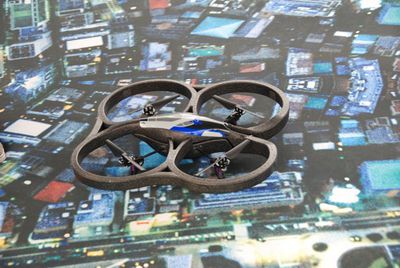
Without a doubt, one of the coolest things introduced at CES 2010 was Parrot's AR.Drone quadricoptor - a Wi-Fi controlled battery powered device that can be flown with your iPhone or iPod Touch.
One of the biggest features behind the technology is the sensors and advanced processing behind the device which allow it to practically fly itself. Unlike other remote helicoptors, the AR.Drone uses a combination of downward looking camera, gyroscopes and other sensors to perform stationary flight and also compensate for other flight conditions. The result is a very easy to fly device.
The device is currently controlled using an iPhone/iPod Touch app which communicates through Wi-Fi to the AR.Drone itself. Simply tap on Launch and the AR.Drone takes off and hovers over a stationary spot. On screen controls are easy and effective.
Left/right buttons allow you to rotate 360 degrees in one spot, while up/down buttons control altitude. Pressing on a special button activates tilt-control on the iPhone/iPod Touch itself. This allow you to fly the device by naturally tilting the iPhone itself. Meanwhile, the on screen controls are overlayed with live video coming from the front-facing camera of the Drone itself.
Parrot is also offering a development kit for 3rd party developers to create augmented reality games using their software/hardware. For example, you could do virtual dogfighting between two AR.Drones.
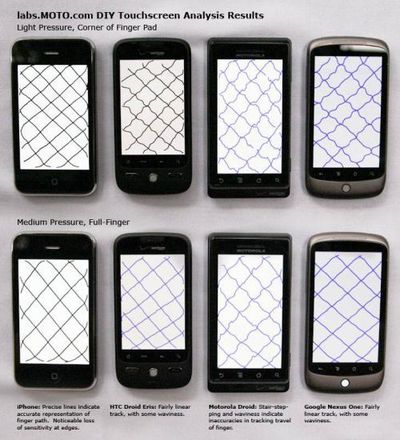
In a report published late last week and gaining significant attention today, MOTO shares the results of some simple testing conducted on the iPhone, Motorola Droid, HTC Droid Eris, and Google Nexus One, assessing the accuracy of the touchscreens on the devices. According to the study, the iPhone's touchscreen performs relatively well, offering precise straight-line tracking under both light and medium pressure, although it does exhibit loss of sensitivity at the screen's edges.
In comparison, the Droid Eris and Nexus One, which share a touch controller chip, perform well under medium pressure, including at the edges, but falter somewhat under light pressure. Motorola's Droid, however, exhibits significant waviness and "stairstepping" under both light and heavy pressure, indicating inaccuracies in the tracking process.
The testing procedure simply involves installing a drawing program on the device and then slowly tracing straight lines across the device's screen to assess how well the system is able to track finger movements.
MOTO has also published a video demonstrating how the testing was performed, although the video shows an original iPhone while the presented results include a newer-generation iPhone. The Nexus One is also not included in the video presentation, as it was unavailable for the initial round of testing.