Last month, a report claimed that both existing supplier OmniVision Technologies and newcomer Sony had been lined up to produce 8-megapixel image sensors for the next-generation iPhone, with OmniVision said to be set to shoulder 90% of the load.
But Forbes today shares a report from FBR Capital Markets analyst Craig Berger, who claims that OmniVision has run into production troubles that may have caused the company to miss Apple's deadline for commercial-scale production of the sensors. As a result, Apple may have decided to shift the majority of production over to Sony.
Berger writes that he still expects the next iPhone - which he and others call the iPhone 4S - to have an 8 MP camera, but adds that "OmniVision may be having technical difficulties with its new CMOS sensor, possibly risking its iPhone socket supplier status."
The analyst adds his contacts says OmniVision "may have missed Apple's commercial production deadline," losing its lead supplier status for the image sensor to Sony.
The report notes that the image sensor chips are manufactured under contract by Taiwan Semiconductor Manufacturing Company (TSMC), which is experiencing unacceptably low yields on the chips.
OmniVision's stock is currently down about 4% after having been down as much 10% following the release of the report.
Barron's reports on a new research note from Citadel Securities analyst Shing Yin claiming that the iPhone is likely to debut on U.S. carrier Sprint sometime before Christmas of this year. Yin notes that with Verizon shifting to tiered data plans beginning tomorrow, Apple likely has additional motivation to strike a deal with Sprint, which continues to offer the unlimited data plans preferred by Apple.
Timing may not depend on exclusives with Verizon and AT&T, writes Yin, as he thinks both carriers are unlikely to try and delay a Sprint introduction of an iPhone for legal reasons. Sprint would want the phone before Christmas, and "we see little reason for Apple to hold back."
Yin points to Sprint's competitive service plan pricing as a significant opportunity to draw in new customers, particularly if the carrier is able to launch with the next-generation iPhone simultaneously with AT&T and Verizon.
As always, analysts' comments should be taken with a grain of salt, and Yin's comments in particular appear to be based primarily on speculation and inference.
Yin is not the first analyst, however, to suggest that a Sprint iPhone may appear in the relatively near future. Back in mid-May, Jeffries & Co. analyst Peter Misek claimed that Apple will be bringing the iPhone to both Sprint and T-Mobile by the end of the year and an Apple job posting looking for a carrier engineer in Kansas City, Missouri near Sprint's headquarters has similarly helped fuel rumors of a Sprint iPhone.
VIA Technologies today announced that it and its partner investment firm WTI are selling off S3 Graphics to smartphone manufacturer HTC.
The acquisition is notable because S3 Graphics recently won a partial victory over Apple in an initial judgment on a patent dispute being reviewed by the U.S. International Trade Commission. HTC's purchase of S3 will turn those patents over to the smartphone company and be a significant bargaining chip should the initial determination that Apple has violated two of the patents hold up.
Owning S3 Graphics may boost HTC in its legal battle against Apple, which last year sued the Taoyuan, Taiwan-based company for patent infringements. S3 Graphics last week won a ruling against the maker of iPhones and iPads regarding two patents for compression technology.
“Buying a patent portfolio will be very useful to us,” Yung said, declining to comment on specific lawsuits.
Apple and HTC have been locked in a legal battle for well over a year, beginning with Apple's March 2010 lawsuit accusing HTC of infringing 20 Apple patents with its Android-powered handsets. HTC filed a countersuit several months later, but no resolution has yet been reached.
The New York Times reports that former Flextronics executive Walter Shimoon has pleaded guilty to two counts of conspiracy to commit wire fraud and one count of security fraud over his role in leaking insider information on Apple's iPhone and iPad plans to research firm Primary Global Research.
Flextronics manufactured chargers for the iPhone, giving Shimoon access to nonpublic information on Apple's internal sales forecasts for the device, which he then shared with Primary Global Research in his role as a "consultant" for the firm.
In addition to sales figures, prosecutors said Mr. Shimoon also tipped a cooperating witness to Apple's plans to develop a new iPhone. But later in the call, according to a transcript from prosecutors, Mr. Shimoon leaked word of an even more secret product in development, the iPad, which at the time was referred to as K48.
"So, you can get, at Apple you can get fired for saying K48...outside of a, you know, outside of a meeting that doesn't have K48 people in it," he told a cooperating witness, according to taped calls. "That's how crazy they are about it."
Primary Global Research has been the target of a federal investigation into "expert networks" that solicit employees offering insider information and provide that nonpublic information to Wall Street money managers to facilitate insider trading. A number of arrests have been made over the firm's collection of insider information on Apple, Dell, AMD, and other tech companies.
The Wall Street Journal reports that Apple is indeed preparing a new iPhone for a launch during the third quarter of this year, with an initial production target of 25 million units through the end of the year.
"Apple's sales estimates of the new iPhone is quite aggressive. It told us to prepare to help the company meet its goal of 25 million units by the end of the year," said another person at one of Apple's suppliers. "The initial production volume will be a few million units... we were told to ship the components to assembler Hon Hai in August."
Countering claims that the next-generation iPhone will be nearly identical in appearance to the iPhone 4, the Journal's sources indicate that the new device will be "thinner and lighter" and that Apple's manufacturing partner Foxconn/Hon Hai is having difficulties with yield rate on the new device due to it being "complicated and difficult to assemble."
Two of the people, however, cautioned that shipments of the new iPhone could be delayed if Hon Hai can't improve its yield rate as the new iPhone is "complicated and difficult to assemble."
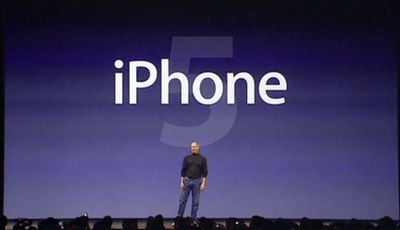
Reports over the past few months have been pointing to a September release for the next-generation iPhone, which has been said to carry Apple's A5 processor found in the iPad 2, an 8-megapixel rear camera, and a baseband chip from Qualcomm to support both GSM and CDMA networks.
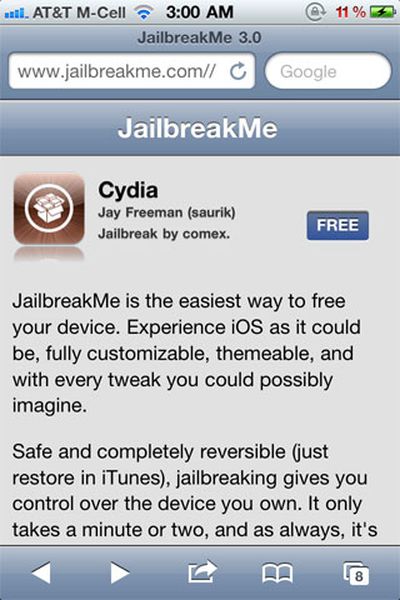
The JailbreakMe.com website has returned to offer an entirely browser-based jailbreak tool for iOS devices including (for the first time) the iPad 2.
Jailbreaking is a process by which Apple's iOS devices can be opened up to allow for installation of non-Apple-approved applications, customizations and file access. Apple officially disapproves of jailbreaking and has even warned users that these unauthorized modifications can cause "instability, disruption of services, and compromised security." Still, a large and active jailbreak community has emerged over the years since the iPhone's introduction.
- iPad1: 4.3 through 4.3.3 - iPad2: 4.3.3 - iPhoneGS: 4.3 through 4.3.3 - iPhone4: 4.3 through 4.3.3 - iPhone4-CDMA: 4.2.6 through 4.2.8 - iPod touch 3g: 4.3, 4.3.2, 4.3.3 - iPod touch 4g: 4.3 through 4.3.3
The JailbreakMe site is unique in that it allows users to jailbreak their devices entirely using the Safari browser and without downloading any additional software. The site itself also offers a Frequently Asked Questions page that reassures users that the jailbreaking process is fully reversible with a simple restore and that there is no risk for any permanent damage. Still, we'd recommend users proceed with caution. The installation process involves simply visiting JailbreakMe from a supported iOS device and tapping "Free/Install" button to initiate the jailbreak.
The browser-based jailbreak process again exploits a flaw in Apple's PDF renderer that allows the tool to open up the device. Just like the previous vulnerability, Apple is expected to patch this one shortly. This same vulnerability could be exploited by malicious parties as well. The programmers of JailbreakMe are also providing a patch to close the security hole behind them for jailbroken users. Users of non-jailbroken iOS devices, however, will have to wait until Apple provides a fix.
More information and answers can be found in our respective "Hacks" forums for iPhone, iPod touch, and iPad.
According to Fortune, the old title, iSteve: The Book of Jobs, chosen by the publisher's publicity department, wasn't a favorite around author Walter Isaacson's household. Isaacson has succeeded in getting a new title approved:
Steve Jobs by Walter Isaacson.
In 2010, it was first reported that Steve Jobs had agreed to participate in an authorized biography. The book is due on March 6th, 2012 and is already available for pre-order from Amazon.
Some Apple TV users have experienced errors connecting to Netflix over the holiday weekend, Netflix confirmed to Wired's Gadget Lab. Netflix claims the issues have been resolved, noting "we had a technical issue with a few devices that’s fixed now."
A number of readers posted in the MacRumors forums about the issues, receiving errors 111, 112 and 115 when attempting to watch a program on Netflix. The issue didn't seem to be caused by jailbreaking, or an older version of the Apple TV software and Netflix didn't give any hint as to the cause of the errors.
Users on other iOS devices, including the iPad and iPhone, were unaffected.
Apple had just over $65 billion in cash and marketable securities at the end of the last fiscal quarter, according to the company's quarterly filing (PDF). Apple has so much cash, it was pointed out last month, that its cash on hand exceeds the market capitalization of Nokia, RIM, HTC and Motorola Mobility combined. If Apple had no revenue, its cash-on-hand would sustain operations through the middle of 2018, more than seven years.
What's Apple doing with all that cash? An anonymous writer on the Q&A site Quora opines that the company uses the money to small-scale strategic advantage, purchasing entire factories for suppliers and using that leverage to guarantee supply of components for Apple -- and no one else:
Apple has access to new component technology months or years before its rivals. This allows it to release groundbreaking products that are actually impossible to duplicate. Remember how for up to a year or so after the introduction of the iPhone, none of the would-be iPhone clones could even get a capacitive touchscreen to work as well as the iPhone's? It wasn't just the software - Apple simply has access to new components earlier, before anyone else in the world can gain access to it in mass quantities to make a consumer device. One extraordinary example of this is the aluminum machining technology used to make Apple's laptops - this remains a trade secret that Apple continues to have exclusive access to and allows them to make laptops with (for now) unsurpassed strength and lightness.
On the operational side of the house, as you probably remember, we've historically entered into certain agreements with different people to secure supply and other benefits. And the largest one in the recent past has been we signed a deal with several Flash suppliers back at the end of 2005 that totaled over $1 billion because we anticipated that Flash would become increasingly important across our entire product line and increasingly important to the industry. And so we wanted to secure supply for the company, and we think that, that was an absolutely fantastic use of Apple's cash. And we constantly look for more of these.
It is thought that Apple made another one of these deals earlier this year, agreeing to spend $3.9 billion on LCD panels. It was rumored that RIM's iPad competitor, the PlayBook, was delayed because RIM couldn't acquire enough LCD panels for production. Apple feels these payments are "very strategic" and a good use of their capital.
However, not everyone is impressed with this line of reasoning. One fund manager, Christopher Bonavico at Delaware investments, said Apple is "destroying value" by sitting on so much cash, and complained that the cash is "earning near zero". Bernstein Research analyst Toni Sacconaghi said the cash pile has "been beyond the point of being rational for a while now."
Apple, for its part, seems perfectly happy to sit on the cash, which allows it to quickly make large purchases when strategically necessary.
While Apple took a fair amount of time developing the current copy-and-paste mechanism for iOS, holding off on releasing it until iPhone OS 3.0 in mid-2009, Microsoft's new update for its Bing for iPad app shows off an alternative method for text selection known as "Lasso". The technique allows users to select text to serve as the basis of Bing searches by simply drawing circles around the desired search terms.
From our research, we know that many searches are inspired by things people see on the web. Today, it can be somewhat painful to search on a tablet when you're engaged in reading something; just copying and pasting pieces of text from a webpage to a search box can take up to nine steps on the iPad. With Lasso you can circle and search in just two steps.
While support for the Lasso search method is of course limited to usage inside the Bing for iPad app, it offers an interesting glimpse at a usability concept that could make its way into other areas.
What you're seeing today is only the beginning. Lasso moves Bing beyond the search box. Although it will only be available in Bing for iPad to begin with, we're already thinking about how to take Lasso even further - so stay tuned.
In addition to Lasso, the new Version 1.1 update to Bing for iPad also adds enhanced movie listings and a host of other improvements.
Even before the iPhone launch on Verizon earlier this year, the carrier had announced that the unlimited data plans being offered with the device were a temporary program, set to be discontinued as soon as this summer in favor of tiered data packages.
Just two weeks ago, Verizon confirmed that it would be dropping the unlimited data plan in July, with leaks pinpointing the new data plans and a debut date of July 7th. Existing unlimited plan subscribers were said to be grandfathered in and thus able to keep their current plans after that date, even after upgrading their devices.
FierceWireless now reports that Verizon has confirmed the new offerings as previously leaked, with the new plans indeed set to go into effect this Thursday, July 7th.
Verizon spokeswoman Brenda Raney told FierceWireless that new smartphone customers will choose from one of four options: $10 for 75 MB per month, $30 for 2 GB, $50 for 5 GB or $80 for 10 GB. There will be an overage charge of $10 per GB of data. AT&T Mobility charges $15 per month for 200 MB and $25 per month for 2 GB.
Verizon has also confirmed that existing customers on the unlimited plan who upgrade their devices on or after July 7th will be able to keep their data plans.
Both Verizon and AT&T have confirmed that they are also looking into rolling out shared data plans across devices, following the lead of other international carriers already offering the plans. Under those plans, customers can draw from a single data allotment using multiple devices such as an iPhone and iPad, but Verizon and AT&T have yet to announce specific timeframes for rolling out such plans.
Update: FierceWireless has edited its story to clarify that the $10 plan offering 75 MB of data is available for feature phones and not for smartphones such as the iPhone.
In Mid-May, several app developers, for both iOS and Android, received legal notification from a patent holding company named Lodsys, claiming that certain functions of their apps (such as the In-App Purchasing mechanism that Apple offers to developers) were in infringement of Lodsys patents.
After Lodsys filed lawsuits against seven iOS developers, Apple attempted to intervene on behalf of the defendants, but Lodsys has continued to send out legal threats to developers. Because of the way patent litigation is designed in the United States, it is frequently considerably cheaper to settle with patent-holders rather than fight it out in court -- even if the defendant believes they are right, because of the extraordinary costs involved with patent litigation.
This past weekend, Florian Mueller at FOSS Patents penned a lengthly article outlining what he believes is the most cost-effective strategy for developers who must deal with Lodsys. He makes it clear that his post isn't meant to be "legal advice" but it is a good starting point for smaller developers who might now know where to begin:
It's time to be pragmatic.
Lodsys won't go away quickly unless Apple and Google pay them many millions of dollars (which could happen anytime but might also never happen). Meanwhile, each app developer who faces this problem should make a rational and responsible decision -- even if it means to pay. So far there's no indication that Android developers can get away without paying, and iOS developers don't have a dependable basis for ignoring Lodsys's insistent demands.
Mueller's conclusion? License the patents to make Lodsys go away and get back to building great apps.
Lodsys is only a risk for you, not an opportunity to get rid of trolls or of software patents. Eliminate the risk now. Follow the two-step approach. Try to get coverage. If not (which is the most likely outcome), do a license deal. Do all of this with legal help, but don't let any lawyer persuade you of futile efforts. Pick the most direct path to a solution. Share the costs with other app developers. And when you've solved this problem, focus on more important, more interesting, more productive and more edifying things in life.
As HP has sought to take on Apple in the tablet market with its webOS-powered TouchPad tablet, the PC giant has been dinged with a number of lukewarm reviews that suggest a fair amount of potential for the platform and device but with only a mediocre initial implementation.
Former Apple executive Jon Rubinstein, who led the development of the original iPod before leaving the company in 2006 to head up Palm's webOS effort and eventually moving to HP with that company's acquisition of Palm, has reportedly weighed in with a message to HP employees regarding the reviews, published by PreCentral. In the note, Rubinstein makes an interesting comparison between the TouchPad and the original Mac OS X as it debuted ten years ago.
We still have work to do to make webOS the platform we know it can be, but remember...it's a marathon, not a sprint.
In that spirit, Richard Kerris, head of worldwide developer relations for webOS, reminded me yesterday of the first reviews for a product introduced a little over ten years ago:
"...overall the software is sluggish" "...there are no quality apps to use, so it won't last" "...it's just not making sense...."
It's hard to believe these statements described MacOS X - a platform that would go on to change the landscape of Silicon Valley in ways that no one could have imagined.
Rubinstein is naturally optimistic in encouraging his staff to keep pressing forward to help webOS and its associated hardware meet expectations, and his unique perspective in having played key roles at Apple, Palm, and now HP enables him to see the parallels and offer conviction that webOS can overcome its challenges.
Palm's webOS has received a fair amount of praise for some aspects of its functionality, but the platform has yet to be a hit with consumers. But with HP putting significant weight behind the platform and moving it into the tablet space while considering licensing it to other major manufacturers, some have seen webOS as a strong contender to become a potential third major smartphone and tablet operating system for the future behind iOS and Android.
Skype today released its new Skype 5.2 for Mac, adding a pair of significant new features in group video screen sharing and a revamped call control bar that includes video support.
Group screen sharing, which requires the same premium package as for basic group video, allows users to share their screens with all participants in the group call, marking a significant enhancement for teleconferencing. Skype Premium is priced at $4.99 per day or $8.99 per month, with significant savings available on longer-term 3-month and 12-month subscriptions.
Skype 5.2's new control bar now support video calls, floating on top of other applications and files when users switch away to other apps in order to allow them to continue seeing the people they are conversing with. The control bar also offers quick access to mute and end call functionalities.
Last week, DigiTimesreported that Apple would be targeting shipments of 12-14 million iPad 2s during the third quarter of 2011, and a new report backs up that conclusion with claims that Apple's touch panel suppliers pushed out five million units in June and plan to produce another five million in July.
Five million touch sensors for the iPad 2 will be shipped in July, according to sources with Apple's supply chain.
Shipments in June were also five million, with TPK Holding and Wintek supplying 1.4-1.6 million units each and the remaining by Cando, Sintek Photronic and Chimei Innolux (CMI), the sources indicated.
Display production has been one bottleneck for Apple in meeting iPad customer demand, even dating back to the original iPad. Wintek and TPK were Apple's initial suppliers for the touch components, but the company was forced to add additional suppliers such as Cando in order to meet its production goals.
Apple has been said to be soaking up 60% of the global supply of touch panels for 2011, putting pressure on smaller manufacturers who are having a difficult time securing components for their own devices.
DigiTimes claims that Pegatron Technology has received orders for 15 million iPhone 5 devices from Apple and is set to start shipping in September 2011.
The sources pointed out that as the iPhone 5, which does not seem to have any major update from iPhone 4, is already set for shipment in September, they are already started supplying components to Pegatron with Pegatron's plants in Shanghai, China also recently started hiring for manpower.
DigiTimes is a frequent source for production and order rumors from Apple. They had previously predicted that Pegatron received an order for CDMA iPhone 4s for the fourth quarter of 2010. The actual Verizon (CDMA) iPhone was announced in January of 2011 and shipped the following month.
Apple skipped the usual yearly upgrade cycle this year and made no iPhone hardware announcements at this year's WWDC. Instead, the iPhone 5 has been rumored to be launching in September.
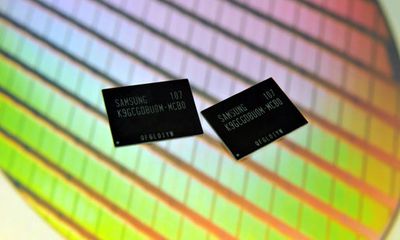
Mac Otakara claims that Apple will be adopting a new Toggle DDR 2.0 type of NAND Flash Memory for the basis of the new MacBook Air's SSD drive. The Japanese website cites an "Asian electronics component person" as the source of the information. (via AppleInsider)
Current SSD device Blade X-gale supporting SATA 2.6 will be abolished and new 19nm flash memory will be packaged into smaller chip and will be soldered on base circuit directly.
The move would be a rapid departure by Apple from the current SSD stick format that was just introduced in last year's MacBook Air. Instead of a replaceable part, the new Flash chips would be soldered directly onto the MacBook Air's motherboard.
The new format supports speeds of 400Mb/s and in conjunction with a new ONFI 3.0 standard will allow future controllers to run faster or similar performance to today's SSDs with "half the number of channels, providing both a cost and space savings".
Samsung also touted another major feature of this new technology last year, claiming that a low-power mode could extend a notebook's battery life for an hour or more.
The resulting power throttling capability enables the drive’s high-performance levels without any increase in power consumption over a 40nm-class 16Gb NAND-based 256GB SSD. The controller also analyzes frequency of use and preferences of the user to automatically activate a low-power mode that can extend a notebook’s battery life for an hour or more.
Given the market positioning of the MacBook Air, the potential battery improvements and cost savings may be driving Apple's adoption of this technology more than the performance advantages.
Last week we reported that there was no Welcome video that had become custom on new installations of Mac OS X. While that is technically true, it seems Apple has replaced it with a similar "Welcome" animation for some installations (presumably clean):
The intro animation similarly displays the word "Welcome" in a variety of languages, but no accompanying soundtrack. Beta testers of iOS 5 might find the animation familiar, as it is also the setup animation for iOS 5 on the iPad:
Apple's first foldable iPhone, with a book-style design featuring a ~5.5-inch outer display and a ~7.8-inch inner display with a minimal crease down the middle.




 VIA Technologies today

 Some Apple TV users have experienced errors connecting to Netflix over the holiday weekend,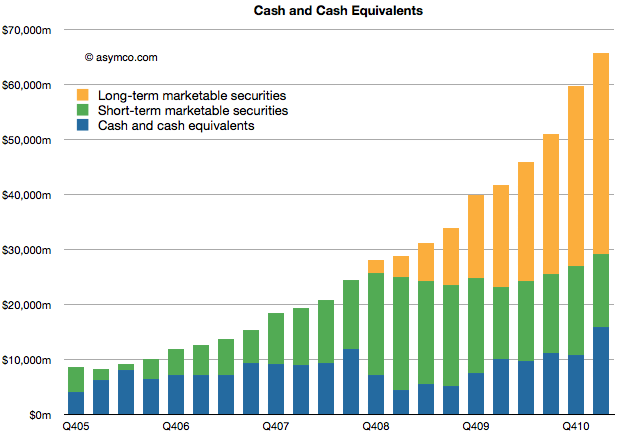
 Even before the iPhone launch on Verizon earlier this year, the carrier had
 As HP has sought to take on Apple in the tablet market with its webOS-powered

 Last week, DigiTimes