MacRumors

After a series of high profile complaints, it seems that Apple is making efforts to improve the App Store experience for their developers. After taking a hard line against the use of private application programming interfaces (APIs), iPhone developer Vimov reports that they have had a relatively positive experience in seeking approval for an update to their iSimulate app.

Despite inadvertently leaving in a programming call to a private API, they were pleased to find the update had still been approved and they were simply warned to address the issue in the next update:

Thank you for submitting your update to iSimulate to the App Store. During our review of your application we found it is using a private API, which is in violation of the iPhone Developer Program License Agreement section 3.3.1; 3.3.1 Applications may only use Documented APIs in the manner prescribed by Apple and must not use or call any private APIs. While your application has not been rejected, it would be appropriate to resolve this issue in your next update.

In the recent past, such an oversight would have resulted in an automatic rejection that would have cost the developer weeks of time going through the re-approval process.

This past week, Apple made further efforts at improving the lines of communication with developers by offering an RSS news feed for developers with news and tips about App Store submissions.

Related Forum: iPhone

043640 pixelqi

A small startup company called Pixel Qi recently announced that they will start production of the first batch of their new LCD screens shortly. These new screens promise low power, easy readability in direct sunlight as well as support for full color and are expected to ship in quantity in Q1 2010. Regarding the screen's benefits:

The readability and legibility of our new screens rival the best epaper available today. What's new about our screens: fast video rate update (refresh), and fully saturated color at low pricing because we use standard manufacturing materials, processes and factories. Our screens use 1/2 to 1/4 the power of a regular LCD screen, and when integrated carefully with the device can increase battery life between charges by 5-fold. You can use our screens in laptops outside in bright sunlight.

Pixel Qi has been closely followed by the industry, as it was founded by One Laptop Per Child's (OLPC) former Chief Technology Officer Mary Lou Jepsen.

Techland.com had spent some time with a prototype screen back in May and were quite impressed. The screen offers two modes: a black and white "reflective" mode similar to e-ink and a more traditional emissive mode that offers full color. Unlike e-ink, however, the black and white mode is capable of full-motion video.

052258 ereadc

Over the past year, Jepsen has revealed that they have been in contact with "all the big laptop companies" and have seen a lot of interest. While there is no specific connection with Apple, it seems clear that Apple must be aware of this coming technology for their rumored tablet device. The readability and battery life savings would, of course, benefit any portable device, but especially one that has been rumored to publish magazine content and take on existing e-readers. Conveniently, the 3Qi screens are also multi-touch capable and can be "super-slim". The size of the screen has also been announced at 10.1 inches, which matches with some of the predictions for the Apple tablet's screen size.

Pixel Qi has revealed their screens will be going into specialized tablet devices with multi-touch in 2010, but has not yet announced specific partners.

The Wall Street Journal indicates that Apple and Google are becoming even more competitive than we had suspected. According to their sources, Google was also in serious negotiations with Lala Media for possible acquisition right before Apple won the bid. Meanwhile, we had previously reported that Apple was in serious talks with Admob immediately prior to Google's acquisition of that company.

The twin pursuit of the start-ups reveal that the two tech titans have further plans to move deeper into each other's business: Apple wanted to get into advertising, while Google sought a music service.

Apple and Google have become increasingly competitive which resulted in the resignation of Google CEO Eric Schmidt from the Apple Board of Directors. As Apple moves towards more web-based services and Google into the mobile phone market, the lines are continuing to blur.

The Wall Street Journal even indicates that Apple's interest in Admob may have been defensive, an attempt to prevent Google from learning details of the App Store economy. Apple is believed to be looking into more iPhone-related acquisitions.

Related Forum: iPhone

Apple today announced that it has rolled out support for six new languages and their corresponding localized App Stores for developers using iTunes Connect to submit their iPhone applications.

With over 50 million users of iPhone and iPod touch in 81 countries around the world, it's more important than ever to make your app available in a user's language of choice. You can, and should, create localized versions of your app for each market you sell to. In iTunes Connect, you can customize your app's metadata, keywords and screenshots for each localized version.

The newly-supported languages include:

- Brazilian Portuguese: Brazil App Store
- Korean: Korea App Store
- Portuguese: Portugal App Store
- Russian: Russia App Store
- Simplified Chinese: China App Store
- Swedish: Sweden App Store

A lack of localization for applications and their instructions have been cited among the many challenges faced by the App Store in China.

Related Forum: iPhone

The U.S. Patent and Trademark Office today published over 20 newly-released patent applications from Apple, and AppleInsider highlights two of the more interesting ones covering tamper-resistant labels for detecting unauthorized opening of devices and accelerometer-based navigation of menus on Apple's handheld devices.

144236 tamper resistant label

The first patent application, entitled "Tamper resistant label for detecting device openings" and filed on August 1st, 2008, addresses a unique type of tamper-resistant label that could be fixed across a seam in an electronic device such that twisting or bending the label beyond a certain point would damage the label, leaving evidence of unauthorized access to the device's internals.

The label can be arranged and affixed such that the label rips, tears or is otherwise damaged to a point that it cannot be repaired when the device is fully or at least substantially opened. The single device can become substantially opened when the first object is tilted with respect to the second object at more than a certain angle, such as an angle that is greater than about 10 degrees or greater than about 40 degrees. Alternatively, the single device can become substantially opened when the first object and second object are separated more than about one inch apart at any location where the first object and second object touch to form the single device. Such a rip or damaging of the label can then be readily noticed by an authorized technician or representative when the entire device is turned in for official servicing or repairs. In some embodiments, the label can remain intact when the device is only partially opened or "cracked open," such that it is possible to peek inside the device without damaging the label.

Apple appears to have been taking an increased interest recently in addressing circumstances which could result in a customer voiding their warranty due to misuse of or unauthorized access to the internals of their devices. Another recent patent application from Apple described methods by which a device could determine and record whether it had been exposed to a variety of conditions including liquids, extreme temperatures, excessive shock, and unauthorized tampering. Repair technicians could later access these recorded "abuse events" in order to determine what may have caused a given device failure.

The second patent application, entitled "Acceleration navigation of media device displays " and filed on June 28th, 2008, addresses the concept of using an accelerometer within a portable media device such as an iPod to navigate menus within the user interface.

In response to the device being physically moved, circuitry of the device can receive acceleration data generated by one or more accelerometers. The circuitry can be configured to respond to the acceleration data by presenting a second display. The second display can be, for example, another menu in the menu hierarchy or the same menu with a different option highlighted. Highlighted, as used herein, includes any means or method for emphasizing one option in relation to another. Common forms of highlighting one or more options include, for example, a bolder font, a colored-in-area around the option, a line around the option, etc. A cover flow type of approach (using, e.g., album covers or other clip art) can also be used to highlight an option.

The patent application describes the use of "flicking" accelerations in various directions to navigate user interface menus and select options. Under certain circumstances, accelerometer-based input could be configured to require that a physical button be held down before being registered, reducing unintentional input.

144236 accelerometer navigation 500

Apple uses accelerometers in variety of products, including its iPhone, iPod touch, and iPod nano, in order to sense device orientation for such tasks as automatically rotating screen display between portrait and landscape mode, as well as for application input. Other Apple devices, such as the company's notebooks, incorporate accelerometers to sense when they have been dropped, allowing sensitive components such as the hard drive to deactivate and brace for impact, limiting potential damage.

121450 imdb 1 121450 imdb 2

TUAW noted yesterday that the Internet Movie Database (IMDb), a popular source for information on movies and TV, has released a dedicated iPhone application [App Store, Free]. The application allows access to IMDb's full offerings, boasting information on over 1.5 million movies and TV shows and over 3.2 million celebrities.

The Internet Movie Database (IMDb) is the largest collection of movie, TV and celebrity information anywhere. We aim to list every detail about every movie and TV show ever made, including who was in it, who made it, the plot, user ratings, trailers, photos, reviews, and trivia.

The application also offers access to trailers and photos for a wide variety of movies, as well as information on movie showtimes and TV listings. Further features include a list of the Top 250 movies as ranked my IMDb users, box office results, and recaps of U.S. TV episodes.

Related Forum: iPhone

120258 google mobile app iphone

Google yesterday announced an update to its Google Mobile App [App Store, Free], which has proven popular due to its voice-enabled search capabilities.

Among the changes in the new update are a redesigned search results display and the inclusion of an integrated browser to allow direct loading of Web pages from the search results.

In this version, we have a redesigned search results display that shows more results at once and, more importantly, opens web pages from the results within the app. This will get you to what you need faster, which is always our goal at Google.

Also included in the new update are previously-hidden visual tweaks and the ability to select a spoken language or accent for greater recognition accuracy in voice-enabled search.

Related Forum: iPhone

The Wall Street Journal reports (subscription required) that Taiwanese LCD manufacturer Chi Mei Optoelectronics has agreed to pay a $220 million fine to address criminal charges stemming from extensive price fixing in the LCD industry from 2001 through 2006 that affected a number of companies, including Apple. Chi Mei becomes the sixth company to plead guilty in the conspiracy over the past year.

The department said the conspiracy affected some of the world's largest computer and television manufacturers, including Apple Inc. (AAPL), Dell Inc. (DELL) and Hewlett-Packard Co. (HPQ).

Prosecutors said Chi Mei and its co-conspirators participated in meetings in Taiwan, South Korea and the U.S. in which they agreed to fix LCD prices. The companies later shared sales data with each other to ensure all conspirators were adhering to the price-fixing agreement, prosecutors alleged.

Prosecutors didn't say how much the price-fixing victims might have paid in inflated LCD prices.

The criminal charges were brought by the U.S. Department of Justice, which has levied a total of $860 million in fines against the six companies.

Chi Mei has been a supplier of LCD displays for several of Apple's notebook models, and just last month agreed to a merger with rival Innolux, itself a subsidiary of long-time Apple manufacturing partner Foxconn. Apple, however, partnered with LG early this year on a five-year deal to lock in a long-term strategic alliance with what was already Apple's largest LCD supplier.

Engadget reports on a Twitter post from Eldar Murtazin, editor-in-chief of Russian mobile phone blog Mobile-Review, claiming that Apple's long-time partner Foxconn has received the manufacturing contract for the next-generation iPhone.

Foxconn received order for next generation iphone

Mobile-Review reportedly has a very strong track record in the mobile phone rumor community, but has rarely turned its attention to the iPhone.

Foxconn has been Apple's iPhone manufacturing partner since production began on the original version, which launched in mid-2007. For the original iPhone, sources had claimed the previous November that Foxconn had been tabbed as the iPhone's manufacturer, suggesting that a new contract now would not be out of the ordinary for a launch in mid-2010.

Related Forum: iPhone

The Wall Street Journal claims that Apple is looking at an "overhaul of the way it sells and stores music" and how to extend that service into the web. According to "people familiar with the matter", Apple is considering using Lala's recently acquired engineers and technologies to accomplish that.

Lala currently allows users to buy and listen to music through their web browser. An Apple version of the service would operate the same way, with music being streamed to users from a central server. This is in stark contrast to Apple's current iTunes model, where songs are purchased and downloaded locally. Record company executives are said to be optimistic about the prospect, but wary at giving Apple more power.

Such a move, however, would be a big departure for Apple, who has previously insisted that customers wish to own their music. This on-demand streaming raises issues of long-term ownership as well as technical issues if rights holders or providers go out of business in the future.

Overall, the article adds little new information but does seem to confirm much of the speculation that Apple might translate Lala's exact business model over to iTunes.

Despite some paltry sales during the first weekend, China Unicom announced today that they have now sold more than 100,000 iPhones since the October 30th launch in China.

These results indicate sales picked up since the opening weekend which only had 5000 in sales reported. Still, analysts report that the 100,000 figure remains disappointing given China Unicom's 144 million subscribers.

High price, lack of Wi-Fi, and a strong gray market for iPhones in China seem to be contributing to the relatively low carrier sales.

Related Forum: iPhone

153249 sunspider javascript mac
SunSpider JavaScript Benchmarks of Mac Browsers
(Shorter bars represent faster performance)

One of the touted features of Google's Chrome browser, which finally saw the release of an official beta version for Mac yesterday, has been its speed in loading and rendering pages. In investigating that aspect of its performance, Computerworld has found that, while Chrome performs extremely well in the SunSpider JavaScript benchmarking test, it only comes in a close second to Apple's Safari browser.

According to tests run by Computerworld, the Chrome beta, which Google launched yesterday, is the second fastest of four Mac browsers tested. Chrome renders JavaScript 10 times faster than Opera 10.10 and almost twice as fast as Firefox 3.6 Beta 4, the most recently-released Mac version of Mozilla's open-source browser.

But Chrome can't match Safari 4.0.4's speed: Apple's browser is approximately 12% faster than Google's beta.

This contrasts with the Windows platform, where Computerworld previously found Chrome to be the top performing browser in the same testing suite, clocking in at 30% faster than Safari for Windows.

JavaScript performance has become a key indicator of browser speed in recent years, with Computerworld noting that the release of Firefox's TraceMonkey JavaScript engine last year set the stage for an arms race in JavaScript performance, one that is currently being led by WebKit-based browsers such as Safari and Chrome.

Silicon Alley Insider reports on a research note from Piper Jaffray analyst Gene Munster, who cites fellow analyst Chris Larsen as giving Apple a 70% chance of launching an iPhone on Verizon sometime next year. According to Silicon Alley Insider, there are a number of good reasons to expect Apple to make the move to Verizon:

- Because Verizon is the biggest U.S. carrier, and could help Apple sell millions more phones per year.
- Because Apple is no doubt aware that AT&T, its current iPhone partner, is majorly flaking on network quality in big markets like New York and San Francisco.
- Because Verizon would otherwise continue to invest heavily in Apple rivals like Google Android and RIM BlackBerry.
- Because the smartphone market is a platform land grab and Apple can't afford to lose ground -- even at the risk of complicating their product line or back-end systems.

There are, however, a number of reasons why such a deal may not occur in 2010, such as difficulties reaching a revenue sharing agreement, increased handset subsidies from AT&T to maintain its exclusivity agreement, and the apparently tenuous relationship between Verizon and Apple as the iPhone maker stands by its U.S. partner AT&T in its ongoing spat with Verizon.

Reports have also centered on the need for Apple to produce different iPhone hardware if it wishes to offer 3G connectivity on Verizon's network due to differences between Verizon's system and that used by all current iPhone carriers. Some speculators have claimed that Apple would be more likely to wait for the converged roll-out of 4G technology that would allow for a single type of hardware across all providers, possibly delaying a Verizon iPhone roll-out until 2011 or 2012 when the carrier achieves broad 4G coverage.

But Silicon Alley Insider notes that even then the iPhone would almost certainly need the capability of falling back to 3G networks where 4G is not yet available, necessitating multiple hardware models or possibly a multi-mode hybrid chip currently under development by Qualcomm that could support both types of 3G networks.

Offering a different perspective on Piper Jaffray's report, Fortune points to other strategies Apple could be looking to employ for the 2010 revision of the iPhone: battery improvements and RFID-enabled payment technology.

-Give the iPhone a battery that lasts longer than one day. "Apple has introduced advanced battery technology with its portable Macs," he writes, "and we expect the company to dramatically improve the iPhone battery life with the next several hardware launches."
-Turn the iPhone into a digital wallet. Munster predicts that future iPhones will have built-in RFID (radio-frequency identification) technology, allowing them to make retail payments with a single swipe.

Related Forum: iPhone

Patently Apple points to a new trademark application from Apple filed on November 30th regarding the "Think Different" advertising slogan used by the company from 1997 until 2002. While the application follows close on the heels of a renewal of an earlier trademark issued for the slogan and could conceivably simply be related to Apple looking to preserve its long-standing trademark, the report notes that Apple's new application specifically extends coverage of the trademark to music players such as the iPod and other electronic devices that could conceivably include a future tablet device.

In 1997 there wasn't an iPod and this may be one of the main reasons for Apple's new trademark application for Think Different. However, Apple's International Classification 009 now covers the iPod under MP3 audio players in addition to generically covering "Portable and handheld digital electronic devices" so as to cover any future tablet Apple may be contemplating in the future. Is Apple gearing up for something?

Beyond the new trademark application, 9 to 5 Mac notes that Apple has begun using the "Think Different" phrase on the packaging of its new 21.5" and 27" iMac models. While the change may again simply be a result of Apple moving to exhibit continued commercial usage of the trademark in support of its renewal applications for protection, 9 to 5 Mac also reports on unconfirmed chatter out of Apple's ad agency TBWA/Chiat/Day regarding the slogan, although no specific word of a related ad campaign has surfaced.


Apple's Original 1997 "Think Different" Commercial

130822 itunes facebook gift cards 500
TechCrunch reports that Apple has rolled out a new feature through its iTunes Facebook page allowing users to create customizable digital gift cards. The feature, which is currently limited to U.S. iTunes Store customers, allows gift givers to choose from six digital gift card designs and iTunes credits ranging from $5 to $50. Gift givers can then enter a gift message and specify a delivery date for their recipient to receive their gift card electronically.

This appears to be one of the only ways to purchase a digital iTunes giftcard -- the Apple site itself only offers physical versions, and sites like Gifts.com and Giftcards.com don't have them either. Aside from this Facebook app, the only place we're seeing the option is from within the iTunes desktop app itself.

The report notes that the Facebook application's interface was designed by GroupCard, while the back-end is driven by Blackhawk Network, which has a long-standing relationship with Apple and is a prominent player in the gift card processing industry.

Related Forum: Mac Apps

The Wall Street Journal reports that AT&T Mobility CEO Ralph de la Vega noted at an investor conference today that the company is continuing to work to address network issues in Manhattan and San Francisco, areas with high densities of iPhone and other smartphone users who have been experiencing subpar performance.

Those two cities see especially high smart-phone penetration, which has put pressure on AT&T's data network. The company expects to see gradual improvements in New York and plans to replace some microcells in San Francisco, he said.

"This is going to get fixed," Mr. de la Vega said. "In both of those markets, I am very confident that you're going to see significant progress."

Despite recent improvements centered around deployment of the 850 MHz spectrum in many of AT&T's markets, complaints have continued to surface, with Apple support staff even apparently acknowledging that a dropped call rate of 30% was considered normal in New York City.

De la Vega also addressed the ongoing issue of high-bandwidth smartphone customers, noting frequently-cited data showing that 3% of smartphone users are responsible for 40% of data traffic. In response to this issue, de la Vega reiterated AT&T's general plan to "incentivize" customers to reduce their data usage.

With about 3% of smart-phone customers driving 40% of data traffic, AT&T is considering incentives to keep those subscribers from hampering the experience for everyone else, he said. "You can rest assured that we're very sure we can address it in a way that's consistent with net-neutrality and FCC regulations."

While specific plans have yet to be rolled out, de la Vega suggested that simply offering users greater insight into their bandwidth usage has been shown to reduce their demand. Over the longer term, however, AT&T is likely to shift to usage-based pricing, although any such changes would be based on industry standards and competition and on regulatory guidelines.

Related Forum: iPhone

113427 ustream 1 113427 ustream 2

TechCrunch notes that Apple has approved Ustream Live Broadcaster [App Store, Free], offering users the ability to stream live video directly from their iPhones via Wi-Fi and 3G.

While one of the key features of the iPhone 3GS was video recording capabilities, that was limited to recordings that were captured on your device and could be uploaded to the web after they were done recording. With the Ustream Live Broadcaster, you can easily record videos right to the web, and allow others to watch them as they're being recorded. These videos can also be archived so that people can watch them later, if they choose.

The application also offers a number of other features, including Twitter, Facebook, and YouTube integration, viewer chatting and polling, and geolocation.

The debut of Ustream Live Broadcasting marks the second approval of a video streaming application for the iPhone in recent days, following Apple CEO Steve Jobs' apparent personal involvement in the approval of Knocking Live Video. Knocking, however, offers only iPhone-to-iPhone one-on-one streaming, while Ustream supports streaming to the Internet for multiple viewers.

Ustream is no stranger to the App Store, having debuted an application for viewing Ustream videos early this year.

Related Forum: iPhone

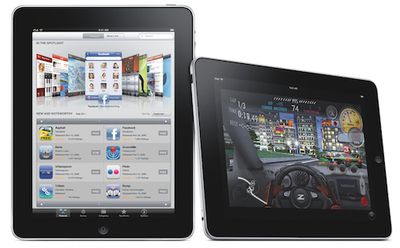
MarketWatch reports on a new research note from Oppenheimer & Co. analyst Yair Reiner predicting, based on industry checks, that Apple will begin mass production of its much-rumored tablet computer in February ahead of a launch in late March or April.

The report claims that the device will include a 10.1" multi-touch LCD screen, specifically countering a recent rumor that the device's launch would be delayed to the second half of next year and would include a model sporting an OLED screen.

Another claim included in the report is that Apple has begun contacting book publishers about distributing their books through Apple for consumption on the new device. Apple is reportedly proposing a similar business model to its App Store, where Apple would retain 30% of each download's sale price with 70% going to the publishers. This model is seen to be a significantly more attractive deal to publishers than that offered by Amazon for its Kindle Store, where sales are split 50-50 between Amazon and the publishers.

Book publishers may not be the only ones looking to get on board with Apple's tablet launch, as a coalition of magazine publishers just yesterday launched a joint venture to develop standards and business models for digital distribution of their content. Magazine publishers have also been designing prototypes of how their content might be presented on tablet devices.

Reiner estimates that Apple may sell 1-1.5 million tablets per quarter at an estimated price of $1,000, contributing $0.22-$0.38 of profit to Apple's quarterly per-share earnings based on a margin of 22%.