Apple Started Developing A11 Bionic Chip When A8 Chip Was Released Three Years Ago

Shortly after Apple's iPhone X event this week, the company's silicon chief Johny Srouji and marketing chief Phil Schiller sat down for an interview about its new A11 Bionic chip with Mashable's editor-at-large Lance Ulanoff.
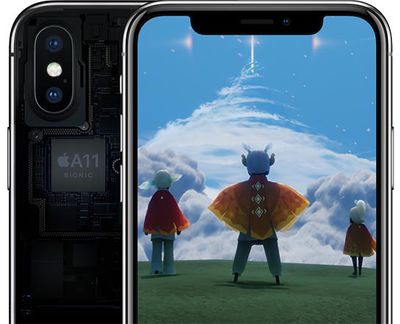
a11 bionic iphone x
One interesting tidbit mentioned was that Apple began exploring and developing the core technologies in the A11 chip at least three years ago, when the iPhone 6 and iPhone 6 Plus launched with A8 chips.

Srouji told me that when Apple architects silicon, they start by looking three years out, which means the A11 Bionic was under development when Apple was shipping the iPhone 6 and its A8 chip. Back then we weren't even talking about AI and machine learning at a mobile level and, yet, Srouji said, "The neural engine embed, it’s a bet we made three years ahead."

Apple's three-year roadmap can change if new features are planned, like the Super Retina HD Display in iPhone X.

"The process is flexible to changes," said Srouji, who’s been with Apple since the first iPhone. If a team comes in with a request that wasn't part of the original plan, "We need to make that happen. We don't say, 'No, let me get back to my road map and, five years later, I'll give you something."

johny srouji phil schiller

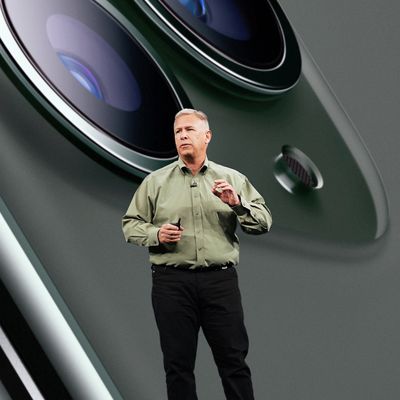
Apple senior executives Phil Schiller, left, and Johny Srouji

In fact, Schiller praised Srouji's team for its ability to "move heaven and earth" when the roadmap suddenly changes.

"There have been some critical things in the past few years, where we've asked Johny's team to do something on a different schedule, on a different plan than they had in place for years, and they moved heaven and earth and done it, and it's remarkable to see."

A11 Bionic six-core chip has two performance cores that are 25 percent faster, and four high-efficiency cores that are 70 percent faster, than the A10 chip in iPhone 7 and iPhone 7 Plus. Early benchmarks suggest the A11 Bionic is even on par with the performance of Apple's latest 13-inch MacBook Pro models.

The A11 chip is more efficient at multi-threaded tasks thanks to a second-generation performance controller that is able to access all six of the cores simultaneously if a particular task demands it.

Gaming might use more cores, said Srouji, but something as simple as predictive texting, where the system suggests the next word to type, can tap into the high-performance CPUs, as well.

The A11 chip also has an Apple-designed neural engine that handles facial recognition for Face ID and Animoji, and other machine learning algorithms. The dual-core engine recognizes people, places, and objects, and processes machine learning tasks at up to 600 billion operations per second, according to Apple.

“When you look at applications and software, there are certain algorithms that are better off using a functional programming model,” said Srouji.

This includes the iPhone X’s new face tracking and Face ID as well as the augmented-reality-related object detection. All of them use neural networks, machine learning or deep learning (which is part of machine learning). This kind of neural processing could run on a CPU or, preferably, a GPU. “But for these neural networking kinds of programming models, implementing custom silicon that’s targeted for that application, that will perform the exact same tasks, is much more energy efficient than a graphics engine,” said Srouji.

Apple's new iPhone 8, iPhone 8 Plus, and iPhone X are all equipped with an A11 chip.

In related news, Carnegie Mellon University's School of Computer Science has announced that Srouji will take part in a distinguished industry lecture on Monday, September 18 from 5:00 p.m. to 6:30 p.m. local time.

Full Interview: The Inside Story of the iPhone X 'Brain,' the A11 Bionic Chip
Related Forum: iPhone

Popular Stories

Apple Logo Black

Apple Just Made Its Second-Biggest Acquisition Ever After Beats

Thursday January 29, 2026 10:07 am PST by
Apple today confirmed to Reuters that it has acquired Q.ai, an Israeli startup that is working on artificial intelligence technology for audio. Apple paid close to $2 billion for Q.ai, according to sources cited by the Financial Times. That would make this Apple's second-biggest acquisition ever, after it paid $3 billion for the popular headphone and audio brand Beats in 2014. Q.ai has...
imac video apple feature

Apple Unveils First New Products of 2026

Monday January 26, 2026 1:55 pm PST by
Apple today introduced its first two physical products of 2026: a second-generation AirTag and the Black Unity Connection Braided Solo Loop for the Apple Watch. Read our coverage of each announcement to learn more:Apple Unveils New AirTag With Longer Range, Louder Speaker, and More Apple Introduces New Black Unity Apple Watch BandBoth the new AirTag and the Black Unity Connection Braided...
iPhone 5s

iPhone 5s Gets New Software Update 13 Years After Launch

Monday January 26, 2026 3:56 pm PST by
Alongside iOS 26.2.1, Apple today released an updated version of iOS 12 for devices that are still running that operating system update, eight years after the software was first released. iOS 12.5.8 is available for the iPhone 5s and the iPhone 6, meaning Apple is continuing to support these devices for 13 and 12 years after launch, respectively. The iPhone 5s came out in September 2013,...
Apple Creator Studio

Apple's Next Launch is Today

Tuesday January 27, 2026 2:39 pm PST by
Update: Apple Creator Studio is now available. Apple Creator Studio launches this Wednesday, January 28. The all-in-one subscription provides access to the Final Cut Pro, Logic Pro, Pixelmator Pro, Motion, Compressor, and MainStage apps, with U.S. pricing set at $12.99 per month or $129 per year. A subscription to Apple Creator Studio also unlocks "intelligent features" and "premium...
apple silicon 1 feature

Apple Responds to Skyrocketing RAM and Storage Chip Prices

Thursday January 29, 2026 2:40 pm PST by
On an earnings call with equity analysts today, Apple CEO Tim Cook responded to fast-rising RAM and SSD storage chip prices in the supply chain. Prices for RAM and NAND storage chips are surging lately due to high demand from companies building out AI servers, resulting in supply constraints. Cook said that rising memory chip prices had a "minimal impact" on Apple's gross margin in the...

Top Rated Comments

vicviper789 Avatar
109 months ago
I don't want 3 year old tech in my phone :mad:
Score: 38 Votes (Like | Disagree)
826317 Avatar
109 months ago
Cue the android fanboys "We did it first 2 years ago" ...
Score: 25 Votes (Like | Disagree)
jonnysods Avatar
109 months ago
Its crazy how fast their tech and speeds are moving. I didn't believe they could replace Intel, but now I feel like they really will someday. That will either bring the price down for us, or make their profit margin insanely great. I'm guessing #2.
Score: 21 Votes (Like | Disagree)
now i see it Avatar
109 months ago
So are they working on the A14 Turbo Maxi Supreme chip now?
Score: 18 Votes (Like | Disagree)
enzoso Avatar
109 months ago
All this makes me think is imagine how advanced the tech they're working on NOW is? They're probably lightyears ahead of what people think.

I always say this but Apple knows where they're going, even though it may take years to get there. Removing the home button was something we knew they were working on for years but people still swear the only reason they decided to do so was because Samsung did it a couple months ago.
Score: 18 Votes (Like | Disagree)
jmh600cbr Avatar
109 months ago
best pipeline in a long time
Score: 13 Votes (Like | Disagree)